Thank you for visiting SNEWPapers!
Sign up free
Story
December 23, 1897
The Sun
New York, New York County, New York
What is this article about?
A 1897 exposé by a gas industry insider accuses the New England Gas & Coke Company of a massive fraud, claiming it overissues $31.5M in securities for control of Boston gas firms worth far less, relying on secret deals and impossible earnings without raising consumer prices.
Clipping
OCR Quality
95%
Excellent
Full Text
THE SUN THURSDAY. DECEMBER 25. 1897
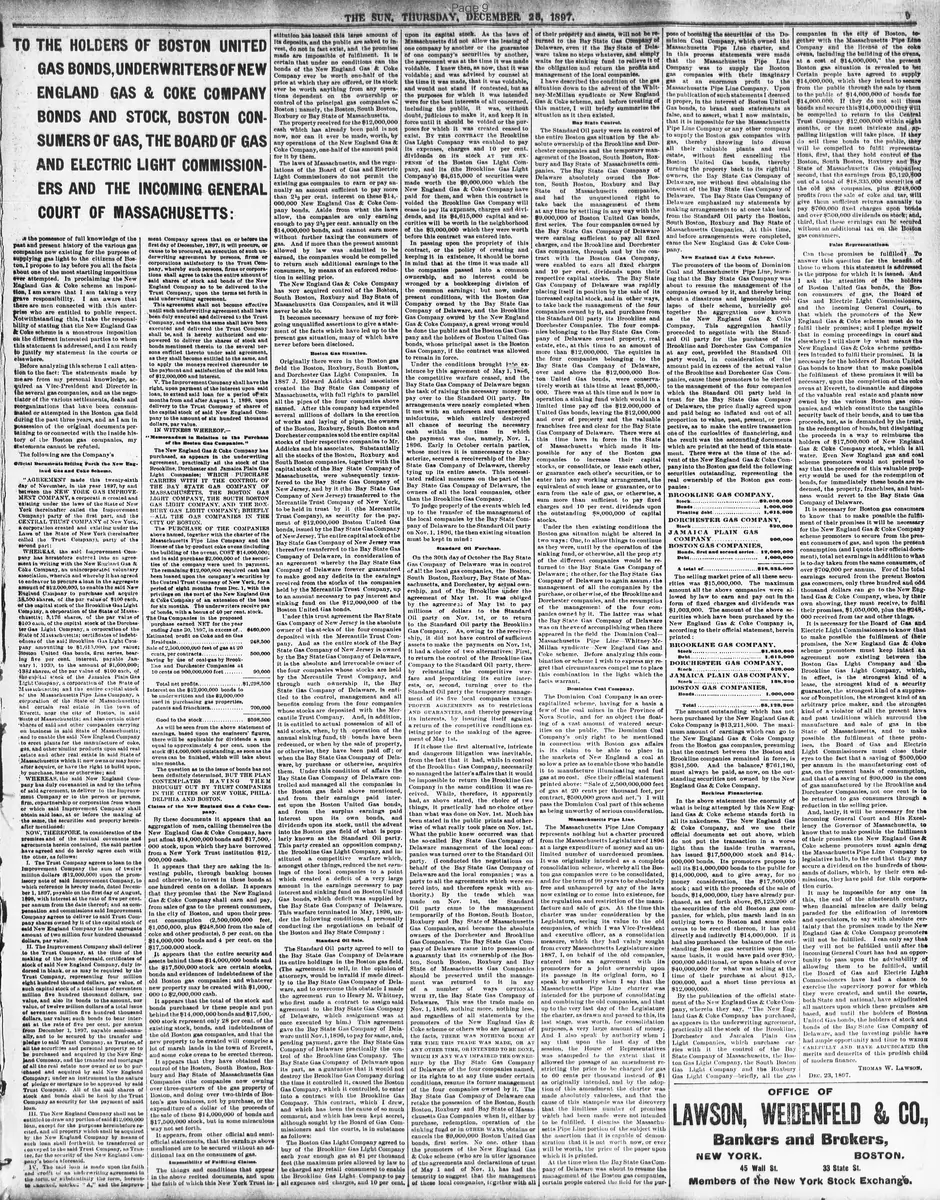
TO THE HOLDERS OF BOSTON UNITED GAS BONDS, UNDERWRITERS OF NEW ENGLAND GAS & COKE COMPANY BONDS AND STOCK, BOSTON CONSUMERS OF GAS. THE BOARD OF GAS AND ELECTRIC LIGHT COMMISSIONERS: AND THE INCOMING GENERAL COURT OF MASSACHUSETTS:
As the possessor of full knowledge of the past and present history of the various gas companies now existing for the purpose of supplying gas light to the citizens of Boston, I propose to lay before you all the facts about one of the most startling impositions ever attempted. In proclaiming the New England Gas & Coke scheme an imposition, I am aware that I am taking a very grave responsibility. I am aware that there are men connected with this enterprise who are entitled to public respect. Notwithstanding this, I take the responsibility of stating that the New England Gas & Coke scheme is a monstrous imposition on the different interested parties to whom this statement is addressed, and I am ready to justify my statement in the courts or elsewhere.
Before analyzing this scheme I call attention to the fact: The statements made by me are from my personal knowledge, acquired as Vice-President and Director in the several gas companies, and as the negotiator of the various settlements, deals and reorganizations that have been consummated or attempted in the Boston gas field during the past three years, and as I am in possession of the original documents pertaining to or connected with the inside history of the Boston gas companies, my statements cannot be refuted.
The following are the Company's Original Documents Setting Forth the New England Gas and Coke Scheme.
"AGREEMENT made this twenty-sixth day of November, in the year 1897, by and between the NEW YORK GAS IMPROVEMENT COMPANY, a corporation created and existing under the laws of the State of New York (hereinafter called the Improvement Company) party of the first part, and the CENTRAL TRUST COMPANY of New York, a corporation created and existing under the laws of the State of New York (hereinafter called the Trust Company) party of the second part:
WHEREAS, the said Improvement Company has heretofore entered into an agreement in writing with the New England Gas & Coke Company, an unincorporated voluntary association, wherein and whereby it has agreed to endeavor to procure a loan in the aggregate amount of six million dollars, to enable the said New England Company to purchase and acquire 18,500 shares, of the par value of $100 each, of the capital stock of the Brookline Gas Light Company, a corporation of the State of Massachusetts: 5,170 shares, of the par value of $100 each, of the capital stock of the Dorchester Gas Light Company, a corporation of the State of Massachusetts: certificates of indebtedness of the said Brookline Gas Light Company amounting to $1,615,000, par value; Boston United Gas bonds, first series, bearing five per cent. interest, payable January 1, 1937, to the amount of $1,000,000; 33 shares, of the par value of $100 each, of the capital stock of the Jamaica Plain Gas Light Company, a corporation of the State of Massachusetts: and the entire capital stock of the Massachusetts Pipe Line Company, a corporation of the State of Massachusetts: and certain real estate in the town of Everett, near the city of Boston, in said State of Massachusetts: and also certain shares of said and other companies carrying on business in said State of Massachusetts and to enable the said New England Company to erect plants for the manufacture of coke, gas, and other similar products upon said real estate and other real estate in said State of Massachusetts which it now owns or may hereafter acquire, or have the right to build upon, by purchase, lease or otherwise; and
WHEREAS, the said New England Company has duly covenanted in and by the terms of said agreement, to deliver to the Improvement Company or to the person or persons, firm, copartnership or corporation from whom or which said Improvement Company shall obtain said loan, at or before the making of the same, the securities and property hereinafter mentioned:
NOW, THEREFORE, in consideration of the premises and of the mutual covenants and agreements herein contained, the said parties have agreed and do hereby agree each with the other, as follows:
I. The Trust Company agrees to loan to the Improvement Company the sum of twelve million dollars ($12,000,000) upon the promissory note of said Improvement Company, to which reference is hereby made, dated December 1, 1897, payable on the first day of August, 1898, with interest at the rate of five per cent. per annum from the date thereof; and as compensation and commissions said Improvement Company agrees to deliver to said Trust Company shares owned by it of the capital stock of said New England Company to the aggregate amount of two million four hundred thousand dollars, par value.
II. The Improvement Company shall deliver to the Trust Company, at the time of the making of the loan aforesaid, certificates of stock of said New England Company, duly indorsed in blank, or as may be required by the Trust Company, representing four million eight hundred thousand dollars, par value, of such capital stock of a total issue of seventeen million five hundred thousand dollars, par value, and also its bonds to the amount, par value, of twelve million dollars of a total issue of seventeen million five hundred thousand dollars, par value; such bonds to bear interest at the rate of five per cent. per annum from December 1, 1897, payable semi-annually, and to be secured by the transfer and pledge to said Trust Company, as Trustee, of all the securities and personal property so to be purchased and acquired by the New England Company, and the transfer and mortgage of all the real estate now owned or to be purchased and acquired by said New England Company; under an instrument in the nature of pledge or mortgage to be approved by said Trust Company. All of the said shares of stock and bonds shall be held by the Trust Company as security for the payment of said loan.
III. The New England Company shall not be entitled to draw any portion of said $12,000,000 loan, except for the purposes hereinbefore recited, and all property which shall be acquired by the New England Company by means of such loan shall forthwith be transferred or conveyed to the said Trust Company, as Trustee, for the security of the New England Company's bonds aforesaid.
IV. The said loan is made upon the faith and credit of an underwriting agreement in the form, or substantially the form, hereinafter annexed, marked 'A,' and the Improvement Company agrees that on or before the first day of December, 1897, it will procure, or cause to be procured, an execution of such underwriting agreement by persons, firms or corporations satisfactory to the Trust Company, whereby such persons, firms or corporations shall agree to take the entire amount of said shares of stock and bonds of the New England Company so to be delivered to the Trust Company, upon the terms set forth in said underwriting agreement. This agreement shall not become effective until such underwriting agreement shall have been duly executed and delivered to the Trust Company, and when the same shall have been executed and delivered the Trust Company shall be, and is hereby authorized and empowered to deliver the shares of stock and bonds mentioned therein to the several persons entitled thereto under said agreement, as they shall become entitled to the same, and to apply the moneys received thereunder to the payment and satisfaction of the said loan of $12,000,000 and interest.
V. The Improvement Company shall have the right, upon payment of the interest upon said loan, to extend said loan for a period of six months from and after August 1, 1898, upon delivery to the Trust Company of shares of the capital stock of said New England Company to the amount of six hundred thousand dollars, par value.
IN WITNESS WHEREOF,
"Memorandum in Relation to the Purchase of the Boston Gas Companies,"
The New England Gas & Coke Company has purchased, as appears in the underwriting agreement, practically all the stock of the Brookline, Dorchester and Jamaica Plain Gas Light Companies: WHICH PURCHASE CARRIES WITH IT THE CONTROL OF THE BAY STATE GAS COMPANY OF MASSACHUSETTS, THE BOSTON GAS LIGHT COMPANY, THE SOUTH BOSTON GAS LIGHT COMPANY, AND THE ROXBURY GAS LIGHT COMPANY: BRIEFLY - ALL THE GAS COMPANIES IN THE CITY OF BOSTON.
The purchase of the companies above named, together with the charter of the Massachusetts Pipe Line Company and the license of the by-product coke ovens (including the building of the ovens), cost $14,000,000; and in said purchase $2,000,000 of the securities of the company were used in payment. The remaining $12,000,000 required cash has been loaned upon the company's securities by the Central Trust Company of New York, for a period of eight months from Dec. 1, with the privilege on the part of the New England Gas & Coke Company of an extension of the loan for six months. The underwriters receive par of bonds, with a bonus of 10 per cent. stock.
The Gas Companies in the proposed purchase earned NET for the year ending June 30, 1897, in excess of $460,000
Estimated profit on Coke and on Gas Residuals 248,500
Sale of 2,500,000,000 feet of gas at 20 cents, per contracts 500,000
Saving by use of coal-gas by Brookline and Dorchester Companies at 10 cents on 900,000,000 feet 90,000
Total net profits $1,298,500
Interest on the $12,000,000 bonds to be underwritten and the $2,000,000 used in purchasing gas properties, patents and franchises. 700,000
Good to the stock $598,500
As will be seen from the above statement of earnings, based upon the engineers' figures, there will be applicable for dividends a sum equal to approximately 4 per cent. upon the stock ($14,000,000) outstanding, as soon as the ovens can be finished, which will take about nine months.
The question as to the issue of bonds has not been definitely determined. BUT THE PLAN CONTEMPLATES HAVING THEM BROUGHT OUT BY TRUST COMPANIES IN THE CITIES OF NEW YORK, PHILADELPHIA AND BOSTON.
Column of the New England Gas & Coke Company.
By these documents it appears that an aggregation of men, calling themselves the New England Gas & Coke Company, have put afloat $14,000,000 bonds and $17,500,000 stock, upon which they have borrowed from a New York Trust institution $12,000,000 cash.
It appears that they are asking the investing public, through banking houses and otherwise, to invest in these bonds at one hundred cents on a dollar. It appears that they promise that the New England Gas & Coke Company shall earn and pay, from sales of gas to the present consumers, in the city of Boston, and upon their present consumption (2,500,000,000 feet, $1,050,000, plus $248,500 from the sale of coke and other products), 5 per cent. on the $14,000,000 bonds and 4 per cent. on the $17,500,000 stock.
It appears that the entire security and assets behind these $14,000,000 bonds and the $17,500,000 stock are certain stocks, bonds and evidences of indebtedness of the old Boston gas companies; and whatever new property may be created with $1,000,000 to $2,000,000 cash.
It appears that the total of the stock and bonds purchased by these people and put behind the $14,000,000 bonds and the $17,500,000 stock represent only 28 per cent. of the existing stock, bonds, and indebtedness of the old Boston gas companies, and that the new property to be created will comprise a lot of marsh lands in the town of Everett, and some coke ovens to be erected thereon.
It appears that they have obtained the control of the Boston, South Boston, Roxbury and Bay State of Massachusetts Gas Companies (the companies now owning over three-quarters of the gas property of Boston, and doing over two-thirds of Boston's gas business), not by purchase, or the expenditure of a dollar of the proceeds of the sale of these $14,000,000 of bonds and $17,500,000 stock, but in some miraculous way not set forth.
It appears, from other official and semi-official statements, that the earnings above mentioned are to be secured without an additional tax on the consumers of gas.
Impossibility of Fulfilling Claims.
The things and conditions that appear in the above recited documents, and upon the faith of which this New York Trust institution has loaned this large amount of its deposits, and the public are asked to invest, do not in fact exist, and the promises made are impossible of fulfillment. It is certain that under no conditions can the bonds of the New England Gas & Coke Company ever be worth one-half of the price at which they are offered, or its stock ever be worth anything from any operations dependent on the ownership or control of the principal gas companies in Boston; namely, the Boston, South Boston, Roxbury or Bay State of Massachusetts.
The property received for the $12,000,000 cash which has already been paid is not now, nor can it ever be made, worth, by any operations of the New England Gas & Coke Company, one-half of the amount paid for it by them.
The laws of Massachusetts, and the regulations of the Board of Gas and Electric Light Commissioners do not permit the existing gas companies to earn or pay annually an amount sufficient to pay more than 2½ per cent. interest on these $14,000,000 New England Gas & Coke Company bonds. Aside from what the laws allow, the companies are only earning enough to pay 2½ per cent. annually on the $14,000,000 bonds, and cannot earn more without further taxing the consumers of gas. And if more than the present amount allowed by law was admitted to be earned, the companies would be compelled to return such additional earnings to the consumers, by means of an enforced reduction in selling price.
The New England Gas & Coke Company has not acquired control of the Boston, South Boston, Roxbury and Bay State of Massachusetts Gas Companies, and it will never be able to.
It becomes necessary because of my foregoing unqualified assertions to give a statement of the facts which have led up to the present gas situation, many of which have never before been disclosed.
Boston Gas Situation.
Originally there were in the Boston gas field the Boston, Roxbury, South Boston, and Dorchester Gas Light Companies. In 1887 J. Edward Addicks and associates created the Bay State Gas Company of Massachusetts, with full rights to parallel all the pipes of the four companies above named. After this company had expended several millions of dollars in the erection of works and laying of pipes, the owners of the Boston, Roxbury, South Boston and Dorchester companies sold the entire capital stocks of their respective companies to Mr. Addicks and his associates. Substantially all the stocks of the Boston, Roxbury and South Boston companies, together with the capital stock of the Bay State Company of Massachusetts, were subsequently transferred to the Bay State Gas Company of New Jersey, and by it (the Bay State Gas Company of New Jersey) transferred to the Mercantile Trust Company of New York, to be held in trust by it (the Mercantile Trust Company), as security for the payment of $12,000,000 Boston United Gas bonds, issued by the Bay State Gas Company of New Jersey. The entire capital stock of the Bay State Gas Company of New Jersey was thereafter transferred to the Bay State Gas Company of Delaware, in consideration of an agreement whereby the Bay State Gas Company of Delaware forever guaranteed to make good any deficits in the earnings received from the stocks of the companies held by the Mercantile Trust Company, up to an amount necessary to pay interest and sinking fund on the $12,000,000 of the Boston United Gas bonds.
Under this trust agreement the Bay State Gas Company of New Jersey is the absolute owner of the stocks of the four companies deposited with the Mercantile Trust Company. And as the entire stock of the Bay State Gas Company of New Jersey is owned by the Bay State Gas Company of Delaware, it is the absolute and irrevocable owner of the four companies whose stocks are held by the Mercantile Trust Company, and through such ownership it, the Bay State Gas Company of Delaware, is entitled to the control, management and all benefits coming from the four companies whose stocks are deposited with the Mercantile Trust Company. And, in addition, it is entitled to actual possession of all of said stocks, when, by the operation of the annual sinking fund, the bonds have been redeemed, or when by the sale of property, or otherwise, they have been paid off; or when the Bay State Gas Company of Delaware, by purchase or otherwise, acquires them. Under this condition of affairs the Bay State Gas Company of Delaware controlled and managed all the companies in the Boston gas field above mentioned, and from their earnings paid interest upon the Boston United Gas bonds, and from the surplus earnings paid interest upon its own bonds, and dividends upon its stock, until the advent into the Boston gas field of what is popularly known as the Standard Oil party.
This party created an opposition company, the Brookline Gas Light Company, and instituted a competitive warfare which amongst other things, reduced the net earnings of the local companies to a point which created a deficit of a very large amount in the earnings necessary to pay interest and sinking fund on Boston United Gas bonds, which deficit was supplied by the Bay State Gas Company of Delaware.
This warfare terminated in May, 1896, under the following conditions, I personally conducting the negotiations on behalf of the Boston and Bay State Company:
Standard Oil Sale,
The Standard Oil party agreed to sell to the Bay State Gas Company of Delaware its entire holdings in the Boston gas field. (The agreement to sell, in the opinion of attorneys, would be invalid if made directly to the Bay State Gas Company of Delaware, and to overcome this obstacle I made the agreement run to Henry M. Whitney, who first made a contract to assign said agreement to the Bay State Gas Company of Delaware, which assignment was at once executed by him.) This agreement gave the Bay State Gas Company of Delaware until Nov. 1, 1896, to pay for same, and, pending payment, gave the Bay State Gas Company of Delaware practically the control of the Brookline Gas Company. The Bay State Gas Company of Delaware upon its part, as a guarantee that it would not destroy the Brookline Gas Company during the time it controlled it, caused the Boston Gas Company, which it controlled, to enter into a contract with the Brookline Gas Company. This contract, which I drew, and which has been the cause of so much comment, and which has been kept secret, although sought by the Board of Gas Commissioners and the courts, is in substance as follows:
The Boston Gas Light Company agreed to buy of the Brookline Gas Light Company each year enough gas at $1 per thousand feet (the maximum price allowed by law to be charged any retail consumers) to enable the Brookline Gas Light Company to pay all expenses and charges, and 10 per cent. upon its capital stock. As the laws of Massachusetts did not allow the leasing of one company by another or the guarantee of one company's securities by another the agreement was at the time it was made voidable. I knew then, as now, that it was voidable: and was advised by counsel at the time it was made, that it was voidable, and would not stand if contested, but as the purposes for which it was intended were for the best interests of all concerned, including the public, it was, without doubt, judicious to make it, and keep it in force until it should be voided or the purposes for which it was created ceased to exist. By this contract the Brookline Gas Light Company was enabled to pay its expenses, charges and 10 per cent. dividends on its stock AT THE EXPENSE OF THE BOSTON GAS LIGHT COMPANY, and its (the Brookline Gas Light Company's) $4,615,000 of securities were made worth the $9,000,000 which the New England Gas & Coke Company have paid for them, and when this contract is voided the Brookline Gas Company will cease to pay its expenses, charges and dividends, and its $4,615,000 capital and securities will be worth in the neighborhood of the $3,000,000 which they were worth before this contract was entered into.
In passing upon the propriety of this contract, or the policy of creating and keeping it in existence, it should be borne in mind that at the time it was made all the companies passed into a common ownership, and no interest could be wronged by a bookkeeping division of the common earnings; but now, under present conditions, with the Boston Gas Company owned by the Bay State Gas Company of Delaware, and the Brookline Gas Company owned by the New England Gas & Coke Company, a great wrong would be done the public and the Boston Gas Company and the holders of Boston United Gas bonds, whose principal asset is the Boston Gas Company, if the contract was allowed to remain in force.
Under the conditions brought into existence by this agreement of May 1, 1896, the competitive warfare ceased, and the Bay State Gas Company of Delaware began the task of raising the necessary money to pay over to the Standard Oil party. Its arrangements were nearly completed when it met with an unforeseen and unexpected misfortune, which entirely destroyed all chance of securing the necessary cash within the time in which the payment was due, namely, Nov. 1, 1896. Early in October certain parties, whose motives it is unnecessary to characterize, secured a receivership of the Bay State Gas Company of Delaware, thereby tying up its entire assets. This necessitated radical measures on the part of the Bay State Gas Company of Delaware, the owners of all the local companies, other than the Brookline Gas Company.
To judge properly of the events which led up to the transfer of the management of the local companies by the Bay State Company of Delaware to the Standard Oil party on Nov. 1, 1896, the then existing situation must be kept in mind:
Standard Oil Purchase.
On the 30th day of October the Bay State Gas Company of Delaware was in control of all the local gas companies, the Boston, South Boston, Roxbury, Bay State of Massachusetts, and Dorchester, by actual ownership, and of the Brookline under the agreement of May 1st. It was obliged by the agreement of May 1st to pay millions of dollars to the Standard Oil party on Nov. 1st, or to return to the Standard Oil party the Brookline Gas Company. As, owing to the receivership, it did not have control of sufficient assets to make the payments on Nov. 1st, it had a choice of two alternatives: First, to return the control of the Brookline Gas Company to the Standard Oil party, thereby reinstating the competitive warfare and jeopardizing its entire interests, or, second, turning over to the Standard Oil party the temporary management of its five local companies under proper agreements as to restrictions and guarantees, and thereby preserving its interests, by insuring itself against a return of the competitive conditions existing prior to the making of the agreement of May 1st.
If it chose the first alternative, intricate and dangerous litigation was inevitable, from the fact that it had, while in control of the Brookline Gas Company, necessarily so managed the latter's affairs that it would be impossible to return the Brookline Gas Company in the same condition it was received. While, therefore, it apparently had, as above stated, the choice of two things, it practically had no choice other than what was done on Nov. 1st. Much has been stated in the public prints and otherwise of what really took place on Nov. 1st. What the public knew occurred was that the so-called Bay State Gas Company of Delaware management of the local companies was turned over to the Standard Oil party. (I conducted the negotiations on behalf of the Bay State Gas Company of Delaware and the local companies; was a party to all the agreements which were entered into, and therefore speak with authority.) By the trade which was made on Nov. 1st, the Standard Oil party came to the management temporarily of the Boston, South Boston, Roxbury and Bay State of Massachusetts Gas Companies, and became the absolute owners of the Dorchester and Brookline Gas Companies. The Bay State Gas Company of Delaware came into possession of a guaranty that its ownership of the Boston, South Boston, Roxbury and Bay State of Massachusetts Gas Companies should be preserved until the management was returned to it in any of a number of ways optional with it, the Bay State Gas Company of Delaware. This was the trade made on Nov. 1, 1896, nothing more, nothing less, and regardless of all statements by the promoters of the New England Gas & Coke scheme or others who are ignorant of the facts. THERE WAS NOTHING DONE AT THE TIME THIS TRADE WAS MADE, OR AT ANY OTHER TIME, OR INTENDED TO BE DONE, WHICH IN ANY WAY IMPAIRED THE OWNERSHIP by the Bay State Gas Company of Delaware of the four companies named, or its rights to at any time under certain conditions, resume its former management of the four companies owned by it. The Bay State Gas Company of Delaware can retake the possession of the Boston, South Boston, Roxbury and Bay State of Massachusetts Gas Companies when it, either by purchase, redemption, operation of the sinking fund or in other ways, obtains or cancels the $9,000,000 Boston United Gas bonds, first series. No one, other than the promoters of the New England Gas & Coke scheme (who are in utter ignorance of the agreements and declarations of trust of May 1 and of Nov. 1), has had the temerity to suggest that the management of these local companies, together with all of their property and assets, will not be returned to the Bay State Gas Company of Delaware, even if the Bay State of Delaware takes no steps whatever, and simply waits for the sinking fund to relieve it of the obligation and return the profits and management of the local companies.
I have described the condition of the gas situation down to the advent of the Whitney-McMillan syndicate or New England Gas & Coke scheme, and before treating of this matter, I will briefly summarize the situation as it then existed.
Bay State Control
The Standard Oil party were in control of the entire Boston gas situation by the absolute ownership of the Brookline and Dorchester companies and the temporary management of the Boston, South Boston, Roxbury and Bay State of Massachusetts companies. The Bay State Gas Company of Delaware absolutely owned the Boston, South Boston, Roxbury and Bay State of Massachusetts companies, and had the unquestioned right to take back the management of them at any time by settling in any way with the $9,000,000 of Boston United Gas bonds, first series. The four companies owned by the Bay State Gas Company of Delaware were earning sufficient to pay all fixed charges, and the Brookline and Dorchester Gas companies, through and by the contract with the Boston Gas Company, were enabled to earn all fixed charges and 10 per cent. dividends upon their respective capital stocks. The Bay State Gas Company of Delaware was rapidly placing itself in position by the sale of its increased capital stock, and in other ways, to take back the management of the four companies owned by it, and purchase from the Standard Oil party its Brookline and Dorchester Companies. The four companies belonging to the Bay State Gas Company of Delaware owned property, real estate, etc., at this time to an amount of more than $12,000,000. The equities in the four companies belonging to the Bay State Gas Company of Delaware, over and above the $12,000,000 Boston United Gas bonds, were conservatively worth at this time at least $5,000,000. There was at this time and is now in operation a sinking fund which would in a limited time pay off the $12,000,000 of United Gas bonds, leaving the $12,000,000 and over of property and the valuable franchises free and clear for the Bay State Gas Company of Delaware. There were at this time laws in force in the State of Massachusetts which made it impossible for any of the Boston gas companies to increase their capital stocks, or consolidate, or lease each other or guarantee each other's securities, or to enter into any working arrangement, the equivalent of such lease or guarantee, or to earn from the sale of gas, or otherwise, a sum more than sufficient to pay fixed charges and 10 per cent. dividends upon the outstanding $8,000,000 of capital stocks.
Under the then existing conditions the Boston gas situation might be altered in two ways: One, to allow things to continue as they were, until by the operation of the sinking fund, or otherwise, all the property of the different companies would be returned to the Bay State Gas Company of Delaware: the other, for the Bay State Gas Company of Delaware to again assume the management of all the companies by the purchase, or otherwise, of the Brookline and Dorchester companies, and the resumption of the management of the four companies owned by it. The latter was what the Bay State Gas Company of Delaware was on the eve of accomplishing when there appeared in the field the Dominion Coal-Massachusetts Pipe Line-Whitney-McMillan syndicate-New England Gas and Coke scheme. Before analyzing this combination or scheme I wish to express my regret that circumstances compel me to place this combination in the light which the facts warrant.
Dominion Coal Company,
The Dominion Coal Company is an over-capitalized scheme, having for a basis a few of the coal mines in the Province of Nova Scotia, and for an object the floating of a vast amount of watered securities on the public. The Dominion Coal Company's only right to be mentioned in connection with Boston gas affairs is its claim to be able to place in the markets of New England a coal at so low a price as to enable those who handle it to manufacture illuminating and fuel gas at no cost. (See their official statement printed above: "Sale of 2,500,000,000 feet of gas at 20 cents per thousand feet, per contract, $500,000 gross and net.") I will pass the Dominion Coal part of this scheme as being unworthy of serious consideration.
Massachusetts Pipe Line.
The Massachusetts Pipe Line Company represents nothing but a charter procured from the Massachusetts Legislature of 1896 at a large expenditure of money and an unlimited number of unredeemed promises. It was originally intended as a complete consolidation scheme, whereby all the Boston gas companies were to be consolidated, and for the term of 99 years to be absolutely free and unhampered by any of the laws now existing or to come into existence, for the regulation and restriction of the manufacture and sale of gas. At the time this charter was under consideration by the Legislature, seeing its value to the old companies, of which I was Vice-President and executive officer, as a consolidation measure, which they had vainly sought from every Massachusetts Legislature since 1887, I, on behalf of the old companies, entered into an agreement with its promoters for a joint ownership upon its passage in its original form, so I speak by authority when I say that the Massachusetts Pipe Line charter was intended for the purpose of consolidating and combining the old companies, and that up to the very last day of the Legislature the charter, as drawn and passed to this, its last stage, was worth, for consolidation purposes, a very large amount of money. And I also speak by authority when I say that upon the last day of the session, the House of Representatives was stampeded to the extent that it allowed the passage of an amendment restricting the price to be charged for gas to 60 cents per thousand instead of $1 as originally intended, and by the adoption of this amendment the charter was made absolutely valueless, and that the cause of this stampede was the discovery that the limitless number of promises which had been made were not intended to be fulfilled. I dismiss the Massachusetts Pipe Line portion of the subject with the assertion that it is capable of demonstration that it is not worth now, or ever will be worth, the price of the paper upon which it is printed.
At the time when the Bay State Gas Company of Delaware was about to resume the management of the Boston gas companies, certain people entered the field for the purpose of booming the securities of the Dominion Coal Company, which owned the Massachusetts Pipe Line charter, and in this process statements were made that the Massachusetts Pipe Line Company was to supply the Boston gas companies with their imaginary gas at an enormous profit to the Massachusetts Pipe Line Company. Upon the publication of such statements I deemed it proper, in the interest of Boston United Gas bonds, to brand such statements as false, and to assert, what I now maintain, that it is impossible for the Massachusetts Pipe Line Company or any other company to supply the Boston gas companies with gas, thereby throwing into disuse all their valuable plants and real estate, without first cancelling the Boston United Gas bonds, thereby turning the property back to its rightful owners, the Bay State Gas Company of Delaware, nor without first obtaining the consent of the Bay State Gas Company of Delaware. The Bay State Gas Company of Delaware emphasized my statements by making arrangements to at once take back from the Standard Oil party the Boston, South Boston, Roxbury and Bay State of Massachusetts Companies. At this time, and before arrangements were completed, came the New England Gas & Coke Company.
New England Gas & Coke Scheme,
The promoters of the boom of Dominion Coal and Massachusetts Pipe Line, learning that the Bay State Gas Company was about to resume the management of the companies owned by it, and thereby bring about a disastrous and ignominious collapse of their scheme, hurriedly got together the aggregation now known as the New England Gas & Coke Company. This aggregation hastily proceeded to negotiate with the Standard Oil party for the purchase of its Brookline and Dorchester Gas Companies at any cost, provided the Standard Oil party would, in consideration of the amount paid in excess of the actual value of the Brookline and Dorchester Gas Companies, cause these promoters to be elected to the management of the four companies which the Standard Oil party held in trust for the Bay State Gas Company of Delaware, the price finally agreed upon and paid being so inflated and out of all proportion to value, past, present, or prospective, as to make the entire transaction one of the curiosities of financiering, and the result was the astounding documents which are printed at the head of this statement. There were at the time of the advent of the New England Gas & Coke Company into the Boston gas field the following securities outstanding, representing the real ownership of the Boston gas companies:
BROOKLINE GAS COMPANY.
Stock $8,000,000
Bonds 1,000,000
Floating debt 1,015,000
DORCHESTER GAS COMPANY,
Stock 620,000
JAMAICA PLAIN GAS COMPANY.
200,000
BOSTON GAS COMPANIES,
Bonds, first and second series $12,000,000
Debt 1,000,000
A total of $18,835,000
The selling market price of all these securities was $15,000,000. The maximum amount all the above companies were allowed by law to earn and pay out in the form of fixed charges and dividends was $1,003,000. The amount of the above securities which have been purchased by the New England Gas & Coke Company is, according to their official statement, herein printed:
BROOKLINE GAS COMPANY.
Stock $1,850,000
Debt 15,000
DORCHESTER GAS COMPANY.
Stock 620,000
JAMAICA PLAIN GAS COMPANY.
Stock 188,900
BOSTON GAS COMPANIES.
To 1,000,000
Total $5,128,900
The amount outstanding which has not been purchased by the New England Gas & Coke Company is $13,211,800. The maximum amount of earnings which can go to the New England Gas & Coke Company from the Boston gas companies, presuming that the contract between the Boston and Brookline companies remained in force, is $381,500. And the balance, $761,180, must always be paid, as now, on the outstanding securities not owned by the New England Gas & Coke Company.
In the above statement the enormity of what is being attempted by this New England Gas & Coke scheme stands forth in all its nakedness. The New England Gas & Coke Company, and we use their official documents set out above, which do not put the transaction in a worse light than the inside truths warrant, has issued $17,500,000 stock and $14,000,000 bonds. Its promoters propose to sell its $14,000,000 bonds to the public for $14,000,000, and to give away, for no money consideration, the $17,500,000 stock; and with the proceeds of the sale of bonds, $14,000,000, they have already purchased, as set forth above, $5,123,200 of the securities of the old Boston gas companies, for which, plus marsh land in an outlying town to Boston and some coke ovens to be erected thereon, it has paid directly and indirectly $14,000,000. If it had also purchased the balance of the outstanding Boston gas securities upon the same basis, it would have paid over $30,000,000 additional, or upon a basis of over $40,000,000 for what was selling at the time of their purchase at about $15,000,000, and a short time previous at $12,000,000.
By the publication of the official statement of the New England Gas & Coke Company, wherein they say, "The New England Gas & Coke Company has purchased, as appears in the underwriting agreement, practically all the stock of the Brookline, Dorchester and Jamaica Plain Gas Light Companies, which purchase carries with it the control of the Bay State Company of Massachusetts, the Boston Gas Light Company, the South Boston Gas Light Company and the Roxbury Gas Light Company-briefly, all the gas companies in the city of Boston, together with the Massachusetts Pipe Line Company and the license of the coke ovens, including the building of the ovens, at a cost of $14,000,000," the present Boston gas situation is revealed to be:
Certain people have agreed to supply $14,000,000, which they intend to secure from the public through the sale by them to the public of $14,000,000 of bonds for $14,000,000. If they do not sell these bonds and secure this $14,000,000 they will be compelled to return to the Central Trust Company $12,000,000 within eight months, or the most intricate and appalling litigation will take place. If they do sell these bonds to the public, they will be compelled to fulfill representations, first, that they hold control of the Boston, South Boston, Roxbury and Bay State of Massachusetts Gas companies: second, that the earnings from $5,120,800 out of a total of $18,335,000 securities of the old gas companies, plus $248,000 profits from the sale of coke and tar, will give them sufficient returns annually to pay $700,000 fixed charges upon bonds and over $500,000 dividends on stock; and third, that these earnings can be secured without an additional tax on the Boston gas consumers.
Untrue Representations.
Can these promises be fulfilled? To answer this question for the benefit of those to whom this statement is addressed is the purpose for which it is issued. And I ask the attention of the Holders of Boston United Gas bonds, the Boston consumers of gas, the Board of Gas and Electric Light Commissioners, and the incoming General Court, to that which the promoters of the New England Gas & Coke scheme must do to fulfill their promises; and I pledge myself that in coming proceedings in court and elsewhere I will show by what means the New England Gas & Coke scheme promoters intended to fulfill their promises. It is necessary for the holders of Boston United Gas bonds to know that to make possible the fulfillment of these promises it will be necessary, upon the completion of the coke ovens at Everett, to dismantle and dispose of the valuable real estate and plants now owned by the various Boston gas companies, and which constitute the tangible security back of their bonds, and to use the proceeds, not, as is demanded by the trust, in the redemption of bonds, but dissipating the proceeds in a way to reimburse the holders of $17,500,000 of New England Gas & Coke Company stock, which is all water. Even New England gas and coal scheme promoters would not pretend to say that the proceeds of this valuable property would be used for the redemption of bonds, for immediately these bonds are redeemed, the property, franchises, and business would revert to the Bay State Gas Company of Delaware.
It is necessary for Boston gas consumers to know that to make possible the fulfillment of their promises it will be necessary for the New England Gas & Coke Company scheme promoters to secure from the present consumers of gas, and upon the present consumption (and I quote their official document), total net earnings in addition to what is to-day taken from the same consumers, of over $700,000 per annum. For of the total earnings secured from the present Boston gas consumers, only three hundred and odd thousand dollars can go to the New England Gas & Coke Company, when, by their own showing, they must receive, to fulfill their promises, $1,050,000, plus the $248,000 received from tar and other things.
It is necessary for the Board of Gas and Electric Light Commissioners to know that to make possible the fulfillment of their promises, the New England Gas & Coke scheme promoters must keep intact an agreement now existing between the Boston Gas Light Company and the Brookline Gas Light Company, which, in effect, is the strongest kind of a lease, the strongest kind of a security guarantee, the strongest kind of a suppressor of competition, the strongest kind of an arbitrary price maker, and the strongest kind of a violator of all the present laws and past traditions which surround the manufacture and sale of gas in the State of Massachusetts, and to make possible the fulfillment of these promises, the Board of Gas and Electric Light Commissioners must close their eyes to the fact that a saving of $500,000 per annum in the manufacturing cost of gas, on the present basis of consumption, and that of a saving of $90,000 in the cost of gas manufactured by the Brookline and Dorchester Companies, not one cent is to be returned to gas consumers through a reduction in the selling price.
And, lastly, it will be necessary for the incoming General Court and His Excellency the Governor of Massachusetts, to know that to make possible the fulfillment of their promises the New England Gas & Coke scheme promoters must again drag the Massachusetts Pipe Line Company to legislative halls, to the end that they may secure a dividend on the hundreds of thousands of dollars, which, by their own admissions, they have paid for this corporation curio.
It may be impossible for any one in this, the end of the nineteenth century, when financial miracles are daily being paraded for the edification of investors and speculators, to say with absolute certainty that the promises made by the New England Gas & Coke Company promoters will not be fulfilled. I can only say that they will not be fulfilled until after the incoming General Court has had an opportunity to pass upon the advisability of allowing them to be fulfilled, until the Board of Gas and Electric Light Commissioners have had a chance to exercise the supervisory power for which they were created, and until the courts, both State and national, have adjudicated all matters upon which these premises are based, and until the holders of Boston United Gas bonds, the holders of stock and bonds of the Bay State Gas Company of Delaware, and the investing public have had ample opportunity and time to weigh CAREFULLY AND HAVE ADJUDICATED THE merits and demerits of this prudish child of modern finance.
TO THE HOLDERS OF BOSTON UNITED GAS BONDS, UNDERWRITERS OF NEW ENGLAND GAS & COKE COMPANY BONDS AND STOCK, BOSTON CONSUMERS OF GAS. THE BOARD OF GAS AND ELECTRIC LIGHT COMMISSIONERS: AND THE INCOMING GENERAL COURT OF MASSACHUSETTS:
As the possessor of full knowledge of the past and present history of the various gas companies now existing for the purpose of supplying gas light to the citizens of Boston, I propose to lay before you all the facts about one of the most startling impositions ever attempted. In proclaiming the New England Gas & Coke scheme an imposition, I am aware that I am taking a very grave responsibility. I am aware that there are men connected with this enterprise who are entitled to public respect. Notwithstanding this, I take the responsibility of stating that the New England Gas & Coke scheme is a monstrous imposition on the different interested parties to whom this statement is addressed, and I am ready to justify my statement in the courts or elsewhere.
Before analyzing this scheme I call attention to the fact: The statements made by me are from my personal knowledge, acquired as Vice-President and Director in the several gas companies, and as the negotiator of the various settlements, deals and reorganizations that have been consummated or attempted in the Boston gas field during the past three years, and as I am in possession of the original documents pertaining to or connected with the inside history of the Boston gas companies, my statements cannot be refuted.
The following are the Company's Original Documents Setting Forth the New England Gas and Coke Scheme.
"AGREEMENT made this twenty-sixth day of November, in the year 1897, by and between the NEW YORK GAS IMPROVEMENT COMPANY, a corporation created and existing under the laws of the State of New York (hereinafter called the Improvement Company) party of the first part, and the CENTRAL TRUST COMPANY of New York, a corporation created and existing under the laws of the State of New York (hereinafter called the Trust Company) party of the second part:
WHEREAS, the said Improvement Company has heretofore entered into an agreement in writing with the New England Gas & Coke Company, an unincorporated voluntary association, wherein and whereby it has agreed to endeavor to procure a loan in the aggregate amount of six million dollars, to enable the said New England Company to purchase and acquire 18,500 shares, of the par value of $100 each, of the capital stock of the Brookline Gas Light Company, a corporation of the State of Massachusetts: 5,170 shares, of the par value of $100 each, of the capital stock of the Dorchester Gas Light Company, a corporation of the State of Massachusetts: certificates of indebtedness of the said Brookline Gas Light Company amounting to $1,615,000, par value; Boston United Gas bonds, first series, bearing five per cent. interest, payable January 1, 1937, to the amount of $1,000,000; 33 shares, of the par value of $100 each, of the capital stock of the Jamaica Plain Gas Light Company, a corporation of the State of Massachusetts: and the entire capital stock of the Massachusetts Pipe Line Company, a corporation of the State of Massachusetts: and certain real estate in the town of Everett, near the city of Boston, in said State of Massachusetts: and also certain shares of said and other companies carrying on business in said State of Massachusetts and to enable the said New England Company to erect plants for the manufacture of coke, gas, and other similar products upon said real estate and other real estate in said State of Massachusetts which it now owns or may hereafter acquire, or have the right to build upon, by purchase, lease or otherwise; and
WHEREAS, the said New England Company has duly covenanted in and by the terms of said agreement, to deliver to the Improvement Company or to the person or persons, firm, copartnership or corporation from whom or which said Improvement Company shall obtain said loan, at or before the making of the same, the securities and property hereinafter mentioned:
NOW, THEREFORE, in consideration of the premises and of the mutual covenants and agreements herein contained, the said parties have agreed and do hereby agree each with the other, as follows:
I. The Trust Company agrees to loan to the Improvement Company the sum of twelve million dollars ($12,000,000) upon the promissory note of said Improvement Company, to which reference is hereby made, dated December 1, 1897, payable on the first day of August, 1898, with interest at the rate of five per cent. per annum from the date thereof; and as compensation and commissions said Improvement Company agrees to deliver to said Trust Company shares owned by it of the capital stock of said New England Company to the aggregate amount of two million four hundred thousand dollars, par value.
II. The Improvement Company shall deliver to the Trust Company, at the time of the making of the loan aforesaid, certificates of stock of said New England Company, duly indorsed in blank, or as may be required by the Trust Company, representing four million eight hundred thousand dollars, par value, of such capital stock of a total issue of seventeen million five hundred thousand dollars, par value, and also its bonds to the amount, par value, of twelve million dollars of a total issue of seventeen million five hundred thousand dollars, par value; such bonds to bear interest at the rate of five per cent. per annum from December 1, 1897, payable semi-annually, and to be secured by the transfer and pledge to said Trust Company, as Trustee, of all the securities and personal property so to be purchased and acquired by the New England Company, and the transfer and mortgage of all the real estate now owned or to be purchased and acquired by said New England Company; under an instrument in the nature of pledge or mortgage to be approved by said Trust Company. All of the said shares of stock and bonds shall be held by the Trust Company as security for the payment of said loan.
III. The New England Company shall not be entitled to draw any portion of said $12,000,000 loan, except for the purposes hereinbefore recited, and all property which shall be acquired by the New England Company by means of such loan shall forthwith be transferred or conveyed to the said Trust Company, as Trustee, for the security of the New England Company's bonds aforesaid.
IV. The said loan is made upon the faith and credit of an underwriting agreement in the form, or substantially the form, hereinafter annexed, marked 'A,' and the Improvement Company agrees that on or before the first day of December, 1897, it will procure, or cause to be procured, an execution of such underwriting agreement by persons, firms or corporations satisfactory to the Trust Company, whereby such persons, firms or corporations shall agree to take the entire amount of said shares of stock and bonds of the New England Company so to be delivered to the Trust Company, upon the terms set forth in said underwriting agreement. This agreement shall not become effective until such underwriting agreement shall have been duly executed and delivered to the Trust Company, and when the same shall have been executed and delivered the Trust Company shall be, and is hereby authorized and empowered to deliver the shares of stock and bonds mentioned therein to the several persons entitled thereto under said agreement, as they shall become entitled to the same, and to apply the moneys received thereunder to the payment and satisfaction of the said loan of $12,000,000 and interest.
V. The Improvement Company shall have the right, upon payment of the interest upon said loan, to extend said loan for a period of six months from and after August 1, 1898, upon delivery to the Trust Company of shares of the capital stock of said New England Company to the amount of six hundred thousand dollars, par value.
IN WITNESS WHEREOF,
"Memorandum in Relation to the Purchase of the Boston Gas Companies,"
The New England Gas & Coke Company has purchased, as appears in the underwriting agreement, practically all the stock of the Brookline, Dorchester and Jamaica Plain Gas Light Companies: WHICH PURCHASE CARRIES WITH IT THE CONTROL OF THE BAY STATE GAS COMPANY OF MASSACHUSETTS, THE BOSTON GAS LIGHT COMPANY, THE SOUTH BOSTON GAS LIGHT COMPANY, AND THE ROXBURY GAS LIGHT COMPANY: BRIEFLY - ALL THE GAS COMPANIES IN THE CITY OF BOSTON.
The purchase of the companies above named, together with the charter of the Massachusetts Pipe Line Company and the license of the by-product coke ovens (including the building of the ovens), cost $14,000,000; and in said purchase $2,000,000 of the securities of the company were used in payment. The remaining $12,000,000 required cash has been loaned upon the company's securities by the Central Trust Company of New York, for a period of eight months from Dec. 1, with the privilege on the part of the New England Gas & Coke Company of an extension of the loan for six months. The underwriters receive par of bonds, with a bonus of 10 per cent. stock.
The Gas Companies in the proposed purchase earned NET for the year ending June 30, 1897, in excess of $460,000
Estimated profit on Coke and on Gas Residuals 248,500
Sale of 2,500,000,000 feet of gas at 20 cents, per contracts 500,000
Saving by use of coal-gas by Brookline and Dorchester Companies at 10 cents on 900,000,000 feet 90,000
Total net profits $1,298,500
Interest on the $12,000,000 bonds to be underwritten and the $2,000,000 used in purchasing gas properties, patents and franchises. 700,000
Good to the stock $598,500
As will be seen from the above statement of earnings, based upon the engineers' figures, there will be applicable for dividends a sum equal to approximately 4 per cent. upon the stock ($14,000,000) outstanding, as soon as the ovens can be finished, which will take about nine months.
The question as to the issue of bonds has not been definitely determined. BUT THE PLAN CONTEMPLATES HAVING THEM BROUGHT OUT BY TRUST COMPANIES IN THE CITIES OF NEW YORK, PHILADELPHIA AND BOSTON.
Column of the New England Gas & Coke Company.
By these documents it appears that an aggregation of men, calling themselves the New England Gas & Coke Company, have put afloat $14,000,000 bonds and $17,500,000 stock, upon which they have borrowed from a New York Trust institution $12,000,000 cash.
It appears that they are asking the investing public, through banking houses and otherwise, to invest in these bonds at one hundred cents on a dollar. It appears that they promise that the New England Gas & Coke Company shall earn and pay, from sales of gas to the present consumers, in the city of Boston, and upon their present consumption (2,500,000,000 feet, $1,050,000, plus $248,500 from the sale of coke and other products), 5 per cent. on the $14,000,000 bonds and 4 per cent. on the $17,500,000 stock.
It appears that the entire security and assets behind these $14,000,000 bonds and the $17,500,000 stock are certain stocks, bonds and evidences of indebtedness of the old Boston gas companies; and whatever new property may be created with $1,000,000 to $2,000,000 cash.
It appears that the total of the stock and bonds purchased by these people and put behind the $14,000,000 bonds and the $17,500,000 stock represent only 28 per cent. of the existing stock, bonds, and indebtedness of the old Boston gas companies, and that the new property to be created will comprise a lot of marsh lands in the town of Everett, and some coke ovens to be erected thereon.
It appears that they have obtained the control of the Boston, South Boston, Roxbury and Bay State of Massachusetts Gas Companies (the companies now owning over three-quarters of the gas property of Boston, and doing over two-thirds of Boston's gas business), not by purchase, or the expenditure of a dollar of the proceeds of the sale of these $14,000,000 of bonds and $17,500,000 stock, but in some miraculous way not set forth.
It appears, from other official and semi-official statements, that the earnings above mentioned are to be secured without an additional tax on the consumers of gas.
Impossibility of Fulfilling Claims.
The things and conditions that appear in the above recited documents, and upon the faith of which this New York Trust institution has loaned this large amount of its deposits, and the public are asked to invest, do not in fact exist, and the promises made are impossible of fulfillment. It is certain that under no conditions can the bonds of the New England Gas & Coke Company ever be worth one-half of the price at which they are offered, or its stock ever be worth anything from any operations dependent on the ownership or control of the principal gas companies in Boston; namely, the Boston, South Boston, Roxbury or Bay State of Massachusetts.
The property received for the $12,000,000 cash which has already been paid is not now, nor can it ever be made, worth, by any operations of the New England Gas & Coke Company, one-half of the amount paid for it by them.
The laws of Massachusetts, and the regulations of the Board of Gas and Electric Light Commissioners do not permit the existing gas companies to earn or pay annually an amount sufficient to pay more than 2½ per cent. interest on these $14,000,000 New England Gas & Coke Company bonds. Aside from what the laws allow, the companies are only earning enough to pay 2½ per cent. annually on the $14,000,000 bonds, and cannot earn more without further taxing the consumers of gas. And if more than the present amount allowed by law was admitted to be earned, the companies would be compelled to return such additional earnings to the consumers, by means of an enforced reduction in selling price.
The New England Gas & Coke Company has not acquired control of the Boston, South Boston, Roxbury and Bay State of Massachusetts Gas Companies, and it will never be able to.
It becomes necessary because of my foregoing unqualified assertions to give a statement of the facts which have led up to the present gas situation, many of which have never before been disclosed.
Boston Gas Situation.
Originally there were in the Boston gas field the Boston, Roxbury, South Boston, and Dorchester Gas Light Companies. In 1887 J. Edward Addicks and associates created the Bay State Gas Company of Massachusetts, with full rights to parallel all the pipes of the four companies above named. After this company had expended several millions of dollars in the erection of works and laying of pipes, the owners of the Boston, Roxbury, South Boston and Dorchester companies sold the entire capital stocks of their respective companies to Mr. Addicks and his associates. Substantially all the stocks of the Boston, Roxbury and South Boston companies, together with the capital stock of the Bay State Company of Massachusetts, were subsequently transferred to the Bay State Gas Company of New Jersey, and by it (the Bay State Gas Company of New Jersey) transferred to the Mercantile Trust Company of New York, to be held in trust by it (the Mercantile Trust Company), as security for the payment of $12,000,000 Boston United Gas bonds, issued by the Bay State Gas Company of New Jersey. The entire capital stock of the Bay State Gas Company of New Jersey was thereafter transferred to the Bay State Gas Company of Delaware, in consideration of an agreement whereby the Bay State Gas Company of Delaware forever guaranteed to make good any deficits in the earnings received from the stocks of the companies held by the Mercantile Trust Company, up to an amount necessary to pay interest and sinking fund on the $12,000,000 of the Boston United Gas bonds.
Under this trust agreement the Bay State Gas Company of New Jersey is the absolute owner of the stocks of the four companies deposited with the Mercantile Trust Company. And as the entire stock of the Bay State Gas Company of New Jersey is owned by the Bay State Gas Company of Delaware, it is the absolute and irrevocable owner of the four companies whose stocks are held by the Mercantile Trust Company, and through such ownership it, the Bay State Gas Company of Delaware, is entitled to the control, management and all benefits coming from the four companies whose stocks are deposited with the Mercantile Trust Company. And, in addition, it is entitled to actual possession of all of said stocks, when, by the operation of the annual sinking fund, the bonds have been redeemed, or when by the sale of property, or otherwise, they have been paid off; or when the Bay State Gas Company of Delaware, by purchase or otherwise, acquires them. Under this condition of affairs the Bay State Gas Company of Delaware controlled and managed all the companies in the Boston gas field above mentioned, and from their earnings paid interest upon the Boston United Gas bonds, and from the surplus earnings paid interest upon its own bonds, and dividends upon its stock, until the advent into the Boston gas field of what is popularly known as the Standard Oil party.
This party created an opposition company, the Brookline Gas Light Company, and instituted a competitive warfare which amongst other things, reduced the net earnings of the local companies to a point which created a deficit of a very large amount in the earnings necessary to pay interest and sinking fund on Boston United Gas bonds, which deficit was supplied by the Bay State Gas Company of Delaware.
This warfare terminated in May, 1896, under the following conditions, I personally conducting the negotiations on behalf of the Boston and Bay State Company:
Standard Oil Sale,
The Standard Oil party agreed to sell to the Bay State Gas Company of Delaware its entire holdings in the Boston gas field. (The agreement to sell, in the opinion of attorneys, would be invalid if made directly to the Bay State Gas Company of Delaware, and to overcome this obstacle I made the agreement run to Henry M. Whitney, who first made a contract to assign said agreement to the Bay State Gas Company of Delaware, which assignment was at once executed by him.) This agreement gave the Bay State Gas Company of Delaware until Nov. 1, 1896, to pay for same, and, pending payment, gave the Bay State Gas Company of Delaware practically the control of the Brookline Gas Company. The Bay State Gas Company of Delaware upon its part, as a guarantee that it would not destroy the Brookline Gas Company during the time it controlled it, caused the Boston Gas Company, which it controlled, to enter into a contract with the Brookline Gas Company. This contract, which I drew, and which has been the cause of so much comment, and which has been kept secret, although sought by the Board of Gas Commissioners and the courts, is in substance as follows:
The Boston Gas Light Company agreed to buy of the Brookline Gas Light Company each year enough gas at $1 per thousand feet (the maximum price allowed by law to be charged any retail consumers) to enable the Brookline Gas Light Company to pay all expenses and charges, and 10 per cent. upon its capital stock. As the laws of Massachusetts did not allow the leasing of one company by another or the guarantee of one company's securities by another the agreement was at the time it was made voidable. I knew then, as now, that it was voidable: and was advised by counsel at the time it was made, that it was voidable, and would not stand if contested, but as the purposes for which it was intended were for the best interests of all concerned, including the public, it was, without doubt, judicious to make it, and keep it in force until it should be voided or the purposes for which it was created ceased to exist. By this contract the Brookline Gas Light Company was enabled to pay its expenses, charges and 10 per cent. dividends on its stock AT THE EXPENSE OF THE BOSTON GAS LIGHT COMPANY, and its (the Brookline Gas Light Company's) $4,615,000 of securities were made worth the $9,000,000 which the New England Gas & Coke Company have paid for them, and when this contract is voided the Brookline Gas Company will cease to pay its expenses, charges and dividends, and its $4,615,000 capital and securities will be worth in the neighborhood of the $3,000,000 which they were worth before this contract was entered into.
In passing upon the propriety of this contract, or the policy of creating and keeping it in existence, it should be borne in mind that at the time it was made all the companies passed into a common ownership, and no interest could be wronged by a bookkeeping division of the common earnings; but now, under present conditions, with the Boston Gas Company owned by the Bay State Gas Company of Delaware, and the Brookline Gas Company owned by the New England Gas & Coke Company, a great wrong would be done the public and the Boston Gas Company and the holders of Boston United Gas bonds, whose principal asset is the Boston Gas Company, if the contract was allowed to remain in force.
Under the conditions brought into existence by this agreement of May 1, 1896, the competitive warfare ceased, and the Bay State Gas Company of Delaware began the task of raising the necessary money to pay over to the Standard Oil party. Its arrangements were nearly completed when it met with an unforeseen and unexpected misfortune, which entirely destroyed all chance of securing the necessary cash within the time in which the payment was due, namely, Nov. 1, 1896. Early in October certain parties, whose motives it is unnecessary to characterize, secured a receivership of the Bay State Gas Company of Delaware, thereby tying up its entire assets. This necessitated radical measures on the part of the Bay State Gas Company of Delaware, the owners of all the local companies, other than the Brookline Gas Company.
To judge properly of the events which led up to the transfer of the management of the local companies by the Bay State Company of Delaware to the Standard Oil party on Nov. 1, 1896, the then existing situation must be kept in mind:
Standard Oil Purchase.
On the 30th day of October the Bay State Gas Company of Delaware was in control of all the local gas companies, the Boston, South Boston, Roxbury, Bay State of Massachusetts, and Dorchester, by actual ownership, and of the Brookline under the agreement of May 1st. It was obliged by the agreement of May 1st to pay millions of dollars to the Standard Oil party on Nov. 1st, or to return to the Standard Oil party the Brookline Gas Company. As, owing to the receivership, it did not have control of sufficient assets to make the payments on Nov. 1st, it had a choice of two alternatives: First, to return the control of the Brookline Gas Company to the Standard Oil party, thereby reinstating the competitive warfare and jeopardizing its entire interests, or, second, turning over to the Standard Oil party the temporary management of its five local companies under proper agreements as to restrictions and guarantees, and thereby preserving its interests, by insuring itself against a return of the competitive conditions existing prior to the making of the agreement of May 1st.
If it chose the first alternative, intricate and dangerous litigation was inevitable, from the fact that it had, while in control of the Brookline Gas Company, necessarily so managed the latter's affairs that it would be impossible to return the Brookline Gas Company in the same condition it was received. While, therefore, it apparently had, as above stated, the choice of two things, it practically had no choice other than what was done on Nov. 1st. Much has been stated in the public prints and otherwise of what really took place on Nov. 1st. What the public knew occurred was that the so-called Bay State Gas Company of Delaware management of the local companies was turned over to the Standard Oil party. (I conducted the negotiations on behalf of the Bay State Gas Company of Delaware and the local companies; was a party to all the agreements which were entered into, and therefore speak with authority.) By the trade which was made on Nov. 1st, the Standard Oil party came to the management temporarily of the Boston, South Boston, Roxbury and Bay State of Massachusetts Gas Companies, and became the absolute owners of the Dorchester and Brookline Gas Companies. The Bay State Gas Company of Delaware came into possession of a guaranty that its ownership of the Boston, South Boston, Roxbury and Bay State of Massachusetts Gas Companies should be preserved until the management was returned to it in any of a number of ways optional with it, the Bay State Gas Company of Delaware. This was the trade made on Nov. 1, 1896, nothing more, nothing less, and regardless of all statements by the promoters of the New England Gas & Coke scheme or others who are ignorant of the facts. THERE WAS NOTHING DONE AT THE TIME THIS TRADE WAS MADE, OR AT ANY OTHER TIME, OR INTENDED TO BE DONE, WHICH IN ANY WAY IMPAIRED THE OWNERSHIP by the Bay State Gas Company of Delaware of the four companies named, or its rights to at any time under certain conditions, resume its former management of the four companies owned by it. The Bay State Gas Company of Delaware can retake the possession of the Boston, South Boston, Roxbury and Bay State of Massachusetts Gas Companies when it, either by purchase, redemption, operation of the sinking fund or in other ways, obtains or cancels the $9,000,000 Boston United Gas bonds, first series. No one, other than the promoters of the New England Gas & Coke scheme (who are in utter ignorance of the agreements and declarations of trust of May 1 and of Nov. 1), has had the temerity to suggest that the management of these local companies, together with all of their property and assets, will not be returned to the Bay State Gas Company of Delaware, even if the Bay State of Delaware takes no steps whatever, and simply waits for the sinking fund to relieve it of the obligation and return the profits and management of the local companies.
I have described the condition of the gas situation down to the advent of the Whitney-McMillan syndicate or New England Gas & Coke scheme, and before treating of this matter, I will briefly summarize the situation as it then existed.
Bay State Control
The Standard Oil party were in control of the entire Boston gas situation by the absolute ownership of the Brookline and Dorchester companies and the temporary management of the Boston, South Boston, Roxbury and Bay State of Massachusetts companies. The Bay State Gas Company of Delaware absolutely owned the Boston, South Boston, Roxbury and Bay State of Massachusetts companies, and had the unquestioned right to take back the management of them at any time by settling in any way with the $9,000,000 of Boston United Gas bonds, first series. The four companies owned by the Bay State Gas Company of Delaware were earning sufficient to pay all fixed charges, and the Brookline and Dorchester Gas companies, through and by the contract with the Boston Gas Company, were enabled to earn all fixed charges and 10 per cent. dividends upon their respective capital stocks. The Bay State Gas Company of Delaware was rapidly placing itself in position by the sale of its increased capital stock, and in other ways, to take back the management of the four companies owned by it, and purchase from the Standard Oil party its Brookline and Dorchester Companies. The four companies belonging to the Bay State Gas Company of Delaware owned property, real estate, etc., at this time to an amount of more than $12,000,000. The equities in the four companies belonging to the Bay State Gas Company of Delaware, over and above the $12,000,000 Boston United Gas bonds, were conservatively worth at this time at least $5,000,000. There was at this time and is now in operation a sinking fund which would in a limited time pay off the $12,000,000 of United Gas bonds, leaving the $12,000,000 and over of property and the valuable franchises free and clear for the Bay State Gas Company of Delaware. There were at this time laws in force in the State of Massachusetts which made it impossible for any of the Boston gas companies to increase their capital stocks, or consolidate, or lease each other or guarantee each other's securities, or to enter into any working arrangement, the equivalent of such lease or guarantee, or to earn from the sale of gas, or otherwise, a sum more than sufficient to pay fixed charges and 10 per cent. dividends upon the outstanding $8,000,000 of capital stocks.
Under the then existing conditions the Boston gas situation might be altered in two ways: One, to allow things to continue as they were, until by the operation of the sinking fund, or otherwise, all the property of the different companies would be returned to the Bay State Gas Company of Delaware: the other, for the Bay State Gas Company of Delaware to again assume the management of all the companies by the purchase, or otherwise, of the Brookline and Dorchester companies, and the resumption of the management of the four companies owned by it. The latter was what the Bay State Gas Company of Delaware was on the eve of accomplishing when there appeared in the field the Dominion Coal-Massachusetts Pipe Line-Whitney-McMillan syndicate-New England Gas and Coke scheme. Before analyzing this combination or scheme I wish to express my regret that circumstances compel me to place this combination in the light which the facts warrant.
Dominion Coal Company,
The Dominion Coal Company is an over-capitalized scheme, having for a basis a few of the coal mines in the Province of Nova Scotia, and for an object the floating of a vast amount of watered securities on the public. The Dominion Coal Company's only right to be mentioned in connection with Boston gas affairs is its claim to be able to place in the markets of New England a coal at so low a price as to enable those who handle it to manufacture illuminating and fuel gas at no cost. (See their official statement printed above: "Sale of 2,500,000,000 feet of gas at 20 cents per thousand feet, per contract, $500,000 gross and net.") I will pass the Dominion Coal part of this scheme as being unworthy of serious consideration.
Massachusetts Pipe Line.
The Massachusetts Pipe Line Company represents nothing but a charter procured from the Massachusetts Legislature of 1896 at a large expenditure of money and an unlimited number of unredeemed promises. It was originally intended as a complete consolidation scheme, whereby all the Boston gas companies were to be consolidated, and for the term of 99 years to be absolutely free and unhampered by any of the laws now existing or to come into existence, for the regulation and restriction of the manufacture and sale of gas. At the time this charter was under consideration by the Legislature, seeing its value to the old companies, of which I was Vice-President and executive officer, as a consolidation measure, which they had vainly sought from every Massachusetts Legislature since 1887, I, on behalf of the old companies, entered into an agreement with its promoters for a joint ownership upon its passage in its original form, so I speak by authority when I say that the Massachusetts Pipe Line charter was intended for the purpose of consolidating and combining the old companies, and that up to the very last day of the Legislature the charter, as drawn and passed to this, its last stage, was worth, for consolidation purposes, a very large amount of money. And I also speak by authority when I say that upon the last day of the session, the House of Representatives was stampeded to the extent that it allowed the passage of an amendment restricting the price to be charged for gas to 60 cents per thousand instead of $1 as originally intended, and by the adoption of this amendment the charter was made absolutely valueless, and that the cause of this stampede was the discovery that the limitless number of promises which had been made were not intended to be fulfilled. I dismiss the Massachusetts Pipe Line portion of the subject with the assertion that it is capable of demonstration that it is not worth now, or ever will be worth, the price of the paper upon which it is printed.
At the time when the Bay State Gas Company of Delaware was about to resume the management of the Boston gas companies, certain people entered the field for the purpose of booming the securities of the Dominion Coal Company, which owned the Massachusetts Pipe Line charter, and in this process statements were made that the Massachusetts Pipe Line Company was to supply the Boston gas companies with their imaginary gas at an enormous profit to the Massachusetts Pipe Line Company. Upon the publication of such statements I deemed it proper, in the interest of Boston United Gas bonds, to brand such statements as false, and to assert, what I now maintain, that it is impossible for the Massachusetts Pipe Line Company or any other company to supply the Boston gas companies with gas, thereby throwing into disuse all their valuable plants and real estate, without first cancelling the Boston United Gas bonds, thereby turning the property back to its rightful owners, the Bay State Gas Company of Delaware, nor without first obtaining the consent of the Bay State Gas Company of Delaware. The Bay State Gas Company of Delaware emphasized my statements by making arrangements to at once take back from the Standard Oil party the Boston, South Boston, Roxbury and Bay State of Massachusetts Companies. At this time, and before arrangements were completed, came the New England Gas & Coke Company.
New England Gas & Coke Scheme,
The promoters of the boom of Dominion Coal and Massachusetts Pipe Line, learning that the Bay State Gas Company was about to resume the management of the companies owned by it, and thereby bring about a disastrous and ignominious collapse of their scheme, hurriedly got together the aggregation now known as the New England Gas & Coke Company. This aggregation hastily proceeded to negotiate with the Standard Oil party for the purchase of its Brookline and Dorchester Gas Companies at any cost, provided the Standard Oil party would, in consideration of the amount paid in excess of the actual value of the Brookline and Dorchester Gas Companies, cause these promoters to be elected to the management of the four companies which the Standard Oil party held in trust for the Bay State Gas Company of Delaware, the price finally agreed upon and paid being so inflated and out of all proportion to value, past, present, or prospective, as to make the entire transaction one of the curiosities of financiering, and the result was the astounding documents which are printed at the head of this statement. There were at the time of the advent of the New England Gas & Coke Company into the Boston gas field the following securities outstanding, representing the real ownership of the Boston gas companies:
BROOKLINE GAS COMPANY.
Stock $8,000,000
Bonds 1,000,000
Floating debt 1,015,000
DORCHESTER GAS COMPANY,
Stock 620,000
JAMAICA PLAIN GAS COMPANY.
200,000
BOSTON GAS COMPANIES,
Bonds, first and second series $12,000,000
Debt 1,000,000
A total of $18,835,000
The selling market price of all these securities was $15,000,000. The maximum amount all the above companies were allowed by law to earn and pay out in the form of fixed charges and dividends was $1,003,000. The amount of the above securities which have been purchased by the New England Gas & Coke Company is, according to their official statement, herein printed:
BROOKLINE GAS COMPANY.
Stock $1,850,000
Debt 15,000
DORCHESTER GAS COMPANY.
Stock 620,000
JAMAICA PLAIN GAS COMPANY.
Stock 188,900
BOSTON GAS COMPANIES.
To 1,000,000
Total $5,128,900
The amount outstanding which has not been purchased by the New England Gas & Coke Company is $13,211,800. The maximum amount of earnings which can go to the New England Gas & Coke Company from the Boston gas companies, presuming that the contract between the Boston and Brookline companies remained in force, is $381,500. And the balance, $761,180, must always be paid, as now, on the outstanding securities not owned by the New England Gas & Coke Company.
In the above statement the enormity of what is being attempted by this New England Gas & Coke scheme stands forth in all its nakedness. The New England Gas & Coke Company, and we use their official documents set out above, which do not put the transaction in a worse light than the inside truths warrant, has issued $17,500,000 stock and $14,000,000 bonds. Its promoters propose to sell its $14,000,000 bonds to the public for $14,000,000, and to give away, for no money consideration, the $17,500,000 stock; and with the proceeds of the sale of bonds, $14,000,000, they have already purchased, as set forth above, $5,123,200 of the securities of the old Boston gas companies, for which, plus marsh land in an outlying town to Boston and some coke ovens to be erected thereon, it has paid directly and indirectly $14,000,000. If it had also purchased the balance of the outstanding Boston gas securities upon the same basis, it would have paid over $30,000,000 additional, or upon a basis of over $40,000,000 for what was selling at the time of their purchase at about $15,000,000, and a short time previous at $12,000,000.
By the publication of the official statement of the New England Gas & Coke Company, wherein they say, "The New England Gas & Coke Company has purchased, as appears in the underwriting agreement, practically all the stock of the Brookline, Dorchester and Jamaica Plain Gas Light Companies, which purchase carries with it the control of the Bay State Company of Massachusetts, the Boston Gas Light Company, the South Boston Gas Light Company and the Roxbury Gas Light Company-briefly, all the gas companies in the city of Boston, together with the Massachusetts Pipe Line Company and the license of the coke ovens, including the building of the ovens, at a cost of $14,000,000," the present Boston gas situation is revealed to be:
Certain people have agreed to supply $14,000,000, which they intend to secure from the public through the sale by them to the public of $14,000,000 of bonds for $14,000,000. If they do not sell these bonds and secure this $14,000,000 they will be compelled to return to the Central Trust Company $12,000,000 within eight months, or the most intricate and appalling litigation will take place. If they do sell these bonds to the public, they will be compelled to fulfill representations, first, that they hold control of the Boston, South Boston, Roxbury and Bay State of Massachusetts Gas companies: second, that the earnings from $5,120,800 out of a total of $18,335,000 securities of the old gas companies, plus $248,000 profits from the sale of coke and tar, will give them sufficient returns annually to pay $700,000 fixed charges upon bonds and over $500,000 dividends on stock; and third, that these earnings can be secured without an additional tax on the Boston gas consumers.
Untrue Representations.
Can these promises be fulfilled? To answer this question for the benefit of those to whom this statement is addressed is the purpose for which it is issued. And I ask the attention of the Holders of Boston United Gas bonds, the Boston consumers of gas, the Board of Gas and Electric Light Commissioners, and the incoming General Court, to that which the promoters of the New England Gas & Coke scheme must do to fulfill their promises; and I pledge myself that in coming proceedings in court and elsewhere I will show by what means the New England Gas & Coke scheme promoters intended to fulfill their promises. It is necessary for the holders of Boston United Gas bonds to know that to make possible the fulfillment of these promises it will be necessary, upon the completion of the coke ovens at Everett, to dismantle and dispose of the valuable real estate and plants now owned by the various Boston gas companies, and which constitute the tangible security back of their bonds, and to use the proceeds, not, as is demanded by the trust, in the redemption of bonds, but dissipating the proceeds in a way to reimburse the holders of $17,500,000 of New England Gas & Coke Company stock, which is all water. Even New England gas and coal scheme promoters would not pretend to say that the proceeds of this valuable property would be used for the redemption of bonds, for immediately these bonds are redeemed, the property, franchises, and business would revert to the Bay State Gas Company of Delaware.
It is necessary for Boston gas consumers to know that to make possible the fulfillment of their promises it will be necessary for the New England Gas & Coke Company scheme promoters to secure from the present consumers of gas, and upon the present consumption (and I quote their official document), total net earnings in addition to what is to-day taken from the same consumers, of over $700,000 per annum. For of the total earnings secured from the present Boston gas consumers, only three hundred and odd thousand dollars can go to the New England Gas & Coke Company, when, by their own showing, they must receive, to fulfill their promises, $1,050,000, plus the $248,000 received from tar and other things.
It is necessary for the Board of Gas and Electric Light Commissioners to know that to make possible the fulfillment of their promises, the New England Gas & Coke scheme promoters must keep intact an agreement now existing between the Boston Gas Light Company and the Brookline Gas Light Company, which, in effect, is the strongest kind of a lease, the strongest kind of a security guarantee, the strongest kind of a suppressor of competition, the strongest kind of an arbitrary price maker, and the strongest kind of a violator of all the present laws and past traditions which surround the manufacture and sale of gas in the State of Massachusetts, and to make possible the fulfillment of these promises, the Board of Gas and Electric Light Commissioners must close their eyes to the fact that a saving of $500,000 per annum in the manufacturing cost of gas, on the present basis of consumption, and that of a saving of $90,000 in the cost of gas manufactured by the Brookline and Dorchester Companies, not one cent is to be returned to gas consumers through a reduction in the selling price.
And, lastly, it will be necessary for the incoming General Court and His Excellency the Governor of Massachusetts, to know that to make possible the fulfillment of their promises the New England Gas & Coke scheme promoters must again drag the Massachusetts Pipe Line Company to legislative halls, to the end that they may secure a dividend on the hundreds of thousands of dollars, which, by their own admissions, they have paid for this corporation curio.
It may be impossible for any one in this, the end of the nineteenth century, when financial miracles are daily being paraded for the edification of investors and speculators, to say with absolute certainty that the promises made by the New England Gas & Coke Company promoters will not be fulfilled. I can only say that they will not be fulfilled until after the incoming General Court has had an opportunity to pass upon the advisability of allowing them to be fulfilled, until the Board of Gas and Electric Light Commissioners have had a chance to exercise the supervisory power for which they were created, and until the courts, both State and national, have adjudicated all matters upon which these premises are based, and until the holders of Boston United Gas bonds, the holders of stock and bonds of the Bay State Gas Company of Delaware, and the investing public have had ample opportunity and time to weigh CAREFULLY AND HAVE ADJUDICATED THE merits and demerits of this prudish child of modern finance.
What sub-type of article is it?
Deception Fraud
Historical Event
Crime Story
What themes does it cover?
Deception
Justice
Crime Punishment
What keywords are associated?
Gas Company Fraud
Boston Gas Scheme
New England Gas Coke
Financial Imposition
Standard Oil
Bay State Gas
Boston United Gas Bonds
What entities or persons were involved?
J. Edward Addicks
Henry M. Whitney
Standard Oil Party
Bay State Gas Company Of Delaware
Where did it happen?
Boston, Massachusetts
Story Details
Key Persons
J. Edward Addicks
Henry M. Whitney
Standard Oil Party
Bay State Gas Company Of Delaware
Location
Boston, Massachusetts
Event Date
1897 12 25
Story Details
An anonymous insider exposes the New England Gas & Coke Company scheme as a fraudulent imposition, detailing its overcapitalization, false claims of control over Boston gas companies, and impossible profit promises backed by minimal assets and secret agreements.