Thank you for visiting SNEWPapers!
Sign up free
The National Intelligencer And Washington Advertiser
Washington, District Of Columbia
What is this article about?
Excerpt from Sir Home Popham's trial defense reveals British government, under Pitt and Melville, planned expeditions to conquer Spanish South American colonies, involving Miranda's scheme and Popham's capture of Buenos Aires, amid diplomatic sensitivities with Spain and Russia.
Merged-components note: These components form a single continuous article on the trial of Sir Home Popham and British government involvement in expeditions to South America, including editorial remarks.
Clippings
1 of 2
OCR Quality
Full Text
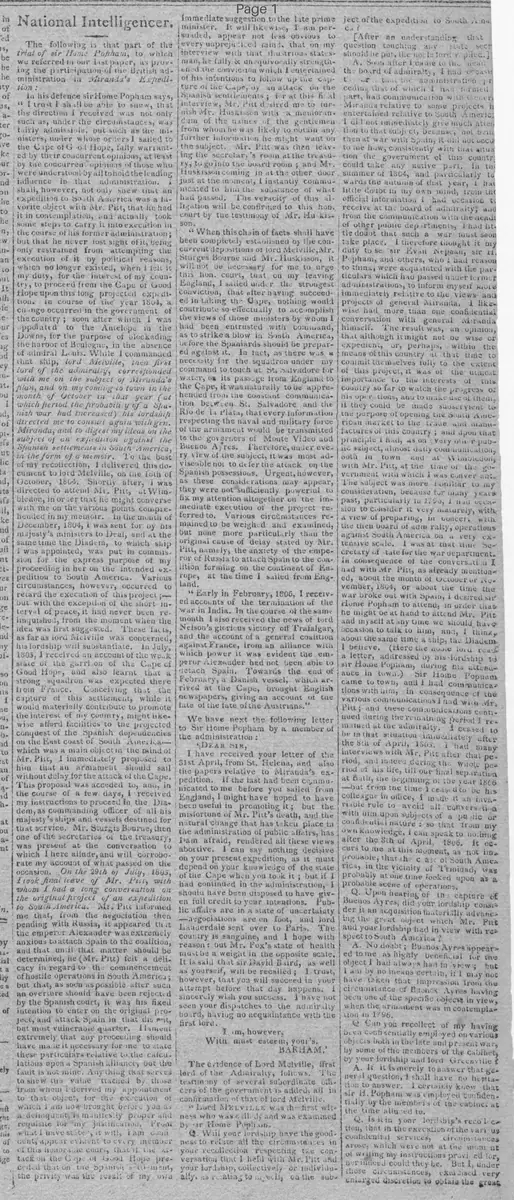
The following is that part of the trial of sir Home Popham, to which we referred in our last paper, as proving the participation of the British administration in Miranda's Expedition :
In his defence sir Home Popham says,
" I trust I shall be able to shew, that the direction I received was not only such as, under the circumstances, was fairly admissible, but such as the ministers, under whose orders I sailed to the Cape of Good Hope, fully warranted- by their concurrent opinions, at least by the concurrent opinions of those who were understood by all to hold the leading influence in that administration.
I shall, however, not only shew that an expedition to South America was a favorite object with Mr. Pitt, that he had it in contemplation, and actually took some steps to carry it into execution in the course of his former administration; but that he never lost sight of it, being only restrained from attempting the execution of it by political reasons, which no longer existed, when I felt it my duty, for the interest of my country, to proceed from the Cape of Good Hope upon this long projected expedition. In course of the year 1804, a change occurred in the government of the Country; soon after which I was appointed to the Antelope in the Downs, for the purpose of blockading the harbor of Boulogne, in the absence of admiral Louis. While I commanded that ship, lord Melville, then first lord of the admiralty, corresponded with me on the subject of Miranda's plan, and on my coming to town in the month of October in that year (at which period the probability of a Spanish war had increased) his lordship directed me to consult again with gen. Miranda, and to digest my ideas on the subject of an expedition against the Spanish settlements in South America, in the form of a memoir. To the best of my recollection, I delivered this document to lord Melville, on the 10th of October, 1804. Shortly after, I was directed to attend Mr. Pitt, at Wimbledon, in order that he might converse with me on the various points comprehended in my memoir. in the month of December, 1804, I was sent for by his majesty's ministers to Deal, and at the same time the Diadem, to which ship I was appointed, was put in commission for the express purpose of my proceeding in her on the intended expedition to South America. Various circumstances, however, occurred to retard the execution of this project ;-- but with the exception of the short interval of peace, it had never been relinquished, from the moment when the idea was first suggested. These facts, as far as lord Melville was concerned, his lordship will substantiate. in July, 1805, I received an account of the weak state of the garrison of the Cape of Good Hope, and also learnt that a strong squadron was expected there from France. Conceiving that the capture of this settlement, while it would materially contribute to promote the interest of my country, might likewise afford facilities to the projected conquest of the Spanish dependencies on the East coast of South America-- which was a main object in the mind of Mr. Pitt, I immediately proposed to him that an armament should sail without delay for the attack of the Cape. This proposal was acceded to, and, in the course of a few days, I received my instructions to proceed in the Diadem, as Commanding officer of all his majesty's ships and vessels destined for that service. Mr. Sturgis Bourne, then one of the secretaries of the treasury, was present at the conversation to which I here allude, and will corroborate my account of what passed on the occasion. On the 29th of July, 1805, I took final leave of Mr. Pitt, with whom I had a long conversation on the original project of an expedition to South America. Mr. Pitt informed me that, from the negociation then pending with Russia, it appeared that the emperor Alexander was extremely anxious to attach Spain to the coalition, and that until that matter should be determined, he (Mr. Pitt) felt a delicacy in regard to the commencement of hostile operations in South America; but that, as soon as possible after such an overture should have been rejected by the Spanish court, it was his fixed intention to enter on the original project, and attack Spain in that distant, but most vulnerable quarter. Lament extremely that any proceeding should have made it necessary for me to state these particulars relative to the calculations upon a Spanish alliance, but the fault is not mine. Any thing that serves to shew the value attached by those from whom I derived my appointment to that object, for the execution of which I am now brought before you as a delinquent, is manifestly proper and requisite for my justification. From what I have stated it will, I am confident, appear evident to every member of this honorable court, that if the attack on the Cape of Good Hope preceded that on the Spanish settlement, the privity was the result of my own immediate suggestion to the late prime minister. It will likewise, I am persuaded, appear not less obvious to every unprejudiced mind, that on my interview with that illustrious statesman, he fully & unequivocally strengthened the conviction which I entertained of his intentions to follow up the capture of the Cape, by an attack on the Spanish settlements : for at this final interview, Mr. Pitt desired me to furnish Mr. Huskisson with a memorandum of the names of the gentlemen from whom he was likely to obtain any further information he might want on the subject. Mr. Pitt was then leaving the secretary's room at the treasury, to go into the board room ; and Mr. Huskisson coming in at the other door just at the moment, I instantly communicated to him the substance of what had passed. The veracity of this allegation will be confirmed to this hon. court by the testimony of Mr. Huskisson.
" When this chain of facts shall have been completely established by the concurrent depositions of lord Melville, Mr. Sturges Bourne and Mr. Huskisson, it will not be necessary for me to urge this hon. court, that on my leaving England, I sailed under the strongest conviction, that after having succeeded in taking the Cape, nothing would contribute so effectually to accomplish the views of those ministers by whom I had been entrusted with command, as to strike a blow in South America, before the Spaniards should be prepared against it. In fact, as there was a necessity for the squadron under my command to touch at St. Salvador for water, on its passage from England to the Cape, it was naturally to be apprehended from the constant communication between St. Salvador and the Rio de la Plata, that every information respecting the naval and military force of the armament would be transmitted to the governors of Monte Video and Buenos Ayres. Therefore, under every view of the subject, it was most advisable not to defer the attack on the Spanish possessions. Urgent, however, as these considerations may appear, they were not sufficiently powerful to fix my attention altogether on the immediate execution of the project referred to. Various circumstances remained to be weighed and examined, but none more particularly than the original cause of delay stated by Mr. Pitt, namely, the anxiety of the emperor of Russia to attach Spain to the Coalition forming on the continent of Europe, at the time I sailed from England.
" Early in February, 1806, I received accounts of the termination of the war in India. In the course of the same month I also received the news of lord Nelson's glorious victory off Trafalgar, and the account of a general coalition against France, from an alliance with which power it was evident the emperor Alexander had not been able to detach Spain. Towards the end of February, a Danish vessel, which arrived at the Cape, brought English newspapers, giving an account of the fate of the Austrians."
We have next the following letter to Sir Home Popham by a member of the administration :
DEAR SIR,
I have received your letter of the 31st April, from St. Helena, and also the papers relative to Miranda's expedition. if the last had been communicated to me before you sailed from England, I might have hoped to have been useful in promoting it; but the misfortune of Mr. Pitt's death, and the natural change that has taken place in the administration of public affairs, has I am afraid, rendered all these views abortive. I can say nothing decisive on your present expedition, as it must depend on your knowledge of the state of the Cape when you took it ; but if I had continued in the administration, I should have been disposed to have given full credit to your intentions. Public affairs are in a state of uncertainty --negotiations are on foot, and lord Lauderdale sent over to Paris. The country is sanguine, and I hope with reason: But Mr. Fox's state of health must be a weight in the opposite scale. It is said that sir David Baird, as well as yourself, will be recalled; I trust, however, that you will succeed in your attempt before that day happens. I sincerely wish you success. I have not seen your dispatches to the admiralty board, having no acquaintance with the first lord.
I am, however,
With must esteem, yours.
BARHAM.'
The evidence of Lord Melville, first lord of the Admiralty, follows, The testimony of several subordinate officers of the government is added, all in confirmation of that of lord Melville.
" Lord MELVILLE was the first witness who was called, and was examined by sir Home Popham.
Q. Will your lordship have the goodness to relate all the circumstances in your recollection respecting the conversation that I held with Mr. Pitt and your lordship, collectively or individually. as relating to me, on the subject of the expedition to South America?
[After an understanding that question touching any state secret should be put, the noble lord replied.]
A. Soon after I came to the head of the board of admiralty, I had occasion to learn that the administration preceding that of which I had formed a part, had communication with General Miranda relative to some projects he entertained relative to South America: I did not immediately give much attention to that subject, because, not being then at war with Spain, it did not occur to me how, consistently with that situation the government of this country could take any active part. in the summer of 1804, and particularly towards the autumn of that year, I had little doubt in my own mind, from the official information I had occasion to receive at the board of admiralty; and from the communication with the heads of other public departments, I had little doubt that such a war must soon take place, I therefore thought it my duty to see sir Evan Nepean, sir Home Popham, and others, who I had reason to think, were acquainted with the particulars which had passed under former administrations, to inform myself more immediately relative to the views and projects of general Miranda. I likewise had more than one confidential conversation with general Miranda himself. The result was, an opinion, that although it might not be wise or expedient, or, perhaps, within the means of this country at that time to commit themselves fully to the extent of this project, It was of the utmost importance to the interests of this country so far to watch the progress of his operations, and to make use of them, if they could be made subservient to the purpose of opening the South American market to the trade and manufactures of this country ; and upon that principle I had, as on very other public subject, almost daily communications both in town and at Wimbledon with Mr. Pitt, at the time of the government with which I was connected. The subject was more familiar to my consideration, because for many years past, particularly in 1796, I had occasion to consider it very maturely, with a view of preparing, in concert with the then board of admiralty, operations against South America on a very extensive scale. I was at that time Secretary of State for the war department. In consequence of the conversation I had with Mr. Pitt, as already mentioned, about the month of October or November, 1804, or about the time the war broke out with Spain, I desired sir Home Popham to attend, in order that he might be at hand to attend Mr. Pitt and myself at any time we should have occasion to talk to him, and, I think about the same time a ship, the Diadem I believe. (Here the noble lord reads) a letter, addressed by his lordship to sir Home Popham during his attendance in town.) Sir Home Popham came to town, and I had communications with him, in consequence of the various communications I had with Mr. Pitt; and these communications continued during the remaining period I remained at the admiralty. I ceased to be in that situation immediately after the 8th of April, 1805. I had many interviews with Mr. Pitt after that period, and indeed during the whole period of his life, till our final separation at Bath, the beginning of the year 1806 -but from the time I ceased to be his colleague in office, I made it an invariable rule to avoid all conversation with him upon subjects of a public or confidential nature : so that from my own knowledge, I can speak to nothing after the 8th of April, 1805. It occurs to me at this moment, as not improbable, that the case of South America, in the vicinity of Trinidad, was probably at one time looked upon as a probable scene of operations.
Q. Upon hearing of the capture of Buenos Ayres, did your lordship consider it an acquisition materially advancing the great object which Mr. Pitt and your lordship had in view with respect to South America?
A. No doubt: Buenos Ayres appeared to me as highly beneficial for the object I had always had in view; but I am by no means certain, if I may not have taken that impression from the circumstance of Buenos Ayres having been one of the specific objects in view, when the armament was in contemplation in 1796.
Q. Can you recollect of my having been confidentially employed on various objects both in the late and present war, by some of the members of the Cabinet, by your lordship and lord Grenville
A. It it is merely to answer that general question, I shall have no hesitation to answer. I certainly know that sir H. Popham was employed confidentially by the members of the cabinet at the time alluded to.
Q. Is it in your lordship's recollection, that in the execution of the various confidential services, circumstances arose, which were not at the moment of writing my instructions provided for. nor indeed could they be. But I, under those circumstances, exercised very enlarged discretion to obtain the great
Acted upon when I was employed.
Printed, I am attached to one of my missions to this court of Petersburgh.
Mr. Jervis objected to the question as irrelevant to the case, but waived it.
A. I am anxious to state, that I should be embarrassed in this question;
I can give any answer, but I am afraid I may be led to disclosures that
may be improper.
Mr. Milnes answered—I am ready
to state generally, that on all occasions
when he was confidentially employed,
his conduct received the approbation
of government in the execution of it;
but trust I will not be called upon to
enter into particular explanations.
Q. Does your
lordship recollect, at what time it was
that Sir Home Popham was appointed
to the Diadem?
A. I cannot recollect at the precise
time, except from the letter I have al-
ready mentioned, 1 Dec. 1804, when
the.
Q. Does your lordship recollect,
whether the negotiation this govern-
ment was carrying on with the Court of
Spain for an amicable adjustment of
the differences between her and this
country, had not terminated unsuccess-
fully before that?
A. I cannot from memory fix the
precise time; but I make no doubt it
was a short time after the date of this
letter, as I remember the accounts
came recently before the meeting of
Parliament.
Q. Was Sir H. Popham appointed to
the Diadem with a view of carrying
on offensive operations against Spanish
South America, and what part of it in
particular?
A. I believe Sir H. Popham was
appointed to that ship, with the view
of co-operating with Gen. Miranda, to
the extent of taking advantage of any
of his proceedings which might tend to
our attaining a position on the conti-
nent of South America, favorable to the
trade of this country, but I do not re-
collect any specific place being fixed
upon.
Q. Your lordship has said you had
many confidential conversations with
respect to Gen. Miranda's plans and
views, and that the result of those con-
versations was, an opinion that, altho'
it might not be wise or essential, or
perhaps within the means of this coun-
try, at that time, to commit themselves
fully to the extent of his projects, it was
of the utmost importance to the in-
terests of his country, so far to watch
the progress of this operation, as to
make use of them, if they could be made
subservient to the purpose of opening
the South American market to the
trade and manufactures of this country:
was that the object your lordship had
in view at that time, when you appoint-
ed Sir Home Popham to the Diadem;
and did your lordship continue to en-
tertain the same objects, to the same
extent only, during the remainder of
the time you presided at the Admi-
ralty?
A. It was with a view, mentioned
in the question, that I appointed Sir H.
Popham to the Diadem, and I do not
recollect that during the period after-
wards, while I remained at the admi-
ralty, government had in contemplation
any plan upon a more extensive scale.
Q. Was Sir H. Popham appointed by
your lordship to any command sufficient
to authorize him to attack any part of
S. America?
A. Certainly not, in the proper sense
of the orders.
Q. Are there any notes or official do-
cuments in the records of the admiralty,
to your lordship's recollection, stating
the object for which Sir H. Popham was
appointed to the Diadem?
A. I cannot speak with absolute cer-
tainty, but I think not.
Q. Your lordship said that, speaking
of Buenos Ayres, one of the specific ob-
jects in view, when the armament
was in contemplation in 1796, had your
lordship that place in your view at any
time since, the breaking out of the Spa-
nish war, up to the time your lordship
retired from the Admiralty.
A. At all times, and in every con-
versation I had with Mr. Pitt on the
subject, I make no doubt Buenos Ayres
was often the subject of discussion. My
reason for being so confident in that opi
nion is, that all the considerations I ever
gave to the subject of South America,
whether the attack was to be made on
a smaller or larger scale, I always con-
sidered the Rio de la Plata as a most
important position to the interests of G.
Britain, on that side of S. America.
Q. Whether it was declared upon by
his majesty's late ministers to attack
Buenos Ayres? and whether Sir Home
Popham was appointed to any command
for that purpose?
A. I do not believe that his majesty's
government collectively did ever come
to any resolution of making an attack on
S. America; and it will be recollected
that I have already stated, and it was
only for a few months in the year 1805,
that I remained in office.
President—When Sir Home Popham
was employed by his majesty's minis-
ters, and having used his discretion,
had his conduct been approved of? was
he employed as a captain in his majesty's
navy, or on service of a nature dis-
tinct and different from the naval ser-
vice?
A. He came under those of the latter
description, except one circumstance,
the Red Sea, which may be excepted.
Q. Does your lordship recollect di-
recting me to attend Mr. Pitt at Wim-
bledon, some time in the month of Oc-
tober, 1805, when there was nobody
present but your lordship and Mr. Pitt
to explain Gen. Miranda's views, and
discuss the subject to which he was anx-
ious to call the attention of ministers?
A. I remember perfectly such con-
versation having taken place, but I can-
not charge my memory with the parti-
cular month. I recollect perfectly well
having received a memoir, being very
glad to know the full extent of Gen. Mi-
randa's views, but certainly avoided
committing myself or the British go-
vernment of England, beyond the object
I have already stated—I mean the mar-
ket of S. America, upon which subject
I have certainly entertained a most
anxious wish, almost from the hour I
had occasion to continue in the public
concerns more immediately under my
consideration: and that anxiety cer-
tainly has never diminished but much
increased, in consequence of all the
events which for some years past have
taken place in the East Indies, the
West Indies, and above all on the conti-
nent of Europe.
Q. In consequence of your lordship's
great pressure of business it is possible
you may not recollect the probable cir-
cumstances relating to this object so
well as myself, who had nothing else to
remember, but you may possibly recol-
lect that you desired me to draw up
the memoir in question?
A. I certainly employed you so to do,
and I thought I had so expressed myself
before.
Q. Does your lordship recollect, that
when you did me the honor to appoint
me to the Diadem, it was my sole view
to bring into execution, either some
part, or the whole of the plan submitted
to your consideration in the above recit-
ed memorandum?
A. I do recollect, that when Sir Home
Popham was appointed to the Diadem,
the object then immediately in view,
was to co-operate with the general, in
such objects mentioned in the memoir
as might be thought conducive to the
interests of G. Britain.
Q. Does your lordship recollect whe-
ther the intention of employing me on
this subject, was so far advanced, as to
bring under your contemplation the part
in which I was to be employed, and the
limits of discretion to pursue if success-
ful in the first object, or to follow up
whatever other might appear to me
most salutary in advancing the general
good, by opening the markets of South
America for the enterprise of our mer-
chants?
A. I know certainly, that the general
object was the S. American markets,
but I cannot speak to any further details
of it with that precision at such a dis-
tance of time, as the business was not so
far advanced as to be the subject of
detailed statement.
Sir H. Popham—Q. Was it custom-
ary to enter a minute at the Board of
Admiralty, when an officer was selected
by the cabinet, or the leading mem-
ber, to make the necessary arrange-
ments for secret service, which was
afterwards to be submitted to their con-
sideration?
A. Certainly not, to the best of my
recollection.
REMARKS.
From the foregoing, it appears that
the British government have for a con-
siderable time directed their attention
to the Spanish possessions in South A.
merica.
That their conquest was a favorite
object of Mr. Pitt, the prime minister,
who is allowed to have controlled the
measures of the administration.
That it was likewise a favorite ob.
ject with Lord Melville, a very influen-
tial member of the Cabinet, and first
lord of the admiralty.
That for the purpose of furthering
their views both these gentlemen had
frequent and confidential communica-
tions with Miranda and Sir Home Pop-
ham.
And it is a fact that while the latter
effected the important capture of Bue-
nos Ayres, the former fitted out an ex-
pedition from this country.
That both these expeditions were
parts of the same scheme cannot admit
of doubt, when we consider the cir-
cumstances admitted, and the coinci-
dence of time.
Neither was openly or officially au-
thorised. That of Popham, because an
attempt was making the Emperor
Alexander to bring Spain into the coa-
lition against France; and that of
Miranda, for reasons of a still more
imperious nature.
England had a right to authorise such
direct hostile measures as she pleased
against her enemy. But she had no
right to authorise, or even to counte-
nance the carrying on such measures
from a nation at peace both with her
and with Spain. She did, however,
notwithstanding, sanction them, and
furnish, we have no doubt, supplies for
their accomplishment, in violation of
good faith towards the United States,
and it is fairly to be presumed, with a
view likewise not merely of advancing
her own interests, but of embroiling
the United States with her enemies.
She calculated, that Spain would consi-
der such an expedition, fitted out from
the United States, as virtually autho-
rised by the United States, and it is
not at all improbable that this hope
was strengthened by a knowledge of
the intriguing and disaffected character
of the Spanish Minister, to whose assi-
duous efforts to convert his personal
differences into a rupture between the
two nations she was no stranger. Such
was probably the harvest which the
cunning man then at the head of the
admiralty expected to reap from the
project in the furtherance of which he
went hand in hand with the prime mi-
nister.
This disclosure of facts will add ano-
ther to the numerous lessons we have
received on the folly of considering the
British government as guided by any
other motives than those of self inter-
est; not on that enlarged and liberal
scale in which self interest becomes
identified with general philanthropy,
and invariably actuated by pure mo-
tives disdains to pursue not merely
improper ends, but also proper ones by
dishonorable means.
We should have had no cause to cen-
sure the British government for waging
an open war against the Spanish pos-
sessions in any part of the world; but
it was a culpable, a criminal act to en-
deavor by deception and stratagem, to
engage a neutral and unoffending nation
in the miseries of war.
This disclosure attests, if the whole
series of the conduct of Great Britain
has not already proved it, that while
her formal and written instructions
point to one object, her verbal and
controlling instructions direct another.
Is this honorable to her, or just to
others?—that what she solemnly issues,
and frequently publishes, as the rule
of her conduct, shall be merely a lure
with which to entrap the credulity of
those who confide in her professions?
We would not wish to push these stric-
tures too far: and we are ready to ad-
mit that there have been periods in the
administration of her public affairs,-
the brightest periods too,—in which an
open, dignified and just policy has dis-
dained to profess one thing while it did
another. We are sure the spirit of
Fox was too lofty to stoop to such dis-
graceful subterfuges. But we cannot
avoid the remark, that, notwithstand-
ing his transcendent talents, he was
only two years, we believe, at the head
of affairs, while Mr. Pitt, who died
comparatively a young man, was at the
head of affairs for eight times as long a
period.
What sub-type of article is it?
What keywords are associated?
What entities or persons were involved?
Where did it happen?
Foreign News Details
Primary Location
South America
Event Date
1804 1806
Key Persons
Outcome
capture of buenos aires and cape of good hope; british plans for south american conquest advanced but not officially authorized due to diplomatic concerns; miranda's expedition supported covertly.
Event Details
During Sir Home Popham's trial, his defense and Lord Melville's testimony reveal British administration under Pitt and Melville planned expeditions to Spanish South America, consulting with General Miranda, appointing Popham to the Diadem for potential operations, capturing Cape of Good Hope and Buenos Aires to open markets, delayed by negotiations to ally Spain against France.