Thank you for visiting SNEWPapers!
Sign up free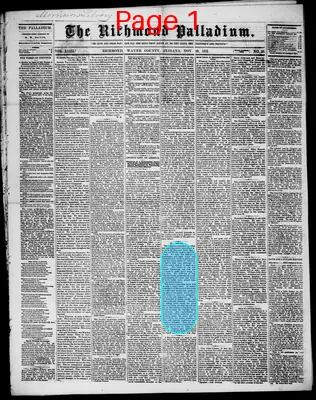
Editorial
November 29, 1873
The Richmond Palladium
Richmond, Wayne County, Indiana
What is this article about?
This editorial warns that war would not stimulate the economy through currency issuance but instead impose heavy taxes, strain public credit, paralyze industry, and draw from Civil War experiences of financial blundering and trade prostration.
Clipping
OCR Quality
98%
Excellent
Full Text
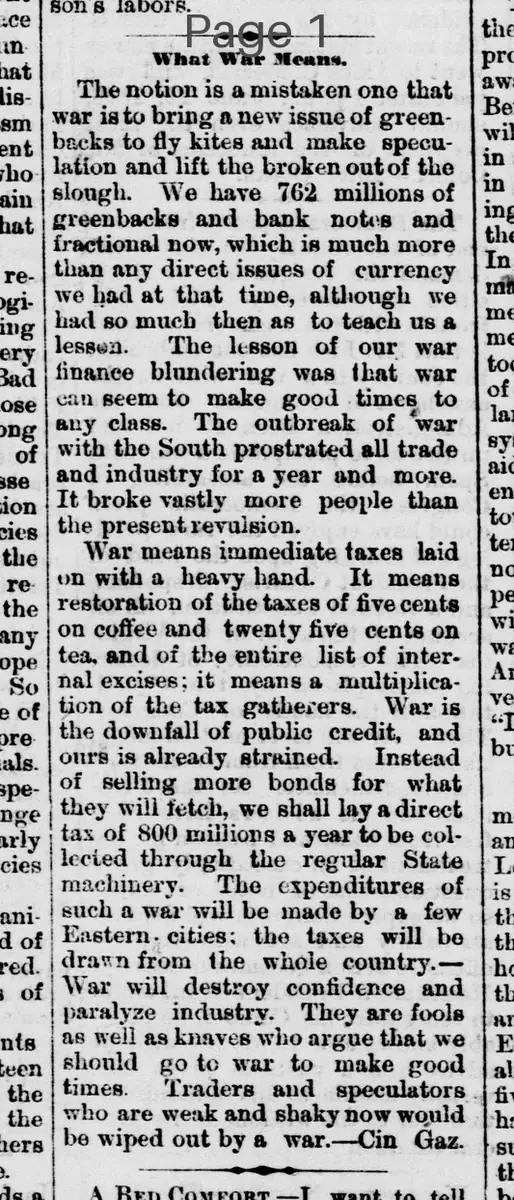
What War Means.
The notion is a mistaken one that war is to bring a new issue of greenbacks to fly kites and make speculation and lift the broken out of the slough. We have 762 millions of greenbacks and bank notes and fractional now, which is much more than any direct issues of currency we had at that time, although we had so much then as to teach us a lesson.
The lesson of our war finance blundering was that war can seem to make good times to any class. The outbreak of war with the South prostrated all trade and industry for a year and more. It broke vastly more people than the present revulsion.
War means immediate taxes laid on with a heavy hand. It means restoration of the taxes of five cents on coffee and twenty five cents on tea, and of the entire list of internal excises; it means a multiplication of the tax gatherers. War is the downfall of public credit, and ours is already strained. Instead of selling more bonds for what they will fetch, we shall lay a direct tax of $500 millions a year to be collected through the regular State machinery. The expenditures of such a war will be made by a few Eastern cities; the taxes will be drawn from the whole country.
War will destroy confidence and paralyze industry. They are fools as well as knaves who argue that we should go to war to make good times. Traders and speculators who are weak and shaky now would be wiped out by a war.—Cin. Gaz.
The notion is a mistaken one that war is to bring a new issue of greenbacks to fly kites and make speculation and lift the broken out of the slough. We have 762 millions of greenbacks and bank notes and fractional now, which is much more than any direct issues of currency we had at that time, although we had so much then as to teach us a lesson.
The lesson of our war finance blundering was that war can seem to make good times to any class. The outbreak of war with the South prostrated all trade and industry for a year and more. It broke vastly more people than the present revulsion.
War means immediate taxes laid on with a heavy hand. It means restoration of the taxes of five cents on coffee and twenty five cents on tea, and of the entire list of internal excises; it means a multiplication of the tax gatherers. War is the downfall of public credit, and ours is already strained. Instead of selling more bonds for what they will fetch, we shall lay a direct tax of $500 millions a year to be collected through the regular State machinery. The expenditures of such a war will be made by a few Eastern cities; the taxes will be drawn from the whole country.
War will destroy confidence and paralyze industry. They are fools as well as knaves who argue that we should go to war to make good times. Traders and speculators who are weak and shaky now would be wiped out by a war.—Cin. Gaz.
What sub-type of article is it?
Economic Policy
War Or Peace
What keywords are associated?
War Finance
Greenbacks
Taxes
Public Credit
Civil War Lessons
Editorial Details
Primary Topic
Economic Consequences Of War
Stance / Tone
Strongly Anti War Economically
Key Arguments
War Does Not Bring Prosperity But Prostrates Trade And Industry
War Leads To Immediate Heavy Taxes Including On Coffee And Tea
War Restores Internal Excises And Multiplies Tax Gatherers
War Causes Downfall Of Public Credit
War Expenditures Benefit Few Eastern Cities While Taxes Burden The Whole Country
War Destroys Confidence And Paralyzes Industry
Traders And Speculators Would Be Wiped Out By War