Thank you for visiting SNEWPapers!
Sign up free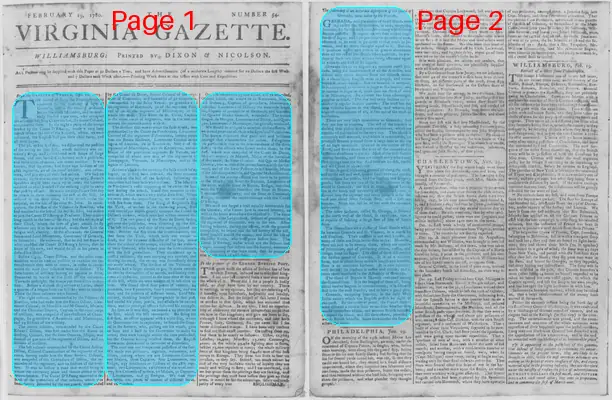
The Virginia Gazette
Richmond, Williamsburg, Richmond County, Virginia
What is this article about?
On July 2, 1779, French forces led by Count d'Estaing landed on Grenada and assaulted British defenses at hospital hill, capturing the island after a night attack. 900 prisoners taken, minimal French losses (35 killed, 71 wounded). Includes description of Grenada's geography and economy.
Merged-components note: These two components detail the French capture of Grenada and provide a description of the island, forming a single coherent foreign news article on the same topic.
Clippings
1 of 2
OCR Quality
Full Text
On the second of July, the French squadron appeared in the morning in sight of Grenada, and in the evening anchored before the creek Molenier, and immediately landed 1300 men, who occupied the adjacent heights; Count Dillon, the senior Colonel, commanded them. In the night a party of the troops headed by the Count D'Estaing, made a very long march to turn the hill of the hospital, where, we were informed, the English had put their chief force, and all their hopes.
The day at break of day, we discovered the position of the enemy on that hill, whose declivity was extremely steep, and incumbered with heaps of large stones, and was fortified at bottom with a pallisado, and three intrenchments, one above another. It was known, that the enemy had there 340 soldiers of the 48th regiment, 40 of the royal artillery, 200 volunteers, and 800 men of their best militia. We had no cannon; there was no time to bring up any; Byron's squadron might have come up in time; the General resolved to avail himself of the ensuing night to carry that post by assault. He made his dispositions that day to attack in three columns the east of the hill; he ordered at the same time, a false attack under the hospital, on the side of the river St. John. In consequence, the division of the Viscount de Noailles, who had marched to the side of the hill St. Eloi, had orders to join the Count D'Estaing at Pradines: They made a long march in the heat of the day; but the example of their Chief, whom the love of glory causes to fly wherever any is to be acquired, made them bear the fatigue with alacrity.
In the afternoon, the General summoned Lord Macartney, Governour of Grenada, to surrender: He answered, that he did not know in what consisted the Count D'Estaing's forces, that he knew of his own, and would do all in his power to defend his island.
Before night, Count Dillon, and the other commanders went as near as possible to examine the intrenchments they were to attack, in order to reconnoitre the road their columns were to follow. The detachment of artillery having no cannon to serve, demanded to march at the head of the columns: Towards midnight, the troops put themselves in motion: Before two o'clock they arrived at Lucas, about a quarter of a league from the hill they were to attack: There the three columns were formed.
The right column, commanded by the Viscount de Noailles, who had under him the Sieurs Odunc, Lieutenant Colonel; de Mondion and M'Donald, Majors; and the Chevalier Deputy, Captain in the royal corps of artillery, was composed of 100 chasseurs of Champagne, 60 grenadiers d'Auxerrois and Martinique, and 10 soldiers of the artillery.
The centre column, commanded by the Count Edward Dillon, who had under him the Baron de Steding, Colonel, and the Sieur Onoran, Major, was formed of 300 men of the regiment of Dillon, and 10 soldiers of artillery.
The left column commanded by the Count Arthur Dillon, Colonel Commandant of the regiment of his name, having under him the Sieur Brown, Colonel, was composed of the Grenadiers of Dillon, the remainder of the regiment, and 20 soldiers of the artillery. It was to follow a road that would bring it nearer the careening place and thence ascend to the intrenchments. The Count D'Estaing marched at the head of the grenadiers of that column, which was immediately preceded by the van guard, commanded by the Count de Durat, second Colonel of the regiment of Cambresis; and composed of 50 volunteers, commanded by the Sieur Vence; 50 grenadiers of the regiment of Hainault, 50 of the regiment Foix, and of 30 of the regiment of Martinique; in the whole 180 men. The Sieur de St. Ciran, Captain in the royal corps of engineers, was in the van and entered the intrenchments with it.
The division that was to make the false attack, was commanded by the Count de Pondevaux, Lieutenant Colonel of the regiment d'Auxerrois, having under him the Sieurs Huenot, Lieutenant Colonel in the legion of Lauzun, de la Bejonniere, Major of the regiment of Martinique, and de Kerangues, ancient Major of the provincial regiment de Vannes, and composed of about 200 men of the regiments of Champagne, Viennois, la Martinique, and of the legion of Lauzun.
At two o'clock in the morning the false attack being begun, as it had been ordered, the three columns marched to the hill of the hospital, following the roads that had been indicated to them. The Marquis de Vaudreuil's vessel happening to be under the battery during the attack, seized that moment to cannonade it, which made a very useful diversion.
When we were near the intrenchments, we received a very brisk fire from them. The King of England's ship the York, at anchor in the careening place, fired with cartridges which greatly annoyed the Count de Dillon's column, which marched within cannon shot of it. The van guard of the Sieur de Durat having got over the pallisades, were climbing up the hill. The left column, and that of the centre, joined the van. Neither the fire from the intrenchments, nor that from the York, which took our troops in flank, nor the extreme difficulty of the post, could abate the ardour of the troops, excited by the presence of their General, who leaped into the intrenchments with the first grenadiers. They clambered up in pressed columns, the men carrying one another, and shoving forward, the enemy was successively drove out every where. The division of the Viscount de Noailles had a larger circuit to go; it made amends for that by the rapidity of its march, and having overcome all obstacles, arrived at the same time at the top of the hill, which we were masters of in less than an hour. We found there four pieces of cannon, 24 pounders, two 8 pounders, four 6 pounders, and one four, and six mortars of different bores, Lord Macartney, thinking himself impregnable in that post, had caused his plate, jewels, and effects to be carried there, and his principal officers followed his example.
As soon as it was day, we turned a 24 pounder on the fort, which the hill commands. On firing the first shot, an officer appeared with a white flag, whom the Governour sent to capitulate; he found the General in the battery, who, pulling out his watch, gave an hour and a half to the Governour to make his terms; they were brought within the time prescribed; but the General having rejected them, the English Governour determined to surrender at discretion. The next day our troops took possession of the fort. We made 900 prisoners, regulars, volunteers, and sailors, among whom are one Lieutenant Colonel, two Majors, three Captains, four Lieutenants, one Ensign, 157 subalterns or soldiers of the 48th regiment; two Lieutenants, 28 soldiers of the royal artillery; five Colonels of militia, six Majors, 8 Captains, 31 Lieutenants, and 33 Ensigns. We took three standards, 102 pieces of cannon of different bores, and 16 mortars.
Our loss amounts to 35 men killed, and 71 wounded. Officers killed, the Sieur de la Betonniere, Major, and Dubourg, Captain of grenadiers, Martinique; Schechy, Lieutenant of Dillon; the Sieur de Laperriere, Captain of grenadiers of Hainault, and Gautier, Aid Quarter Master General, wounded: The Sieurs Dugan, de Morgan, Lieutenants of Dillon, and Quergus, Lieutenant of Martinique, dangerously wounded.
We should be obliged to mention all the officers, if we would point out all those who signalized themselves. The troops displayed that good will and brilliant courage that characterizes the nation. Eulogiums are particularly due to the commandants of the divisions; to the officers who served under them; to the staff, which was composed of the Count de Durat, Major General; de Manoel, Major of the battalion of Hainault; the Sieur Gautier, Aid Quarter Master General, who mounted the intrenchments with the General; and of the Sieur Paerat, de la Chapelle, Majors of the Martinique militia, Aid Quarter Master General. Some of the marine officers had leave to be present at the attack; the Sieur du Rumain, Lieutenant of the navy, and the Sieur de Barras, Ensign, marched with the Viscount de Noailles; the Sieur de Broves, Lieutenant of the navy, and the Sieur de Combaud, Ensign, mounted the intrenchments with the Count D'Estaing.
We must not forget a trait equally honourable for the General, who knows how to reward bravery, as well as the brave man who is the object of it. The Sieur Horadou, alias Languedock, Serjeant of grenadiers in the regiment of Hainault, was in the van. After having behaved, during the action, with the greatest intrepidity, he leaped into the last battery of the hill, flung himself amidst the enemy, and saved the life of the Sieur Vence, who was gone before him. The Count D'Estaing, under whose eye the serjeant had fought, coming that instant into the battery, embraced him, declaring at the same time, that he promoted him to the rank of an officer.
The following is an accurate description of the island of Grenada, now taken by the French.
GRENADA, and the cluster of small islands near it, called the Grenadines, is now, excepting Jamaica, by far the most valuable colony which Great Britain possesses. It exports no less than 20,000 hogsheads of sugar, and in a proportionable quantity of rum, esteemed to be next in goodness to that made in Jamaica, and by many thought equal to it. Besides, it produces coffee and cotton in greater abundance than all the rest of our islands taken together; its produce in these two latter articles being esteemed equal in value to one half of its sugars.
Grenada lies in 12 degrees 3 minutes north latitude, being the southernmost of all the Antilles, and distant only thirty leagues from the Spanish main. It is about thirty English miles in length, and where broadest, about sixteen: But its breadth is unequal. It is computed to be twice as large as Barbados, and to contain in sugar land, more than one third of what is in Martinique. Its climate has one advantage peculiar to itself. The dry and rainy seasons are remarkably regular in their periods: The blight has not been hitherto known in the island, and what is the happiest circumstance of all, it lies out of the tract of hurricanes.
There are very high mountains in Grenada; but they are few in number. The rest of the country is divided into plains and gentle eminences, which are capable of cultivation to the very top. This island is extremely well watered, and which is remarkable, its principle streams proceed from a large lake at the top of an high mountain, situated in the centre of the land, and flows down the sides of the mountains in different directions to the sea. Most of the hills furnish smaller brooks, and there are almost every where very fine springs near the sea: And here are sea-fish, turtle, and wild fowl in abundance.
There is good anchoring ground all along the coast, and on the east and west, several small bays and creeks, commodious for vessels, and for landing and shipping goods; but there are two of the finest harbours in the world in Grenada; the first of these, called Levis, lies at the south east extremity of the island, and is divided into the outward and inner port, it is for the most part about seven fathom deep, and a soft ozy bottom. Ships can sail in or out with the common trade-wind.
The other harbour, called St. George, is situated at the north west of the island, so capacious, that it is capable of holding a large fleet of line of battle ships.
The Grenadines are a cluster of small islands which lie between Grenada and St. Vincent, in a north by east direction. Their number is not well known, as many of them are little better than rocks: However, there are said to be twenty three, which are capable of cultivation, and of producing cotton, coffee, and indigo, some say sugar. The chief of them still retains the Indian name of Carriacou. It is of a circular form, and is about seven miles in length and breadth. Here is an excellent harbour. It is now tolerably well settled; its produce is coffee and cotton, and it sends three members to the Assembly of Grenada.
The island of Bequia is likewise reckoned among the Grenadines. It is the longest of them all, being about twelve leagues in circumference; it is likewise said to be the most fruitful, and to have a good port.
Grenada, excepting Jamaica, is the only West India colony which the English possess by right of conquest. By the treaty of peace, the French settlers were allowed a certain time to consider whether they would retain their estates, and become British subjects, or depart the island, and sell their estates, provided it was to British Subjects. Some have chosen the former; others the latter.
What sub-type of article is it?
What keywords are associated?
What entities or persons were involved?
Where did it happen?
Foreign News Details
Primary Location
Grenada
Event Date
July 2, 1779
Key Persons
Outcome
french captured grenada, 900 prisoners (including officers and soldiers), 102 pieces of cannon, 16 mortars, 3 standards; french losses: 35 killed, 71 wounded.
Event Details
French squadron under Count D'Estaing appeared off Grenada on July 2, 1779, landed 1300 men commanded by Count Dillon. Night assault in three columns on hospital hill defenses held by 1380 English (340 of 48th regiment, 40 artillery, 200 volunteers, 800 militia). False attack diversion. Overcame steep, fortified position despite fire from intrenchments and HMS York. Captured hill in under an hour, then fort surrendered. Governor Lord Macartney capitulated after terms rejected.