Thank you for visiting SNEWPapers!
Sign up free
Richmond Enquirer
Richmond, Richmond County, Virginia
What is this article about?
In October 1816, French commissioners aboard the frigate Flora correspond with Hayti's President Boyer and General Christophe, conveying King Louis XVIII's intentions for reconciliation, aid, and stabilization of St. Domingo post-revolution, disavowing prior unauthorized missions and offering extensive powers for negotiation.
Merged-components note: Continuation of the same correspondence from the West Indies commissioners.
Clipping
OCR Quality
Full Text
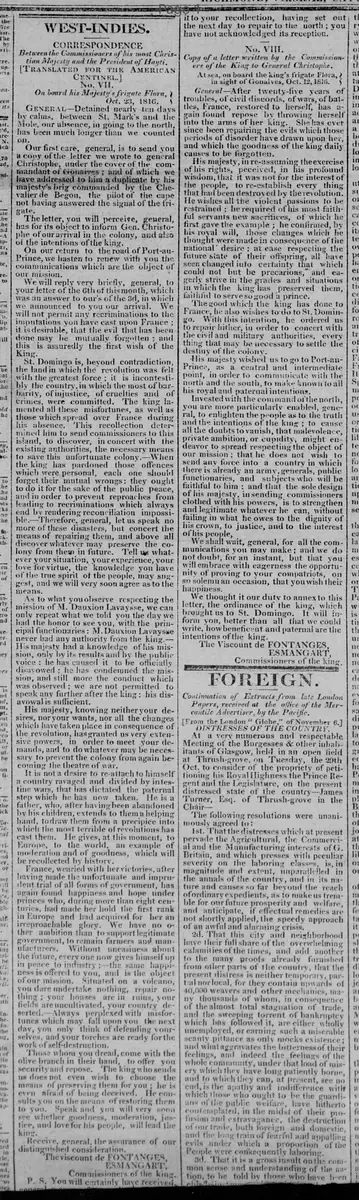
CORRESPONDENCE
Between the Commissioners of his most Christian Majesty and the President of Hayti.
TRANSLATED FOR THE AMERICAN
CENTINEL.
No. VII.
On board his Majesty's frigate Flora, 7 Oct. 23. 1816.
GENERAL—Detained nearly ten days by calms, between St. Mark's and the Mole, our absence, in going to the north, has been much longer than we counted on.
Our first care, general, is to send you a copy of the letter we wrote to general Christophe, under the cover of the commandant of Gonaives; and of which we have addressed to him a duplicate by his majesty's brig commanded by the Chevalier de Begon, the pilot of the cape not having answered the signal of the frigate.
The letter, you will perceive, general, has for its object to inform Gen. Christophe of our arrival in the colony, and also of the intentions of the king.
On our return to the road of Port-au-Prince, we hasten to renew with you the communications which are the object of our mission.
We will reply very briefly, general, to your letter of the 6th of this month, which was an answer to ours of the 3d, in which we announced to you our arrival. We will not permit any recriminations to the imputations you have cast upon France; it is desirable, that the evil that has been done may be mutually forgotten; and this is assuredly the first wish of the King.
St. Domingo is, beyond contradiction, the land in which the revolution was felt with the greatest force; it is incontestibly the country, in which the most of barbarity, of injustice, of cruelties and of crimes, were committed. The king lamented all these misfortunes, as well as those which spread over France during his absence. This recollection determined him to send commissioners to this island, to discover, in concert with the existing authorities, the necessary means to save this unfortunate colony.—When the king has pardoned those offences which were personal, each one should forget their mutual wrongs: they ought to do it for the sake of the public peace, and in order to prevent reproaches from leading to recriminations which always end by rendering reconciliation impossible.—Therefore, general, let us speak no more of these disasters, but concert the means of repairing them, and above all discover whatever may preserve the colony from them in future. Tell us whatever your situation, your experience, your love for virtue, the knowledge you have of the true spirit of the people, may suggest, and we will very soon agree as to the means.
As to what you observe respecting the mission of M. Dauxion Lavaysse, we can only repeat what we told you the day we had the honor to see you, with the principal functionaries: M. Dauxion Lavaysse never had any authority from the king.—His majesty had a knowledge of his mission, only by its results and by the public voice: he has caused it to be officially disavowed: he has condemned the mission, and still more the conduct which was observed; we are not permitted to speak any further after the king: his disavowal is sufficient.
His majesty, knowing neither your desires, nor your wants, nor all the changes which have taken place in consequence of the revolution, has granted us very extensive powers, in order to meet your demands, and to do whatever may be necessary to prevent the colony from again becoming the theatre of war.
It is not a desire to re-attach to himself a country ravaged and divided by intestine wars, that has dictated the paternal step which he has now taken. He is a father, who, after having been abandoned by his children, extends to them a helping hand, to draw them from a precipice into which the most terrible of revolutions has cast them. He gives, at this moment, to Europe, to the world, an example of moderation and of goodness, which will be recollected by history.
France, wearied with her victories, after having made the unfortunate and imprudent trial of all forms of government, has again found happiness and hope under princes who, during more than eight centuries, had made her hold the first rank in Europe and had acquired for her an irreproachable glory. We have no other ambition than to support legitimate government, to remain farmers and manufacturers. Without uneasiness about the future, every one now gives himself up in peace to industry;—the same happiness is offered to you, and is the object of our mission. Situated on a volcano, you dare undertake nothing, repair nothing: your houses are in ruins, your fields are uncultivated, your country deserted.—Always perplexed with misfortunes which may fall upon you the next day, you only think of defending yourselves, and your torches are ready for the work of self-destruction.
Those whom you dread, come with the olive branch in their hand, to offer you security and repose. The king who sends us does not even wish to choose the means of preserving them for you: he is even afraid of being deceived. He consults you on the means of restoring them to you. Speak and you will very soon see whether goodness, moderation, justice, and love for his people, will lead the king.
Receive, general, the assurance of our distinguished consideration.
The viscount de FONTANGES
ESMANGART.
Commissioners of the king.
P. S. You will certainly have received.
it to your recollection, having set out the next day to repair to the north; you have not acknowledged its reception.
No. VIII.
Copy of a letter written by the Commissioners of the King to General Christophe.
At sea, on board the king's frigate Flora, in sight of Gonaives, Oct. 12, 1816.
General—After twenty-five years of troubles, of civil discords, of wars, of battles, France, restored to herself, has again found repose by throwing herself into the arms of her king. She has ever since been repairing the evils which those periods of disorder have drawn upon her, and which the goodness of the king daily causes to be forgotten.
His majesty, in re-assuming the exercise of his rights, perceived, in his profound wisdom, that it was not for the interest of the people, to re-establish every thing that had been destroyed by the revolution. He wishes all the violent passions to be restrained: he required of his most faithful servants new sacrifices, of which he first gave the example: he confirmed, by his royal will, those changes which he thought were made in consequence of the national desire; at ease respecting the future state of their offspring, all have seen changed into certainty that which could not but be precarious, and eagerly strive in the grades and situations in which the King has preserved them, faithful to serve so good a prince.
The good which the king has done to France, he also wishes to do to St. Domingo. With this intention, he ordered us to repair hither, in order to concert with the civil and military authorities, every thing that may be necessary to settle the destiny of the colony.
His majesty wished us to go to Port-au-Prince, as a central and intermediate point, in order to communicate with the north and the south, to make known to all his royal and paternal intentions.
Invested with the command of the north, you are more particularly enabled, general, to enlighten the people as to the truth and the intentions of the king; to cause all the doubts to vanish, that malevolence, private ambition, or cupidity, might endeavor to spread respecting the object of our mission; that he does not wish to send any force into a country in which there is already an army, generals, public functionaries, and subjects who will be faithful to him: and that the sole design of his majesty, in sending commissioners clothed with his powers, is to strengthen and legitimate whatever he can, without failing in what he owes to the dignity of his crown, to justice, and to the interest of his people.
We shall wait, general, for all the communications you may make; and we do not doubt, for an instant, but that you will embrace with eagerness the opportunity of proving to your compatriots, on so solemn an occasion, that you wish their happiness.
We thought it our duty to annex to this letter, the ordinance of the king, which brought us to St. Domingo. It will inform you, better than all that we could write, how beneficent and paternal are the intentions of the king.
The Viscount de FONTANGES.
ESMANGART,
Commissioners of the king.
What sub-type of article is it?
What keywords are associated?
What entities or persons were involved?
Where did it happen?
Foreign News Details
Primary Location
St. Domingo
Event Date
October 1816
Key Persons
Outcome
french king disavows unauthorized mission of m. dauxion lavaysse; offers reconciliation, extensive powers for negotiation to stabilize colony and prevent war; seeks consultation on means to restore peace and prosperity.
Event Details
French commissioners, aboard the frigate Flora, write to Hayti's President on 7 October 1816, informing of their mission from King Louis XVIII to reconcile after revolution, forget past wrongs, repair damages, and prevent future conflicts; disavow Lavaysse's mission. They enclose copy of letter to General Christophe. On 12 October 1816, they write to Christophe, explaining the King's paternal intentions to settle colony's destiny without force, legitimize authorities, and enclose royal ordinance.