Thank you for visiting SNEWPapers!
Sign up free
Literary
July 27, 1796
Gazette Of The United States, & Philadelphia Daily Advertiser
Philadelphia, Philadelphia County, Pennsylvania
What is this article about?
A lay preacher delivers a reflective essay on the ephemeral nature of intellectual and social fashions, citing shifts in theology from Calvinism to Deism, medical theories from Boerhaave to Brown, and political views from anti-French sentiment to republicanism, concluding with a preference for stable Federalism and gospel charity.
Clipping
OCR Quality
98%
Excellent
Full Text
THE LAY PREACHER
"The fashion of this world passeth away."
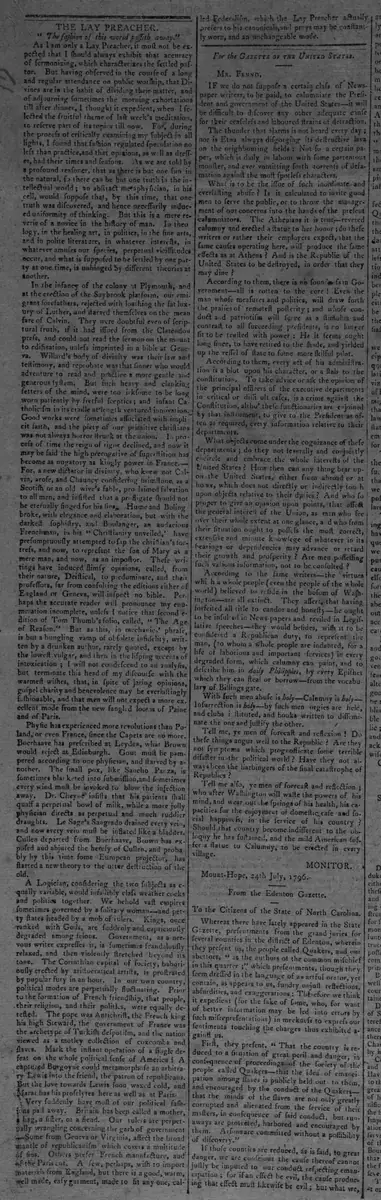
As I am only a Lay Preacher, it must not be expected that I should always exhibit that accuracy of sermonizing, which characterizes the settled pastor. But having observed in the course of a long and regular attendance on public worship, that Divines are in the habit of dividing their matter, and of adjourning sometimes the morning exhortations till after dinner, I thought it expedient, when I selected the fruitful theme of last week's meditation, to reserve part of its topics till now. For, during the process of critically examining my subject in all lights, I found that fashion regulated speculation no less than practice, and that opinions, as well as dresses, had their times and seasons. As we are told by a profound reasoner, that as there is but one sun in the natural, so there can be but one truth in the intellectual world; an abstract metaphysician, in his cell, would suppose that, by this time, that one truth was discovered, and hence necessarily induced uniformity of thinking. But this is a mere reverie of a novice in the history of man. In theology, in the healing art, in politics, in the fine arts, and in polite literature, in whatever interests, in whatever amuses our species, perpetual vicissitudes occur, and what is supposed to be settled by one party at one time, is unhinged by different theories at another.
In the infancy of the colony at Plymouth, and at the erection of the Saybrook platform, our emigrant forefathers, rejected with loathing the gay luxury of Luther, and starved themselves on the mean fare of Calvin. They were doubtful even of scriptural truth, if it had issued from the Clarendon press, and could not read the sermon on the mount to edification, unless imprinted in a bible at Geneva. Willard's body of divinity was their law and testimony, and reprobate was that sinner who would adventure to read and practice a more gentle and generous system. But such heavy and clanking fetters of the mind, were too irksome to be long worn patiently by restless skeptics; and infant Catholicism in its cradle at length ventured innovation. Good works were sometimes associated with implicit faith, and the piety of our primitive Christians was not always horror struck at the union. In process of time the reign of rigor declined, and now it may be said the high prerogative of superstition has become as nugatory as kingly power in France.
For, a new dictator in divinity, who knew not Calvin, arose, and Chauncy considering brimstone as a Scottish or an old wife's fable, proclaimed salvation to all men, and insisted that a profligate should not be eternally singed for his sins. Hume and Bolingbroke, with elegance and elaboration, but with the darkest sophistry, and Boulanger, an audacious Frenchman, in his "Christianity unveiled," have presumptuously attempted to sap the Christian's fortress, and now, to represent the son of Mary as a mere man, and now, as an impostor. These writings have induced flimsy opinions, called, from their nature, Deistical, to predominate, and their professors, far from consulting the editions either of England or Geneva, will inspect no bible. Perhaps the accurate reader will pronounce my enumeration incomplete, unless I notice that second edition of Tom Thumb's folio, called, "The Age of Reason." But as this, in mechanics' phrase, is but a bungling vamp of obsolete infidelity, written by a drunken author, rarely quoted, except by the lowest vulgar, and then in the lisping accents of intoxication; I will not condescend to an analysis, but terminate this head of my discourse with the warmest wishes, that, in spite of jaring opinions, gospel charity and benevolence may be everlastingly fashionable, and that men will not expect a more excellent mode from the new fangled loquacity of Paine and of Paris.
Physic has experienced more revolutions than Poland, or even France, since the Capets are no more. Boerhaave has prescribed at Leyden, what Brown would reject at Edinburgh. Gout must be pampered according to one physician, and starved by another. The small pox, like Sancho Panza, is sometimes blanketed into submission, and sometimes every wind must be invoked to blow the infection away. Dr. Cheyne insists that his patients shall quaff a perpetual bowl of milk, while a more jolly physician directs as perpetual and much ruddier draughts. Le Sage's Sangrado drained every vein, and now every vein must be inflated like a bladder. Cullen departed from Boerhaave, Brown has exposed and abjured the heresy of Cullen, and probably by this time some European projector, has started a new theory to the utter destruction of the old.
A Logician, considering the two subjects as equally variable, would infallibly class weather cocks and politicians together. We behold vast empires sometimes governed by a solitary woman--and petty states headed by a mob of rulers. Kings, once ranked with Gods, are suddenly and capriciously degraded among felons. Government, as a nervous writer expresses it, is sometimes scandalously relaxed, and then violently stretched beyond its tone. The Corinthian capital of society, laboriously erected by aristocratical artists, is prostrated by popular fury in an hour. In our own country, political modes are perpetually fluctuating. Prior to the formation of French friendship, that people, their religion, and their politics, were equally detested. The pope was Antichrist, the French king his high Steward, the government of France was the archetype of Turkish despotism, and the nation viewed as a motley collection of coxcombs and slaves. Mark the instant operation of a single defeat on the whole political sense of America! A captured Burgoyne could metamorphose an arbitrary Lewis into the friend, the patron of republicans. But the love towards Lewis soon waxed cold, and Marat has his proselytes here as well as at Paris.
Very suddenly have most of our political fashions passed away. Britain has been called a mother, hag, sister, or a fiend. Our rulers are perpetually wrangling concerning the garb of government. Some from Geneva or Virginia, affect the broad mantle of republicanism which covers a multitude of sins. Others prefer French manufacture, and of the Paris cut. A few, perhaps, wish to import materials from England, but there is a good, warm, well made, easy garment, made to fit any one, called Federalism. which the Lay Preacher actually prefers to his canonicals, and prays may be constantly worn, and an unchangeable mode.
"The fashion of this world passeth away."
As I am only a Lay Preacher, it must not be expected that I should always exhibit that accuracy of sermonizing, which characterizes the settled pastor. But having observed in the course of a long and regular attendance on public worship, that Divines are in the habit of dividing their matter, and of adjourning sometimes the morning exhortations till after dinner, I thought it expedient, when I selected the fruitful theme of last week's meditation, to reserve part of its topics till now. For, during the process of critically examining my subject in all lights, I found that fashion regulated speculation no less than practice, and that opinions, as well as dresses, had their times and seasons. As we are told by a profound reasoner, that as there is but one sun in the natural, so there can be but one truth in the intellectual world; an abstract metaphysician, in his cell, would suppose that, by this time, that one truth was discovered, and hence necessarily induced uniformity of thinking. But this is a mere reverie of a novice in the history of man. In theology, in the healing art, in politics, in the fine arts, and in polite literature, in whatever interests, in whatever amuses our species, perpetual vicissitudes occur, and what is supposed to be settled by one party at one time, is unhinged by different theories at another.
In the infancy of the colony at Plymouth, and at the erection of the Saybrook platform, our emigrant forefathers, rejected with loathing the gay luxury of Luther, and starved themselves on the mean fare of Calvin. They were doubtful even of scriptural truth, if it had issued from the Clarendon press, and could not read the sermon on the mount to edification, unless imprinted in a bible at Geneva. Willard's body of divinity was their law and testimony, and reprobate was that sinner who would adventure to read and practice a more gentle and generous system. But such heavy and clanking fetters of the mind, were too irksome to be long worn patiently by restless skeptics; and infant Catholicism in its cradle at length ventured innovation. Good works were sometimes associated with implicit faith, and the piety of our primitive Christians was not always horror struck at the union. In process of time the reign of rigor declined, and now it may be said the high prerogative of superstition has become as nugatory as kingly power in France.
For, a new dictator in divinity, who knew not Calvin, arose, and Chauncy considering brimstone as a Scottish or an old wife's fable, proclaimed salvation to all men, and insisted that a profligate should not be eternally singed for his sins. Hume and Bolingbroke, with elegance and elaboration, but with the darkest sophistry, and Boulanger, an audacious Frenchman, in his "Christianity unveiled," have presumptuously attempted to sap the Christian's fortress, and now, to represent the son of Mary as a mere man, and now, as an impostor. These writings have induced flimsy opinions, called, from their nature, Deistical, to predominate, and their professors, far from consulting the editions either of England or Geneva, will inspect no bible. Perhaps the accurate reader will pronounce my enumeration incomplete, unless I notice that second edition of Tom Thumb's folio, called, "The Age of Reason." But as this, in mechanics' phrase, is but a bungling vamp of obsolete infidelity, written by a drunken author, rarely quoted, except by the lowest vulgar, and then in the lisping accents of intoxication; I will not condescend to an analysis, but terminate this head of my discourse with the warmest wishes, that, in spite of jaring opinions, gospel charity and benevolence may be everlastingly fashionable, and that men will not expect a more excellent mode from the new fangled loquacity of Paine and of Paris.
Physic has experienced more revolutions than Poland, or even France, since the Capets are no more. Boerhaave has prescribed at Leyden, what Brown would reject at Edinburgh. Gout must be pampered according to one physician, and starved by another. The small pox, like Sancho Panza, is sometimes blanketed into submission, and sometimes every wind must be invoked to blow the infection away. Dr. Cheyne insists that his patients shall quaff a perpetual bowl of milk, while a more jolly physician directs as perpetual and much ruddier draughts. Le Sage's Sangrado drained every vein, and now every vein must be inflated like a bladder. Cullen departed from Boerhaave, Brown has exposed and abjured the heresy of Cullen, and probably by this time some European projector, has started a new theory to the utter destruction of the old.
A Logician, considering the two subjects as equally variable, would infallibly class weather cocks and politicians together. We behold vast empires sometimes governed by a solitary woman--and petty states headed by a mob of rulers. Kings, once ranked with Gods, are suddenly and capriciously degraded among felons. Government, as a nervous writer expresses it, is sometimes scandalously relaxed, and then violently stretched beyond its tone. The Corinthian capital of society, laboriously erected by aristocratical artists, is prostrated by popular fury in an hour. In our own country, political modes are perpetually fluctuating. Prior to the formation of French friendship, that people, their religion, and their politics, were equally detested. The pope was Antichrist, the French king his high Steward, the government of France was the archetype of Turkish despotism, and the nation viewed as a motley collection of coxcombs and slaves. Mark the instant operation of a single defeat on the whole political sense of America! A captured Burgoyne could metamorphose an arbitrary Lewis into the friend, the patron of republicans. But the love towards Lewis soon waxed cold, and Marat has his proselytes here as well as at Paris.
Very suddenly have most of our political fashions passed away. Britain has been called a mother, hag, sister, or a fiend. Our rulers are perpetually wrangling concerning the garb of government. Some from Geneva or Virginia, affect the broad mantle of republicanism which covers a multitude of sins. Others prefer French manufacture, and of the Paris cut. A few, perhaps, wish to import materials from England, but there is a good, warm, well made, easy garment, made to fit any one, called Federalism. which the Lay Preacher actually prefers to his canonicals, and prays may be constantly worn, and an unchangeable mode.
What sub-type of article is it?
Essay
Satire
What themes does it cover?
Political
Religious
What keywords are associated?
Lay Preacher
Changing Fashions
Theology
Deism
Politics
Federalism
Medicine
Revolutions
Literary Details
Title
The Lay Preacher
Subject
"The Fashion Of This World Passeth Away."
Key Lines
"The Fashion Of This World Passeth Away."
In Spite Of Jaring Opinions, Gospel Charity And Benevolence May Be Everlastingly Fashionable
There Is A Good, Warm, Well Made, Easy Garment, Made To Fit Any One, Called Federalism. Which The Lay Preacher Actually Prefers To His Canonicals