Thank you for visiting SNEWPapers!
Sign up free
Daily Republican
Wilmington, New Castle County, Delaware
What is this article about?
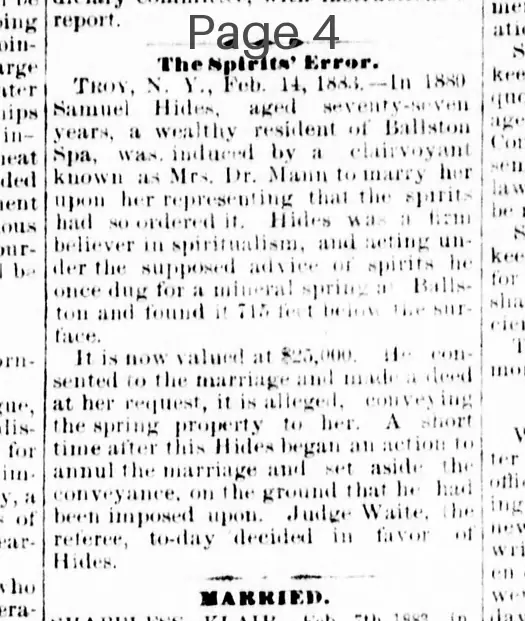
In 1880, 77-year-old wealthy spiritualist Samuel Hides of Ballston Spa married clairvoyant Mrs. Dr. Mann, who claimed spirits mandated it, and deeded her a $5,000 mineral spring. He sued to annul the marriage for fraud; Judge Waite ruled in his favor on Feb. 14, 1883.
Clipping
OCR Quality
Full Text
TROY, N. Y., Feb. 14, 1883.—In 1880 Samuel Hides, aged seventy-seven years, a wealthy resident of Ballston Spa, was induced by a clairvoyant known as Mrs. Dr. Mann to marry her upon her representing that the spirits had so ordered it. Hides was a firm believer in spiritualism. Acting under the supposed advice of spirits he once dug for a mineral spring at Ballston and found it 15 feet below the surface. It is now valued at $5,000. In consequence of the marriage and is said to have deeded at her request, it is alleged, conveying the spring property to her. A short time after this Hides began an action to annul the marriage and set aside the conveyance, on the ground that he had been imposed upon. Judge Waite, the referee, to-day decided in favor of Hides.
What sub-type of article is it?
What themes does it cover?
What keywords are associated?
What entities or persons were involved?
Where did it happen?
Story Details
Key Persons
Location
Ballston Spa, N. Y.
Event Date
1880 To Feb. 14, 1883
Story Details
Wealthy spiritualist Samuel Hides, aged 77, married clairvoyant Mrs. Dr. Mann in 1880 after she claimed spirits ordered it, deeding her a valuable mineral spring he discovered under spiritual guidance. He sued to annul the marriage and conveyance, alleging imposition, and Judge Waite ruled in his favor on Feb. 14, 1883.