Thank you for visiting SNEWPapers!
Sign up free
Phenix Gazette
Alexandria, Virginia
What is this article about?
Report of Mr. Burges's speech in the U.S. House of Representatives on January 23, 1826, advocating recommittal of the Judiciary Bill to reform the federal judiciary by separating Supreme Court duties from circuits, addressing delays, inequalities in administration, representation, and knowledge of state laws.
Merged-components note: Continuation of Mr. Burges's speech on the Judiciary Bill across pages 2 and 3, text explicitly indicates 'To be concluded in our next'.
Clippings
1 of 2
OCR Quality
Full Text
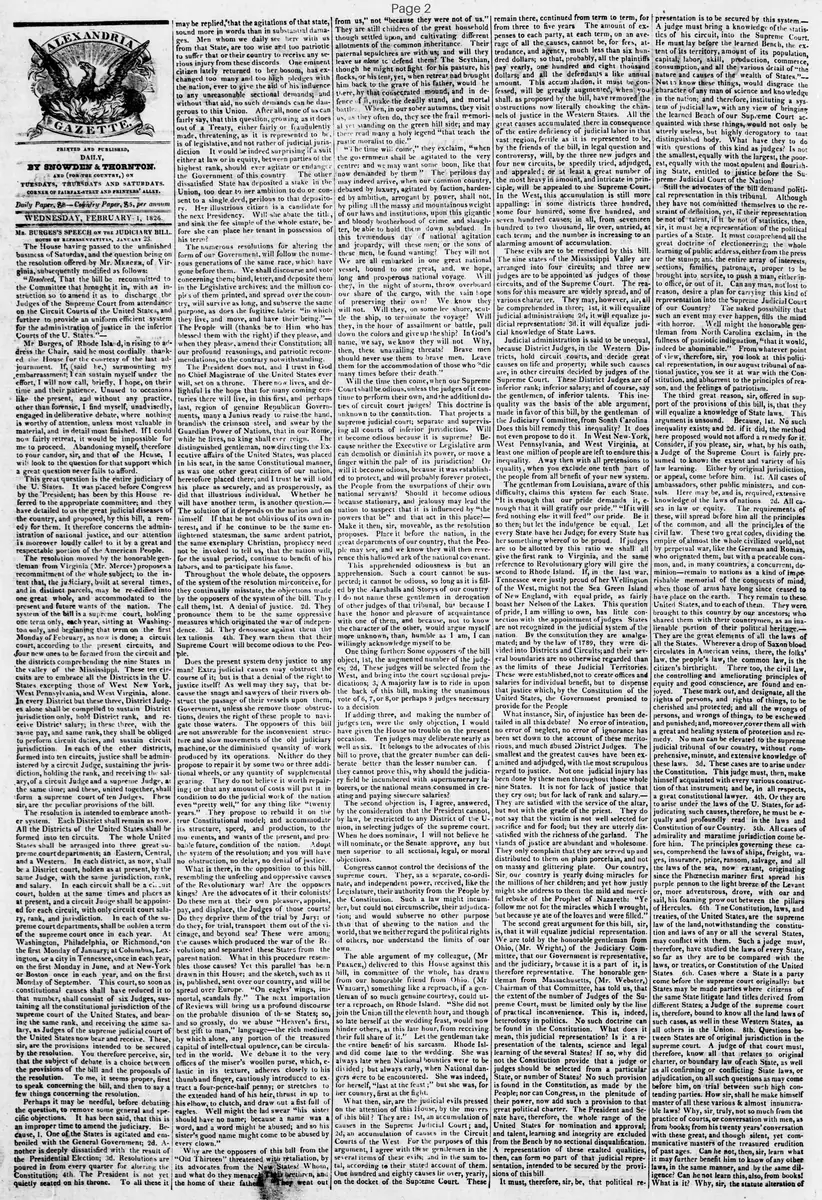
MR. BURGES'S SPEECH ON THE JUDICIARY BILL.
HOUSE OF REPRESENTATIVES, JANUARY 23.
The House having passed to the unfinished business of Saturday, and the question being on the resolution offered by Mr. Mercer, of Virginia, subsequently modified as follows:
"Resolved, That the bill be recommitted to the Committee that brought it in, with an instruction so to amend it as to discharge the Judges of the Supreme Court from attendance on the Circuit Courts of the United States, and further to provide an uniform efficient system for the administration of justice in the inferior Courts of the U. States."
Mr. Burges, of Rhode Island, in rising to address the Chair, said he most cordially thanked the House for the courtesy of the last adjournment. If, (said he,) surmounting my embarrassment, I can sustain myself under the effort, I will now call, briefly, I hope, on their time and their patience. Unused to occasions like the present, and without any practice, other than forensic, I find myself, unadvisedly, engaged in deliberative debate, where nothing is worthy of attention, unless most valuable in material, and in detail most finished. If I could now fairly retreat, it would be impossible for me to proceed. Abandoning myself, therefore, to your candor, sir, and that of the House, I will look to the question for that support which a great question never fails to afford.
This great question is the entire judiciary of the U. States. It was placed before Congress by the President; has been by this House referred to the appropriate committee; and they have detailed to us the great judicial diseases of the country, and proposed, by this bill, a remedy for them. It therefore concerns the administration of national justice, and our attention is moreover loudly called to it by a great and respectable portion of the American People.
The resolution moved by the honorable gentleman from Virginia (Mr. Mercer) proposes a recommittal of the whole subject; to the intent that, the judiciary, built at several times, and in distinct parcels, may be re-edified into one great whole, and accommodated to the present and future wants of the nation. The system of the bill is a supreme court, holding one term only, each year, sitting at Washington only, and beginning that term on the first Monday of February, as now is done; a circuit court, according to the present circuits, and four new ones to be formed from the circuit and the districts comprehending the nine States in the valley of the Mississippi. These ten circuits are to embrace all the Districts in the U. States excepting those of West New York, West Pennsylvania, and West Virginia, alone. In every District but these three, District Judges alone shall be compelled to sustain District jurisdiction only, hold District rank, and receive District salary; in these three, with the same pay, and same rank, they shall be obliged to perform circuit duties, and sustain circuit jurisdiction. In each of the other districts, formed into ten circuits, justice shall be administered by a circuit Judge, sustaining the jurisdiction, holding the rank, and receiving the salary, of a circuit Judge and a supreme Judge, at the same time; and these, united together, shall form a supreme court of ten Judges. These, sir, are the peculiar provisions of the bill.
The resolution is intended to embrace another system. Each District shall remain as now. All the Districts of the United States shall be formed into ten circuits. The whole United States shall be arranged into three great supreme court departments; an Eastern, Central, and a Western. In each district, as now, shall be a District court, holden as at present, by the same Judge, with the same jurisdiction, rank, and salary. In each circuit shall be a circuit court, holden at the same times and places as at present, and a circuit Judge shall be appointed for each circuit, with only circuit court salary, rank, and jurisdiction. In each of the supreme court departments, shall be holden a term of the supreme court once in each year. At Washington, Philadelphia, or Richmond, on the first Monday of January; at Columbus, Lexington, or a city in Tennessee, once in each year, on the first Monday in June, and at New-York or Boston once in each year, and on the first Monday of September. This court, so soon as constitutional causes shall have reduced it to that number, shall consist of six Judges, sustaining all the constitutional jurisdiction of the supreme court of the United States, and bearing the same rank, and receiving the same salary, as Judges of the supreme judicial court of the United States now bear and receive. These, sir, are the provisions intended to be secured by the resolution. You therefore perceive, sir, that the subject of debate is a choice between the provisions of the bill and the proposals of the resolution. To me, it seems proper, first to speak concerning the bill, and then to say a few things concerning the resolution.
Perhaps it may be needful, before debating the question, to remove some general and specific objections. It has been said, that this is an improper time to amend the judiciary. Because, 1. One of the States is agitated and embroiled with the General Government; 2d. Another is deeply dissatisfied with the result of the Presidential Election; 3d. Resolutions are poured in from every quarter of altering the Constitution; 4th. The President is not yet quietly seated on his throne. To all these it may be replied, that the agitations of that state, sound more in words than in substantial damages. Men whom we daily see here with us from that State, are too wise and too patriotic to suffer that or their country to receive any serious injury from these discords. (One eminent citizen lately returned to her bosom, has exchanged too many and too high pledges with the nation, ever to give the aid of his influence to any unreasonable sectional demands; and without that aid, no such demands can be dangerous to this Union.) After all, none of us can fairly say, that this question, growing as it does out of a Treaty, either fairly or fraudulently made, threatening, as it is represented to be, is of legislative, and not rather of judicial jurisdiction. It would be indeed surprising if a suit either at law or in equity, between parties of the highest rank, should ever agitate or endanger the Government of this country. The other dissatisfied State has deposited a stake in the Union, too dear to her ambition to do or consent to a single deed, perilous to that depositary. Her illustrious citizen is a candidate for the next Presidency. Will she abate the title, and sink the fee simple of the whole estate, before she can place her tenant in possession of his term?
The numerous resolutions for altering the form of our Government, will follow the numerous generations of the same race, which have gone before them. We shall discourse and vote concerning them; bind, letter, and deposit them in the Legislative archives: and the million copies of them printed, and spread over the country, will survive as long, and subserve the same purpose, as does the fugitive fabric "in which they live, and move, and have their being."
The People will (thanks be to Him who has blessed them with the right) if they please, and when they please, amend their Constitution; all our profound reasonings, and patriotic recommendations, to the contrary notwithstanding.
The President does not, and I trust in God no Chief Magistrate of the United States ever will, set on a throne. There now lives, and delightful is the hope that for many coming centuries there will live, in this first, and perhaps last, region of genuine Republican Governments, many a Junius ready to raise the hand, brandish the crimson steel, and swear by the Guardian Power of Nations, that in our Rome, while he lives, no king shall ever reign. The distinguished gentleman, now directing the Executive affairs of the United States, was placed in his seat, in the same Constitutional manner, as was one other great citizen of our nation, heretofore placed there; and I trust he will hold his place as securely, and as prosperously, as did that illustrious individual. Whether he will have another term, is another question. The solution of it depends on the nation and on himself. If that be not oblivious of its own interest, and if he continue to be the same enlightened statesman, the same ardent patriot, the same exemplary Christian, prophecy need not be invoked to tell us, that the nation will for the usual period, continue to benefit of his labors, and to participate his fame.
Throughout the whole debate, the opposers of the system of the resolution misconceive, for they continually misstate, the objections made by the opposers of the system of the bill. They call them, 1st. A denial of justice. 2d. They pronounce them to be the same oppressive measures which originated the war of independence. 3d. They denounce against them the lex talionis. 4th. They warn them that their Supreme Court will become odious to the People.
Does the present system deny justice to any man? Extra judicial causes may obstruct the course of it; but is that a denial of the right to justice itself? As well may they say, that because the snags and sawyers of their rivers obstruct the passage of their vessels upon them, Government, unless she remove those obstructions, denies the right of these people to navigate those waters. The opposers of this bill are not answerable for the inconvenient structure and slow movements of the old judiciary machine, or the diminished quantity of work produced by its operations. Neither do they propose to repair it by some two or three additional wheels, or any quantity of supplemental gearing. They do not believe it worth repairing; or that any amount of costs will put it in condition to do the judicial work of the nation even "pretty well," for any thing like "twenty years." They propose to rebuild it on the true Constitutional model; and accommodate its structure, speed, and production, to the movements, and wants of the present, and probable future, condition of the nation. Adopt the system of the resolution; and you will have no obstruction, no delay, no denial of justice.
What is there, in the opposition to this bill, resembling the unfeeling and oppressive causes of the Revolutionary war? Are the opposers kings? Are the advocates of it their colonists? Do these men at their own pleasure, appoint, pay, and displace, the Judges of those courts? Do they deprive them of the trial by Jury; or do they, for trial, transport them out of the vicinage, and beyond sea? These were among the causes which produced the war of the Revolution; and separated these States from the parent nation. What in this procedure resembles those causes? Yet this parallel has been drawn in this House; and the sketch, such as it is, published, sent over our country, and will be spread over Europe. "On eagles' wings, immortal scandals fly." The next importation of Reviews will bring us a profound discourse on the probable disunion of these States; so, and so grossly, do we abuse "Heaven's first, best gift to man," language--the rich medium by which alone, any portion of the treasured capital of intellectual opulence, can be circulated in the world. We debase it to the very offices of the miser's woollen purse, which, elastic in its texture, adheres closely to his thumb and finger, cautiously introduced to extract a four-pence-half penny; or stretches to the extended hand of his heir, thrust in up to his elbow, to clutch, and draw out a fist full of eagles. Well might the lad swear "his sister should have no name; because a name was a word, and a word might be abused; and so his sister's good name might come to be abused by every clown."
Why are the opposers of this bill from the "Old Thirteen" threatened with retaliation, by its advocates from the New States? Whom, and what do they menace? Our brethren, and the home of their fathers went out from us," not "because they were not of us." They are still children of the great household though settled upon, and cultivating different allotments of the common inheritance. Their paternal sepulchres are with us; and will they leave us alone to defend them? The Scythian, though he might not fight for his pasture, his flocks, or his tent, yet, when retreat had brought him back to the grave of his father, would he there, by that consecrated mound, and in defence of it, make the deadly stand, and mortal battle. When, in our sober autumns, they visit us, as they often do, they see the frail memorial yet standing on the green hill side; and may there read many a holy legend "that teach the rustic moralist to die."
"The time will come," they exclaim, "when the government shall be agitated to the very centre: and we may want some boon, like that now demanded by them." The perilous day may indeed arrive, when our common country, debased by luxury, agitated by faction, hardened by ambition, arrogant by power, shall not, by piling all the massy and mountainous weight of our laws and institutions, upon this gigantic and bloody brotherhood of crime and slaughter, be able to hold them down subdued. In this tremendous day of national agitation and jeopardy, will these men; or the sons of these men, be found wanting? They will not. We are all embarked in one great national vessel, bound to one great, and, we hope, long and prosperous national voyage. Will they, in the night of storm, throw overboard our share of the cargo, with the vain hope of preserving their own? We know they will not. Will they, on some lee shore, scuttle the ship, to terminate the voyage? Will they, in the hour of assailment or battle, pull down the colors and give up the ship? In God's name, we say, we know they will not. Why, then, these unavailing threats?
Brave men should never use them to brave men. Leave them for the accommodation of those who "die many times before their death."
Will the time then come, when our Supreme Court shall be odious, unless the judges of it continue to perform their own, and the additional duties of circuit court judges? This doctrine is unknown to the constitution. That projects a supreme judicial court; separate and supervising all courts of inferior jurisdiction. Will it become odious because it is supreme? Because neither the Executive or Legislative arm can demolish or diminish its power, or move a finger within the pale of its jurisdiction? Or will it become odious, because it was established to protect, and will probably forever protect, the People from the usurpations of their own national servants? Should it become odious because stationary, and jealousy may lead the nation to suspect that it is influenced by "the powers that be" and that act in this place?— Make it then, sir, moveable, as the resolution proposes. Place it before the nation, in the great departments of our country, that the People may see, and we know they will then reverence this hallowed ark of the national covenant.
This apprehended odiousness is but an apprehension. Such a court cannot be suspected; it cannot be odious, so long as it is filled by the Marshalls and Storys of our country. I do not name these gentlemen in derogation of other judges of that tribunal, but because I have the honor and pleasure of acquaintance with one of them, and because, not to know the character of the other, would argue myself more unknown, than, humble as I am, I can willingly acknowledge myself to be.
One thing further: Some opposers of the bill object, 1st, the augmented number of the judges; 2d, These judges will be selected from the West, and bring into the court sectional prejudications; 3, A majority law is to ride in upon the back of this bill, making the unanimous vote of 6, 7, or 8, or perhaps 9 judges necessary to a decision.
If adding three, and making the number of judges ten, were the only objection, I would have given the House no trouble on the present occasion. Ten judges may deliberate nearly as well as six. It belongs to the advocates of this bill to prove, that the greater number can deliberate better than the lesser number can. If they cannot prove this, why should the judiciary field be incumbered with supernumerary laborers, or the national means consumed in creating and paying sinecure salaries?
The second objection is, I agree, answered, by the consideration that the President cannot, by law, be restricted to any District of the Union, in selecting judges of the supreme court. When he does nominate, I will not believe he will nominate, or the Senate approve, any but men superior to all sectional, legal, or moral objections.
Congress cannot control the decisions of the supreme court. They, as a separate, co-ordinate, and independent power, received, like the Legislature, their authority from the People by the Constitution. Such a law might incumber, but could not circumscribe, their adjudication; and would subserve no other purpose than that of shewing to the nation and the world, that we neither regard the political rights of others, nor understand the limits of our own.
The able argument of my colleague, (Mr. Pearce,) delivered to this House against this bill, in committee of the whole, has drawn from our honorable friend from Ohio, (Mr. Wright,) something like a reproach, if a gentleman of so much genuine courtesy, could utter a reproach, on Rhode Island. "She did not join the Union till the eleventh hour, and though so late herself at the wedding feast, would now hinder others, at this late hour, from receiving their full share of it." Let the gentleman take the entire benefit of his sarcasm. Rhode Island did come late to the wedding. She was always late when National bounties were to be divided; but always early, when National dangers were to be encountered. She was indeed, for herself, "last at the feast;" but she was, for her country, first at the fight.
What then, sir, are the judicial evils pressed on the attention of this House, by the movers of this bill? They are: 1st, an accumulation of causes in the Supreme Judicial Court; and, 2d, an accumulation of causes in the Circuit Courts of the West. For the purposes of this argument, I agree with these gentlemen in the several items of these evils; and in the sum total, according to their stated account of them. One hundred and eighty causes lie over, yearly, on the docket of the Supreme Court. These remain there, continued from term to term, for from three to five years. The amount of expenses to each party, at each term, on an average of all the causes, cannot be, for fees, attendance, and agency, much less than six hundred dollars; so that, probably, all the plaintiffs pay yearly, one hundred and eight thousand dollars; and all the defendants a like annual amount. This accumulation, it must be confessed, will be greatly augmented, when you shall, as proposed by the bill, have removed the obstructions now literally choking the channels of justice in the Western States. All the great causes accumulated there in consequence of the entire deficiency of judicial labor in that vast region, fertile as it is represented to be, by the friends of the bill, in legal question and controversy, will, by the three new judges and four new circuits, be speedily tried, adjudged, and appealed; or at least a great number of the most heavy in amount, and intricate in principle; will be appealed to the Supreme Court.
In the West, this accumulation is still more appalling: in some districts three hundred, some four hundred, some five hundred, and seven hundred causes; in all, from seventeen hundred to two thousand, lie over, untried, at each term; and the number is increasing to an alarming amount of accumulation.
These evils are to be remedied by this bill. The nine states of the Mississippi Valley are arranged into four circuits; and three new judges are to be appointed as judges of those circuits, and of the Supreme Court. The reasons for this measure are widely spread, and of various character. They may, however, sir, all be comprehended in three; 1st, it will equalize judicial administration: 2d, it will equalize judicial representation: 3d. it will equalize judicial knowledge of State Laws.
Judicial administration is said to be unequal, because District Judges, in the Western Districts, hold circuit courts, and decide great causes on life and property; while such causes are, in other circuits decided by judges of the Supreme Court. These District Judges are of inferior rank; inferior salary; and of course, say the gentlemen, of inferior talents. This inequality was the basis of the able argument, made in favor of this bill, by the gentleman of the Judiciary Committee, from South Carolina. Does this bill remedy this inequality? It does not even propose to do it. In West New-York, West Pennsylvania, and West Virginia, at least one million of people are left to endure this inequality. Away then with all pretensions to equality, when you exclude one tenth part of the people from all benefit of your new system.
The gentleman from Louisiana, aware of this difficulty, claims this system for each State. "It is enough that our pride demands it, enough that it will gratify our pride." "If it will feed nothing else it will feed" our pride. Be it so then; but let the indulgence be equal. Let every State have her Judge; for every State has her something whereof to be proud." If judges are to be allotted by this ratio we shall all give the first rank to Virginia, and the same reference to Revolutionary glory will give the second to Rhode Island. If, in the last war, Tennessee were justly proud of her Wellington of the West, might not the Sea Green Island of New England, with equal pride, as fairly boast her Nelson of the Lakes. This question of pride, I am willing to own, has little connection with the appointment of judges. States are not recognized in the judicial system of the nation. By the constitution they are amalgamated; and by the law of 1789, they were divided into Districts and Circuits; and their several boundaries are no otherwise regarded than as the limits of these Judicial Territories. These were established, not to create offices and salaries for individual benefit, but to dispense that justice which, by the Constitution of the United States, the Government promised to provide for the People.
What instance, Sir, of injustice has been detailed in all this debate? No error of intention, no error of neglect, no error of ignorance has been set down to the account of these meritorious, and much abused District Judges. The smallest and the greatest causes have been examined and adjudged, with the most scrupulous regard to justice. Not one judicial injury has been done by these men throughout those whole nine States." It is not for lack of justice that they cry out; but for lack of rank and salary.— They are satisfied with the service of the altar, but not with the grade of the priest. They do not say that the victim is not well selected for sacrifice and for food; but they are utterly dissatisfied with the richness of the garland. The viands of justice are abundant and wholesome. They only complain that they are served up and distributed to them on plain porcelain, and not on massy and glittering plate. Our country, Sir, our country is yearly doing miracles for the millions of her children; and yet how justly might she address to them the mild and merciful rebuke of the Prophet of Nazareth: "Ye follow me not for the miracles which I wrought but because ye ate of the loaves and were filled."
The second great argument for this bill, sir, is, that it will equalize judicial representation. We are told by the honorable gentleman from Ohio, (Mr. Wright,) of the Judiciary Committee, that our Government is representative, and the judiciary, because it is a part of it, is therefore representative. The honorable gentleman from Massachusetts, (Mr. Webster,) Chairman of that Committee, has told us, that the extent of the number of Judges of the Supreme Court, must be limited only by the line of practical inconvenience. This is, indeed, heterodoxy in politics. No such doctrine can be found in the Constitution. What does it mean, this judicial representation? Is it a representation of the talents, science and legal learning of the several States? If so, why did not the Constitution provide that a judge or judges should be selected from a particular State, or number of States? No such provision is found in the Constitution, as made by the People; nor can Congress, in the plenitude of their power, now add such a provision to that great political charter. The President and Senate have, therefore, the whole range of the United States for nomination and approval; and talent, learning and integrity are excluded from the Bench by no sectional disqualification. A representation of these exalted qualities, then, can form no part of that judicial representation, intended to be secured by the provisions of this bill.
It must, therefore, sir, be, that political representation is to be secured by this system.- A judge must bring a knowledge of the statistics of his circuit, into the Supreme Court. He must lay before the learned Bench, the extent of its territory, amount of its population, capital, labor, skill, production, commerce, consumption, and all the various detail of "the nature and causes of the wealth of States."- Not to know these things, would disgrace the character of any man of science and knowledge in the nation; and therefore, instituting a system of judicial law, with any view of bringing the learned Bench of our Supreme Court acquainted with these things, would not only be utterly useless, but highly derogatory to that distinguished body. What have they to do with questions of this kind as judges? Is not the smallest, equally with the largest, the poorest, equally with the most opulent and flourishing State, entitled to justice before the Supreme Judicial Court of the Nation?
Still the advocates of the bill demand political representation in this tribunal. Although they have not committed themselves to the restraint of definition, yet, if their representation be not of talent, if it be not of statistics, then, sir, it must be a representation of the political parties of a State. It must comprehend all the great doctrine of electioneering; the whole learning of public address, either from the press or the stump; and the entire array of interests, sections, families, patronage, proper to be brought into service, to push a man, either into office, or out of it. Can any man, not lost to reason, desire a plan for carrying this kind of representation into the Supreme Judicial Court of our Country? The naked possibility that such an event may ever happen, fills the mind with horror. Well might the honorable gentleman from North Carolina exclaim, in the fullness of patriotic indignation, "that it would, indeed be abominable." From whatever point of view, therefore, sir, you look at this political representation, in our august tribunal of national justice, you see it at war with the Constitution, and abhorrent to the principles of reason, and the feelings of patriotism.
The third great reason, sir, offered in support of the provisions of this bill, is, that they will equalize a knowledge of State laws. This argument is unsound. Because, 1st. No such inequality exists; and 2d. if it did, the method here proposed would not afford a remedy for it. Consider, if you please, sir, what, by his oath, a Judge of the Supreme Court is fairly presumed to know: the extent and variety of his law learning. Either by original jurisdiction, or appeal, come before him. 1st. All cases of ambassadors, other public ministers, and consuls. Here may be, and is, required, extensive knowledge of the laws of nations. 2d. All cases in law or equity. The requirements of these, will spread before him all the principles of the common, and all the principles of the civil law. These two great codes, dividing the empire of almost the whole civilized world, not by perpetual war, like the German and Roman, who originated them, but with a peaceable common, and, in many countries, a concurrent, dominion—remain to nations as a kind of imperishable memorial of the conquests of mind, when those of arms have long since ceased to have place on the earth. They remain to these United States, and to each of them. They were brought to this country by our ancestors; who shared them with their countrymen, as an inalienable portion of their political heritage.- They are the great elements of all the laws of all the States. Wherever a drop of Saxon blood circulates in American veins, there, the folks' law, the people's law, the common law, is the citizen's birthright. There too, the civil law, the controlling and ameliorating principles of equity and good conscience, are found and enjoyed. These mark out, and designate, all the rights of persons, and rights of things, to be cherished and protected; and all the wrongs of persons, and wrongs of things, to be eschewed and punished; and, moreover, cover them all with a great and healing system of protection and remedy. No man can be elevated to the supreme judicial tribunal of our country, without comprehensive, minute, and extensive knowledge of these laws. 3d. These cases are to arise under the Constitution. This judge must, then, make himself acquainted with every various construction of that instrument; and be, in all respects, a great constitutional lawyer. 4th. Or they are to arise under the laws of the U. States, or adjudicating such causes, therefore, he must be equally and profoundly read in the laws and Constitution of our Country. 5th. All cases of admiralty and maritime jurisdiction come before him. The principles governing these cases, comprehend the laws of ships, freight, wages, insurance, prize, ransom, salvage, and all the laws of the sea, now extant, originating since the Phœnician mariner first spread his purple pennon to the light breeze of the Levant or, more adventurous, drove, with oar and sail, his foaming prow out between the pillars of Hercules. 6th. The Constitution, laws, and treaties, of the United States, are the supreme law of the land, notwithstanding the constitution and laws of any or all the several States, may conflict with them. Such a judge must, therefore, have studied the laws of every State, so far as they are to be compared with the laws, or treaties, or Constitution of the United States. 7th. Cases where a State is a party come before the supreme court originally: but States may be made parties where citizens of the same State litigate land titles derived from different States; a Judge of the supreme court is, therefore, bound to know all the land laws of such cases, as well in these Western States, as all others in the Union. 8th. Questions between States are of original jurisdiction in the supreme court. A judge of that court must, therefore, know all that relates to original charter, or boundary law of each State, as well as all confirming or conflicting State laws, or adjudication, on all such questions as may come before him, on trial between such high contending parties. How sir, shall he make himself master of all these various & almost innumerable laws? Why, sir, truly, not so much from the practice of courts, or conversation with men, as from books; from his twenty years' conversation with these great, and though silent, yet communicative masters of the treasured erudition of past ages. Can he not, then, sir, learn what it may further benefit him to know of any other laws, in the same manner, and by the same diligence? Can he not learn this, also, from books! What is it? Why, sir, the statute alteration of
the common law in each State, and their court adjudications upon such statutes. These are all contained in their books or in the records of such decisions. These nine States have no lex non scripta; no local common law, for the oldest of them is not forty, and the youngest not five years of age: and no usage can have grown up among them into the strength and vigor of common law, in any time less than that, "whereof the memory of man runneth not to the contrary."
Can a judge, sir, not learn these by reading and study? Can he thus make himself master of all the almost infinite variety and extent of all other laws: and must he depend for a knowledge of these few items of State law, on the testimony of local judges? Tell it not, sir, in hearing of those nations who, by their ambassadors are near our government in this city of Washington. Tell it not in hearing of that gifted citizen, who first, in honorable field, lifted targe and lance against the learned chivalry of Europe, and in defence of the talent and science of our own country. Leave us, sir, leave us to the literary tomahawk and scalpingknife of the Giffords and Buffons of the old world.
To be concluded in our next.
What sub-type of article is it?
What themes does it cover?
What keywords are associated?
What entities or persons were involved?
Where did it happen?
Story Details
Key Persons
Location
House Of Representatives
Event Date
January 23, 1826
Story Details
Mr. Burges of Rhode Island speaks in support of Mr. Mercer's resolution to recommit the Judiciary Bill for amendments discharging Supreme Court judges from circuit duties and establishing a uniform system, critiques the bill's provisions for new circuits and judges, addresses judicial delays and accumulations, refutes objections on timing, equality, representation, and state law knowledge.