Thank you for visiting SNEWPapers!
Sign up free
Virginia Argus
Richmond, Virginia
What is this article about?
An extract of a letter from a Virginia gentleman to his friend opposes large-scale state-sponsored manufacturing schemes, like the Richmond association's $500,000 plan, arguing they threaten agricultural virtue, independence, and simplicity. He advocates small-scale home and county-level production instead, critiquing responses from 'The Enquirer.'
Clipping
OCR Quality
Full Text
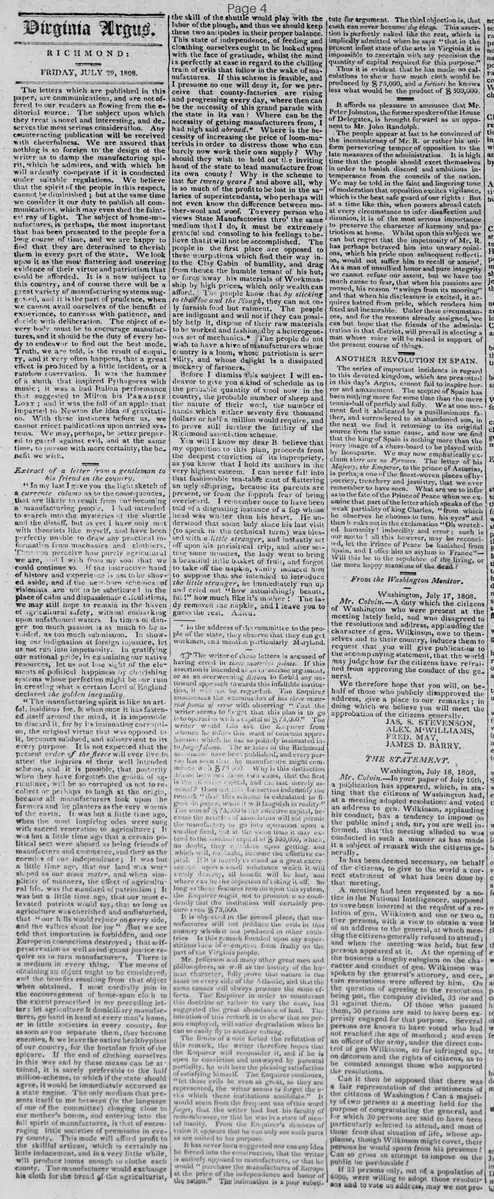
"In my last I gave you the light sketch of a currente calamo as to the consequences, that are likely to result from our becoming a manufacturing people. I had intended to search into the mysteries of the shuttle and the distaff, but as yet I have only met with theorists like myself, and have been perfectly unable to draw any practical information from mechanics and clothiers. Thus you perceive how purely agricultural we are, and I wish from my soul that we could continue so. If the instructive hand of history and experience is not to be shoved aside, and if the new-born schemes of visionaries are not to be substituted in the place of calm and dispassionate calculations, we may still hope to remain in the haven of agricultural safety, without embarking upon unfathomed waters. In times of danger too much passion is as much to be avoided, as too much submission. In showing our indignation at foreign injustice, let us not run into impetuosity. In gratifying our national pride, in examining our native resources, let us not lose sight of the elements of political happiness by cherishing systems whose perfection might be our ruin in creating what a certain Lord of England declared the golden inequality.
"The manufacturing spirit is like an artful, insidious foe. & when once it has fastened itself around the mind. it is impossible to discard it, for by its insinuating corruption, the original virtue that was opposed to it, becomes subdued, and subservient to its every purpose. It is not expected that the present order of the fleece will ever live to attest the injuries of their well intended scheme, and it is possible, that posterity when they have forgotten the genius of agriculture, will be so corrupted as not to recollect or perhaps to laugh at the origin, because all manufacturers look upon the farmers and the planters as the very worms of the earth. It was but a little time ago, when the most inspiring odes were sung with sacred veneration to agriculture; It was but a little time ago that a certain political sect were abused as being friends of manufacture and commerce, and they as the enemies of our independence; It was but a little time ago, that our land was worshiped as our alma mater, and when simplicity of manners, the effect of agricultural life, was the standard of patriotism; It was but a little time ago, that our most elevated patriots would say, that so long as agriculture was cherished and undisturbed, that our hills would rejoice on every side, and the vallies shout for joy" But we are told that importation is forbidden, and our European connections destroyed; that self-preservation as well as indignant justice require us to turn manufacturers. There is a medium in every thing. The means of obtaining an object ought to be considered, and the benefits resulting from that object when obtained. I most cordially join in the encouragement of home-spun cloth to the extent prescribed in my preceding letter: let agriculture & domiciliary manufactures, go hand in hand at every man's home, or in little societies in every county, for as soon as you separate them, they become enemies, & we leave the native healthy plant of our country, for the hortulan fruit of the epicure. If the end of clothing ourselves in this way and by these means can be attained, it is surely preferable to the half million-scheme, to which if the state should agree, it would be immediately accursed as a state engine. The only medium that presents itself to me between (in the language of one of the committee) clinging close to our mother's bosom, and entering into the full spirit of manufactures, is that of encouraging little societies of premiums in every county. This mode will afford profit to the skilful artizan, which is certainly no little inducement, and in a very little while, will produce looms enough to clothe each county. The manufacturer would exchange his cloth for the bread of the agriculturist, the skill of the shuttle would play with the labor of the plough, and thus we should keep these two antipodes in their proper balance. This state of independence, of feeding and cloathing ourselves ought to be looked upon with the face of gratitude, whilst the mind is perfectly at ease in regard to the chilling train of evils that follow in the wake of manufactures. If this scheme is feasible, and I presume no one will deny it, for we perceive that county-factories are rising and progressing every day, where then can be the necessity of this grand parade with the state in its van? Where can be the necessity of getting manufacturers from, I had nigh said abroad.- Where is the necessity of increasing the price of loom-materials in order to distress those who can barely now work their own supply? Why should they wish to hold out the inviting hand of the state to lead manufacture from its own county? Why is the scheme to last for twenty years? and above all, why is so much of the profit to be lost in the salaries of superintendants, who perhaps will not even know the difference between warp and woof. To every person who views State Manufactories thro' the same medium that I do, it must be extremely grateful and consoling to his feelings to believe that it will not be accomplished. The people in the first place are opposed to these usurpations which find their way into the Clay Cabin of humility, and drag from thence the humble tenant of his hut, or force away his materials of Workmanship by high prices, which only wealth can afford. The people know that by sticking to the Hoe and the Plough, they can not only furnish food but raiment. The people are indignant and will not if they can possibly help it, dispose of their raw materials to be worked and fashioned by a heterogeneous set of mechanics.* The people do not wish to have a hive of manufacturers whose country is a loom, whose patriotism is servility, and whose delight is a dissipated mockery of farmers.
Before I dismiss this subject I will endeavor to give you a kind of schedule as to the probable quantity of wool now in the country, the probable number of sheep and the nature of their wool, the number of hands which either seventy five thousand dollars or half a million would require, and to prove still further the futility of the Richmond association scheme.
You will I know my dear B. believe that my opposition to this plan, proceeds from the deepest conviction of its impropriety, as you know that I hold its authors in the very highest esteem. I can never fall into that fashionable tea-table cant of flattering an ugly offspring, because its parents are present, or from the foppish fear of being overheard. I remember once to have been told of a disgusting instance of a fop whose head was whiter than his heart. He understood that some lady since his last visit (to speak in the technical term) was blessed with a little stranger, and instantly set off upon his parasitical trip, and after setting some minutes, the lady went to bring a beautiful little basket of fruit, and forgot to take off the napkin, Vanity induced him to suppose that she intended to introduce the little stranger, he immediately run up and cried out "how astonishingly beautiful! how much like it's mother!' The lady removed the napkin, and I leave you to guess the rest. Alicu.
In the address of the committee to the people of the state, they observe that they can get workmen, and mention particularly Maryland. The writer of these letters is accused of having erred in three material points. If this assertion is intended as an invincible argument, or as an overweening dictum to forbid any untoward approach towards this infallible institution, it will not be regarded. The Enquirer commences the examination of his three material points of error with observing "That the writer seems to forget that this plan is to go into operation with a Capital of $75,000." The writer would fain ask the Enquirer from "hence he infers this want of common apprehension which he has so politely insinuated into forgetfulness. The articles of the Richmond association have been published, and every person has seen that the manufacture might commence with $75,000. Why is this distinction drawn between these two sums, that the first is the effective capital, and the last merely nominal? Does not as I suspect indemnify the remark "that this scheme is calculated to figure on paper, while it will languish in reality" The sum of $75,000 is the effective capital, because the articles of association will not permit the manufactory to go into operation upon a smaller fund, but at the same time it may extend to the nominal capital of $500,000, which, no doubt, they calculate upon getting, and which will, no doubt, become the effective capital. If it is merely to stand as a great excresence upon a small substance which it will surely destroy, all benefit will be lost, and where can be the objection of taking it off. So long as these features remain upon this system, the Enquirer ought not to pronounce so confidently that the institution will certainly procure even $75,000.
It is objected in the second place, that manufactures will not produce the evils in this country which it has produced in other countries. Is this remark founded upon any superstitious idea of exemption from frailty on the part of the Virginia people.
Mr. Jefferson and many other great men and philosophers, as well as the history of the human character, fully prove that nature is the same on every side of the Atlantic, and that the same causes will always produce the same effects. The Enquirer in order to counteract this doctrine or rather- to vary the case, has suggested the great abundance of land. The intention of this remark is to shew that no person employed, will suffer degradation when he can so easily fly to another calling.
The limits of a note forbid the refutation of this remark, the writer therefore hopes that the Enquirer will reconsider it, and if he is open to conviction and unswayed by parental partiality, he will have the pleasing satisfaction of satisfying himself. The Enquirer continues, "let those evils be even as great, as they are represented, the writer seems to forget the evils which these institutions annihilate." It would seem from the frequent use of this word forget, that the writer had lost his faculty of remembrance, or that he was in a state of mental inanity. From the Enquirer's dimness of vision it appears that he can only see such parts as are suited to his purpose.
It has never been suggested nor can any idea be forced into the construction, that the writer is entirely opposed to manufactures, or that he would "purchase the manufactures of Europe at the price of the independence and honor of the nation." The insinuation is a poor substitute for argument. The third objection is, that cloth can never become dog cheap. This assertion is perfectly naked like the rest, which is impliedly admitted when he says "that in the present infant state of the arts in Virginia it is impossible to ascertain with any precision the quantity of capital required for this purpose." Thus it is evident that he has made no calculations to shew how much cloth would be produced by $75,000, and a fortiori he knows less what would be the product of $500,000."
What sub-type of article is it?
What themes does it cover?
What keywords are associated?
What entities or persons were involved?
Letter to Editor Details
Author
Alicu.
Recipient
My Dear B.
Main Argument
large-scale state manufacturing schemes like the richmond association's will corrupt virginia's agricultural virtue and independence; instead, promote small-scale home and county societies for cloth production alongside farming to achieve self-sufficiency without societal ruin.
Notable Details