Thank you for visiting SNEWPapers!
Sign up free
The New Hampshire Gazette
Portsmouth, Rockingham County, New Hampshire
What is this article about?
A fire destroyed the large workshop in Concord's State Prison yard on Thursday night, May 4, likely set by prisoners attempting escape. Warden Capt. Phinney discovered it early but fell through the floor, breaking his thigh, preventing extinguishment. Losses estimated at $2000 to state, under $1000 to individuals; fire contained to the building.
Clipping
OCR Quality
Full Text
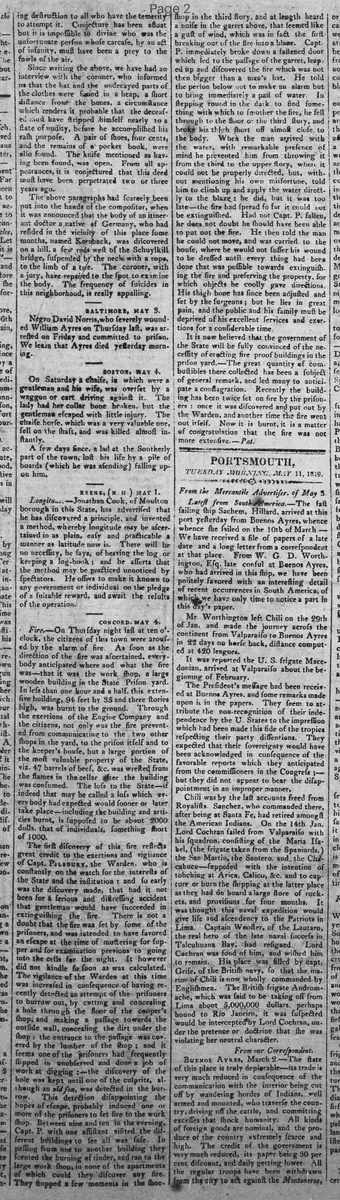
Fire.—On Thursday night last at ten o'clock, the citizens of this town were aroused by the alarm of fire. As soon as the direction of the fire was ascertained, everybody anticipated where and what the fire was—that it was the work shop, a large wooden building in the State Prison yard.
In less than one hour and a half, this extensive building, 94 feet by 35 and three stories high, was burnt to the ground. Through the exertions of the Engine Company and the citizens, not only was the fire prevented from communicating to the two other shops in the yard, to the prison itself and to the keeper's house, but a large portion of the most valuable property of the State, viz. 47 barrels of beef, &c. was wrested from the flames in the cellar after the building was consumed. The loss to the State—if indeed that may be called a loss which everybody had expected would sooner or later take place—including the building and articles burnt, is supposed to be about 2000 dolls. that of individuals, something short of 1000.
The first discovery of this fire reflects great credit to the exertions and vigilance of Capt. Phinney, the Warden, who is constantly on the watch for the interests of the State and the institution: and so early was the discovery made, that had it not been for a serious and distressing accident that gentleman would have succeeded in extinguishing the fire. There is not a doubt that the fire was set by some of the prisoners, and was intended to have favored an escape at the time of mustering for supper and for examination previous to going into the cells for the night. It however did not kindle so soon as was calculated.
The vigilance of the Warden at this time was increased in consequence of having recently detected an attempt of the prisoners to burrow out, by cutting and concealing a hole through the floor of the cooper's shop, and making a passage towards the outside wall, concealing the dirt under the shop: the entrance to the passage was covered by the lumber of the shop; and it seems one of the prisoners had frequently slipped in unobserved and done a job of work at digging: the discovery of the hole was kept until one of the culprits, although an old fox, was detected in the burrow. This detection disappointing the hopes of escape, probably induced one or more of the prisoners to set fire to the work shop. Between nine and ten in the evening, Capt. P. with one assistant visited the different buildings to see all was safe. In passing from one to another building they scented the burning of tinder, and ran to the large work shop, in none of the apartments of which could they discover any fire.
They stopped a few moments in the shop in the third story, and at length heard a noise in the garret above, that seemed like a gust of wind, which was in fact the first breaking out of the fire into a blaze. Capt. P. immediately broke down a fastened door which led to the passage of the garret, leaped up and discovered the fire which was not then bigger than a man's hat. He told the person below not to make an alarm but to bring immediately a pail of water. In stepping round in the dark to find something with which to smother the fire, he fell through to the floor of the third story, and broke his thigh short off almost close to the body. When the man arrived with the water, with remarkable presence of mind he prevented him from throwing it from the third to the upper story, where it could not be properly directed, but, without mentioning his own misfortune, told him to climb up and apply the water directly to the blaze: he did, but it was too late—the fire had spread so far it could not be extinguished. Had not Capt. P. fallen, he does not doubt he should have been able to put out the fire. He then told the man he could not move, and was carried to the house, where he would not suffer his wound to be dressed until every thing had been done that was possible towards extinguishing the fire and preserving the property, for which objects he coolly gave directions.
His thigh bone has since been adjusted and set by the surgeons; but he lies in great pain, and the public and his family must be deprived of his excellent services and exertions for a considerable time.
It is now believed that the government of the State will be fully convinced of the necessity of erecting fire proof buildings in the prison yard.—The great quantity of combustibles there collected has been a subject of general remark, and led many to anticipate a conflagration. Recently the building has been twice set on fire by the prisoners: once it was discovered and put out by the Warden, and another time the fire went out itself. Now it is burnt, it is a matter of congratulation that the fire was not more extensive.—Pat.
What sub-type of article is it?
What keywords are associated?
What entities or persons were involved?
Where did it happen?
Domestic News Details
Primary Location
Concord
Event Date
Thursday Night Last, May 4
Key Persons
Outcome
workshop building (94 ft by 35 ft, three stories) completely destroyed; state loss ~$2000 including building and contents; individual loss <$1000; 47 barrels of beef saved; capt. phinney broke his thigh; fire contained to the workshop.
Event Details
Fire started in the garret of the State Prison workshop, likely arson by prisoners to aid escape following a failed burrowing attempt; discovered early by Warden Capt. Phinney who attempted to extinguish it but fell through the floor, injuring himself; despite efforts, building burned down in 1.5 hours; previous arson attempts noted.