Thank you for visiting SNEWPapers!
Sign up free
Letter to Editor
August 6, 1836
The Liberator
Boston, Suffolk County, Massachusetts
What is this article about?
Letter from Wm. Drown in Providence to Wm. Lloyd Garrison urges abolitionists to avoid slave-labor products like molasses for moral reasons, citing available substitutes, Free Produce stores, a local anecdote, and a 15-year personal conviction reinforced by figures like Judge Jay and Gerrit Smith. (248 characters)
Clipping
OCR Quality
98%
Excellent
Full Text
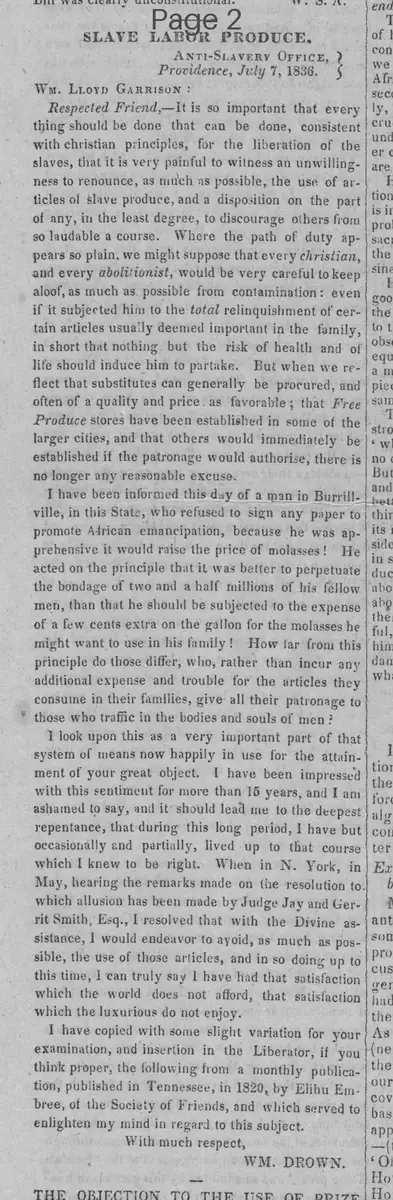
SLAVE LABOR PRODUCE.
Anti-Slavery Office, Providence, July 7, 1836.
WM. LLOYD GARRISON:
Respected Friend,—It is so important that every thing should be done that can be done, consistent with christian principles, for the liberation of the slaves, that it is very painful to witness an unwillingness to renounce, as much as possible, the use of articles of slave produce, and a disposition on the part of any, in the least degree, to discourage others from so laudable a course. Where the path of duty appears so plain, we might suppose that every christian, and every abolitionist, would be very careful to keep aloof, as much as possible from contamination: even if it subjected him to the total relinquishment of certain articles usually deemed important in the family. In short that nothing but the risk of health and of life should induce him to partake. But when we reflect that substitutes can generally be procured, and often of a quality and price as favorable; that Free Produce stores have been established in some of the larger cities, and that others would immediately be established if the patronage would authorise, there is no longer any reasonable excuse.
I have been informed this day of a man in Burrillville, in this State, who refused to sign any paper to promote African emancipation, because he was apprehensive it would raise the price of molasses! He acted on the principle that it was better to perpetuate the bondage of two and a half millions of his fellow men, than that he should be subjected to the expense of a few cents extra on the gallon for the molasses he might want to use in his family! How far from this principle do those differ, who, rather than incur any additional expense and trouble for the articles they consume in their families, give all their patronage to those who traffic in the bodies and souls of men?
I look upon this as a very important part of that system of means now happily in use for the attainment of your great object. I have been impressed with this sentiment for more than 15 years, and I am ashamed to say, and it should lead me to the deepest repentance, that during this long period, I have but occasionally and partially, lived up to that course which I knew to be right. When in N. York, in May, hearing the remarks made on the resolution to which allusion has been made by Judge Jay and Gerrit Smith, Esq., I resolved that with the Divine assistance, I would endeavor to avoid, as much as possible, the use of those articles, and in so doing up to this time, I can truly say I have had that satisfaction which the world does not afford, that satisfaction which the luxurious do not enjoy.
I have copied with some slight variation for your examination, and insertion in the Liberator, if you think proper, the following from a monthly publication, published in Tennessee, in 1820, by Elihu Embree, of the Society of Friends, and which served to enlighten my mind in regard to this subject.
With much respect,
WM. DROWN.
Anti-Slavery Office, Providence, July 7, 1836.
WM. LLOYD GARRISON:
Respected Friend,—It is so important that every thing should be done that can be done, consistent with christian principles, for the liberation of the slaves, that it is very painful to witness an unwillingness to renounce, as much as possible, the use of articles of slave produce, and a disposition on the part of any, in the least degree, to discourage others from so laudable a course. Where the path of duty appears so plain, we might suppose that every christian, and every abolitionist, would be very careful to keep aloof, as much as possible from contamination: even if it subjected him to the total relinquishment of certain articles usually deemed important in the family. In short that nothing but the risk of health and of life should induce him to partake. But when we reflect that substitutes can generally be procured, and often of a quality and price as favorable; that Free Produce stores have been established in some of the larger cities, and that others would immediately be established if the patronage would authorise, there is no longer any reasonable excuse.
I have been informed this day of a man in Burrillville, in this State, who refused to sign any paper to promote African emancipation, because he was apprehensive it would raise the price of molasses! He acted on the principle that it was better to perpetuate the bondage of two and a half millions of his fellow men, than that he should be subjected to the expense of a few cents extra on the gallon for the molasses he might want to use in his family! How far from this principle do those differ, who, rather than incur any additional expense and trouble for the articles they consume in their families, give all their patronage to those who traffic in the bodies and souls of men?
I look upon this as a very important part of that system of means now happily in use for the attainment of your great object. I have been impressed with this sentiment for more than 15 years, and I am ashamed to say, and it should lead me to the deepest repentance, that during this long period, I have but occasionally and partially, lived up to that course which I knew to be right. When in N. York, in May, hearing the remarks made on the resolution to which allusion has been made by Judge Jay and Gerrit Smith, Esq., I resolved that with the Divine assistance, I would endeavor to avoid, as much as possible, the use of those articles, and in so doing up to this time, I can truly say I have had that satisfaction which the world does not afford, that satisfaction which the luxurious do not enjoy.
I have copied with some slight variation for your examination, and insertion in the Liberator, if you think proper, the following from a monthly publication, published in Tennessee, in 1820, by Elihu Embree, of the Society of Friends, and which served to enlighten my mind in regard to this subject.
With much respect,
WM. DROWN.
What sub-type of article is it?
Persuasive
Ethical Moral
Religious
What themes does it cover?
Slavery Abolition
Morality
Religion
What keywords are associated?
Slave Produce
Free Produce
Abolition
Molasses
Christian Principles
Burrillville
Elihu Embree
What entities or persons were involved?
Wm. Drown
Wm. Lloyd Garrison
Letter to Editor Details
Author
Wm. Drown
Recipient
Wm. Lloyd Garrison
Main Argument
abolitionists should renounce the use of slave-produced articles, such as molasses, to avoid supporting slavery, as substitutes are available and free produce stores can be established with sufficient patronage.
Notable Details
Anecdote Of A Man In Burrillville Refusing To Sign Emancipation Paper Due To Fear Of Higher Molasses Prices
Personal Resolution After Hearing Judge Jay And Gerrit Smith
Reference To Elihu Embree's 1820 Tennessee Publication On The Subject