Thank you for visiting SNEWPapers!
Sign up free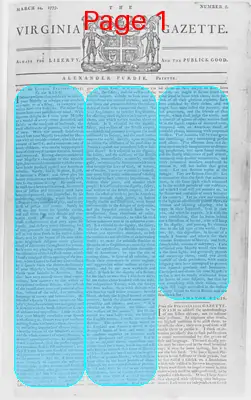
Editorial
March 24, 1775
The Virginia Gazette
Williamsburg, Virginia
What is this article about?
An open letter to King George III from the London Evening Post criticizes British ministerial policies towards American colonies, arguing they are oppressive, unjust, and contrary to the King's benevolent nature. It urges reconciliation and warns of future American greatness and British loss.
Clipping
OCR Quality
95%
Excellent
Full Text
From the London Evening Post.
To the KING.
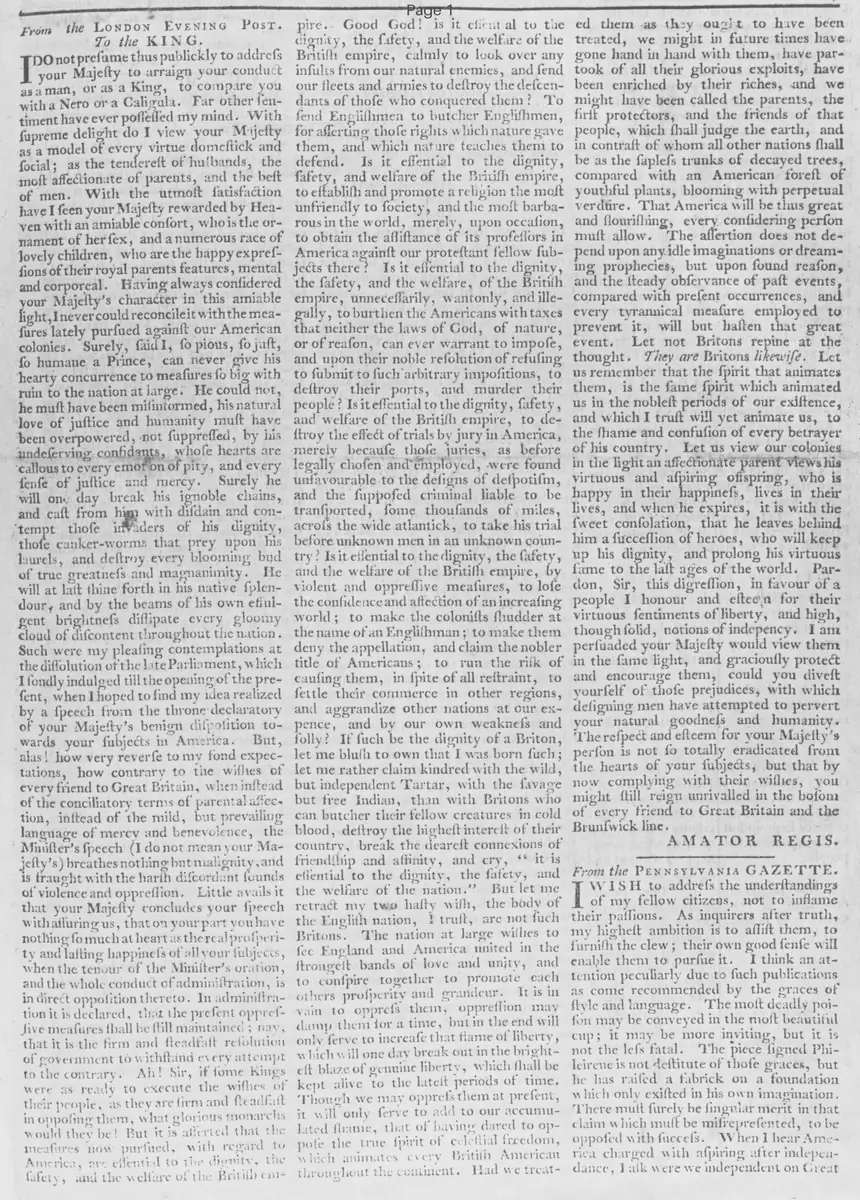
Do not presume thus publicly to address your Majesty to arraign your conduct as a man, or as a King, to compare you with a Nero or a Caligula. Far other sentiments have ever possessed my mind. With supreme delight do I view your Majesty as a model of every virtue domestic and social; as the tenderest of husbands, the most affectionate of parents, and the best of men. With the utmost satisfaction have I seen your Majesty rewarded by Heaven with an amiable consort, who is the ornament of her sex, and a numerous race of lovely children, who are the happy expressions of their royal parents' features, mental and corporeal. Having always considered your Majesty's character in this amiable light, I never could reconcile it with the measures lately pursued against our American colonies. Surely, said I, O pious, O just, so humane a Prince, can never give his hearty concurrence to measures so big with ruin to the nation at large. He could not, he must have been misinformed, his natural love of justice and humanity must have been overpowered, not suppressed, by his undeserving confidants, whose hearts are callous to every emotion of pity, and every sense of justice and mercy. Surely he will one day break his ignoble chains, and cast from him with disdain and contempt those invaders of his dignity, those canker-worms that prey upon his laurels, and destroy every blooming bud of true greatness and magnanimity. He will at last shine forth in his native splendour, and by the beams of his own effulgent brightness dissipate every gloomy cloud of discontent throughout the nation.
Such were my pleasing contemplations at the dissolution of the late Parliament, which I fondly indulged till the opening of the present, when I hoped to find my idea realized by a speech from the throne declaratory of your Majesty's benign disposition towards your subjects in America. But, alas! how very reverse to my fond expectations, how contrary to the wishes of every friend to Great Britain, when instead of the conciliatory terms of parental affection, instead of the mild, but prevailing language of mercy and benevolence, the Minister's speech (I do not mean your Majesty's) breathes nothing but malignity, and is fraught with the harsh discordant sounds of violence and oppression. Little avails it that your Majesty concludes your speech with assuring us, that on your part you have nothing so much at heart as the real prosperity and lasting happiness of all your subjects, when the tenor of the Minister's oration, and the whole conduct of administration, is in direct opposition thereto. In administration it is declared, that the present oppressive measures shall be still maintained; nay, that it is the firm and steadfast resolution of government to withstand every attempt to the contrary. Ah! Sir, if some Kings were as ready to execute the wishes of their people, as they are firm and steadfast in opposing them, what glorious monarchs would they be! But it is asserted that the measures now pursued, with regard to America, are essential to the dignity, the safety, and the welfare of the British empire. Good God! is it essential to the dignity, the safety, and the welfare of the British empire, calmly to look over any insults from our natural enemies, and send our fleets and armies to destroy the descendants of those who conquered them? To send Englishmen to butcher Englishmen, for asserting those rights which nature gave them, and which nature teaches them to defend. Is it essential to the dignity, safety, and welfare of the British empire, to establish and promote a religion the most unfriendly to society, and the most barbarous in the world, merely, upon occasion, to obtain the assistance of its professors in America against our protestant fellow subjects there? Is it essential to the dignity, the safety, and the welfare, of the British empire, unnecessarily, wantonly, and illegally, to burthen the Americans with taxes that neither the laws of God, of nature, or of reason, can ever warrant to impose. and upon their noble resolution of refusing to submit to such arbitrary impositions, to destroy their ports, and murder their people? Is it essential to the dignity, safety, and welfare of the British empire, to destroy the effect of trials by jury in America, merely because those juries, as before legally chosen and employed, were found unfavourable to the designs of despotism, and the supposed criminal liable to be transported, some thousands of miles, across the wide Atlantic, to take his trial before unknown men in an unknown country? Is it essential to the dignity, the safety, and the welfare of the British empire, by violent and oppressive measures, to lose the confidence and affection of an increasing world; to make the colonists shudder at the name of an Englishman; to make them deny the appellation, and claim the nobler title of Americans; to run the risk of causing them, in spite of all restraint, to settle their commerce in other regions, and aggrandize other nations at our expense, and by our own weakness and folly? If such be the dignity of a Briton, let me blush to own that I was born such: let me rather claim kindred with the wild, but independent Tartar, with the savage but free Indian, than with Britons who can butcher their fellow creatures in cold blood, destroy the highest interest of their country, break the dearest connexions of friendship and affinity, and cry, it is essential to the dignity, the safety, and the welfare of the nation. But let me retract my two hasty wishes, the body of the English nation, I trust, are not such Britons. The nation at large wishes to see England and America united in the strongest bands of love and unity, and to conspire together to promote each others prosperity and grandeur. It is in vain to oppress them, oppression may clamp them for a time, but in the end will only serve to increase that flame of liberty, which will one day break out in the brightest blaze of genuine liberty, which shall be kept alive to the latest periods of time. Though we may oppress them at present, it will only serve to add to our accumulated flame, that of having dared to oppose the true spirit of celestial freedom, which animates every British American throughout the continent. Had we treated them as they ought to have been treated, we might in future times have gone hand in hand with them, have partook of all their glorious exploits, have been enriched by their riches, and we might have been called the parents, the first protectors, and the friends of that people, which shall judge the earth, and in contrast of whom all other nations shall be as the sapless trunks of decayed trees, compared with an American forest of youthful plants, blooming with perpetual verdure. That America will be thus great and flourishing, every considering person must allow. The assertion does not depend upon any idle imaginations or dreaming prophecies, but upon sound reason, and the steady observance of past events, compared with present occurrences, and every tyrannical measure employed to prevent it, will but hasten that great event. Let not Britons repine at the thought. They are Britons likewise. Let us remember that the spirit that animates them, is the same spirit which animated us in the noblest periods of our existence. and which I trust will yet animate us, to the shame and confusion of every betrayer of his country. Let us view our colonies in the light an affectionate parent views his virtuous and aspiring offspring, who is happy in their happiness, lives in their lives, and when he expires, it is with the sweet consolation, that he leaves behind him a succession of heroes, who will keep up his dignity, and prolong his virtuous fame to the last ages of the world. Pardon, Sir, this digression, in favour of a people I honour and esteem for their virtuous sentiments of liberty, and high, though solid, notions of independency. I am persuaded your Majesty would view them in the same light, and graciously protect and encourage them, could you divest yourself of those prejudices, with which designing men have attempted to pervert your natural goodness and humanity. The respect and esteem for your Majesty's person is not so totally eradicated from the hearts of your subjects, but that by now complying with their wishes, you might still reign unrivalled in the bosom of every friend to Great Britain and the Brunswick line.
AMATOR REGIS.
To the KING.
Do not presume thus publicly to address your Majesty to arraign your conduct as a man, or as a King, to compare you with a Nero or a Caligula. Far other sentiments have ever possessed my mind. With supreme delight do I view your Majesty as a model of every virtue domestic and social; as the tenderest of husbands, the most affectionate of parents, and the best of men. With the utmost satisfaction have I seen your Majesty rewarded by Heaven with an amiable consort, who is the ornament of her sex, and a numerous race of lovely children, who are the happy expressions of their royal parents' features, mental and corporeal. Having always considered your Majesty's character in this amiable light, I never could reconcile it with the measures lately pursued against our American colonies. Surely, said I, O pious, O just, so humane a Prince, can never give his hearty concurrence to measures so big with ruin to the nation at large. He could not, he must have been misinformed, his natural love of justice and humanity must have been overpowered, not suppressed, by his undeserving confidants, whose hearts are callous to every emotion of pity, and every sense of justice and mercy. Surely he will one day break his ignoble chains, and cast from him with disdain and contempt those invaders of his dignity, those canker-worms that prey upon his laurels, and destroy every blooming bud of true greatness and magnanimity. He will at last shine forth in his native splendour, and by the beams of his own effulgent brightness dissipate every gloomy cloud of discontent throughout the nation.
Such were my pleasing contemplations at the dissolution of the late Parliament, which I fondly indulged till the opening of the present, when I hoped to find my idea realized by a speech from the throne declaratory of your Majesty's benign disposition towards your subjects in America. But, alas! how very reverse to my fond expectations, how contrary to the wishes of every friend to Great Britain, when instead of the conciliatory terms of parental affection, instead of the mild, but prevailing language of mercy and benevolence, the Minister's speech (I do not mean your Majesty's) breathes nothing but malignity, and is fraught with the harsh discordant sounds of violence and oppression. Little avails it that your Majesty concludes your speech with assuring us, that on your part you have nothing so much at heart as the real prosperity and lasting happiness of all your subjects, when the tenor of the Minister's oration, and the whole conduct of administration, is in direct opposition thereto. In administration it is declared, that the present oppressive measures shall be still maintained; nay, that it is the firm and steadfast resolution of government to withstand every attempt to the contrary. Ah! Sir, if some Kings were as ready to execute the wishes of their people, as they are firm and steadfast in opposing them, what glorious monarchs would they be! But it is asserted that the measures now pursued, with regard to America, are essential to the dignity, the safety, and the welfare of the British empire. Good God! is it essential to the dignity, the safety, and the welfare of the British empire, calmly to look over any insults from our natural enemies, and send our fleets and armies to destroy the descendants of those who conquered them? To send Englishmen to butcher Englishmen, for asserting those rights which nature gave them, and which nature teaches them to defend. Is it essential to the dignity, safety, and welfare of the British empire, to establish and promote a religion the most unfriendly to society, and the most barbarous in the world, merely, upon occasion, to obtain the assistance of its professors in America against our protestant fellow subjects there? Is it essential to the dignity, the safety, and the welfare, of the British empire, unnecessarily, wantonly, and illegally, to burthen the Americans with taxes that neither the laws of God, of nature, or of reason, can ever warrant to impose. and upon their noble resolution of refusing to submit to such arbitrary impositions, to destroy their ports, and murder their people? Is it essential to the dignity, safety, and welfare of the British empire, to destroy the effect of trials by jury in America, merely because those juries, as before legally chosen and employed, were found unfavourable to the designs of despotism, and the supposed criminal liable to be transported, some thousands of miles, across the wide Atlantic, to take his trial before unknown men in an unknown country? Is it essential to the dignity, the safety, and the welfare of the British empire, by violent and oppressive measures, to lose the confidence and affection of an increasing world; to make the colonists shudder at the name of an Englishman; to make them deny the appellation, and claim the nobler title of Americans; to run the risk of causing them, in spite of all restraint, to settle their commerce in other regions, and aggrandize other nations at our expense, and by our own weakness and folly? If such be the dignity of a Briton, let me blush to own that I was born such: let me rather claim kindred with the wild, but independent Tartar, with the savage but free Indian, than with Britons who can butcher their fellow creatures in cold blood, destroy the highest interest of their country, break the dearest connexions of friendship and affinity, and cry, it is essential to the dignity, the safety, and the welfare of the nation. But let me retract my two hasty wishes, the body of the English nation, I trust, are not such Britons. The nation at large wishes to see England and America united in the strongest bands of love and unity, and to conspire together to promote each others prosperity and grandeur. It is in vain to oppress them, oppression may clamp them for a time, but in the end will only serve to increase that flame of liberty, which will one day break out in the brightest blaze of genuine liberty, which shall be kept alive to the latest periods of time. Though we may oppress them at present, it will only serve to add to our accumulated flame, that of having dared to oppose the true spirit of celestial freedom, which animates every British American throughout the continent. Had we treated them as they ought to have been treated, we might in future times have gone hand in hand with them, have partook of all their glorious exploits, have been enriched by their riches, and we might have been called the parents, the first protectors, and the friends of that people, which shall judge the earth, and in contrast of whom all other nations shall be as the sapless trunks of decayed trees, compared with an American forest of youthful plants, blooming with perpetual verdure. That America will be thus great and flourishing, every considering person must allow. The assertion does not depend upon any idle imaginations or dreaming prophecies, but upon sound reason, and the steady observance of past events, compared with present occurrences, and every tyrannical measure employed to prevent it, will but hasten that great event. Let not Britons repine at the thought. They are Britons likewise. Let us remember that the spirit that animates them, is the same spirit which animated us in the noblest periods of our existence. and which I trust will yet animate us, to the shame and confusion of every betrayer of his country. Let us view our colonies in the light an affectionate parent views his virtuous and aspiring offspring, who is happy in their happiness, lives in their lives, and when he expires, it is with the sweet consolation, that he leaves behind him a succession of heroes, who will keep up his dignity, and prolong his virtuous fame to the last ages of the world. Pardon, Sir, this digression, in favour of a people I honour and esteem for their virtuous sentiments of liberty, and high, though solid, notions of independency. I am persuaded your Majesty would view them in the same light, and graciously protect and encourage them, could you divest yourself of those prejudices, with which designing men have attempted to pervert your natural goodness and humanity. The respect and esteem for your Majesty's person is not so totally eradicated from the hearts of your subjects, but that by now complying with their wishes, you might still reign unrivalled in the bosom of every friend to Great Britain and the Brunswick line.
AMATOR REGIS.
What sub-type of article is it?
Imperialism
Constitutional
Taxation
What keywords are associated?
American Colonies
British Policy
Taxation
Liberty
Oppression
King George
Reconciliation
What entities or persons were involved?
King George Iii
Minister
American Colonies
British Administration
Editorial Details
Primary Topic
Criticism Of British Oppressive Measures Against American Colonies
Stance / Tone
Critical Of Administration, Supportive Of Colonial Rights And Reconciliation
Key Figures
King George Iii
Minister
American Colonies
British Administration
Key Arguments
King Misinformed By Undeserving Confidants
Oppressive Measures Contrary To King's Just Nature
Taxation Without Warrant Violates Laws Of God, Nature, Reason
Sending Englishmen To Butcher Englishmen For Asserting Rights
Destruction Of Jury Trials And Promotion Of Barbarous Religion Unjust
Oppression Will Fuel American Liberty And Future Greatness
Britain Should View Colonies As Virtuous Offspring