Thank you for visiting SNEWPapers!
Sign up free
The National Intelligencer And Washington Advertiser
Washington, District Of Columbia
What is this article about?
This editorial discusses the anticipated effects of the US Embargo on British perceptions, expresses cautious hope for improved foreign relations, and enthusiastically promotes the rapid growth of domestic manufactures as a beneficial response, while noting strong support for the administration and Madison's election in the West.
Merged-components note: Merged continuation of the editorial discussing the effects of the embargo on foreign relations and the promotion of domestic manufactures across pages 2 and 3, as the text connects mid-sentence.
Clippings
1 of 2
OCR Quality
Full Text
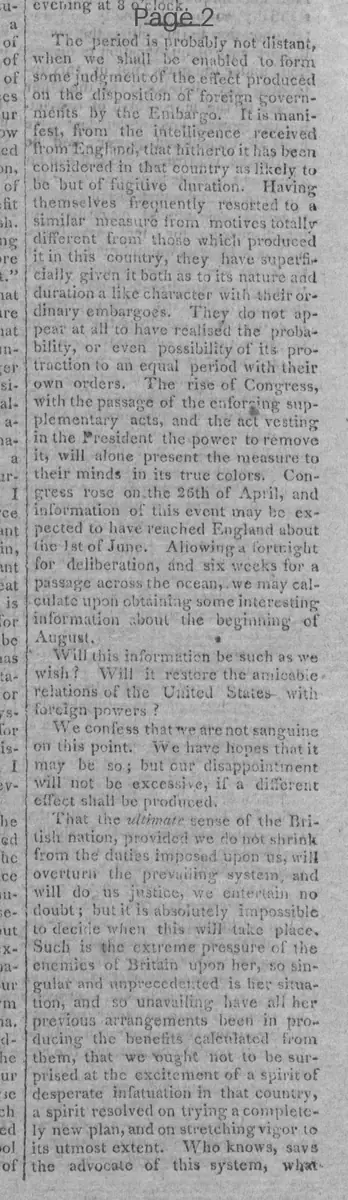
Will this information be such as we wish? Will it restore the amicable relations of the United States with foreign powers?
We confess that we are not sanguine on this point. We have hopes that it may be so; but our disappointment will not be excessive, if a different effect shall be produced.
That the ultimate sense of the British nation, provided we do not shrink from the duties imposed upon us, will overturn the prevailing system, and will do us justice, we entertain no doubt; but it is absolutely impossible to decide when this will take place. Such is the extreme pressure of the enemies of Britain upon her, so singular and unprecedented is her situation, and so unavailing have all her previous arrangements been in producing the benefits calculated from them, that we ought not to be surprised at the excitement of a spirit of desperate infatuation in that country, a spirit resolved on trying a completely new plan, and on stretching vigor to its utmost extent. Who knows, says the advocate of this system, what
The die of Despair may throw the die, but fortune may crown it with victory. There is good reason to believe, from recent advices from England, that the orders are there rather popular. Experience only will remove this delusion. The West India planters, the enemies of American institutions, and the merchants generally who are jealous of our commercial rivalry, are probably prepared to make great sacrifices before they will consent to abandon their forlorn hope, and to retrace the rash steps they have induced their government to take. And such is the vast opulence of the merchants of England, that there can be no doubt of their ability to make great sacrifices; there can be as little doubt of the insensibility of avarice and power to the consequent wide-spread calamities of the lower orders of society. Exclusively consulting their own interests, it will be only when the distresses of the lower classes shall materially injure them, that they will relax.
Under this uncertainty with regard to the future, we are rejoiced to perceive our fellow-citizens generally throughout the union pursuing a course of conduct, which will equally promote their solid interests, whether our foreign relations become more troubled, or shall be restored to their usual tranquility. It is certain that if we are permanently deprived of that commerce which can alone enable us to part with our surplus products in a foreign market, we must find a succedaneum in manufactures and internal improvements; and it is equally clear, that even on the return of all undisturbed trade, this progress in the cultivation of our internal resources would, notwithstanding, be of vast benefit.
Who, too, will say whether the zeal with which, under the present pressure, manufactures are pursued, may not be the most effectual means of moving England to a sense of her own interests, by convincing her that we cannot only do without her fabrics, but that we shall find a greater profit in our manufacturing establishments than in the trade that enables us to part with our surplus agricultural products?
By an official statement of the exports from Great Britain to the U.S. of America, it appears that they amount to the annual sum of forty-eight millions of dollars, of which thirty-six millions consist of woollens and cotton goods.
Of cotton we have the most abundant supply within ourselves; and if there be not a sufficiency of wool, the zealous attention paid to the raising and improvement of sheep will in the course of a few years render us equally independent. Our ability to cultivate this resource to a sure profit, and so as to afford the best and finest wool, is unequivocally established.
All then that is wanting is the general establishment of manufactories; and these are progressing with inconceivable rapidity. At no period of our existence have such numerous and united efforts been made; and all that have been made on a liberal scale have been crowned with success.
In the New England states, thousands of respectable manufactories are in active operation.
In Philadelphia, besides a respectable public establishment, a great number of private flourishing manufactories of cotton have been established.
In Baltimore a company, with a million, is organized.
In Petersburg twenty-five thousand dollars have been subscribed in a day.
In Richmond, under the most intelligent and patriotic auspices, a capital of half a million is to be engaged in this object.
In short the patriotic flame appears to be fed throughout the whole union by an inexhaustible fuel.
Already it is computed that at least five millions of dollars have been devoted to manufactures in the last six months; a capital competent to the furnishing manufactured articles to the amount of at least ten millions.
Britain, seeing what is already done, will anticipate what will happen if she persist in her injustice; she will see that, five years hence, we shall not need a tenth part of the manufactured goods we now receive from her.
We are assured from the most respectable sources of information, that in the state of Kentucky the universal sentiment is in favor of the measures of the administration, and of the election of Mr. Madison to the Presidency. On both of these points we have reposed implicit confidence in the patriotism of the whole western country.
A plan has been submitted to the citizens of Richmond, and has been adopted for the establishment of The Richmond Manufacturing Company of Virginia, with a capital of $500,000. of which $200,000 are to be reserved for the state. We are glad to find men of all parties warmly united in the plan.
What sub-type of article is it?
What keywords are associated?
What entities or persons were involved?
Editorial Details
Primary Topic
Effects Of The Embargo On Foreign Relations And Promotion Of Domestic Manufactures
Stance / Tone
Cautiously Hopeful On Foreign Relations, Enthusiastic About Manufactures And Administration Support
Key Figures
Key Arguments