Thank you for visiting SNEWPapers!
Sign up free
Editorial
May 14, 1805
The Enquirer
Richmond, Henrico County, Virginia
What is this article about?
An editorial in The Enquirer introduces and publishes 'The Lay-Preacher,' a discourse by an admired author warning Virginia's youth against the destructive vices of illicit sexual indulgence, contrasting it with the joys of virtue and urging moral and religious reformation to avoid earthly and eternal ruin.
Merged-components note: Continuation of 'The Lay-Preacher' discourse on youthful vices, seamless narrative.
Clipping
OCR Quality
98%
Excellent
Full Text
The Enquirer.
RICHMOND, MAY 14, 1805.
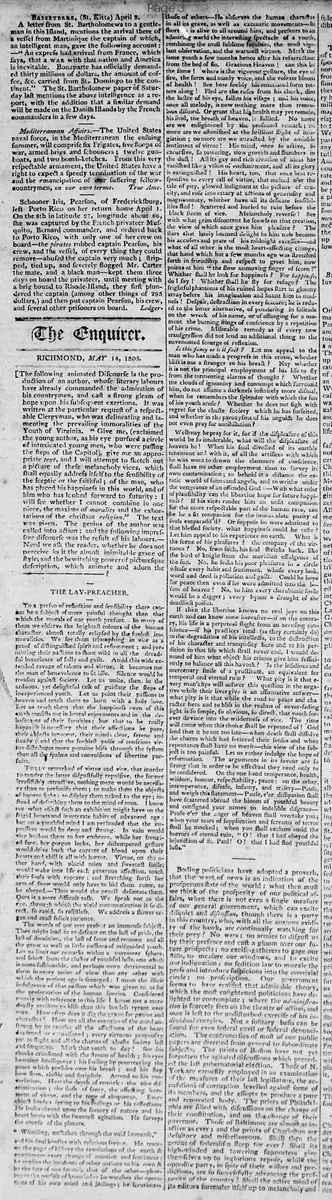
[The following animated Discourse is the production of an author, whose literary labours have already commanded the admiration of his countrymen, and cast a strong gleam of hope upon his subsequent exertions. It was written at the particular request of a respectable Clergyman, who was delineating and lamenting the prevailing immoralities of the Youth of Virginia. "Give me, (exclaimed the young author, as his eye pursued a circle of intoxicated young men, who were passing the steps of the Capitol), give me an appropriate text, and I will attempt to sketch out a picture of these melancholy vices, which shall equally address itself to the sensibility of the sceptic or the faithful; of the man, who has placed his happiness in this world, and of him who has looked forward to futurity: I will see whether I cannot combine in one piece, the maxims of morality and the exhortations of the christian religion." The text was given. The genius of the author was called into action: and the following impressive discourse was the result of his labours.—
Need we ask the reader, whether he does not perceive in it the almost inimitable grace of style, and the bewitching power of picturesque description, which animate and adorn the writings of this elegant author?]
THE LAY-PREACHER.
To a person of reflection and sensibility there cannot be a subject of more painful thought than that which the morals of our youth present. In many of them we observe the brightest colours of the human character, almost totally eclipsed by the foulest immoralities. We see them triumphing in vice as a proof of distinguished spirit and refinement; and permitting their passions to shoot wild in all the dreadful luxuriance of folly and guilt. Amid this wide extended ravage of talents and virtue, it becomes not the man of benevolence to sit idle. Silence would be treason against society. Let us unite, then, in the arduous, yet delightful task of guiding the steps of inexperienced youth. Let us point their passions to heaven and teach them to burn with a holy love. Let us teach them that the happiness even of this earth consists not in brutal enjoyments and in the debasement of their faculties; but that to be really happy it is necessary that their affections be pure, their objects innocent, their minds clear, serene and steady: and that the feeblest pulse of conscious virtue distributes more genuine bliss through the system than all the spasms and convulsions of libertine pursuits.
Tully remarked of virtue and vice, that in order to render the latter disgustfully repulsive, the former irresistibly attractive, nothing more would be necessary than to personify them; to make them the objects of human sight: to display them naked to the eye; instead of describing them to the mind of man. I know not what effect such an exhibition might have on the frigid hearts and inveterate habits of advanced age: but on a youthful mind I am persuaded that the impression would be deep and strong. In vain would vice beckon them to her embrace, while her frenzied face, her gorgon locks, her distempered gesture would drive back the current of blood upon their hearts and chill it all with horror. Virtue, on the other hand, with placid mien and sweetest smile, would wake into life each generous affection, touch their souls with rapture; and stretching forth her arm of snow would only have to bid them come, to be obeyed.—Thus would the pencil delineate them.
Ours is a more difficult task. We speak not to the eye, through which the vivid communication is so direct, so rapid, so irresistible. We address a slower organ and must solicit patience.
The words of our text present an immense subject. They might lead us to descant on the lust of pride, the lust of dominion, the lust of fame and renown and all the great as well as little passions of misguided youth. Let us limit our remarks within a narrower sphere, and select from the cluster of youthful lusts, one which is more fashionable, and perhaps more detrimental to them in every point of view than any other with which the present age is scourged: I mean the illicit indulgence of that passion which was given to us for the preservation of the human species. Considered merely with reference to this life I know not a more deadly antidote to bliss than this lawless tyrant over man. How often does it dig the grave for genius and character! How are all the energies of the mind unstrung by its excess; all the affections of the heart deadened or envenomed; every virtuous propensity put to flight and all the charms of chaste society lost and forgotten. Mark that youth to day! See his cheeks crimsoned with the stream of health; his eyes beaming intelligence; his smiling lip portraying the peace which presides over his breast; and his step how firm, elastic and sprightly. Attend to his conversation. Hear the depth of remark: the nice discrimination; the flash of fancy, the affecting sentiment of virtue, and the tone of eloquence. Every object lends a spring to his feelings or his reflections. He looks abroad upon the scenery of nature and his heart beats with the sweetest agitation. He surveys the course of the planets.
"Wheeling, unshaken through the void immense,"
god his soul kindles with religious fervor. He traces on the page of history the revolutions of the earth & experiences every change of emotion and sentiment: he applies the incidents of other nations to his own & by the fate of one foretells that of the other—glowing in the pursuit of knowledge he watches the operations of his own mind and feelings: he scrutinizes
those of others—He observes the human character in all its grave, as well as eccentric movements—In short is alive to all around him; and presents to an admiring world the interesting spectacle of a youth, combining the most sublime faculties, the most vigilant observation, and the warmest virtues. Mark the same youth a few months hence after his resurrection from the bed of sin. Gracious Heaven! can this be the same! where is the vigorous gesture, the eye of fire, the form and manly voice, and the roseate bloom of health! See how feebly his emaciated form totters along! Fled are the roses from his cheek, dim the lustre of his eye, ashen his visage; and his voice, once all melody, is now nothing more than tremulous discord. Or grant that his health may yet remain, his soul, the breath of heaven, is sullied. No more are we enlightened by the profound remark; no more are we astonished at the brilliant flight of imagination; no more are we attracted by the amiable sentiment of virtue! His mind, once so active, so excursive, so towering, now grovels and slumbers in the dust! All its gay and rich creation of ideas has vanished like a vision of enchantment, and all its glory is extinguished. His heart, too, that once beat responsive to every call of virtue, that melted o'er the tale of pity, glowed indignant at the picture of cruelty, and rose into ecstasy at actions of generosity and magnanimity, whither have all its delicate sensibilities fled! Scattered and hurled to ruin before the black storm of vice.
Melancholy reverse! See with what grim discontent he scowls on that creation, the view of which once gave him pleasure? The stars that lately beamed delight to him now become his accusers and prate of his midnight excesses—and what of all other is the most heart-affecting change, that hand which but a few months ago was stretched forth in friendship and respect to greet him, now points at him "the slow unmoving finger of scorn!" Whither Shall he look for happiness? For happiness, do I say! Whither shall he fly for refuge? The frightful phantoms of his ruined hopes start in gloomy array before his imagination and haunt him to madness! Despair, distraction in every feature; he is reduced to the bitter alternative, of pondering in solitude on the wreck of his name, or of assuaging for a moment the burning stings of conscience by a repetition of his crime. Miserable remedy as if every new transgression did not lend an additional thorn to the envenomed scourge of reflection.
Is this fancy or is it fact? Let me appeal to the man who has made a progress in this crime, whether bliss is not a stranger to his breast? Nay whether it is not the principal employment of his life to fly from the tormenting alarms of thought? Whether the clouds of ignominy and contempt which surround him, do not assume a darkness infinitely more dismal, when he remembers the splendor with which the sun of his youth arose? Whether he does not sigh with regret for the chaste society which he has forfeited. and whether in the paroxysms of his anguish he does not even pray for annihilation?
Well may he pray for it, for if the displeasure of this world be so intolerable, what will the displeasure of heaven be! When his soul divested of its earthly tenement and with it, of all the artifices with which he was wont to drown the clamours of conscience, shall have no other employment than to survey its own contamination; to behold at a distance the ecstatic world of saints and angels, and to writhe under the vengeance of an offended God:—With what color of plausibility can the libertine hope for future happiness? If his vices render him an unfit companion for the more respectable part of the human race, can he be a fit companion for the immaculate purity of souls emparadised? Or suppose he were admitted to that blessed society, what happiness could he taste? Let him appeal to his experience on earth. What is the scene of his pleasures? the company of the virtuous? No, from such, his soul shrinks back, like the bird of night from the meridian effulgence of the sun. No, he seeks his poor pleasures in a circle whose every habit and sentiment, whose every look, word and deed is pollution and guilt. Could he hope for peace then even if he were admitted into the bosom of heaven! No, to him every cherubic smile would be a dagger; every hymn a draught of the deadliest poison.
If then the libertine knows no real joys on this earth and can know none hereafter—if on the contrary, his life is a perpetual flight from an accusing conscience—if his practices tend (as they certainly do) to the degradation of his intellects, to the destruction of his character and tranquility here and to his perdition in that life which shall never end, I would demand of him what object his crimes give him sufficiently to balance all this havock? Is the insidious and mercenary smile of a prostitute, an equivalent for temporal and eternal ruin? What pity is it that every man's lips will answer this question in the negative while their lives give it an affirmative answer—what pity is it that while the road to peace and character here and to bliss in the realms of never-fading light is so simple, so obvious, so direct, that youth forever deviate into the wilderness of vice. The time will come when this choice shall be repented of! God send that it be not too late—when death shall dissolve the charm which had fettered their senses and when repentance shall have no merit—this view of the subject is too painful. Let us rather indulge the hope of reformation. The arguments in its favour are so strong that in order to be effectual they need only to be considered. On the one hand temperance, health, wisdom, honour, respectability, peace: on the other, intemperance, disease, infamy, and misery—Pause, and weigh this statement—Pause, e'er dissipation shall have scattered abroad the bloom of youthful beauty and consigned your names to indelible disgrace—Pause e'er the anger of heaven shall overtake you; when your tears of supplication and screams of terror shall be mocked; when you shall exclaim amid the horrors of eternal ruin, "O! that I had obeyed the injunction of St. Paul! O! that I had fled youthful lusts."
RICHMOND, MAY 14, 1805.
[The following animated Discourse is the production of an author, whose literary labours have already commanded the admiration of his countrymen, and cast a strong gleam of hope upon his subsequent exertions. It was written at the particular request of a respectable Clergyman, who was delineating and lamenting the prevailing immoralities of the Youth of Virginia. "Give me, (exclaimed the young author, as his eye pursued a circle of intoxicated young men, who were passing the steps of the Capitol), give me an appropriate text, and I will attempt to sketch out a picture of these melancholy vices, which shall equally address itself to the sensibility of the sceptic or the faithful; of the man, who has placed his happiness in this world, and of him who has looked forward to futurity: I will see whether I cannot combine in one piece, the maxims of morality and the exhortations of the christian religion." The text was given. The genius of the author was called into action: and the following impressive discourse was the result of his labours.—
Need we ask the reader, whether he does not perceive in it the almost inimitable grace of style, and the bewitching power of picturesque description, which animate and adorn the writings of this elegant author?]
THE LAY-PREACHER.
To a person of reflection and sensibility there cannot be a subject of more painful thought than that which the morals of our youth present. In many of them we observe the brightest colours of the human character, almost totally eclipsed by the foulest immoralities. We see them triumphing in vice as a proof of distinguished spirit and refinement; and permitting their passions to shoot wild in all the dreadful luxuriance of folly and guilt. Amid this wide extended ravage of talents and virtue, it becomes not the man of benevolence to sit idle. Silence would be treason against society. Let us unite, then, in the arduous, yet delightful task of guiding the steps of inexperienced youth. Let us point their passions to heaven and teach them to burn with a holy love. Let us teach them that the happiness even of this earth consists not in brutal enjoyments and in the debasement of their faculties; but that to be really happy it is necessary that their affections be pure, their objects innocent, their minds clear, serene and steady: and that the feeblest pulse of conscious virtue distributes more genuine bliss through the system than all the spasms and convulsions of libertine pursuits.
Tully remarked of virtue and vice, that in order to render the latter disgustfully repulsive, the former irresistibly attractive, nothing more would be necessary than to personify them; to make them the objects of human sight: to display them naked to the eye; instead of describing them to the mind of man. I know not what effect such an exhibition might have on the frigid hearts and inveterate habits of advanced age: but on a youthful mind I am persuaded that the impression would be deep and strong. In vain would vice beckon them to her embrace, while her frenzied face, her gorgon locks, her distempered gesture would drive back the current of blood upon their hearts and chill it all with horror. Virtue, on the other hand, with placid mien and sweetest smile, would wake into life each generous affection, touch their souls with rapture; and stretching forth her arm of snow would only have to bid them come, to be obeyed.—Thus would the pencil delineate them.
Ours is a more difficult task. We speak not to the eye, through which the vivid communication is so direct, so rapid, so irresistible. We address a slower organ and must solicit patience.
The words of our text present an immense subject. They might lead us to descant on the lust of pride, the lust of dominion, the lust of fame and renown and all the great as well as little passions of misguided youth. Let us limit our remarks within a narrower sphere, and select from the cluster of youthful lusts, one which is more fashionable, and perhaps more detrimental to them in every point of view than any other with which the present age is scourged: I mean the illicit indulgence of that passion which was given to us for the preservation of the human species. Considered merely with reference to this life I know not a more deadly antidote to bliss than this lawless tyrant over man. How often does it dig the grave for genius and character! How are all the energies of the mind unstrung by its excess; all the affections of the heart deadened or envenomed; every virtuous propensity put to flight and all the charms of chaste society lost and forgotten. Mark that youth to day! See his cheeks crimsoned with the stream of health; his eyes beaming intelligence; his smiling lip portraying the peace which presides over his breast; and his step how firm, elastic and sprightly. Attend to his conversation. Hear the depth of remark: the nice discrimination; the flash of fancy, the affecting sentiment of virtue, and the tone of eloquence. Every object lends a spring to his feelings or his reflections. He looks abroad upon the scenery of nature and his heart beats with the sweetest agitation. He surveys the course of the planets.
"Wheeling, unshaken through the void immense,"
god his soul kindles with religious fervor. He traces on the page of history the revolutions of the earth & experiences every change of emotion and sentiment: he applies the incidents of other nations to his own & by the fate of one foretells that of the other—glowing in the pursuit of knowledge he watches the operations of his own mind and feelings: he scrutinizes
those of others—He observes the human character in all its grave, as well as eccentric movements—In short is alive to all around him; and presents to an admiring world the interesting spectacle of a youth, combining the most sublime faculties, the most vigilant observation, and the warmest virtues. Mark the same youth a few months hence after his resurrection from the bed of sin. Gracious Heaven! can this be the same! where is the vigorous gesture, the eye of fire, the form and manly voice, and the roseate bloom of health! See how feebly his emaciated form totters along! Fled are the roses from his cheek, dim the lustre of his eye, ashen his visage; and his voice, once all melody, is now nothing more than tremulous discord. Or grant that his health may yet remain, his soul, the breath of heaven, is sullied. No more are we enlightened by the profound remark; no more are we astonished at the brilliant flight of imagination; no more are we attracted by the amiable sentiment of virtue! His mind, once so active, so excursive, so towering, now grovels and slumbers in the dust! All its gay and rich creation of ideas has vanished like a vision of enchantment, and all its glory is extinguished. His heart, too, that once beat responsive to every call of virtue, that melted o'er the tale of pity, glowed indignant at the picture of cruelty, and rose into ecstasy at actions of generosity and magnanimity, whither have all its delicate sensibilities fled! Scattered and hurled to ruin before the black storm of vice.
Melancholy reverse! See with what grim discontent he scowls on that creation, the view of which once gave him pleasure? The stars that lately beamed delight to him now become his accusers and prate of his midnight excesses—and what of all other is the most heart-affecting change, that hand which but a few months ago was stretched forth in friendship and respect to greet him, now points at him "the slow unmoving finger of scorn!" Whither Shall he look for happiness? For happiness, do I say! Whither shall he fly for refuge? The frightful phantoms of his ruined hopes start in gloomy array before his imagination and haunt him to madness! Despair, distraction in every feature; he is reduced to the bitter alternative, of pondering in solitude on the wreck of his name, or of assuaging for a moment the burning stings of conscience by a repetition of his crime. Miserable remedy as if every new transgression did not lend an additional thorn to the envenomed scourge of reflection.
Is this fancy or is it fact? Let me appeal to the man who has made a progress in this crime, whether bliss is not a stranger to his breast? Nay whether it is not the principal employment of his life to fly from the tormenting alarms of thought? Whether the clouds of ignominy and contempt which surround him, do not assume a darkness infinitely more dismal, when he remembers the splendor with which the sun of his youth arose? Whether he does not sigh with regret for the chaste society which he has forfeited. and whether in the paroxysms of his anguish he does not even pray for annihilation?
Well may he pray for it, for if the displeasure of this world be so intolerable, what will the displeasure of heaven be! When his soul divested of its earthly tenement and with it, of all the artifices with which he was wont to drown the clamours of conscience, shall have no other employment than to survey its own contamination; to behold at a distance the ecstatic world of saints and angels, and to writhe under the vengeance of an offended God:—With what color of plausibility can the libertine hope for future happiness? If his vices render him an unfit companion for the more respectable part of the human race, can he be a fit companion for the immaculate purity of souls emparadised? Or suppose he were admitted to that blessed society, what happiness could he taste? Let him appeal to his experience on earth. What is the scene of his pleasures? the company of the virtuous? No, from such, his soul shrinks back, like the bird of night from the meridian effulgence of the sun. No, he seeks his poor pleasures in a circle whose every habit and sentiment, whose every look, word and deed is pollution and guilt. Could he hope for peace then even if he were admitted into the bosom of heaven! No, to him every cherubic smile would be a dagger; every hymn a draught of the deadliest poison.
If then the libertine knows no real joys on this earth and can know none hereafter—if on the contrary, his life is a perpetual flight from an accusing conscience—if his practices tend (as they certainly do) to the degradation of his intellects, to the destruction of his character and tranquility here and to his perdition in that life which shall never end, I would demand of him what object his crimes give him sufficiently to balance all this havock? Is the insidious and mercenary smile of a prostitute, an equivalent for temporal and eternal ruin? What pity is it that every man's lips will answer this question in the negative while their lives give it an affirmative answer—what pity is it that while the road to peace and character here and to bliss in the realms of never-fading light is so simple, so obvious, so direct, that youth forever deviate into the wilderness of vice. The time will come when this choice shall be repented of! God send that it be not too late—when death shall dissolve the charm which had fettered their senses and when repentance shall have no merit—this view of the subject is too painful. Let us rather indulge the hope of reformation. The arguments in its favour are so strong that in order to be effectual they need only to be considered. On the one hand temperance, health, wisdom, honour, respectability, peace: on the other, intemperance, disease, infamy, and misery—Pause, and weigh this statement—Pause, e'er dissipation shall have scattered abroad the bloom of youthful beauty and consigned your names to indelible disgrace—Pause e'er the anger of heaven shall overtake you; when your tears of supplication and screams of terror shall be mocked; when you shall exclaim amid the horrors of eternal ruin, "O! that I had obeyed the injunction of St. Paul! O! that I had fled youthful lusts."
What sub-type of article is it?
Moral Or Religious
Social Reform
What keywords are associated?
Youthful Lusts
Moral Reform
Vice And Virtue
Virginia Youth
Christian Exhortation
Illicit Passions
Libertine Ruin
What entities or persons were involved?
Youth Of Virginia
St. Paul
Editorial Details
Primary Topic
Immoralities Of Virginia Youth And Illicit Passions
Stance / Tone
Moral Exhortation Against Vice
Key Figures
Youth Of Virginia
St. Paul
Key Arguments
Vice Eclipses Youthful Talents And Virtue
Illicit Indulgence Destroys Health, Mind, And Character
Libertine Pursuits Lead To Earthly Misery And Eternal Perdition
Virtue Brings Genuine Bliss In This Life And Hereafter
Reformation Offers Temperance, Health, And Peace Over Disease And Infamy
Appeal To Flee Youthful Lusts As Per St. Paul