Thank you for visiting SNEWPapers!
Sign up free
Editorial
March 7, 1810
Alexandria Daily Gazette, Commercial & Political
Alexandria, Virginia
What is this article about?
This editorial critiques Thomas Jefferson's administration for worsening U.S. foreign relations with Great Britain, particularly regarding the impressment of American seamen, the rejection of renewing Jay's Treaty, and adherence to the 'free ships make free goods' doctrine, contrasting it with the stability under Washington.
Clipping
OCR Quality
95%
Excellent
Full Text
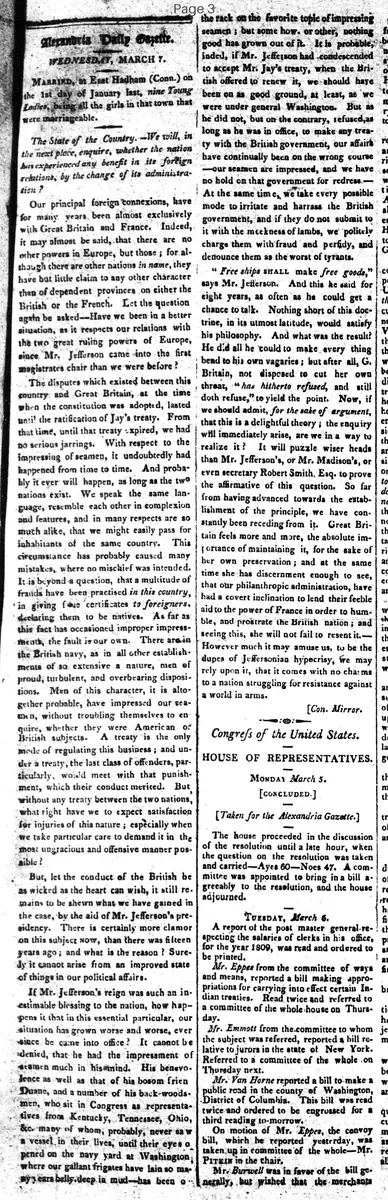
The State of the Country. - We will, in the next place, enquire, whether the nation has experienced any benefit in its foreign relations, by the change of its administration?
Our principal foreign connexions, have for many years, been almost exclusively with Great Britain and France. Indeed, it may almost be said, that there are no other powers in Europe, but those; for although there are other nations in name, they have but little claim to any other character than of dependent provinces on either the British or the French. Let the question again be asked--Have we been in a better situation, as it respects our relations with the two great ruling powers of Europe, since Mr. Jefferson came into the first magistrate's chair than we were before?
The disputes which existed between this country and Great Britain, at the time when the constitution was adopted, lasted until the ratification of Jay's treaty. From that time, until that treaty expired, we had no serious jarrings. With respect to the impressing of seamen, it undoubtedly had happened from time to time. And probably it ever will happen, as long as the two nations exist. We speak the same language, resemble each other in complexion and features, and in many respects are so much alike, that we might easily pass for inhabitants of the same country. This circumstance has probably caused many mistakes, where no mischief was intended.
It is beyond a question, that a multitude of frauds have been practised in this country, in giving false certificates to foreigners, declaring them to be natives. As far as this fact has occasioned improper impressments, the fault is our own. There again in the British navy, as in all other establishments of so extensive a nature, men of proud, turbulent, and overbearing dispositions. Men of this character, it is altogether probable, have impressed our seamen, without troubling themselves to enquire, whether they were American or British subjects. A treaty is the only mode of regulating this business; and under a treaty, the last class of offenders, particularly, would meet with that punishment, which their conduct merited. But without any treaty between the two nations, what right have we to expect satisfaction for injuries of this nature; especially when we take particular care to demand it in the most ungracious and offensive manner possible?
But, let the conduct of the British be as wicked as the heart can wish, it still remains to be shewn what we have gained in the case, by the aid of Mr. Jefferson's presidency. There is certainly more clamor on this subject now, than there was fifteen years ago; and what is the reason? Surely it cannot arise from an improved state of things in our political affairs.
If Mr. Jefferson's reign was such an inestimable blessing to the nation, how happens it that in this essential particular, our situation has grown worse and worse, ever since he came into office? It cannot be denied, that he had the impressment of seamen much in his mind. His benevolence as well as that of his bosom friend Duane, and a number of his back-woods men, who sit in Congress as representatives from Kentucky, Tennessee, Ohio, &c. many of whom, probably, never saw a vessel in their lives, until their eyes opened on the navy yard at Washington: where our gallant frigates have lain so many years belly-deep in mud--has been on the rack on the favorite topic of impressing seamen; but some how or other, nothing good has grown out of it. It is probable, indeed, if Mr. Jefferson had condescended to accept Mr. Jay's treaty, when the British offered to renew it, we should have been on as good ground, at least, as we were under general Washington. But as he did not, but on the contrary, refused, as long as he was in office, to make any treaty with the British government, our affairs have continually been on the wrong course--our seamen are impressed, and we have no hold on that government for redress.--
At the same time, we take every possible mode to irritate and harass the British government, and if they do not submit to it with the meekness of lambs, we politely charge them with fraud and perfidy, and denounce them as the worst of tyrants.
"Free ships shall make free goods," says Mr. Jefferson. And this he said for eight years, as often as he could get a chance to talk. Nothing short of this doctrine, in its utmost latitude, would satisfy his philosophy. And what was the result? He did all he could to make, every thing bend to his own vagaries; but after all, Great Britain, not disposed to cut her own throat, "has hitherto refused, and still doth refuse," to yield the point. Now, if we should admit, for the sake of argument, that this is a delightful theory; the enquiry will immediately arise, are we in a way to realize it? It will puzzle wiser heads than Mr. Jefferson's, or Mr. Madison's, or even secretary Robert Smith, Esq. to prove the affirmative of this question. So far from having advanced towards the establishment of the principle, we have constantly been receding from it. Great Britain feels more and more, the absolute importance of maintaining it, for the sake of her own preservation; and at the same time she has discernment enough to see, that our philanthropic administration, have had a covert inclination to lend their feeble aid to the power of France in order to humble, and prostrate the British nation; and seeing this, she will not fail to resent it.--
However much it may amuse us, to be the dupes of Jeffersonian hypocrisy, we may rely upon it, that it comes with no charms to a nation struggling for resistance against a world in arms.
Our principal foreign connexions, have for many years, been almost exclusively with Great Britain and France. Indeed, it may almost be said, that there are no other powers in Europe, but those; for although there are other nations in name, they have but little claim to any other character than of dependent provinces on either the British or the French. Let the question again be asked--Have we been in a better situation, as it respects our relations with the two great ruling powers of Europe, since Mr. Jefferson came into the first magistrate's chair than we were before?
The disputes which existed between this country and Great Britain, at the time when the constitution was adopted, lasted until the ratification of Jay's treaty. From that time, until that treaty expired, we had no serious jarrings. With respect to the impressing of seamen, it undoubtedly had happened from time to time. And probably it ever will happen, as long as the two nations exist. We speak the same language, resemble each other in complexion and features, and in many respects are so much alike, that we might easily pass for inhabitants of the same country. This circumstance has probably caused many mistakes, where no mischief was intended.
It is beyond a question, that a multitude of frauds have been practised in this country, in giving false certificates to foreigners, declaring them to be natives. As far as this fact has occasioned improper impressments, the fault is our own. There again in the British navy, as in all other establishments of so extensive a nature, men of proud, turbulent, and overbearing dispositions. Men of this character, it is altogether probable, have impressed our seamen, without troubling themselves to enquire, whether they were American or British subjects. A treaty is the only mode of regulating this business; and under a treaty, the last class of offenders, particularly, would meet with that punishment, which their conduct merited. But without any treaty between the two nations, what right have we to expect satisfaction for injuries of this nature; especially when we take particular care to demand it in the most ungracious and offensive manner possible?
But, let the conduct of the British be as wicked as the heart can wish, it still remains to be shewn what we have gained in the case, by the aid of Mr. Jefferson's presidency. There is certainly more clamor on this subject now, than there was fifteen years ago; and what is the reason? Surely it cannot arise from an improved state of things in our political affairs.
If Mr. Jefferson's reign was such an inestimable blessing to the nation, how happens it that in this essential particular, our situation has grown worse and worse, ever since he came into office? It cannot be denied, that he had the impressment of seamen much in his mind. His benevolence as well as that of his bosom friend Duane, and a number of his back-woods men, who sit in Congress as representatives from Kentucky, Tennessee, Ohio, &c. many of whom, probably, never saw a vessel in their lives, until their eyes opened on the navy yard at Washington: where our gallant frigates have lain so many years belly-deep in mud--has been on the rack on the favorite topic of impressing seamen; but some how or other, nothing good has grown out of it. It is probable, indeed, if Mr. Jefferson had condescended to accept Mr. Jay's treaty, when the British offered to renew it, we should have been on as good ground, at least, as we were under general Washington. But as he did not, but on the contrary, refused, as long as he was in office, to make any treaty with the British government, our affairs have continually been on the wrong course--our seamen are impressed, and we have no hold on that government for redress.--
At the same time, we take every possible mode to irritate and harass the British government, and if they do not submit to it with the meekness of lambs, we politely charge them with fraud and perfidy, and denounce them as the worst of tyrants.
"Free ships shall make free goods," says Mr. Jefferson. And this he said for eight years, as often as he could get a chance to talk. Nothing short of this doctrine, in its utmost latitude, would satisfy his philosophy. And what was the result? He did all he could to make, every thing bend to his own vagaries; but after all, Great Britain, not disposed to cut her own throat, "has hitherto refused, and still doth refuse," to yield the point. Now, if we should admit, for the sake of argument, that this is a delightful theory; the enquiry will immediately arise, are we in a way to realize it? It will puzzle wiser heads than Mr. Jefferson's, or Mr. Madison's, or even secretary Robert Smith, Esq. to prove the affirmative of this question. So far from having advanced towards the establishment of the principle, we have constantly been receding from it. Great Britain feels more and more, the absolute importance of maintaining it, for the sake of her own preservation; and at the same time she has discernment enough to see, that our philanthropic administration, have had a covert inclination to lend their feeble aid to the power of France in order to humble, and prostrate the British nation; and seeing this, she will not fail to resent it.--
However much it may amuse us, to be the dupes of Jeffersonian hypocrisy, we may rely upon it, that it comes with no charms to a nation struggling for resistance against a world in arms.
What sub-type of article is it?
Foreign Affairs
Partisan Politics
What keywords are associated?
Jefferson Administration
Impressment Of Seamen
Jay's Treaty
British Relations
Free Ships Make Free Goods
Foreign Policy
Us Diplomacy
What entities or persons were involved?
Mr. Jefferson
Great Britain
France
Jay's Treaty
Duane
Mr. Madison
Secretary Robert Smith
General Washington
Editorial Details
Primary Topic
Critique Of Jefferson's Foreign Policy With Britain
Stance / Tone
Strongly Critical Of Jefferson's Administration
Key Figures
Mr. Jefferson
Great Britain
France
Jay's Treaty
Duane
Mr. Madison
Secretary Robert Smith
General Washington
Key Arguments
U.S. Relations With Britain Worsened Under Jefferson Compared To Before
Impressment Of Seamen Persists Due To Lack Of Treaty Renewal
Jefferson Refused To Renew Jay's Treaty, Leading To No Redress For Impressments
U.S. Frauds With False Certificates Contribute To Impressment Issues
Jefferson's 'Free Ships Make Free Goods' Doctrine Has Not Been Accepted By Britain
Administration Shows Bias Toward France Against Britain
More Clamor On Impressment Now Without Improvement