Thank you for visiting SNEWPapers!
Sign up free
Literary
September 2, 1858
Fayetteville Observer
Fayetteville, Lincoln County, Tennessee
What is this article about?
A narrative tale of a longstanding Kentucky family feud between the Borlands and Harlands, originating from Revolutionary loyalties. Political rivals duel fatally; the dying Harland extracts a revenge oath from his son, leading to young Harland's drunken confrontation and death with young Borland, leaving Flora Borland insane.
Clipping
OCR Quality
98%
Excellent
Full Text
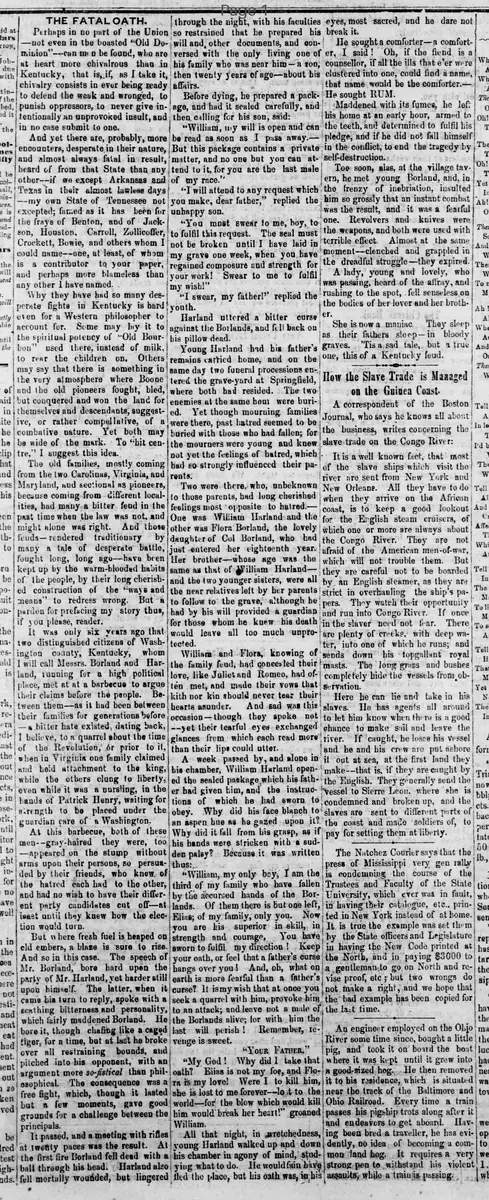
THE FATAL OATH.
Perhaps in no part of the Union--not even in the boasted "Old Dominion"--can men be found, who are at heart more chivalrous than in Kentucky, that is, if, as I take it, chivalry consists in ever being ready to defend the weak and wronged, to punish oppressors, to never give intentionally an unprovoked insult, and in no case submit to one.
And yet there are, probably, more encounters, desperate in their nature, and almost always fatal in result, heard of from that State than any other--if we except Arkansas and Texas in their almost lawless days--my own State of Tennessee not excepted; reared as it has been for the rays of Benton, and of Jackson, Houston, Carroll, Zollicoffer, Crockett, Bowie, and others whom I could name--one, at least, of whom is a contributor to your paper, and perhaps more blameless than any other I have named.
Why they have had so many desperate fights in Kentucky is hard even for a Western philosopher to account for. Some may lay it to the spiritual potency of "Old Bourbon" used there, instead of milk, to rear the children on. Others may say that there is something in the very atmosphere where Boone and the old pioneers fought, bled, but conquered and won the land for themselves and descendants, suggestive, or rather compellative, of a combative nature. Yet both may be wide of the mark. To hit centre, I suggest this idea.
The old families, mostly coming from the two Carolinas, Virginia, and Maryland, and sectional as pioneers, because coming from different localities, had many a bitter feud in the past time when the law was not, and might alone was right. And those feuds--rendered traditionary by many a tale of desperate battle, fought long, long ago--have been kept up by the warm-blooded habits of the people, by their long cherished construction of the ways and means to redress wrong. But a pardon for prefacing my story thus, if you please, reader.
It was only six years ago that two distinguished citizens of Washington county, Kentucky, whom I will call Messrs. Borland and Harland, running for a high political place, met at a barbecue to argue their claims before the people. Between them--as it had been between their families for generations before--a bitter hate existed, dating back, I believe, to a quarrel about the time of the Revolution, or prior to it, when in Virginia one family claimed and held attachment to the king, while the others clung to liberty, even while it was a pursing, in the hands of Patrick Henry, waiting or strength to be placed under the guardian care of a Washington.
At this barbecue, both of these men--gray-haired they were, too--appeared on the stump without arms upon their persons, so persuaded by their friends, who knew of the hatred each had to the other, and had no wish to have their different party candidates cut off--at least until they knew how the election would turn.
But where resin fuel is heaped on old embers, a blaze is sure to rise. And so in this case. The speech of Mr. Borland, bore hard upon the party of Mr. Harland, yet harder still upon himself. The latter, when it came his turn to reply, spoke with a scathing bitterness and personality, which fairly maddened Borland. He bore it, though chafing like a caged tiger, or a time, but at last he broke over all restraining bounds, and pitched into his opponent, with an argument more so-fistical than philosophical. The consequence was a free fight, which, though it lasted but a few moments, gave good grounds for a challenge between the principals.
It passed, and a meeting with rifles at twenty paces was the result. At the first fire Borland fell dead with a ball through his head. Harland also fell mortally wounded, but lingered through the night, with his faculties so restrained that he prepared his will and other documents, and conversed with the only living one of his family who was near him--a son, then twenty years of age--about his affairs.
Before dying, he prepared a package, and had it sealed carefully, and then calling for his son, said:
"William, my will is open and can be read as soon as I pass away. But this package contains a private matter, and no one but you can attend to it, for you are the last male of my race."
"I will attend to any request which you make, dear father," replied the unhappy son.
"You must swear to me, boy, to fulfil this request. The seal must not be broken until I have laid in my grave one week, when you have regained composure and strength for your work! Swear to me to fulfil my wish!"
"I swear, my father!" replied the youth.
Harland uttered a bitter curse against the Borlands, and fell back on his pillow dead.
Young Harland had his father's remains carried home, and on the same day two funeral processions entered the grave-yard at Springfield, where both had resided. The two enemies at the same hour were buried. Yet though mourning families were there, past hatred seemed to be buried with those who had fallen; for the mourners were young and knew not yet the feelings of hatred, which had so strongly influenced their parents.
Two were there, who, unbeknown to those parents, had long cherished feelings most opposite to hatred. One was William Harland and the other was Flora Borland, the lovely daughter of Col. Borland, who had just entered her eighteenth year. Her brother--whose age was the same as that of William Harland--and the two younger sisters, were all the near relatives left by her parents to follow to the grave, although he had by his will provided a guardian for those whom he knew his death would leave all too much unprotected.
William and Flora, knowing of the family feud, had concealed their love, like Juliet and Romeo, had often met, and made their vows that kith nor kin should never tear their hearts asunder. And sad was this occasion--though they spoke not--yet their tearful eyes exchanged glances from which each read more than their lips could utter.
A week passed by, and alone in his chamber, William Harland opened the sealed package which his father had given him, and the instructions of which he had sworn to obey. Why did his face blanch to an aspen hue as he gazed upon it? Why did it fall from his grasp, as if his hands were stricken with a sudden palsy? Because it was written thus:
"William, my only boy, I am the third of my family who have fallen by the accursed hands of the Borlands. Of them there is but one left, Elias; of my family, only you. Now you are his superior in skill, in strength and courage. You have sworn to fulfil my direction! Keep your oath, or feel that a father's curse hangs over you! And, oh, what on earth is more fearful than a father's curse? It is my wish that at once you seek a quarrel with him, provoke him to an attack; and leave not a male of the Borlands alive; for with him the last will perish! Remember, revenge is sweet.
Your Father."
"My God! Why did I take that oath? Elias is not my foe, and Flora is my love! Were I to kill him, she is lost to me forever--lost to the world--for the blow which would kill him would break her heart!" groaned William.
All that night, in wretchedness, young Harland walked up and down his chamber in agony of mind, studying what to do. He would fain have fled the place, but his oath was, in his eyes, most sacred, and he dare not break it.
He sought a comforter--a comforter, I said! Oh, if the fiend is a counsellor, if all the ills that e'er were clustered into one, could find a name, that name would be the comforter.--He sought RUM.
Maddened with its fumes, he left his home at an early hour, armed to the teeth, and determined to fulfil his pledge, and if he did not fall himself in the conflict, to end the tragedy by self-destruction.
Too soon, alas, at the village tavern, he met young Borland, and, in the frenzy of inebriation, insulted him so grossly that an instant combat was the result, and it was a fearful one. Revolvers and knives were the weapons, and both were used with terrible effect. Almost at the same moment--clenched and grappled in the dreadful struggle--they expired.
A lady, young and lovely, who was passing, heard of the affray, and rushing to the spot, fell senseless on the bodies of her lover and her brother.
She is now a maniac. They sleep as their fathers sleep--in bloody graves. 'Tis a sad tale, but a true one, this of a Kentucky feud.
Perhaps in no part of the Union--not even in the boasted "Old Dominion"--can men be found, who are at heart more chivalrous than in Kentucky, that is, if, as I take it, chivalry consists in ever being ready to defend the weak and wronged, to punish oppressors, to never give intentionally an unprovoked insult, and in no case submit to one.
And yet there are, probably, more encounters, desperate in their nature, and almost always fatal in result, heard of from that State than any other--if we except Arkansas and Texas in their almost lawless days--my own State of Tennessee not excepted; reared as it has been for the rays of Benton, and of Jackson, Houston, Carroll, Zollicoffer, Crockett, Bowie, and others whom I could name--one, at least, of whom is a contributor to your paper, and perhaps more blameless than any other I have named.
Why they have had so many desperate fights in Kentucky is hard even for a Western philosopher to account for. Some may lay it to the spiritual potency of "Old Bourbon" used there, instead of milk, to rear the children on. Others may say that there is something in the very atmosphere where Boone and the old pioneers fought, bled, but conquered and won the land for themselves and descendants, suggestive, or rather compellative, of a combative nature. Yet both may be wide of the mark. To hit centre, I suggest this idea.
The old families, mostly coming from the two Carolinas, Virginia, and Maryland, and sectional as pioneers, because coming from different localities, had many a bitter feud in the past time when the law was not, and might alone was right. And those feuds--rendered traditionary by many a tale of desperate battle, fought long, long ago--have been kept up by the warm-blooded habits of the people, by their long cherished construction of the ways and means to redress wrong. But a pardon for prefacing my story thus, if you please, reader.
It was only six years ago that two distinguished citizens of Washington county, Kentucky, whom I will call Messrs. Borland and Harland, running for a high political place, met at a barbecue to argue their claims before the people. Between them--as it had been between their families for generations before--a bitter hate existed, dating back, I believe, to a quarrel about the time of the Revolution, or prior to it, when in Virginia one family claimed and held attachment to the king, while the others clung to liberty, even while it was a pursing, in the hands of Patrick Henry, waiting or strength to be placed under the guardian care of a Washington.
At this barbecue, both of these men--gray-haired they were, too--appeared on the stump without arms upon their persons, so persuaded by their friends, who knew of the hatred each had to the other, and had no wish to have their different party candidates cut off--at least until they knew how the election would turn.
But where resin fuel is heaped on old embers, a blaze is sure to rise. And so in this case. The speech of Mr. Borland, bore hard upon the party of Mr. Harland, yet harder still upon himself. The latter, when it came his turn to reply, spoke with a scathing bitterness and personality, which fairly maddened Borland. He bore it, though chafing like a caged tiger, or a time, but at last he broke over all restraining bounds, and pitched into his opponent, with an argument more so-fistical than philosophical. The consequence was a free fight, which, though it lasted but a few moments, gave good grounds for a challenge between the principals.
It passed, and a meeting with rifles at twenty paces was the result. At the first fire Borland fell dead with a ball through his head. Harland also fell mortally wounded, but lingered through the night, with his faculties so restrained that he prepared his will and other documents, and conversed with the only living one of his family who was near him--a son, then twenty years of age--about his affairs.
Before dying, he prepared a package, and had it sealed carefully, and then calling for his son, said:
"William, my will is open and can be read as soon as I pass away. But this package contains a private matter, and no one but you can attend to it, for you are the last male of my race."
"I will attend to any request which you make, dear father," replied the unhappy son.
"You must swear to me, boy, to fulfil this request. The seal must not be broken until I have laid in my grave one week, when you have regained composure and strength for your work! Swear to me to fulfil my wish!"
"I swear, my father!" replied the youth.
Harland uttered a bitter curse against the Borlands, and fell back on his pillow dead.
Young Harland had his father's remains carried home, and on the same day two funeral processions entered the grave-yard at Springfield, where both had resided. The two enemies at the same hour were buried. Yet though mourning families were there, past hatred seemed to be buried with those who had fallen; for the mourners were young and knew not yet the feelings of hatred, which had so strongly influenced their parents.
Two were there, who, unbeknown to those parents, had long cherished feelings most opposite to hatred. One was William Harland and the other was Flora Borland, the lovely daughter of Col. Borland, who had just entered her eighteenth year. Her brother--whose age was the same as that of William Harland--and the two younger sisters, were all the near relatives left by her parents to follow to the grave, although he had by his will provided a guardian for those whom he knew his death would leave all too much unprotected.
William and Flora, knowing of the family feud, had concealed their love, like Juliet and Romeo, had often met, and made their vows that kith nor kin should never tear their hearts asunder. And sad was this occasion--though they spoke not--yet their tearful eyes exchanged glances from which each read more than their lips could utter.
A week passed by, and alone in his chamber, William Harland opened the sealed package which his father had given him, and the instructions of which he had sworn to obey. Why did his face blanch to an aspen hue as he gazed upon it? Why did it fall from his grasp, as if his hands were stricken with a sudden palsy? Because it was written thus:
"William, my only boy, I am the third of my family who have fallen by the accursed hands of the Borlands. Of them there is but one left, Elias; of my family, only you. Now you are his superior in skill, in strength and courage. You have sworn to fulfil my direction! Keep your oath, or feel that a father's curse hangs over you! And, oh, what on earth is more fearful than a father's curse? It is my wish that at once you seek a quarrel with him, provoke him to an attack; and leave not a male of the Borlands alive; for with him the last will perish! Remember, revenge is sweet.
Your Father."
"My God! Why did I take that oath? Elias is not my foe, and Flora is my love! Were I to kill him, she is lost to me forever--lost to the world--for the blow which would kill him would break her heart!" groaned William.
All that night, in wretchedness, young Harland walked up and down his chamber in agony of mind, studying what to do. He would fain have fled the place, but his oath was, in his eyes, most sacred, and he dare not break it.
He sought a comforter--a comforter, I said! Oh, if the fiend is a counsellor, if all the ills that e'er were clustered into one, could find a name, that name would be the comforter.--He sought RUM.
Maddened with its fumes, he left his home at an early hour, armed to the teeth, and determined to fulfil his pledge, and if he did not fall himself in the conflict, to end the tragedy by self-destruction.
Too soon, alas, at the village tavern, he met young Borland, and, in the frenzy of inebriation, insulted him so grossly that an instant combat was the result, and it was a fearful one. Revolvers and knives were the weapons, and both were used with terrible effect. Almost at the same moment--clenched and grappled in the dreadful struggle--they expired.
A lady, young and lovely, who was passing, heard of the affray, and rushing to the spot, fell senseless on the bodies of her lover and her brother.
She is now a maniac. They sleep as their fathers sleep--in bloody graves. 'Tis a sad tale, but a true one, this of a Kentucky feud.
What sub-type of article is it?
Prose Fiction
What themes does it cover?
Moral Virtue
Liberty Freedom
Death Mortality
What keywords are associated?
Family Feud
Fatal Oath
Revenge
Duel
Tragedy
Kentucky
Prohibited Love
Literary Details
Title
The Fatal Oath.
Subject
A Tale Of Kentucky Family Feud
Key Lines
"William, My Only Boy, I Am The Third Of My Family Who Have Fallen By The Accursed Hands Of The Borlands. Of Them There Is But One Left, Elias; Of My Family, Only You. Now You Are His Superior In Skill, In Strength And Courage. You Have Sworn To Fulfil My Direction! Keep Your Oath, Or Feel That A Father's Curse Hangs Over You! And, Oh, What On Earth Is More Fearful Than A Father's Curse? It Is My Wish That At Once You Seek A Quarrel With Him, Provoke Him To An Attack; And Leave Not A Male Of The Borlands Alive; For With Him The Last Will Perish! Remember, Revenge Is Sweet.
Your Father."
"My God! Why Did I Take That Oath? Elias Is Not My Foe, And Flora Is My Love! Were I To Kill Him, She Is Lost To Me Forever Lost To The World For The Blow Which Would Kill Him Would Break Her Heart!" Groaned William.
She Is Now A Maniac. They Sleep As Their Fathers Sleep In Bloody Graves. 'Tis A Sad Tale, But A True One, This Of A Kentucky Feud.