Thank you for visiting SNEWPapers!
Sign up free
New York Tribune
New York, New York County, New York
What is this article about?
Legal dispute: Edilberto Giro attaches Albert Weber's property over unpaid $2,000 mining investment amid Weber's personal insolvency claims from speculations. Estate of late father Albert Weber remains solvent; background on family piano business and son's lavish spending. (248 characters)
Merged-components note: These two sequential components (ro23 and ro24) form a single coherent story about Albert Weber's financial troubles and the Weber family business history.
Clipping
OCR Quality
Full Text
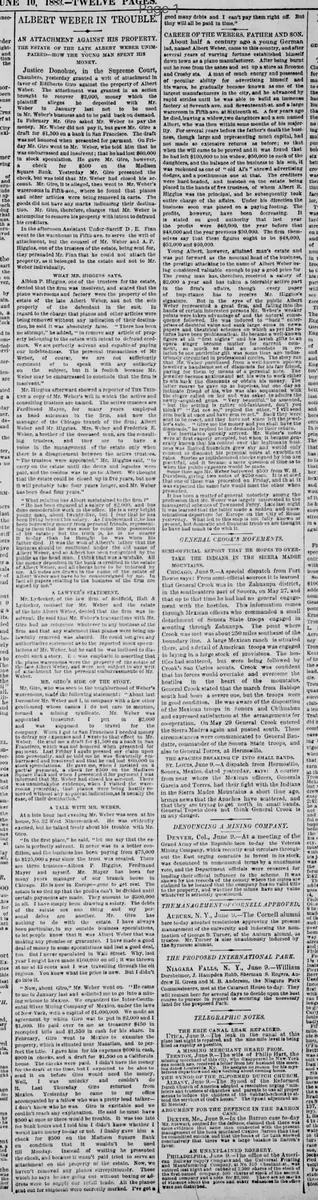
AN ATTACHMENT AGAINST HIS PROPERTY
THE ESTATE OF THE LATE ALBERT WEBER UNIMPAIRED—HOW THE YOUNG MAN SPENT HIS MONEY.
Justice Donohue, in the Supreme Court, Chambers, yesterday granted a writ of attachment in favor of Edilberto Giro against the property of Albert Weber. The attachment was granted in an action brought to recover $2,000, money which the plaintiff alleges he deposited with Mr. Weber in January last not to be used in Mr. Weber's business and to be paid back on demand.
In February Mr. Giro asked Mr. Weber to pay the money. Mr. Weber did not pay it, but gave Mr. Giro a draft for $1,500 on a bank in San Francisco. The draft was not honored when presented for payment. On Friday Mr. Giro went to Mr. Weber, who told him that he was embarrassed and insolvent; that he had lost $60,000 in stock speculation. He gave Mr. Giro, however, a check for $500 on the Madison Square Bank. Yesterday Mr. Giro presented the check, but was told that Mr. Weber had closed his account. Mr. Giro, it is alleged, then went to Mr. Weber's warerooms in Fifth-ave., where he found that pianos and other articles were being removed in carts. The goods did not have any marks indicating their destination. Mr. Giro, therefore, charges that Mr. Weber is attempting to remove his property with intent to defraud his creditors.
In the afternoon Assistant Under-Sheriff D. E. Finn went to the warehouse in Fifth-ave. to serve the writ of attachment, but the counsel of Mr. Weber and A. P. Higgins, one of the trustees of the estate, being sent for, they persuaded Mr. Finn that he could not attach the property, as it belonged to the estate and not to Mr. Weber individually.
WHAT MR. HIGGINS SAYS.
Albion P. Higgins, one of the trustees for the estate, denied that the firm was insolvent, and stated that the piano warerooms and factory were the property of the estate of the late Albert Weber, and not the sole property of the defendant in the suit. In regard to the charge that pianos and other articles were being removed without any indication of their destination, he said it was absolutely false. "There has been no attempt," he added, "to remove any article of property belonging to the estate with intent to defraud creditors. We are perfectly solvent and capable of paying our indebtedness."
The personal transactions of Mr. Weber, of course, we are not sufficiently cognizant of to speak with any authority on the subject, but it is foolish because Mr. Weber may be embarrassed to conclude that the firm is insolvent.
Mr. Higgins afterward showed a reporter of The Tribune a copy of Mr. Weber's will in which the active and consulting trustees are named. The active trustees are Ferdinand Mayer, for many years employed as head salesman in the firm, and now the manager of the Chicago branch of the firm; Albert Weber and Mr. Higgins. Mrs. Weber and Frederick E. Weber, a brother of the deceased man, are the consulting trustees, and they are to have a voice in the management of the estate only when there is a disagreement between the active trustees.
"The trustees were appointed," Mr. Higgins said, "to carry on the estate until the debts and legacies were paid, and the residue was to go to Albert. We thought that the estate could be closed up in five years, but now it will probably take four years longer, and Mr. Weber has been dead four years."
"What relation has Albert maintained to the firm?"
"He has been engaged at a salary of $2,000, and has done considerable work in the office. He is a very bright young man, about twenty-five, but I fear that he has been living beyond his salary. As I understand it, he has been borrowing money from personal friends, representing to them that he was soon to come into possession of his estate; but the truth is, he is no nearer it to-day than he thought he was when his father died. It was the wish of Albert's father that the business should be continued under the old name of Albert Weber, and so Albert has been recognized by the public as the head man. I think that was a mistake. All the money deposited in the bank is credited to the estate of Albert Weber, and all checks have to be indorsed by me. All notes are drawn in the name of the estate of Albert Weber and have to be countersigned by me. In fact all papers relating to the business of the firm are signed by me."
A LAWYER'S STATEMENT
Mr. Lydecker, of the law firm of Redfield, Hall & Lydecker, counsel for Mr. Weber and the estate of the late Albert Weber, denied that the firm was insolvent. He said that Mr. Weber's transactions with Mr. Giro had no reference whatever to any business of the firm and that any statement that pianos were being unlawfully removed was absurd. He could not give any authoritative statement as to the reported stock speculations of Mr. Weber, but he said he was inclined to dis-credit such a story. He was emphatic in asserting that the piano warerooms were the property of the estate of the late Albert Weber, and were not subject to any writ of attachment for the personal embarrassments of Mr. Weber.
MR. GIRO'S SIDE OF THE STORY.
Mr. Giro, who was seen in the neighborhood of Weber's warerooms, made the following statement: "About last December Mr. Weber and I, in company with a few other gentlemen whose names I do not care to mention, formed mining syndicate. Mr. Weber was appointed treasurer. I put in $2,000 and was supposed to travel for the company. When I got to San Francisco I needed money to defray my expenses and I wrote to that effect to Mr. Weber. He sent me a draft for $1,500 on a bank in San Francisco, which was not honored when presented for payment. Last Friday I again pressed my claim upon him personally, and he told me he was financially embarrassed and insolvent and that he had lost $60,000 in stock speculations. He gave me, when I insisted on a partial payment, a check for $500 on the Madison Square Bank and when I presented it for payment I was informed that Mr. Weber had closed his account. There was unmistakable evidence, when I visited the warerooms yesterday, that pianos were being hastily removed without any apparent indication, as is usually the case, of their destination."
A TALK WITH MR. WEBER.
At a late hour last evening Mr. Weber was seen at his house, No. 32 West Nineteenth-st. He was evidently excited, but he talked freely about his trouble with Mr. Giro.
"In the first place," he said, "let me say that the estate is perfectly solvent. It never was in a better condition, and the business has been paying from $75,000 to $125,000 a year since the trust was created. There are three trustees—Albion P. Higgins, Ferdinand Mayer and myself. Mr. Mayer has been for many years manager of our branch house in Chicago. He is now in Europe—gone to get rest. The estate is so tied up that the profits can't be divided until certain payments are made. They amount to $500,000 in all. I have simply been drawing a salary. The debts of the estate are one thing and my personal debts are another.
Mr. Giro has nothing to do with the estate. I have always been particular, in my outside business speculations, to let people know that it was Albert Weber that was making any promise or guarantee. I have made a good deal of money in some speculations and lost a good deal too. But I never speculated in Wall Street. Why, last year I might have made $100,000 on oil; it was thrown at me at 42 cents and I was travelling through the oil regions. You know what the price is now. But I didn't go into it.
"Now, about Giro," Mr. Weber went on. "He came to me in January last and solicited me to go into a mining scheme in Mexico. We organized the Inter-Continental Silver Mining Company of Mexico, under the laws of New-York, with a capital of $1,000,000. We made an agreement by which Giro was to put in $2,000 and I $1,000. He paid over to me as treasurer $450 in receipted bills and $1,550 in cash for his share. In February, Giro went to Mexico to examine the property, which is situated near Mazatlan, and to perfect the title. I gave him for his expenses $600 in cash, $900 in checks, and a draft for $1,500 on a California house. The checks were paid. I didn't have the money for the draft at the time, but I expected to be able to send it on before Giro would need the money.
Well, I was unlucky and couldn't do it. Last Thursday Giro returned from Mexico. Yesterday he came to my office accompanied by a fellow who was a pretty loud talker—I don't know who he was. Giro is excitable and we couldn't reach any explanation. He said he must have $500 at once or there would be trouble. It was too late for bank hours and I told him I didn't know whether I would have money to-day or not. I finally gave him a check for $500 on the Madison Square Bank on condition that it wouldn't be used till Monday. Instead of waiting he presented the check, and because it wasn't paid tried to serve an attachment on the property of the estate. Now, we haven't removed any pianos surreptitiously. Those which he says he saw going out without boxing or address were to supply our retail trade. All the pianos sent out for shipment were correctly marked. I've got a good many debts and I can't pay them right off. But they will all be paid in time."
CAREER OF THE WEBERS. FATHER AND SON.
About half a century ago a young German lad, named Albert Weber, came to this country, and after several years of varying fortune established himself down town as a piano manufacturer. After being burnt out he rose from the ashes and set up a store at Broome and Crosby sts. A man of much energy and possessed of peculiar ability for advertising himself and his wares, he gradually became known as one of the largest manufacturers in the city, and he advanced by rapid strides until he was able to build an immense factory at Seventh-ave. and Seventeenth-st. and a large wareroom in Fifth-ave. at Sixteenth st. A few years ago he died, leaving a widow, two daughters and a son named Albert, who was then within some months of his majority. For several years before the father's death the business, though large and representing much capital, had not made so extensive returns as before; so that when the will came to be proved and it was found that he had left $100,000 to his widow, $50,000 to each of the daughters, and the balance of the business to his son, it was reckoned as one of "old Al's" shrewd advertising dodges, and a posthumous one at that. The creditors were hard-headed, and insisted on the estate being placed in the hands of five trustees, of whom Albert R. Higgins was the principal, and he subsequently took entire charge of the affairs. Under his direction the business soon was placed on a paying footing. The profits, however, have been decreasing. It is stated on good authority that last year the profits were $40,000, the year before that $48,000 and the year previous $50,000. The firm themselves say that these figures ought to be $48,000, $52,000 and $60,000.
Young Albert, however, attained man's estate and was put forward as the nominal head of the business the prestige attaching to the name of Albert Weber being considered valuable enough to pay a good price for The young man has, therefore, received a salary of $2,000 a year and has taken a tolerably active part in the firm's affairs, though every paper of importance has to receive Mr. Higgins's signature.
But in the eyes of the public Albert Weber represented a great firm, and falling into the hands of certain interested persons Mr. Weber's weaker points were taken advantage of and the natural consequence followed. He was induced to "back" enterprises of doubtful value and sank large sums in newspapers and theatrical schemes on which as yet the returns have been problematical. He became a well-known figure at all "first nights" and his lavish gifts to an opera singer became matter for current comment, so much so that an anecdote in relation to one particular gift was some time ago industriously circulated in professional circles. The story ran that Mr. Weber purchased from a well-known uptown jeweler a handsome set of diamonds for his fair friend, paying for them by means of a personal note. The jeweler became anxious and set his wits to work either to win back the diamonds or obtain his money. The latter course he gave up as hopeless, but one day an intimate friend of his, who was also acquainted with the singer called on her and was asked to admire the newly-acquired gems. "Very beautiful," he assented. "but the setting is rather old-fashioned, don't you think!" "Zat ees so," replied the other. "I vill send zem back at once and have zem re-set." Back they were sent to be re-set, and they have not since left the jeweler's safe. "Give me the money and you shal have the diamonds," he replied to the demands for their return.
The Inevitable quickly arrived. Mr. Weber's notes were at first eagerly accepted, but when it became generally known that his control over the legitimate business was limited financiers grew shy and would only consent to discount his personal notes at exorbitant rates. Stories as to dishonored checks signed by him are plentiful, and it became a mere question of time as to when the public exposure would be made.
Some time ago Mr. Weber borrowed $500 from W. H. Davidson, giving two notes of $250 each. It is stated that one of these was protested on Friday, and that it was expected the same fate would meet the other when presented.
It has been a matter of general notoriety among the profession that Mr. Weber was largely interested in the managerial schemes of Townsend Percy. Late last night it was learned that the latter made a sudden and unostentatious departure for Europe on the City of Rome yesterday. What led to this step is not fully known at present, but domestic and financial troubles are thought to have had much to do with it.
What sub-type of article is it?
What themes does it cover?
What keywords are associated?
What entities or persons were involved?
Where did it happen?
Story Details
Key Persons
Location
New York City, Fifth Avenue
Event Date
January And February Last
Story Details
Edilberto Giro sues Albert Weber for $2,000 deposited for a mining syndicate, alleging fraud after dishonored payments and attempts to remove property. Weber denies insolvency of the family piano estate, attributes personal troubles to speculations. Background on Weber family's business history and young Albert's extravagances leading to debts.