Thank you for visiting SNEWPapers!
Sign up free
Phenix Gazette
Alexandria, Virginia
What is this article about?
Detailed report from St. Christopher's Gazette on the piracy of the schooner Las Damas Argentinas, originally Bolivar, fitted as Buenos Ayrean privateer in St. Thomas. It captured vessels including the British brig Carraboo, with involvement of local agents and authorities in St. Eustatius and Saba. Crew tried, condemned, and executed; authorities complicit in plunder.
Clipping
OCR Quality
Full Text
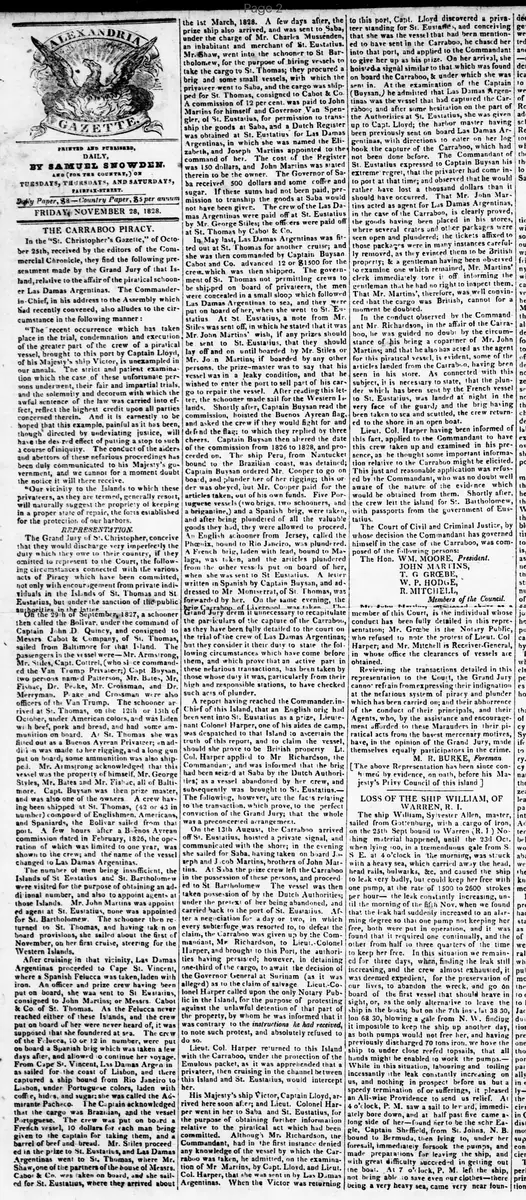
In the St. Christopher's Gazette, of October 25th, received by the editors of the Commercial Chronicle, they find the following presentment made by the Grand Jury of that Island, relative to the affair of the piratical schooner Las Damas Argentinas. The Commander-in-Chief, in his address to the Assembly which had recently convened, also alludes to the circumstance in the following manner:
"The recent occurrence which has taken place in the trial, condemnation and execution of the greater part of the crew of a piratical vessel, brought to this port by Captain Lloyd, of his Majesty's ship Victor, is unexampled in our annals. The strict and patient examination which the case of these unfortunate persons underwent, their fair and impartial trials, and the solemnity and decorum with which the awful sentence of the law was carried into effect, reflect the highest credit upon all parties concerned therein. And it is earnestly to be hoped that this example, painful as it has been, though directed by undeviating justice, will have the desired effect of putting a stop to such a course of iniquity. The conduct of the aiders and abettors of these nefarious proceedings has been duly communicated to his Majesty's government, and we cannot for a moment doubt the notice it will there receive.
"Our vicinity to the Islands to which these privateers, as they are termed, generally resort, will naturally suggest the propriety of keeping in a proper state of repair, the forts established for the protection of our harbors."
REPRESENTATION.
The Grand Jury of St. Christopher, conceive that they would discharge very imperfectly the duty which they owe to their country, if they omitted to represent to the Court, the following circumstances connected with the various acts of Piracy which have been committed, not only with encouragement from private individuals in the Islands of St. Thomas and St. Eustatius, but under the sanction of the public authorities in the latter.
On the 29th of September, 1827, a schooner then called the Bolivar, under the command of Captain John D. Quincy, and consigned to Messrs. Cabot & Company, of St. Thomas, sailed from Baltimore for that Island. The passengers in the vessel were—Mr. Armstrong, Mr. Stiles, Capt. Cottrel, (who since commanded the Van Trump Privateer;) Capt. Buysan, two persons named Patterson, Mr. Bates, Mr. Fishac, Dr. Peoke, Mr. Crossman, and Dr. Merryman. Pake and Crossman were also officers of the Van Trump. The schooner arrived at St. Thomas, on the 12th or 15th of October, under American colors, and was laden with beef, pork and bread, and had some ammunition onboard. At St. Thomas she was fitted out as a Buenos Ayrean Privateer; an addition was made to her rigging, and a long gun put onboard; some ammunition was also shipped. Mr. Armstrong acknowledged that this vessel was the property of himself, Mr. George Stiles, Mr. Bates and Mr. Fisbac, all of Baltimore. Capt. Buysan was then prize master and was also one of the owners. A crew having been shipped at St. Thomas, (42 or 43 in number) composed of Englishmen, Americans, and Spaniards, the Bolivar sailed from that port. A few hours after a Buenos Ayrean commission dated in February, 1826, the operation of which was limited to one year, was shown to the crew; and the name of the vessel changed to Las Damas Argentinas.
The number of men being insufficient, the Islands of St. Eustatius and St. Bartholomew were visited for the purpose of obtaining an additional number, and also to appoint agents at those Islands. Mr. John Martins was appointed agent at St. Eustatius, none was appointed for St. Bartholomew. The schooner then returned to St. Thomas, and having taken on board provisions, she sailed about the first of November, on her first cruise, steering for the Western Islands.
After cruising in that vicinity, Las Damas Argentinas proceeded to Cape St. Vincent, where a Spanish Felucca was taken, laden with iron. An officer and prize crew having been put on board, she was sent to St. Eustatius, consigned to John Martins; or Messrs. Cabot & Co. of St. Thomas. As the Felucca never reached either of these Islands, and the crew put on board of her were never heard of, it was supposed that she foundered at sea. The crew of the Felucca, 10 or 12 in number, were put on board a Spanish brig which was taken a few days after, and allowed to continue her voyage.
From Cape St. Vincent, Las Damas Argentinas sailed for the coast of Lisbon, and there captured a ship bound from Rio Janeiro to Lisbon, under Portuguese colors, laden with coffee, hides, and sugar: she was called the Admiraute Pacheco. The Captain acknowledged that the cargo was Brazilian, and the vessel Portuguese. The crew was put on board a French vessel, 10 dollars for each man being given to the captain for taking them, and a barrel of beef and bread. Mr. Stiles proceeded in the prize to St. Eustatius, and Las Damas Argentinas went to St. Thomas, where Mr. Shaw, one of the partners of the house of Messrs. Cabot & Co. was taken on board, and she sailed for St. Eustatius, where they arrived about the 1st March, 1828. A few days after, the prize ship also arrived, and was sent to Saba, under the charge of Mr. Charles Mussenden, an inhabitant and merchant of St. Eustatius. Mr. Shaw, went into the schooner to St. Bartholomew, for the purpose of hiring vessels to take the cargo to St. Thomas; they procured a brig and some small vessels, with which the privateer went to Saba, and the cargo was shipped for St. Thomas, consigned to Cabot & Co. A commission of 12 per cent. was paid to John Martins for himself and Governor Van Spengler, of St. Eustatius, for permission to transship the goods at Saba, and a Dutch Register was obtained at St. Eustatius for Las Damas Argentinas, in which she was named the Elizabeth, and Joseph Martins appointed to the command of her. The cost of the Register was 150 dollars, and John Martins was stated therein to be the owner. The Governor of Saba received 500 dollars and some coffee and sugar. If these sums had not been paid, permission to tranship the goods at Saba would not have been given. The crew of the Las Damas Argentinas were paid off at St. Eustatius by Mr. George Stiles; the officers were paid off at St. Thomas by Cabot & Co.
In May last, Las Damas Argentinas was fitted out at St. Thomas for another cruise; and she was then commanded by Captain Buysan. Cabot and Co. advanced 12 or 1500 for the crew which was then shipped. The government of St. Thomas not permitting crews to be shipped onboard of privateers, the men were concealed in a small sloop which followed Las Damas Argentinas to sea, and they were put on board of her, when she went to St. Eustatius. At St. Eustatius, a note from Mr. Stiles was sent off, in which he stated that it was Mr. John Martins' wish, if any prizes should be sent to St. Eustatius, that they should lay off and on until boarded by Mr. Stiles or Mr. John Martins; if boarded by any other persons, the prize-master was to say that his vessel was in a leaky condition, and that he wished to enter the port to sell part of his cargo to repair the vessel. After reading this letter, the schooner made sail for the Western Islands. Shortly after, Captain Buysan read the commission, hoisted the Buenos Ayrean flag, and asked the crew if they would fight for and defend the flag: to which they replied by three cheers. Captain Buysan then altered the date of the commission from 1826 to 1828, and proceeded on. The ship Peru, from Nantucket bound to the Brazilian coast, was detained; Captain Buysan ordered Mr. Cooper to go on board, and plunder her of her rigging; this order was obeyed, but Mr. Cooper paid for the articles taken, out of his own funds. Five Portuguese vessels (two brigs, two schooners, and a brigantine,) and a Spanish brig, were taken, and after being plundered of all the valuable goods they had, they were allowed to proceed. An English schooner from Jersey, called the Phænix, bound to Rio Janeiro, was plundered. A French brig, laden with lead, bound to Malaga, was taken, and the articles plundered from the other vessels put onboard of her, when she was sent to St. Eustatius. A letter written in Spanish by Captain Buysan, and addressed to Mr. Montserrat, of St. Thomas, was forwarded by her. On the same evening, the brig Carraboo of Liverpool was taken.
The Grand Jury deem it unnecessary to recapitulate the particulars of the capture of the Carraboo, as they have been fully detailed to the court on the trial of the crew of Las Damas Argentinas; but they consider it their duty to state the following circumstances which have come before them, and which prove that an active part in these nefarious transactions, has been taken by those whose duty it was, particularly from their high and responsible stations, to have checked such acts of plunder.
A report having reached the Commander-in-Chief of this Island, that an English brig had been sent into St. Eustatius as a prize, Lieutenant Colonel Harper, one of his aides de camp, was despatched to that Island to ascertain the truth of this report, and to claim the vessel, should she prove to be British property. Lt. Col. Harper applied to Mr. Richardson, the Commandant, and was informed that the brig had been seized at Saba by the Dutch Authorities; as a vessel abandoned by her crew, and subsequently was brought to St. Eustatius. The following, however, are the facts relating to the transaction, which prove, to the perfect conviction of the Grand Jury; that the whole was a preconcerted arrangement.
On the 13th August, the Carraboo arrived off St. Eustatius, hoisted a private signal, and communicated with the shore; in the evening she sailed for Saba, having taken on board Joseph and Jacob Martins, brothers of John Martins. At Saba the prize crew left the Carraboo in the possession of these persons, and proceeded to St. Bartholomew. The vessel was then taken possession of by the Dutch Authorities; under the pretext of her being abandoned, and carried back to the port of St. Eustatius. After a negociation for a day or two, in which every subterfuge was resorted to, to defeat the claim, the Carraboo was given up by the Commandant, Mr. Richardson, to Lieut.-Colonel Harper, and brought to this Port, the authorities having persisted; however, in detaining one-third of the cargo, to await the decision of the Governor General at Surinam (as it was alleged) as to the claim of salvage. Lieut.-Colonel Harper called upon the only Notary Public in the Island, for the purpose of protesting against the unlawful detention of that part of the property, by whom he was informed that it was contrary to the instructions he had received, to note such protest, and absolutely refused to do so.
Lieut. Col. Harper returned to this Island with the Carraboo, under the protection of the Emulous packet, as it was apprehended that a privateer, then cruising in the channel between this Island and St. Eustatius, would intercept her.
His Majesty's ship Victor, Captain Lloyd, arrived here soon after; and Lieut. Colonel Harper went in her to Saba and St. Eustatius, for the purpose of obtaining further information relative to the piratical act which had been committed. Although Mr. Richardson, the Commandant, had in the first instance denied any knowledge of the vessel by which the Carraboo was taken, he admitted, on the examination of Mr. Martins, by Capt. Lloyd, and Lieut. Col. Harper, that she was sent in by Las Damas Argentinas. When the Victor was returning to this port, Capt. Lloyd discovered a privateer standing for St. Eustatius, and conceiving that she was the vessel that had been mentioned to have sent in the Carraboo, he chased her into that port, and applied to the Commandant to give her up as his prize. On her arrival, she hoisted a signal similar to that which was found on board the Carraboo, & under which she was sent in. At the examination of the Captain (Buysan,) he admitted that Las Damas Argentinas was the vessel that had captured the Carraboo; and after some hesitation on the part of the Authorities at St. Eustatius, she was given up to Capt. Lloyd; the harbor master having been previously sent on board Las Damas Argentinas, with directions to enter on her log book the capture of the Carraboo, which had not been done before. The Commandant of St. Eustatius expressed to Captain Buysan his extreme regret, that the privateer had come into port at that time: and observed that he would rather have lost a thousand dollars than it should have occurred. That Mr. John Martins acted as agent for Las Damas Argentinas, in the case of the Carraboo, is clearly proved, the goods having been placed in his stores, where several crates and other packages were seen open and plundered; the tickets affixed to those packages were in many instances carefully removed, as they evinced them to be British property; & a gentleman having been observed to examine one which remained, Mr. Martins' clerk immediately tore it off informing the gentleman that he had no right to inspect them. That Mr. Martins', therefore, was well convinced that the cargo was British, cannot for a moment be doubted.
In the conduct observed by the Commandant Mr. Richardson, in the affair of the Carraboo, he was guided no doubt by the circumstance of his being a copartner of Mr. John Martins: and that he also has acted as the agent for this piratical vessel, is evident, some of the articles landed from the Carraboo, having been seen in his store. As connected with this subject, it is necessary to state, that the plunder which has been sent by the French vessel to St. Eustatius, was landed at night in the very face of the guard; and the brig having been taken to sea and scuttled, the crew returned to the shore in an open boat.
Lieut. Col. Harper having been informed of this fact, applied to the Commandant to have this crew taken up and examined in his presence, as he thought some important information relative to the Carraboo might be elicited. This just and reasonable application was refused by the Commandant, who was no doubt well aware of the nature of the evidence which would be obtained from them. Shortly after, the crew left the island for St. Bartholomew, with passports from the government of Eustatius.
The Court of Civil and Criminal Justice, by whose decision the Commandant has governed himself in the case of the Carraboo, was composed of the following persons:
The Hon. WM. MOORE, President.
JOHN MARTINS,
T. G. GRÆBE,
W. P. HODGE,
R. MITCHELL,
Members of the Council.
Mr. Martins, a member of this Court, is the individual whose conduct has been fully detailed in this representation; Mr. Græbe is the Notary Public, who refused to note the protest of Lieut. Col. Harper; and Mr. Mitchell is Receiver-General, in whose office the clearances of vessels are obtained.
Reviewing the transactions detailed in this representation to the Court, the Grand Jury cannot refrain from expressing their indignation at the nefarious system of piracy and plunder which has been carried on; and their abhorrence of the conduct of their principals, and their Agents, who, by the assistance and encouragement afforded to these Marauders in their piratical acts from the basest mercenary motives, have, in the opinion of the Grand Jury, made themselves equally participators in the crime.
M. R. BURKE, Foreman
{The above Representation has been since confirmed by evidence, on oath, before his Majesty's Privy Council of this island }
What sub-type of article is it?
What keywords are associated?
What entities or persons were involved?
Where did it happen?
Foreign News Details
Primary Location
St. Eustatius
Event Date
September 1827 To August 1828
Key Persons
Outcome
trial, condemnation, and execution of the greater part of the crew of las damas argentinas; carraboo recovered by british authorities after detention of one-third cargo; complicity of local agents and officials exposed and reported to his majesty's government.
Event Details
The schooner Bolivar, fitted as Buenos Ayrean privateer Las Damas Argentinas in St. Thomas, conducted cruises capturing Spanish, Portuguese, and British vessels including the brig Carraboo. Prizes sent to St. Eustatius and Saba with aid from agents like John Martins and officials like Commandant Richardson, involving bribes and cover-ups. British intervention by HMS Victor led to capture of the privateer and recovery of Carraboo. Grand Jury indicts involved parties for aiding piracy.