Thank you for visiting SNEWPapers!
Sign up free
The Recorder, Or, Lady's And Gentleman's Miscellany
Richmond, Virginia
What is this article about?
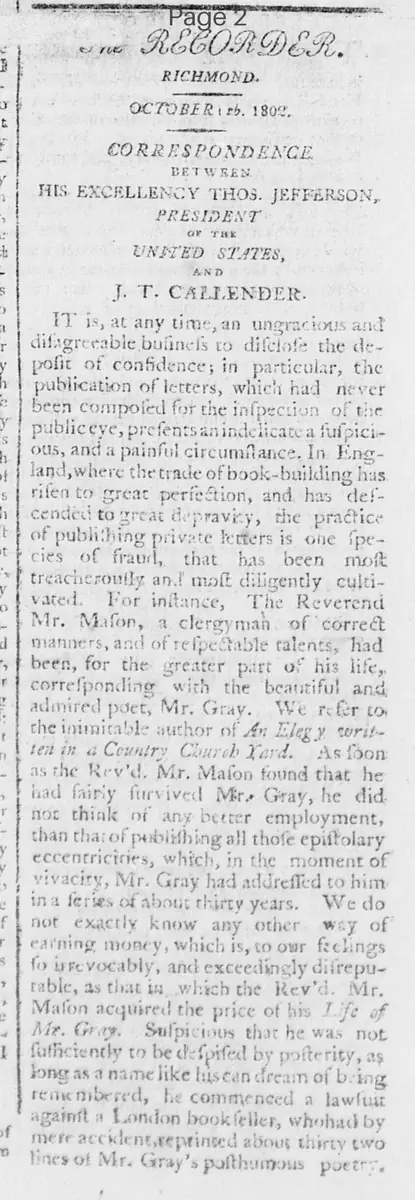
Editorial in the Virginia Recorder justifies publishing private letters between President Thomas Jefferson and J.T. Callender, despite ethical concerns illustrated by English examples, due to political attacks and editorial challenges; includes Jefferson's letters from Monticello dated Sept. 6 and Oct. 6, 1799, discussing payment, political violence, and electoral processes.
Merged-components note: These two components form a single continuous editorial piece by the newspaper editors, discussing the ethics of publishing private letters and including the full correspondence between Jefferson and Callender; original labels were 'story' and 'editorial', unified under 'editorial' as it is opinionated commentary.
Clippings
1 of 2
OCR Quality
Full Text
BETWEEN
HIS EXCELLENCY THOS. JEFFERSON,
PRESIDENT
OF THE
UNITED STATES,
AND
J. T. CALLENDER.
IT is, at any time, an ungracious and disagreeable business to disclose the disposition of confidence; in particular, the publication of letters, which had never been composed for the inspection of the public eye, presents an indelicate suspicious, and a painful circumstance. In England, where the trade of book-building has risen to great perfection, and has descended to great depravity, the practice of publishing private letters is one species of fraud, that has been most treacherously and most diligently cultivated. For instance, The Reverend Mr. Mason, a clergyman of correct manners, and of respectable talents, had been, for the greater part of his life, corresponding with the beautiful and admired poet, Mr. Gray. We refer to the inimitable author of An Elegy written in a Country Church Yard. As Soon as the Rev'd. Mr. Mason found that he had fairly survived Mr. Gray, he did not think of any better employment, than that of publishing all those epistolary eccentricities, which, in the moment of vivacity, Mr. Gray had addressed to him in a series of about thirty years. We do not exactly know any other way of earning money, which is, to our feelings so irrevocably, and exceedingly disreputable, as that in which the Rev'd. Mr. Mason acquired the price of his Life of Mr. Gray. Suspicious that he was not sufficiently to be despised by posterity, as long as a name like his can dream of being remembered, he commenced a lawsuit against a London book seller, who had by mere accident, reprinted about thirty two lines of Mr. Gray's posthumous poetry:
An English jury, that inestimable institution, as Dr. Blackstone calls it, gave a verdict against Mr. John Murray, for one hundred pounds sterling. The person put the penalty into his pocket. We never were able to learn that Mr. Gray wrote letters to Mr. Mason, with a previous intention that they were to be sold and purchased after his death, in order to gratify the sensibilities of a Yorkshire parson. Among other elegant and dignified expressions, which this invaluable correspondence transmitted to the British world, one which follows, was contained in a letter, dated from Edinburgh. Mr. Gray is therein made to inform the public, that, for some days, he had been residing at the house of Dr. Robertson, the memorable historian, the Sallust of the English language: "But, I am afraid," says he, "of Edinburgh, and the itch." This is the way in which one of your posthumous editors treated the confidence of the friends of his youth. This is the sort of correspondence which has exhibited under the name of a classical scholar, of a virtuous man and of an admired poet. We hope that very few of the readers of "The Recorder" would be solicitous to pocket a sum of money by selling the copy-right of such a publication.
This is one specimen of the respectable amusement of publishing confidential letters. We hasten to dispatch two instances, out of many that might be selected from the same class. The late Philip, earl of Chesterfield, wrote some hundreds of letters to his natural son. He therein describes him as a weak man. Mr. Stanhope was married. He died. His lordship died, also and as soon as they were both fairly buried, the widow of Mr. Stanhope carried the whole private and confidential manuscript to a bookseller. The sale was extremely extensive. It produced, upon the memory of her husband, and of her father-in-law, the most unlimited torrent of contempt and reproach. The lady pocketed the money, and smiled internally at the impatience of the world.
We shall only produce one other instance of the possible consequence of publishing letters. The Rev'd. Lawrence Sterne, the writer of Tristram Shandy, was another Yorkshire parson. He entertained a correspondence with a respectable lady. He was so unfortunate as to preserve a copy of his letters. As soon as he was dead, his faithful daughter conveyed the manuscript to market. The letters from Yorick to Eliza have attracted the attention of the world. They contain two or three sentences, which were, no doubt, produced in the impetuosity of composition. But, if Sterne could have foreseen, that they were to walk into publicity, he would rather have put the publisher under ground.
We have entered into this discussion with a design of detailing the dislike that we feel to the printing of a private letter. An unforeseen assemblage of fatalities has compelled the publication of what follows. It has neither been unprovoked, nor wanton. All Richmond knows, that it has been extorted by such a tempest of brutality, by a series of such editorial challenges and defiances, as, perhaps, never before disgraced the art of printing; and for the honor of human nature, we hope that such another process of publication will never arise again. The writer of this article has in the way of business, found it often necessary to address the world. He has often been forced to publish what he wished to suppress; but, in the present instance, his finding it indispensable to publish confidential letters has cost him an excess of anguish, which he never felt before, and which he does not possess faculties capable of describing.
If the editors of the Recorder have expressed themselves with prolixity, let it be considered, that solicitude is apt to be verbose. Let any impartial person transport himself, in fancy, into the situation of the present writer. Let him form the supposition that he had been attacked in the manner in which we have been. Let him read, if he can read it, that unmatched indecency which has burst open the asylum of the grave. It is useless to say, that the virtuous and delicate writer of The Notes on Virginia had no connection with certain publications. After this day's Recorder, -a visage of ten-fold solid brass would not venture to hint that we have not been upon the inner side of the curtain. And, if we are injured, are we not to reply?
What is a president of the United States? No citizen was more prompt than Mr. Jefferson to recommend a reduction of the twenty-five thousand dollars per annum, as a presidential salary. If it was, all at once, found eligible to make a reversal of opinion, is not this just the history of mankind? For, as the writer of the True-born Englishman says:
"The rogues without, still rail at rogues in place,
And men are always honest in disgrace."
The variety of impressions, which have occurred in the endeavour to finish this article, has made it necessary for us to say, that our previous observations cannot be finished until our next number. In the mean time, the reader will pay all that degree of attention to this correct publication of the two letters, which he thinks that they may deserve. It is possible, it is believed to be certain, that some other minute circumstances will transpire, once a week, in the Recorder. In the mean time, we take the hazard of saying, that the editors of this paper will ultimately, and most indisputably be able to extricate themselves from all those explosions of calumny, and of fiction, which have been pointed against them. To be continued in our next Wednesday's paper.
Monticello, Sept. 6, '99.
SIR,
By a want of arrangement in a neighboring post office during the absence of the postmaster, my letters and papers for two posts back were detained I suppose it was owing to this that your letter tho' dated Aug. 10. did not get to my hand till the last day of the month, since which this is the first day I can through the post office acknowledge the receipt of it. Mr. Jefferson happens to be here and directs his agent to call on you with this and pay you 50 dollars, on account of the book you are about to publish. When it shall be out be so good as to send me 2. or 3. copies, and the rest only when I shall ask for them.
The violence which was meditated against you lately has excited a very general indignation in this part of the country. Our state from it's first planting has been remarkable for it's order and submission to the laws. But three instances are recollected in it's history of an organized opposition to the laws. The first was Bacon's rebellion; the 2d. our revolution; the 3d. the Richmond association who, by their committee, have in the public papers avowed their purpose of taking out of the hands of the law the function of declaring who may or may not have peace reference among us. But those gentlemen woefully calculate the temper and force of this country extremely if they suppose there would have been a want of either to support the authority of the laws: and equally mistake their own interests in setting the example of club-law. Whether their self organization, election of a committee, and publication of their manifestos, be such overt acts as bring them within the pale of law: the law I presume is to decide: and there it is our duty to leave it.--The delivery of Robbins to the British excites much feeling and enquiry here.
With every wish for your welfare I am with great regard Sir
Your most obedient servt.
THOS. JEFFERSON.
Mr. Callender
Monticello Oct. 6, '99.
SIR,
On receiving your favor of Sept. 29, I did believe it would be in my power to answer you satisfactorily on both the points on which you asked information I knew indeed that I had not made any particular memorandum of the sum which the C'de Vergennes supposed a treaty with the Porte would cost: but I expected that I had mentioned it either in my letter on the subject to Mr Jay, or in that to Mr. Adams my colleague in the Barbary negociations. After a very long search yesterday I found both letters, but in neither have I stated any particular sum. They are of May 1786. and only say generally that in a conversation with the Ct. de Vergennes on the subject he said that a treaty with the Porte would cost us a great deal of money, as great presents are expected at that court and a great many claim them; and that we should not buy a peace one penny the cheaper at Algiers : that the Algerines did indeed acknowledge a certain dependence on the Porte, and availed themselves of it whenever any thing was to be gained by it, but disregarded it when it subjected them to any demand: and that at Algiers there were but two agents, money and fear. This is the statement in those letters, and my memory does not enable me to fix any particular sum as having been named by him; but only generally that it was very far beyond any thing then at our command. All who were members of Congress in 1786. may be supposed to remember this information, and if it could be understood to come to you through some such channel, it would save the public from reading all the blackguardism which would be vented on me were I quoted not that this would weigh an atom with me, on any occasion where my avowal of either facts or opinions would be of public use: but whenever it will not. I then think it useful to keep myself out of the way of calumny.
On the other point I can be more certain Georgia, N. Carolina Tennessee Kentucky, Virginia, Maryland and Pennsylvania chose their electors by the people directly. In Massachusetts the choice is, first by the people in districts. But if a candidate has not a majority of all the qualified voters of the district. it devolves on the legislature to appoint the elector for that district, besides, as they have but 14 districts (laid off for some state purpose) and are entitled to 16. electors, the legislature name the two extra ones in the first instance. Again if any of those elected either by the people or legislature die, or decline to act, the residue of the electors fill up the vacancies themselves. In this way the people in Massachusetts chose 7. electors on the last occasion. and the legislature 9. In New Hampshire Rhode. Ind. Connec. Vermont, New-York, Jersey Delaware and South Carolina. the legislature name electors. My information is good as to all these particulars except N. Hampshire and Connecticut: and as to them I think I am right; but speaking only from memory it should be further ascertained before asserted. I THANK YOU FOR THE PROOF SHEETS YOU IN-CLOSED ME. SUCH PAPERS CAN-NOT FAIL TO PRODUCE THE BEST EFFECT. They inform the thinking part of the nation; and these again, supported by the taxgatherers as their vouchers, set the people to rights. You will know from whom this comes without a signature: the omission of which has been rendered almost habitual with me by the curiosity of the post offices. Indeed a period is now approaching during which I shall discontinue writing letters as much as possible, knowing that every snare will be used to get hold of what may be perverted in the eyes of the public- Adieu.
The original copies of the above letters may be seen at the Office of the Virginia Gazette, Richmond.
What sub-type of article is it?
What keywords are associated?
What entities or persons were involved?
Editorial Details
Primary Topic
Justification For Publishing Jefferson Callender Correspondence Amid Political Attacks
Stance / Tone
Reluctant Defense Against Calumny And Editorial Brutality
Key Figures
Key Arguments