Thank you for visiting SNEWPapers!
Sign up free
Wisconsin Tribune
Mineral Point, Iowa County, Wisconsin
What is this article about?
A visitor's observations on London's vast size, efficient transport via omnibuses, clean streets compared to filthy New York pavements, rarity of fires due to better building, and severe pauperism fueled by vice like gin palaces, advocating education and religion as remedies over punishment.
Merged-components note: These two components continue the same article on 'The Magnitude of London' without interruption.
Clipping
OCR Quality
Full Text
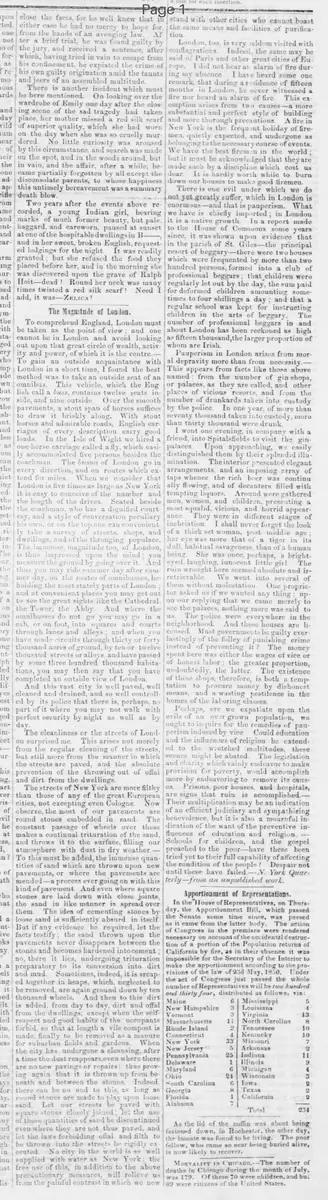
To comprehend England, London must be taken as the point of view; and one cannot be in London and avoid looking out upon that great circle of wealth, activity and power, of which it is the centre—To gain an outside acquaintance with London in a short time, I found the best method was to take an outside seat of an omnibus. This vehicle, which the English call a buss, contains twelve seats inside, and nine outside Over the smooth pavements, a stout span of horses suffices to draw it briskly along. With stout horses and admirable roads, English carriages of every description carry good loads. In the Isle of Wight we hired a one-horse carriage called a fly, which easily accommodated five persons besides the coachman. The busses of London go in every direction, and on routes which extend for miles. When we consider that London is five times as large as New York it is easy to conceive of the number and the length of the drives. Seated beside the coachman, who has a dignified courtesy, and a style of conversation peculiarly his own, or on the top one can conveniently take a survey of streets, shops, and dwellings, and of the thronging populace. The immense magnitude too, of London, is thus impressed upon the mind; you measure the ground by going over it And thus you may ride summer day after summer day, on the routes of omnibusses, beholding the most stately parts of London; and at convenient places you may get out to see the great sights like the Cathedral the Tower, the Abbey And where the omnibusses do not go you may go in a cab, or on foot, into squares and courts through lanes and alleys; and when you have made circuits through thirty or forty thousand acres of ground, by ten or twelve thousand streets or alleys and have passed by some three hundred thousand habitations, you may then say that you have completed an outside view of London. And this vast city is well paved, well cleaned and drained, and so well controlled by its police that there is, perhaps, no part of it where you may not walk with perfect security by night as well as by day
The cleanliness of the streets of London surprised me. This arises not merely from the regular cleaning of the streets, but still more from the manner in which the streets are paved, and the absolute prevention of the throwing out of offal and dirt from the dwellings.
The streets of New York are more filthy than those of any of the great European cities, not excepting even Cologne Now observe, the most of our pavements are round stones embedded in sand The constant passage of wheels over these makes a continual trituration of the sand, and throws it to the surface, filling our atmosphere with dust in dry weather—To this must be added, the immense quantities of sand which are thrown upon new pavements, or where the pavements are mended—a process ever going on with this kind of pavement And even where square stones are laid down with close joints, the sand in like manner is spread over them. The idea of cementing stones by loose sand is sufficiently absurd in itself But if any evidence be required, let the facts testify; the sand thrown upon the pavements never disappears between the stones and becomes hardened into cement: no, there it lies, undergoing trituration preparatory to its conversion into dirt and mud. Sometimes, indeed, it is scraped together in heaps, which, neglected to be removed, are again ground down by ten thousand wheels. And then to this dirt is added, from day to day, dirt and offal from the dwellings, except when the self respect and good habits of the occupants forbid, so that at length a vile compost is made, finally to be removed as a manure for suburban fields and gardens. When the city has undergone a cleansing, after a time the dust reappears, even where there are no new pavements or repairs; thus proving again that it is thrown up from beneath and between the stones, Indeed there can be no end to this, as long as round stones are made to play upon loose sand Let our streets be paved with square stones closely joined: let the use of those quantities of sand be discontinued even where they are not thus paved, and let the laws forbidding offal and filth to be thrown into the streets be rigidly executed No city in the world is so well supplied with water as New York: the free use of this, in addition to the above precautionary measures, will relieve us from the painful contrast in which we now stand with other cities who cannot boast the same means and facilities of purification
London, too, is very seldom visited with conflagrations Indeed, the same may be said of Paris and other great cities of Europe. I did not hear an alarm of fire during my absence I have heard some one remark, that during a residence of fifteen months in London, he never witnessed a fire nor heard an alarm of fire. This exemption arises from two causes—a more substantial and perfect style of building and more thorough precautions. A fire in New York is the frequent holiday of firemen, quietly expected, and undergone as belonging to the necessary course of events. We have the best firemen in the world; but it must be acknowledged that they are made such by a discipline which cost us dear. It is hardly worth while to burn down our houses to make good firemen.
There is one evil under which we do not yet greatly suffer, which in London is enormous—and that is pauperism. What we have is chiefly imported; in London it is a native growth In a report made to the House of Commons some years since, it was shown upon evidence that in the parish of St. Giles—the principal resort of beggary—there were two houses which were frequented by more than two hundred persons, formed into a club of professional beggars: that children were regularly let out by the day, the sum paid for deformed children amounting sometimes to four shillings a day: and that a regular school was kept for instructing children in the arts of beggary. The number of professional beggars in and about London has been reckoned as high as fifteen thousand, the larger proportion of whom are Irish.
Pauperism in London arises from moral depravity more than from necessity.—This appears from facts like those above named from the number of gin shops, or palaces, as they are called, and other places of vicious resorts, and from the number of drunkards taken into custody by the police In one year, of more than seventy thousand taken into custody, more than thirty thousand were drunk.
I went one evening, in company with a friend, into Spitalfields to visit the gin-palaces
Upon approaching, we easily distinguished them by their splendid illumination. The interior presented elegant arrangements, and an imposing array of taps whence the rich beer was continually flowing, and of decanters filled with tempting liquors. Around were gathered men, women, and children, presenting a most squalid, vicious, and horrid appearance They were in different stages of inebriation I shall never forget the look of a thick set woman, past middle age; her eye was more that of a tiger in its full, habitual savageness, than of a human being She was once, perhaps, a bright-eyed laughing, innocent little girl The ruin wrought here seemed absolute and irretrievable. We went into several of them without molestation One proprietor asked us if we wanted anything; upon our replying that we came merely to see the palaces, nothing more was said to us The police were everywhere in the neighborhood. And these houses are licensed Must governments be guilty everlastingly of the folly of punishing crime instead of preventing it? The money spent here was either the wages of vice or of honest labor; the greater proportion, undoubtedly, the latter. The existence of these shops, therefore, is both a temptation to procure money by dishonest means, and a wasting pestilence in the homes of the laboring classes.
Perhaps, ere we expatiate upon the evils of an over grown population, we ought to inquire for the remedies of pauperism induced by vice Could education and the influences of religion be extended to the wretched multitudes, these scenes might be abated The legislation and charity which vainly endeavor to make provision for poverty, would accomplish more by endeavoring to remove its causes. Prisons, poor houses, and hospitals, are signs that ruin is accomplished.—Their multiplication may be an indication of an efficient judiciary and sympathizing benevolence, but it is also a mournful indication of the want of the preventive influences of education and religion. —Schools for children, and the gospel preached to the poor—have these been
tried yet to their full capability of affecting the condition of the people? Despair not until these have failed—N. York Quarterly—from an unpublished work.
What sub-type of article is it?
What themes does it cover?
What keywords are associated?
Where did it happen?
Story Details
Location
London
Story Details
Visitor describes London's vast scale via omnibus tours, superior cleanliness and paving over New York's dusty streets, low fire incidence due to construction, and rampant pauperism from vice like gin palaces, urging preventive education and religion.