Thank you for visiting SNEWPapers!
Sign up free
The Recorder
Richmond, Virginia
What is this article about?
Boston, May 3: Report from Liverpool (March 28) states war between Britain and France has not begun, though expectations diminished. London paper discusses tensions over Malta, French armaments, and Bonaparte's ambitions, urging honorable defense if peace fails.
Clipping
OCR Quality
Full Text
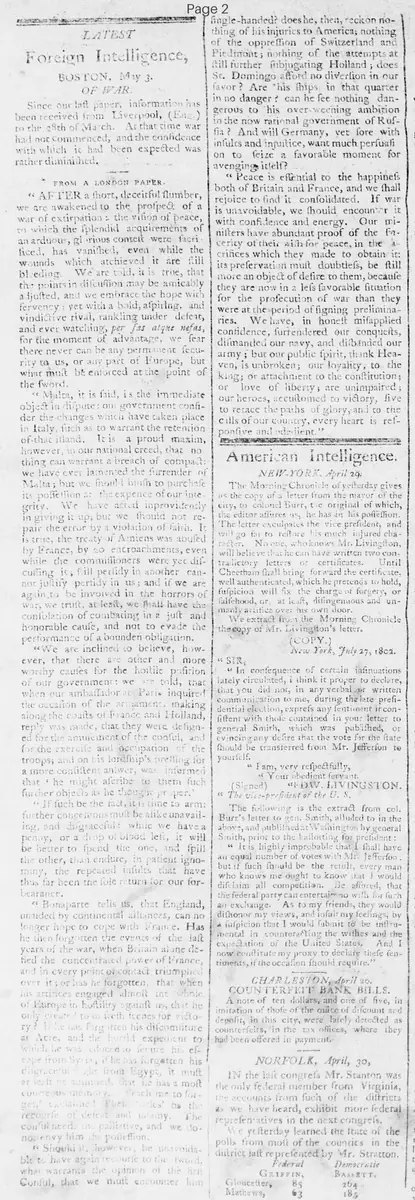
BOSTON, May 3.
OF WAR.
Since our last paper, information has been received from Liverpool, (Eng.) to the 28th of March. At that time war had not commenced, and the confidence with which it had been expected was rather diminished.
FROM A LONDON PAPER.
"AFTER a short, deceitful slumber, we are awakened to the prospect of a war of extirpation: the vision of peace, to which the splendid acquirements of an arduous, glorious contest were sacrificed, has vanished, even while the wounds which achieved it are still bleeding. We are told, it is true, that the points in discussion may be amicably adjusted, and we embrace the hope with fervency: yet with a bold, aspiring, and vindictive rival, rankling under defeat, and ever watching, per fas atque nefas, for the moment of advantage, we fear there never can be any permanent security to us, or any part of Europe, but what must be enforced at the point of the sword.
"Malta, it is said, is the immediate object in dispute: our government considers the changes which have taken place in Italy, such as to warrant the retention of that island. It is a proud maxim, however, in our national creed, that nothing can warrant a breach of compact: we have ever lamented the surrender of Malta: but we should blush to purchase its possession at the expense of our integrity. We have acted improvidently in giving it up, but we should not repair the error by a violation of faith. It is true, the treaty of Amiens was abused by France, by encroachments, even while the commissioners were yet discussing it; still perfidy in another cannot justify perfidy in us; and if we are again to be involved in the horrors of war, we trust, at least, we shall have the consolation of combating in a just and honorable cause, and not to evade the performance of a bounden obligation.
"We are inclined to believe, however, that there are other and more worthy causes for the hostile position of our government: we are told, that when our ambassador at Paris inquired the occasion of the armaments, making along the coasts of France and Holland, reply was made, that they were designed for the amusement of the consul, and for the exercise and occupation of the troops; and on his lordship's pressing for a more consistent answer, was informed that he might ascribe to them such further objects as he thought proper. If such be the fact, it is time to arm: further concessions must be alike unavailing, and disgraceful: while we have a penny, or a drop of blood left, it will be better to spend the one, and spill the other, than endure, in patient ignominy, the repeated insults that have thus far been the sole return for our forbearance.
"Bonaparte tells us, that England, unided by continental alliances, can no longer hope to cope with France. Has he then forgotten the events of the last years of the war, when Britain alone defied the concentrated power of France, and in every point of contact triumphed over it; or has he forgotten, that when his artifices engaged almost the whole of Europe in hostility against us, that he only created too fresh scenes for victory? If he has forgot his discomfiture at Acre, and the horrid expedient to which he was forced to retreat his escape from Syria, if he has forgot his disgraceful flight from Egypt, it must at least be remembered, he has imposed most courteous men to so-
few at a determined bend as the recourse of defense and money. The consul needs a palliative, and we do not envy him the possession.
"Should it, however, be unavoidable to have again recourse to the sword, what warrants the opinion of the helpful, that we must encounter immense single-handed? does he, then, reckon nothing of his injuries to America; nothing of the oppression of Switzerland and Piedmont; nothing of the attempts at still further subjugating Holland; does St. Domingo afford no diversion in our favor? Are his ships in that quarter in no danger? can he see nothing dangerous to his over-weaning ambition in the now rational government of Russia? And will Germany, yet sore with insults and injuries, want much persuasion to seize a favorable moment for avenging itself?
"Peace is essential to the happiness both of Britain and France, and we shall rejoice to find it consolidated. If war is unavoidable, we should encounter it with confidence and energy. Our ministers have abundant proof of the sincerity of their wish for peace, in the sacrifices which they made to obtain it: its preservation must doubtless, be still more an object of desire to them, because they are now in a less favorable situation for the prosecution of war than they were at the period of signing preliminaries. We have, in honest misapplied confidence, surrendered our conquests, dismantled our navy, and disbanded our army; but our public spirit, thank Heaven, is unbroken; our loyalty to the king; or attachment to the constitution; or love of liberty; are unimpaired; our heroes, accustomed to victory, live to retrace the paths of glory, and to the calls of our country, every heart is responsive and obedient."
What sub-type of article is it?
What keywords are associated?
What entities or persons were involved?
Where did it happen?
Foreign News Details
Primary Location
Malta
Event Date
28th Of March
Key Persons
Outcome
war had not commenced
Event Details
Information from Liverpool indicates war between Britain and France has not started, with diminished expectations. A London paper discusses prospects of war over Malta, critiques French armaments and Bonaparte's ambitions, references the Treaty of Amiens, past defeats, and potential European alliances against France, emphasizing desire for peace but readiness for honorable war.