Thank you for visiting SNEWPapers!
Sign up free
Freeman's Chronicle
Columbus, Franklin County, Ohio
What is this article about?
Biographical memoir of Commodore Oliver Hazard Perry, covering his early naval career, family life, and command of the American squadron in the victorious Battle of Lake Erie on September 10, 1813, during the War of 1812, amid reflections on national pride and Anglo-American relations.
Merged-components note: Merging the biographical memoir of Commodore Perry across page 1 and page 2, including the embedded tables listing the American and British squadrons, as they are integral to the narrative description of the battle.
Clippings
1 of 2
OCR Quality
Full Text
OF
COMMODORE PERRY
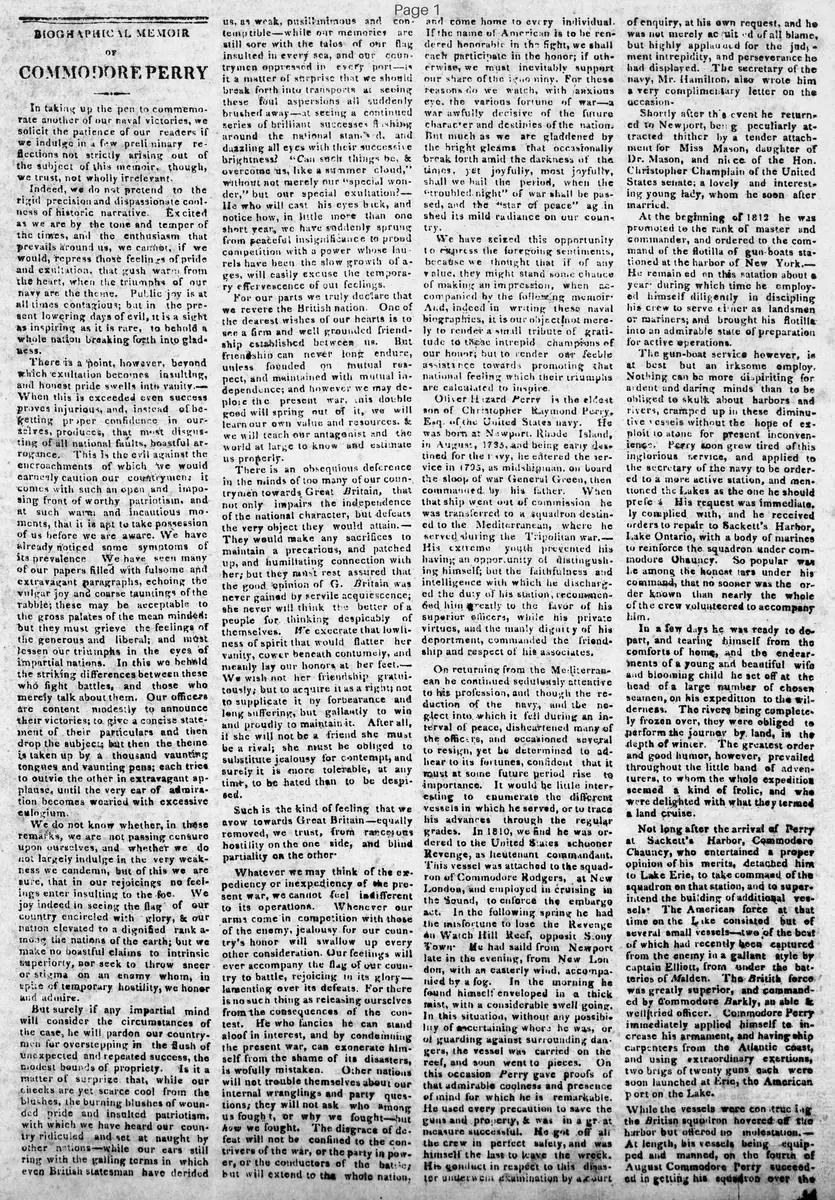
In taking up the pen to commemorate another of our naval victories, we solicit the patience of our readers if we indulge in a few preliminary reflections not strictly arising out of the subject of this memoir, though, we trust, not wholly irrelevant.
Indeed, we do not pretend to the rigid precision and dispassionate coolness of historic narrative. Excited as we are by the tone and temper of the times, and the enthusiasm that prevails around us, we cannot, if we would, repress those feelings of pride and exultation, that gush warm from the heart, when the triumphs of our navy are the theme. Public joy is at all times contagious; but in the present lowering days of evil, it is a sight as inspiring as it is rare, to behold a whole nation breaking forth into gladness.
There is a point, however, beyond which exultation becomes insulting, and honest pride swells into vanity. When this is exceeded even success proves injurious, and, instead of begetting proper confidence in ourselves, produces, that most disgusting of all national faults, boastful arrogance. This is the evil against the encroachments of which we would earnestly caution our countrymen: it comes with such an open and imposing front of worthy patriotism, and at such warm and incautious moments, that it is apt to take possession of us before we are aware. We have already noticed some symptoms of its prevalence. We have seen many of our papers filled with fulsome and extravagant paragraphs, echoing the vulgar joy and coarse tauntings of the rabble; these may be acceptable to the gross palates of the mean minded: but they must grieve the feelings of the generous and liberal; and lessen our triumphs in the eyes of impartial nations. In this we behold the striking difference between these who fight battles, and those who merely talk about them. Our officers are content modestly to announce their victories; to give a concise statement of their particulars and then drop the subject; but then the theme is taken up by a thousand vaunting tongues and vaunting pens; each tries to outvie the other in extravagant applause, until the very ear of admiration becomes wearied with excessive eulogium.
We do not know whether, in these remarks, we are not passing censure upon ourselves, and whether we do not largely indulge in the very weakness we condemn, but of this we are sure, that in our rejoicings no feelings enter insulting to the foe. We joy indeed in seeing the flag of our country encircled with glory, & our nation elevated to a dignified rank among the nations of the earth: but we make no boastful claims to intrinsic superiority, nor seek to throw sneer or stigma on an enemy whom, in spite of temporary hostility, we honor and admire.
But surely if any impartial mind will consider the circumstances of the case, he will pardon our countrymen for overstepping in the flush of unexpected and repeated success, the modest bounds of propriety. Is it a matter of surprise that, while our cheeks are yet scarce cool from the burning blushes of wounded pride and insulted patriotism, with which we have heard our country ridiculed and set at naught by other nations--while our ears still ring with the galling terms in which even British statesmen have derided us, a weak, pusillanimous and contemptible--while our memories are still sore with the tales of our flag insulted in every sea, and our countrymen oppressed in every port--is it a matter of surprise that we should break forth into transports at seeing these foul aspersions all suddenly brushed away--at seeing a continued series of brilliant successes flashing around the national standard, and dazzling all eyes with their successive brightness? "Can such things be, & overcome us, like a summer cloud," without not merely our "special wonder," but our special exultation?--
He who will cast his eyes back, and notice how, in little more than one short year, we have suddenly sprung from peaceful insignificance to proud competition with a power whose laurels have been the slow growth of ages, will easily excuse the temporary effervescence of our feelings.
For our parts we truly declare that we revere the British nation. One of the dearest wishes of our hearts is to see a firm and well grounded friendship established between us. But friendship can never long endure, unless founded on mutual respect, and maintained with mutual independence; and however we may deplore the present war, this double good will spring out of it, we will learn our own value and resources. & we will teach our antagonist and the world at large to know and estimate us properly.
There is an obsequious deference in the minds of too many of our countrymen towards Great Britain, that not only impairs the independence of the national character, but defeats the very object they would attain. They would make any sacrifices to maintain a precarious, and patched up, and humiliating connection with her; but they must rest assured that the good opinion of G. Britain was never gained by servile acquiescence; she never will think the better of a people for thinking despicably of themselves. We execrate that lowliness of spirit that would flatter her vanity, cower beneath contumely, and meanly lay our honors at her feet.-- We wish not her friendship gratuitously; but to acquire it as a right not to supplicate it by forbearance and long suffering, but gallantly to win and proudly to maintain it. After all, if she will not be a friend she must be a rival; she must be obliged to substitute jealousy for contempt, and surely it is more tolerable, at any time, to be hated than to be despised.
Such is the kind of feeling that we avow towards Great Britain equally removed, we trust, from rancorous hostility on the one side, and blind partiality on the other:
Whatever we may think of the expediency or inexpediency of the present war, we cannot feel indifferent to its operations. Whenever our arms come in competition with those of the enemy, jealousy for our country's honor will swallow up every other consideration. Our feelings will ever accompany the flag of our country to battle, rejoicing in its glory-- lamenting over its defeats. For there is no such thing as releasing ourselves from the consequences of the contest. He who fancies he can stand aloof in interest, and by condemning the present war, can exonerate himself from the shame of its disasters, is wofully mistaken. Other nations will not trouble themselves about our internal wranglings and party questions; they will not ask who among us fought, or why we ought but how we fought. The disgrace of defeat will not be confined to the contrivers of the war, or the party in power, or the conductors of the battle; but will extend to the whole nation, and come home to every individual.
If the name of American is to be rendered honorable in the fight, we shall each participate in the honor; if otherwise, we must inevitably support our share of the ignominy. For these reasons do we watch, with anxious eye, the various fortune of war--a war awfully decisive of the future character and destinies of the nation.
But much as we are gladdened by the bright gleams that occasionally break forth amid the darkness of the times, yet joyfully, most joyfully, shall we hail the period, when the troubled night of war shall be passed, and the "star of peace" again shed its mild radiance on our country.
We have seized this opportunity to express the foregoing sentiments, because we thought that if of any value, they might stand some chance of making an impression, when accompanied by the following memoir.
And, indeed in writing these naval biographies, it is our object not merely to render a small tribute of gratitude to these intrepid champions of our honor; but to render our feeble assistance towards promoting that national feeling which their triumphs are calculated to inspire.
Oliver Hazard Perry is the eldest son of Christopher Raymond Perry, Esq. of the United States navy. He was born at Newport, Rhode Island, in August, 1785, and being early destined for the navy, he entered the service in 1798, as midshipman, on board the sloop of war General Greene, then commanded by his father. When that ship went out of commission he was transferred to a squadron destined to the Mediterranean, where he served during the Tripolitan war.-- His extreme youth prevented his having an opportunity of distinguishing himself; but the faithfulness and intelligence with which he discharged the duty of his station, recommended him greatly to the favor of his superior officers, while his private virtues, and the manly dignity of his deportment, commanded the friendship and respect of his associates.
On returning from the Mediterranean he continued sedulously attentive to his profession, and though the reduction of the navy, and the neglect into which it fell during an interval of peace, disheartened many of the officers, and occasioned several to resign, yet he determined to adhere to its fortunes, confident that it must at some future period rise to importance. It would be little interesting to enumerate the different vessels in which he served, or to trace his advances through the regular grades. In 1810, we find he was ordered to the United States schooner Revenge, as lieutenant commandant.
This vessel was attached to the squadron of Commodore Rodgers, at New London, and employed in cruising in the Sound, to enforce the embargo act. In the following spring he had the misfortune to lose the Revenge on Watch Hill Reef, opposite Stony Point. He had sailed from Newport late in the evening, from New London, with an easterly wind, accompanied by a fog. In the morning he found himself enveloped in a thick mist, with a considerable swell going. In this situation, without any possibility of ascertaining where he was, or of guarding against surrounding dangers, the vessel was carried on the reef, and soon went to pieces. On this occasion Perry gave proofs of that admirable coolness and presence of mind for which he is remarkable. He used every precaution to save the guns and property, & was in a great measure successful. He got off all the crew in perfect safety, and was himself the last to leave the wreck. His conduct in respect to this disaster underwent examination by a court of enquiry, at his own request, and he was not merely acquitted of all blame, but highly applauded for the judgment intrepidity, and perseverance he had displayed. The secretary of the navy, Mr. Hamilton, also wrote him a very complimentary letter on the occasion.
Shortly after this event he returned to Newport, being peculiarly attracted thither by a tender attachment for Miss Mason, daughter of Dr. Mason, and niece of the Hon. Christopher Champlain of the United States senate; a lovely and interesting young lady, whom he soon after married.
At the beginning of 1812 he was promoted to the rank of master and commander, and ordered to the command of the Flotilla of gun-boats stationed at the harbor of New York.-- He remained on this station about a year during which time he employed himself diligently in disciplining his crew to serve either as landsmen or mariners; and brought his Flotilla into an admirable state of preparation for active operations.
The gun-boat service however, is at best but an irksome employment. Nothing can be more dispiriting for ardent and daring minds than to be obliged to skulk about harbors and rivers, cramped up in these diminutive vessels without the hope of exploit to atone for present inconvenience; Perry soon grew tired of this inglorious service, and applied to the secretary of the navy to be ordered to a more active station, and mentioned the Lakes as the one he should prefer. His request was immediately complied with, and he received orders to repair to Sacket's Harbor, Lake Ontario, with a body of marines to reinforce the squadron under commodore Chauncy. So popular was he among the honest tars under his command, that no sooner was the order known than nearly the whole of the crew volunteered to accompany him.
In a few days he was ready to depart, and tearing himself from the comforts of home, and the endearments of a young and beautiful wife and blooming child he set off at the head of a large number of chosen seamen, on his expedition to the wilderness. The rivers being completely frozen over, they were obliged to perform the journey by land, in the depth of winter. The greatest order and good humor, however, prevailed throughout the little band of adventurers, to whom the whole expedition seemed a kind of frolic, and who were delighted with what they termed a land cruise.
Not long after the arrival of Perry at Sacket's Harbor, Commodore Chauncy, who entertained a proper opinion of his merits, detached him to Lake Erie, to take command of the squadron on that station, and to superintend the building of additional vessels: The American force at that time on the Lake consisted but of several small vessels--two of the best of which had recently been captured from the enemy in a gallant style by Captain Elliott, from under the batteries of Malden. The British force was greatly superior, and commanded by Commodore Barkly, an able & well tried officer. Commodore Perry immediately applied himself to increase his armament, and having chosen carpenters from the Atlantic coast, and using extraordinary exertions, two brigs of twenty guns each were soon launched at Erie, the American port on the Lake.
While the vessels were constructing the British squadron hovered off the harbor but offered no molestation.- At length, his vessels being equipped and manned, on the fourth of August Commodore Perry succeeded in getting his squadron over the
| Brig | Lawrence, | Com. | Perry, | 20 |
| Niagara, | Capt. | Ellio, | 20 | |
| Caledonia, | Purser | M’Grath, | 3 | |
| Sch. | Ariel, | Lieut. | Packet, | 4 |
| Scorpion, | Sail. | Mas. | Camplin, 2 | |
| Somers, | Almy, | Almy, | 2 | |
| & 2 swivels | ||||
| Tigress, | Lieut. | Coaklin, | 1 | |
| Porcupine, | Mid. | G. | Senat, | |
| Sloop | Trippe, | Lietu. | Smith, | 1 |
bar at the mouth of the harbor. The water on the bar was but five feet deep, and the large vessels had to be buoyed over; this was accomplished in the face of the British, who fortunately did not think proper to make an attack. The next day he sailed in pursuit of the enemy, but returned on the eighth, without having encountered him. Being reinforced by the arrival of the brave Elliott, accompanied by several officers and eighty-nine sailors, he was enabled completely to man his squadron, and again set sail on the twelfth, in quest of the enemy. On the fifteenth he arrived at Sandusky Bay, where the American army under General Harrison lay encamped. From thence he cruised off Malden, where the British squadron remained at anchor, under the guns of the fort. The appearance of Perry's squadron spread great alarm on shore; the women and children ran shrieking about the place, expecting an immediate attack. The Indians, we are told, looked on with astonishment, and urged the British to go out and fight. Finding the enemy not disposed to venture a battle, Commodore Perry returned to Sandusky.
Nothing of moment happened until the morning of the tenth of September. The American squadron were, at that time, lying at anchor in Put-in-Bay, and consisted of
At sunrise they discovered the enemy, and immediately got under way and stood for him with a light wind at southwest. The British force consisted of
63 guns.
At 10 A. M. the wind hauled to the southeast and brought our squadron to windward. Commodore Perry then hoisted his Union Jack, having for a motto, the dying words of the valiant Lawrence, "Don't give up the ship!" It was received with repeated cheerings by the officers and crews. And now having formed his line he bore on the enemy; who likewise cleared for action, and hauled up his courses. It is deeply interesting to picture to ourselves the advances of these gallant & well matched squadrons to a contest, where the strife must be obstinate and sanguinary, and the event decisive of the fate of almost an empire.
The lightness of the wind occasioned them to approach each other but slowly, and prolonged the awful interval of suspense and anxiety that precedes a battle. This is the time when the stoutest heart beats quick, "and the boldest holds his breath;" it is the still moment of direful expectation; of fearful looking out for slaughter and destruction; when even the glow of pride and ambition is chilled for a while, and nature shudders at the awful jeopardy of existence. The very order and regularity of naval discipline heighten the dreadful quiet of the moment. No bustle, no noise prevails to distract the mind, except at intervals the shrill piping of the boatswain's whistle, or a murmuring whisper among the men, who, grouped around their guns, earnestly regard the movements of the foe, now and then stealing a wistful glance at the countenances of their commanders. In this manner did the hostile squadrons approach each other, in mute watchfulness and terrible tranquility; when suddenly a bugle was sounded from on board the enemy's ship Detroit, and loud huzzas immediately burst forth from all their crews.
No sooner did the Lawrence come within reach of the enemies' long guns, than they opened a heavy fire upon her, which, from the shortness
| Ship Detroit, | 19 guns, 1 on (pivot, & 2 howitzers. |
| Queen Charlotte, 17 | 1 on pivot |
| Sch. Lady Prevost, | 13 1 de. |
| Brig Hunter | 10 |
| Sloop Little Belt, | 3 |
| Schr. Chippeway, | 1 2 swivels. |
What sub-type of article is it?
What themes does it cover?
What keywords are associated?
What entities or persons were involved?
Where did it happen?
Story Details
Key Persons
Location
Newport, Rhode Island; Mediterranean; Lake Erie; Sacket's Harbor; Put In Bay
Event Date
Born August 1785; Entered Service 1798; Battle Of Lake Erie, Tenth Of September 1813
Story Details
The memoir details Perry's birth in 1785, early naval entry in 1798, service in Tripolitan War, shipwreck of Revenge in 1811 with exemplary conduct, marriage, promotion in 1812, transfer to Lake Erie in 1813, building and commanding squadron, culminating in the Battle of Lake Erie on September 10, 1813, where American forces under Perry defeated the superior British squadron.