Thank you for visiting SNEWPapers!
Sign up free
The Jersey City News
Jersey City, Hudson County, New Jersey
What is this article about?
Report on the October 1, 1901, New Jersey Democratic State Convention in Trenton, where Newark Mayor James M. Seymour gains strong support for gubernatorial nomination amid opposition from Jim Smith and Essex faction, with enthusiastic crowds and county vote predictions favoring Seymour.
Merged-components note: Continuation of the Democratic State Convention coverage across pages, same topic and dateline from Trenton on Oct. 1, 1901.
Clippings
1 of 2
OCR Quality
Full Text
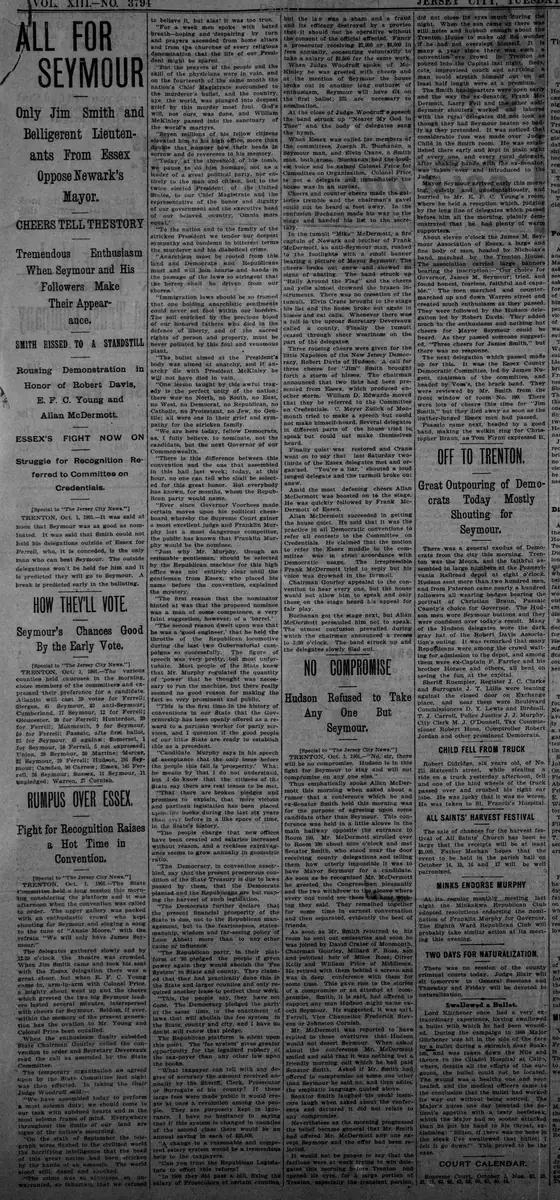
Only Jim Smith and Belligerent Lieutenants From Essex Oppose Newark's Mayor.
CHEERS TELL THE STORY
Tremendous Enthusiasm When Seymour and His Followers Make Their Appearance.
SMITH HISSED TO A STANDSTILL
Rousing Demonstration in Honor of Robert Davis. To E. F. C. Young and Allan McDermott.
ESSEX'S FIGHT NOW ON
Struggle for Recognition Referred to Committee on Credentials.
[Special to "The Jersey City News."]
TRENTON, Oct. 1, 1901.—It was said at noon that Seymour was as good as nominated. It was said that Smith could not hold his delegations outside of Essex for Ferrell, who, it is conceded, is the only man who can beat Seymour. The outside delegations won't be held for him and it is predicted they will go to Seymour. A break is predicted early in the balloting.
HOW THEY'LL VOTE.
Seymour's Chances Good By the Early Vote.
[Special to "The Jersey City News."]
TRENTON, Oct. 1, 1901.—The various counties held caucuses in the morning chose members of the committees and expressed their preference for a candidate.
Atlantic will cast 29 votes for Ferrell; Bergen, 41 Seymour, 23 anti-Seymour; Cumberland, 17 Seymour, 12 for Ferrell; Gloucester, 20 for Ferrell; Hunterdon, 29 for Ferrell; Monmouth, 9 for Seymour, 50 for Ferrell; Passaic, after first ballot, 25 for Seymour, 45 against; Somerset, 1 for Seymour, 18 Ferrell, 5 not expressed; Union, 39 Seymour, 20 Martine; Mercer, 31 Seymour, 29 Ferrell; Hudson, 191 Seymour; Camden, 90 Carrow; Essex, 145 Ferrell, 36 Seymour; Sussex, 11 Seymour, 11 unpledged; Warren, 27 Cornish.
RUMPUS OVER ESSEX
Fight for Recognition Raises a Hot Time in Convention.
[Special to "The Jersey City News."]
TRENTON, Oct. 1, 1901.—The State Committee held a long session this morning considering the platform and it was afternoon when the convention was called to order. The upper gallery was packed with an enthusiastic crowd who kept shouting for Seymour and singing a song to the tune of "Annie Moore," with the refrain "We will only have James Seymour."
The delegates gathered slowly and by 12:30 o'clock the theatre was crowded.
When Jim Smith came and took his seat with the Essex delegation there was a great cheer, but when E. F. C. Young came in, arm-in-arm with Colonel Price, a mighty shout went up and the cheers which greeted the two big Seymour leaders lasted several minutes, interspersed with cheers for Seymour. Seldom, if ever, within the memory of the present generation has the ovation to Mr. Young and Colonel Price been equalled.
When the enthusiasm finally subsided State Chairman Gourley called the convention to order and Secretary Devereaux read the call as amended by the State Committee.
The temporary organization as agreed upon by the State Committee last night was then effected. In taking the chair Judge Woodruff said:-
"We have assembled today to perform a most solemn duty; we should come to our task with subdued hearts and in the most solemn frame of mind. Everywhere throughout the limits of our land are signs of the nation's mourning.
"On the sixth of September the telegraph wires flashed to the civilized world the horrifying intelligence that the head of this great nation had been stricken by the hands of an assassin. The world stood still, dazed and shocked. The crime was so atrocious, so unwarranted, so inhuman that awe refused to believe it, but alas! it was too true.
"For a week men spoke with bated breath—hoping and despairing by turns, and prayers ascended from home altars and from the churches of every religious denomination that the life of our President might be spared.
"But the prayers of the people and the skill of the physicians were in vain, and on the fourteenth of the same month the nation's Chief Magistrate succumbed to the murderer's bullet, and the country, aye, the world, was plunged into deepest grief by this murder most foul. God's will, not ours, was done, and William McKinley passed into the sanctuary of the world's martyrs.
"Seven millions of his fellow citizens elevated him to his high office, more than double that number bow their heads in sorrow and do reverence to his memory.
"Today, at the threshold of his tomb, we pause to do him homage, not as a leader of a great political party, nor entirely to the man and citizen, but to the twice elected President of the United States, to our Chief Magistrate and the representative of the honor and dignity of our government and the executive head of our beloved country. Omnia mors equat.
"To the nation and to the family of the stricken President we tender our deepest sympathy and condemn in bitterest terms the murderer and his diabolical crime.
"Anarchism must be rooted from this land and Democrats and Republicans must and will join hearts and hands in the passage of the laws so stringent that the heresy shall be driven from our shores.
"Immigration laws should be so framed that one holding anarchistic sentiments could never set foot within our borders. The soil enriched by the precious blood of our honored fathers who died in the defence of liberty, and of the sacred rights of person and property, must be never polluted by this foul and venomous plant.
"The bullet aimed at the President's body was aimed at anarchy, and if anarchy die with President McKinley he will not have died in vain.
"One lesson taught by this awful tragedy is the perfect unity of the nation; there was no North, no South, no East, no West, no Democrat, no Republican, no Catholic, no Protestant, no Jew, no Gentile; all were one in their grief and sympathy for the stricken family.
"We are here today, fellow Democrats, as, I fully believe, to nominate, not the candidate, but the next Governor of our Commonwealth.
"There is this difference between this convention and the one that assembled in this hall last week; today, at this hour, no one can tell who shall be selected for this great honor. But everybody has known, for months, whom the Republican party would name.
"Ever since Governor Voorhees made certain moves upon his political chessboard whereby the Supreme Court gained a most excellent judge and Franklin Murphy lost a most dangerous competitor, the public has known that Franklin Murphy would be the nominee.
"Just why Mr. Murphy, though an estimable gentleman, should be selected by the Republican machine for this high office was not entirely clear until the gentleman from Essex, who placed his name before the convention, explained the mystery.
"The first reason that the nominator hinted at was that the proposed nominee was a man of some competence, a very faint suggestion, however, of a 'barrel.'
"The second reason dwelt upon was that he was a good engineer, that he held the throttle of the Republican locomotive during the last two Gubernatorial campaigns so successfully. The figure of speech was very pretty, but most unfortunate. Most people of the State knew that Mr. Murphy regulated the quantity of power that he thought was necessary to run the machine, but there really seemed no good reason for making the fact so very prominent and public.
"This is the first time in the history of conventions in our State that the Governorship has been openly offered as a reward to a partisan worker for party services, and I question if the good people of our little State are ready to establish this as a precedent.
"Candidate Murphy says in his speech of acceptance that the only issue before the people this fall is prosperity. What he means by that I do not understand, but I do know that the citizens of the State say there are real issues to be met.
"That there are broken pledges and promises to explain, that more vicious and partisan legislation has been placed upon the books during the last six years than ever before in a like space of time, in the State's history.
The people charge that new offices have been created and salaries increased without reason, and a reckless extravagance seems to grow annually in geometric ratio.
"The Democracy, in convention assembled, say that the present prosperous condition of the State Treasury is due to laws passed by them, that the Democrats planted and the Republicans are but reaping the harvest of such legislation.
"The Democrats further declare that the present financial prosperity of the State is due, not to the Republican management, but to the fearlessness, statesmanship, wisdom and far-seeing policy of Leon Abbett more than to any other cause or influence.
"The Republican party, in their platform of '98 pledged the people if given power again they would abolish the 'Fee System' in State and county. They claimed that they had practically done this in the State and larger counties and only required another lease to perfect their work.
"This, the people say, they have not done. The Democracy pledged the party at the same time, to the enactment of laws that will abolish the fee system in the State, county and city, and I have no doubt will renew that pledge.
The Republican platform is silent upon this point. The 'fee system' gives greater opportunity for the legalized robbery of the tax-payer than any other law upon the books.
"What taxpayer can tell with any degree of accuracy the amount received annually by the Sheriff, Clerk, Prosecutor or Surrogate of his county? If these large fees were made public it would create at once a revolution among the people. They are purposely kept in ignorance. I have no hesitancy in saying that if this system is changed in counties of the second class there would be an annual saving in each of $25,000.
"A change to a reasonable and competent salary system would be a tremendous help to the taxpayers.
"Can you trust the Republican Legislature to effect this reform?
"In 1900 they did pass a bill, fixing the salary of Prosecutors of certain counties but the law was a sham and a fraud and its efficacy destroyed by a proviso that it should not be operative without the consent of the official affected. Fancy a prosecutor receiving $7,000 or $8,000 in fees annually, consenting voluntarily to take a salary of $3,500 for the same work.
When Judge Woodruff spoke of McKinley he was greeted with cheers and at the mention of Seymour the house broke out in another long outburst of enthusiasm. Seymour will have 474 on the first ballot; 575 are necessary to nomination.
At the close of Judge Woodruff's speech the band struck up "Nearer My God to Thee" and the body of delegates sang the hymn.
When Essex was called for members of the committees, Joseph R. Buchanan, a Seymour man, and Elvin Crane, a Smith man, both arose. Buchanan had the loudest voice and he named Colonel Price for Committee on Organization. Colonel Price is not a delegate and immediately the house was in an uproar.
Cheers and counter cheers made the galleries tremble and the chairman's gavel could not be heard a foot away. In the confusion Buchanan made his way to the stage and handed his list to the secretary.
In the tumult "Mike" McDermott, a fire captain of Newark and brother of Frank McDermott, an anti-Seymour man, rushed to the footlights with a small banner bearing a picture of Mayor Seymour. The cheers broke out anew and showed no signs of abating. The band struck up "Rally Around the Flag" and the cheers and yells almost drowned the brazen instruments. There was no cessation of the tumult. Elvin Crane brought to the stage his list and the house broke out again in hisses and cat calls. Whenever there was a lull in the uproar Secretary Devereaux called a county. Finally the tumult ceased through sheer weariness on the part of the delegates.
Three rousing cheers were given for the little Napoleon of the New Jersey Democracy, Robert Davis of Hudson. A call for three cheers for "Jim" Smith brought forth a storm of hisses. The chairman announced that two lists had been presented from Essex, which produced another storm. William D. Edwards moved that they be referred to the Committee on Credentials. C. Meyer Zulick of Monmouth tried to make a speech but could not make himself heard. Several delegates in different parts of the house tried to speak but could not make themselves heard.
Finally quiet was restored and Crane went on to say that last Saturday two-thirds of the Essex delegates met and organized. "You're a liar," shouted a loud lunged delegate and the turmoil broke out anew.
Amid the most deafening cheers Allan McDermott was boosted on to the stage. He was quickly followed by Frank McDermott of Essex.
Allan McDermott succeeded in getting the house quiet. He said that it was the practice in all Democratic conventions to refer all contests to the Committee on Credentials. He claimed that the motion to refer the Essex muddle to the committee was in strict accordance with Democratic usage. The irrepressible Frank McDermott tried to reply but his voice was drowned in the turmoil.
Chairman Gourley appealed to the convention to hear every one, but the house would not allow him to speak and only those on the stage heard his appeal for fair play.
Buchanan got the stage next, but Allan McDermott persuaded him not to speak. The utmost confusion prevailed during which the chairman announced a recess to 3:30 o'clock. The band struck up and the delegates slowly filed out.
NO COMPROMISE
Hudson Refused to Take Any One But Seymour.
[Special to "The Jersey City News."]
TRENTON, Oct. 1, 1901.—"No, sir, there will be no compromise. Hudson is in this fight for Seymour to stay and will not compromise on any one else."
Thus emphatically spoke Allan McDermott this morning when asked about a rumor that a conference which he and ex-Senator Smith held this morning was for the purpose of agreeing upon some candidate other than Seymour. This conference was held in a little alcove in the main hallway opposite the entrance to Room 100. Mr. McDermott strolled over to Room 100 about nine o'clock and met Senator Smith, who stood near the door receiving county delegations and telling them how utterly impossible it was to have Mayor Seymour for a candidate.
As soon as he recognized Mr. McDermott he greeted the Congressman pleasantly and the two withdrew to the alcove where every one could see them but hear nothing they said. They remained together for some time in earnest conversation and then separated, evidently the best of friends.
As soon as Mr. Smith returned to his room he sent out emissaries and soon he was joined by David Crater of Monmouth, Chairman Gourley, Millard F. Ross, son and political heir of Miles Ross; Oliver Kelly and William Price of Middlesex.
He retired with them behind a screen and was in deep conference with them for some time. This gave rise to the stories of a compromise or an attempt at compromise. Smith, it is said, had offered to support any man Hudson might name except Seymour. He suggested, it was said, Ferrell, Vice Chancellor Frederick Stevens or Johnston Cornish.
Mr. McDermott was reported to have replied to these overtures that Hudson would not desert Seymour. When asked about the conference Mr. McDermott smiled and said that it was nothing but a friendly morning call which he had paid Senator Smith. Asked if Mr. Smith had offered to compromise on some one other than Seymour he said no and then added the emphatic language quoted above.
Senator Smith laughed his usual insincere laugh when asked about the conference and declared it did not relate to any compromise.
Nevertheless as the morning progressed the belief became general that Mr. Smith had offered Mr. McDermott any one except Seymour and the offer had been rejected.
It would not be proper to say that the factions were at work trying to win delegates this morning before Trenton had opened its eyes, for a large portion of Trenton especially the transient portion did not close its eyes much during the night. When the sun came up there was still noise and hubbub enough about the Trenton House to make old Sol wonder if he had not overslept himself. It is many a year since there was such a convention eve crowd in Trenton as poured into the Capital last night. Beds, cots, improvised couches and anything a man could stretch himself out on at least half length were at a premium.
The Smith headquarters were open early and the way the ex-Senator, Frank McDermott, Larry Fell and the other anti-Seymour shouters worked and labored with the rural delegates did not look as though they had Seymour beaten so badly as they pretended. It was noticed that considerable fuss was made over Jud Child in the Smith room. He was established there early and kept in plain sight of every one, and every rural delegate after shaking hands with the ex-Senator, was taken over and introduced to the Judge.
Mayor Seymour arrived early this morning quietly and unostentatiously, and hurried to Mr. E. F. C. Young's room where he held a reception, which, judging by the long line of delegates which passed before him all the morning, plainly demonstrated that he had plenty of warm supporters.
About eleven o'clock the James M. Seymour Association of Essex, a large and fine body of men, headed by Nicholas's band, marched by the Trenton House. The association carried large banners bearing the inscriptions "Our choice for Governor, James M. Seymour; tried, and found honest, fearless, faithful and capable." The men marched and counter-marched up and down Warren street and created much enthusiasm as they passed.
They were followed by the Hudson delegation led by Robert Davis. They added much to the enthusiasm and nothing but cheers for Mayor Seymour could be heard. As they passed someone suggested, "Three cheers for James Smith," but there was no response.
The next delegation which passed made up for this. It was the Essex County Democratic Committee, led by James Nugent, chairman of the committee, and headed by Voss's, the brass band. They were reviewed by Mr. Smith from the front window of room No. 100. There were lots of cheers this time for Jim Smith, but they died away as soon as the leather-lunged Essex men had passed.
Passaic came next, headed by a good band, making the welkin ring for Christopher Braun, as Tom Flynn expressed it.
OFF TO TRENTON.
Great Outpouring of Democrats Today Mostly Shouting for Seymour.
There was a general exodus of Democrats from the city this morning. Trenton was the Mecca, and the faithful assembled in large numbers at the Pennsylvania Railroad depot at eight o'clock.
Hudson sent more than two hundred men, and from Paterson came nearly a hundred followers all wearing badges bearing the portrait of Christian Braun, Passaic County's choice for Governor. The Hudson men wore Seymour buttons and they were confident over today's result. Many of the Hudson delegates wore the dark gray hat of the Robert Davis Association's outing. It was remarked that many Republicans were among the crowd waiting for admission to the depot, and among them were ex-Captain F. Farrier and his brother Horace and others, all bent on seeing the fun at the capital.
Sheriff Ruempler, Register J. C. Clarke and Surrogate J. T. Lillis were leaning against the closed door on Exchange place, and near them were Boulevard Commissioners D. Y. Lewis and Birdsall T. J. Carroll, Police Justice J. J. Murphy, City Clerk M. J. O'Donnell, Tax Commissioner Robert Hoos, Comptroller Robert Jordan and other prominent Democrats.
SEYmour'S POPULARITY GROWS
Mr. E. F. C. Young and Colonel Price Pile Up Votes For the Essex Man.
[Special to "The Jersey City News."
TRENTON, Oct. 1, 1901—There is a decided Seymour flavor to the atmosphere which pervaded the capital last evening. Although the enemies of the Mayor of Newark were out in force they were unable to stem the tide of popular demand for the nomination of James M. Seymour for Governor by the Democratic State Convention which meets here today. The sun had hardly passed the meridian yesterday when Democrats from the various counties of the State began to gather here. Delegations and leaders, both de facto and de jure, were here in force and overran the corridors of the Trenton House, the scene of all preliminary political battles in this State. Both the Seymour and anti-Seymour factions were well represented and missionaries of both branches of the party were prominent in the corridors and lobbies of the historical hotel. Both factions plotted and caucussed during the evening and at midnight both claimed to have won a signal victory. Toward morning an undercurrent in favor of Newark's Mayor seemed to have gained irresistible headway, still the anti-Seymour leaders stoutly declared that Newark's Mayor was beaten.
At one o'clock this morning those who opposed the Mayor's nomination acknowledged that they had not agreed upon any candidate to oppose him and after several counties had caucussed without coming to any decision the general impression was that Newark's Mayor was by far the leading candidate. Ferrell's chances were not considered worth banking on and it was thought by many that some one not heretofore considered would land the nomination. In this connection considerable was heard of Vice Chancellor Stevens of Newark, Judge G. D. W. Vroom and Vice Chancellor Reed.
Headquarters of the various candidates were open before the sun sank out of sight behind the Pennsylvania hills across the Delaware River. Ex-Congressman Thomas M. Ferrell, who had been selected by the Smith faction as a catspaw to draw the nomination chestnut from the fire, established himself in room 16 of the Trenton House and held a reception during the evening. The noise about his room was accentuated by a band of delegates from South Jersey, who wore on their breasts portraits of their candidate and a ribbon bearing in large letters the word "Ferrell." Every effort to boom along the ex-Congressman was made at this point, but the boomers met with little success. Cumberland with her handful of delegates opened headquarters and tried to boom ex-State Senator Philip Baker of that county, but all their efforts tended only to add to the funny side of the situation. Those of the Morris and Warren delegations who were present declared in favor of Senator Johnston Cornish of Warren, but their declarations met with very little response.
Judge Howard Carrow of Camden was on hand with his little boom, but it did not create much enthusiasm. Neither did that of Judge Child of Essex. Surrogate David S. Crater of Monmouth, who some people are trying to boom and who takes their efforts as a good joke, was about the first leader of any note to arrive. He did not bring his boom with him and did not establish headquarters. He sauntered about the corridors and porch of the Trenton House and seemed awfully glad to see everyone who accosted him.
Mr. E. F. C. Young arrived early in the evening, and opened the Seymour headquarters in room 17 on the same floor with the Smith headquarters. He was accompanied by ex-Senator William D. Edwards, ex-State Comptroller William H. Heppenheimer, State Senator Robert S. Hudspeth and Assemblymen Leon Abbett, Maurice Marks, George Tennant, P. Anthony Brock, Killian Lutz, John Dennin and Patrick Connelly. John D. Gorman, Deputy Sheriff Hague, Corporation Attorney John Quinn, ex-Freeholder Clement and Edward Flaherty assisted them in making votes for Mayor Seymour. These headquarters were very popular and all the evening were crowded to their utmost capacity. The arguments used by Mr. Young and his associates were most convincing, and many a wavering delegate went away convinced that Democratic success at the polls next month depended upon the nomination of Mayor Seymour.
In the famous room 100 at the other end of the hotel, where so many Republican schemes of infamy have been hatched in the past the anti-Seymour headquarters were established. It was a most notable gathering of has beens. Chief and foremost was ex-Senator James Smith, as cocky and debonair as ever. Close to him was Frank McDermit, ex-member of the Essex County Bar, whom the Supreme Court decided some time ago was unfit to be a member of the court and debarred him. Prominent in the throng was Elvin Crane who ran for Governor three years ago with such disastrous results to the Democratic party, and who has a personal grievance against Mayor Seymour on account thereof. George R. Gray, ex-State Treasurer, and about as big a non-conductor as the anti-Seymour men can boast, rode from the station in the same carriage with Mr. Smith, and evidently thought that was enough glory for one day for he kept modestly in the background during the evening.
Later in the evening Colonel E. Livingston Price, who has personal charge of the pro-Seymour interests in Newark, visited Mr. Young's room and joined in the good work of making votes for the Mayor of Newark. He was ably assisted later in the evening by Judge Geo. H. Lambert and Assistant City Attorney Nelson Abeel of Newark. During the evening the Hudson men on the ground were not idle a minute, but spent their time doing missionary work for Mayor Seymour. Seymour headquarters appeared to be the most popular and all night long a steady throng visited them, while Senator Smith's room and the Ferrell headquarters were comparatively deserted.
The anti-Seymour men attempted to make considerable capital out of the selection of Judge Robert S. Woodruff of Trenton for temporary chairman of the convention. The Judge was proposed by the committee of the State Committee, which was appointed to select the State chairman, and Colonel Price opposed him in favor of Allan McDermott, but the County Committee sustained its subcommittee. This was considered by the anti-Seymour men to be a victory for them, but Colonel Price declared that he did not oppose Judge Woodruff from any personal motives, but simply because he thought that Congressman McDermott having had more experience would be able to handle better the stirring session which the convention promised to be.
Chairman Gourley objected to any change from the sub-committee's choice, saying that the sub-committee had been given full power in the premises and should be sustained. Colonel Price retorted that the choice of the sub-committee had not been unanimous, and that the State Committee had all the necessary power to revise their action. Mr. Gourley said he had taken no sides in the matter and, as Passaic had a candidate of its own in the person of Christian Braun, he did not propose to be drawn into the Seymour fight. He advocated the adoption of the committee's report. General Heppenheimer declared emphatically that there was nothing personal in the objection to Judge Woodruff, but thought that Allan McDermott would be better able to handle the convention. On the vote on the chairmanship question Messrs. Heppenheimer and Young of Hudson, Price of Essex, Lanning of Mercer, Rogers of Ocean and Egenolf of Union voted for Congressman McDermott. The only absentees from the meeting of the State Committee were Rufus Blodgett of Monmouth, William E. Pugh of Bergen and Robert Gwynn of Salem. William Devereaux was selected as secretary of the convention, with Samuel A. Lanning of Cumberland, John J. Matthews of Union, John J. O'Rourke of Passaic, Samuel S. Child of Somerset, and James Carpenter of Gloucester as assistants. Oliver Kelly of Middlesex started a lively debate by proposing that tickets to the convention be given to the chairman of each county delegation for distribution among the delegates. Heretofore it has been the custom to give the tickets to the State committeeman of each county, and Colonel Price at once objected. He said there would be a contesting delegation from Essex. He, himself, was not among the recognized delegates, but the man who held the credentials from his district was no more entitled to them than the man in the moon. He wanted the tickets given to the State committeemen as heretofore.
After much discussion it was agreed that where there were no contests the tickets would be given to the chairman of the delegation, but in the case of Essex the chairman of the State Committee should give the tickets to the men with the credentials while tickets for admission to another part of the theatre should be given to the Seymour men.
The gathering about the hotels last night was unique in its way, as there was no talk of platform or campaign issues, every effort appearing to be bent to securing votes for or against Mayor Seymour. Nothing else was spoken of and every effort was bent toward that object.
Just before closing the Seymour headquarters this morning Mr. Young said that the prospect of Seymour's nomination was better than ever and that he would be nominated on the first formal ballot. Atlantic, he declared, had pledged her 29 votes for Seymour, and he expected Bergen and Burlington and Bergen to do the same, in which event he thought a stampede would be made for Newark's Mayor.
The situation was changed slightly by a change in the representation made by the State Committee last night. The call issued by the State Committee named 1,099 delegates, which did not allow for a number of new election districts in several cities and towns, and delegates corresponding with these changes were elected. The committee made allowances for these and increased the number of delegates to 1,145, making 573 votes necessary to a choice. The amended representation follows:
Atlantic 29
Burlington 26
Camden 47
Cape May 12
Cumberland 18
Essex 142
Gloucester 15
Hudson 124
Hunterdon 18
Mercer 32
Middlesex 38
Monmouth 42
Morris 28
Ocean 12
Passaic 40
Salem 10
Somerset 16
Sussex 12
Union 30
Warren 16
Total 1,145
What sub-type of article is it?
What themes does it cover?
What keywords are associated?
What entities or persons were involved?
Where did it happen?
Story Details
Key Persons
Location
Trenton, New Jersey
Event Date
Oct. 1, 1901
Story Details
At the Democratic State Convention, James M. Seymour receives overwhelming enthusiasm and delegate support for Governor nomination, despite opposition from Jim Smith's Essex faction backing Ferrell; convention opens with tribute to assassinated President McKinley, features chaotic Essex credential fight referred to committee, and reports strong Seymour caucus votes from multiple counties.