Thank you for visiting SNEWPapers!
Sign up free
Story
March 24, 1939
The Midland Journal
Rising Sun, Cecil County, Maryland
What is this article about?
An article marvels at insects' natural tools and abilities that outdo human inventions, including the spider's combs and web-spinning, the fly's adhesive feet for walking on ceilings, and the bee's versatile hooks.
Clipping
OCR Quality
98%
Excellent
Full Text
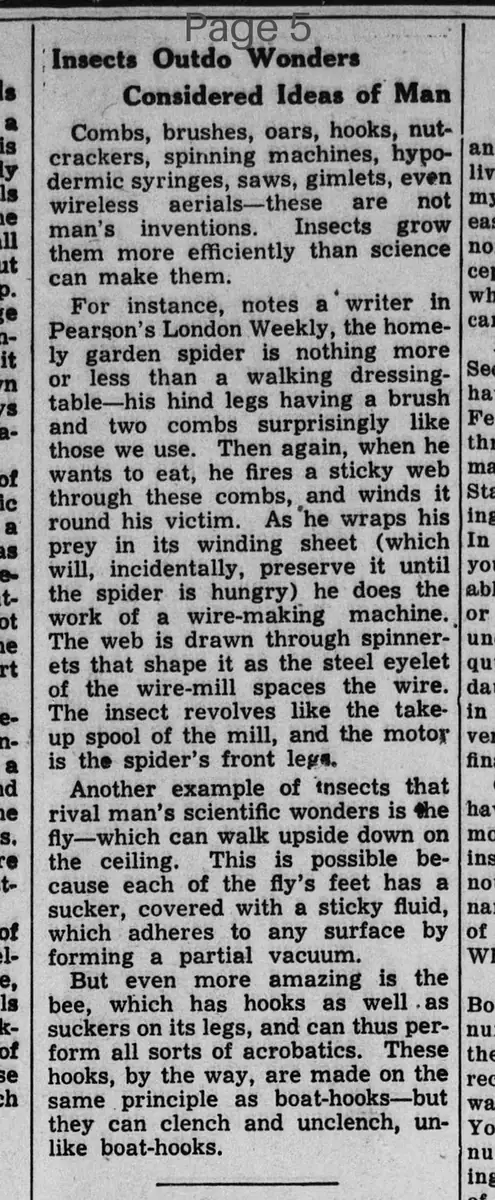
Insects Outdo Wonders Considered Ideas of Man
Combs, brushes, oars, hooks, nut-crackers, spinning machines, hypodermic syringes, saws, gimlets, even wireless aerials—these are not man's inventions. Insects grow them more efficiently than science can make them.
For instance, notes a writer in Pearson's London Weekly, the homely garden spider is nothing more or less than a walking dressing-table—his hind legs having a brush and two combs surprisingly like those we use. Then again, when he wants to eat, he fires a sticky web through these combs, and winds it round his victim. As he wraps his prey in its winding sheet (which will, incidentally, preserve it until the spider is hungry) he does the work of a wire-making machine.
The web is drawn through spinnerets that shape it as the steel eyelet of the wire-mill spaces the wire. The insect revolves like the take-up spool of the mill, and the motor is the spider's front legs.
Another example of insects that rival man's scientific wonders is the fly—which can walk upside down on the ceiling. This is possible because each of the fly's feet has a sucker, covered with a sticky fluid, which adheres to any surface by forming a partial vacuum.
But even more amazing is the bee, which has hooks as well as suckers on its legs, and can thus perform all sorts of acrobatics. These hooks, by the way, are made on the same principle as boat-hooks—but they can clench and unclench, unlike boat-hooks.
Combs, brushes, oars, hooks, nut-crackers, spinning machines, hypodermic syringes, saws, gimlets, even wireless aerials—these are not man's inventions. Insects grow them more efficiently than science can make them.
For instance, notes a writer in Pearson's London Weekly, the homely garden spider is nothing more or less than a walking dressing-table—his hind legs having a brush and two combs surprisingly like those we use. Then again, when he wants to eat, he fires a sticky web through these combs, and winds it round his victim. As he wraps his prey in its winding sheet (which will, incidentally, preserve it until the spider is hungry) he does the work of a wire-making machine.
The web is drawn through spinnerets that shape it as the steel eyelet of the wire-mill spaces the wire. The insect revolves like the take-up spool of the mill, and the motor is the spider's front legs.
Another example of insects that rival man's scientific wonders is the fly—which can walk upside down on the ceiling. This is possible because each of the fly's feet has a sucker, covered with a sticky fluid, which adheres to any surface by forming a partial vacuum.
But even more amazing is the bee, which has hooks as well as suckers on its legs, and can thus perform all sorts of acrobatics. These hooks, by the way, are made on the same principle as boat-hooks—but they can clench and unclench, unlike boat-hooks.
What sub-type of article is it?
Curiosity
Animal Story
Extraordinary Event
What themes does it cover?
Nature
What keywords are associated?
Insect Inventions
Spider Web
Fly Feet
Bee Hooks
Natural Wonders
Story Details
Story Details
The article describes various insects possessing natural tools and mechanisms that mimic or surpass human inventions, such as the spider's combs, web-spinning like a wire machine, the fly's sucker feet for ceiling walking, and the bee's clenching hooks for acrobatics.