Thank you for visiting SNEWPapers!
Sign up free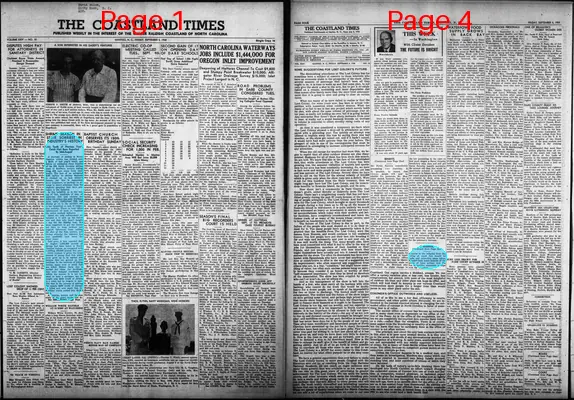
The Coastland Times
Manteo, Dare County, North Carolina
What is this article about?
North Carolina's shrimp industry faces its worst season ever, catching only a tenth of last year's haul by mid-August due to shortages possibly from winter freezes or wasteful practices like killing undersized fish and shrimp, lax enforcement, and overfishing, resulting in $100M losses and boats fleeing south.
Merged-components note: Continuation of shrimp season article across pages.
Clippings
1 of 2
OCR Quality
Full Text
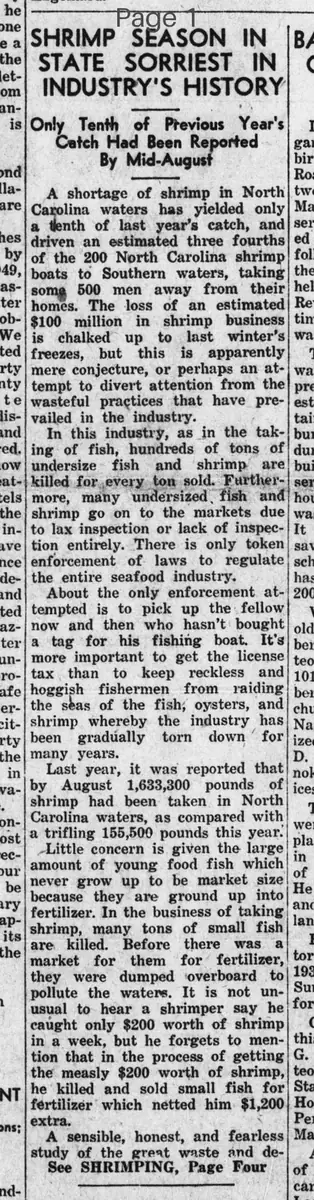
Only Tenth of Previous Year's Catch Had Been Reported By Mid-August
A shortage of shrimp in North Carolina waters has yielded only a tenth of last year's catch, and driven an estimated three fourths of the 200 North Carolina shrimp boats to Southern waters, taking some 500 men away from their homes. The loss of an estimated $100 million in shrimp business is chalked up to last winter's freezes, but this is apparently mere conjecture, or perhaps an attempt to divert attention from the wasteful practices that have prevailed in the industry.
In this industry, as in the taking of fish, hundreds of tons of undersize fish and shrimp are killed for every ton sold. Furthermore, many undersized fish and shrimp go on to the markets due to lax inspection or lack of inspection entirely. There is only token enforcement of laws to regulate the entire seafood industry.
About the only enforcement attempted is to pick up the fellow now and then who hasn't bought a tag for his fishing boat. It's more important to get the license tax than to keep reckless and hoggish fishermen from raiding the seas of the fish, oysters, and shrimp whereby the industry has been gradually torn down for many years.
Last year, it was reported that by August 1,633,300 pounds of shrimp had been taken in North Carolina waters, as compared with a trifling 155,500 pounds this year.
Little concern is given the large amount of young food fish which never grow up to be market size because they are ground up into fertilizer. In the business of taking shrimp, many tons of small fish are killed. Before there was a market for them for fertilizer, they were dumped overboard to pollute the waters. It is not unusual to hear a shrimper say he caught only $200 worth of shrimp in a week, but he forgets to mention that in the process of getting the measly $200 worth of shrimp, he killed and sold small fish for fertilizer which netted him $1,200 extra.
A sensible, honest, and fearless study of the great waste and de-
See SHRIMPING, Page Four
SHRIMPING (Continued from Page One)
struction to the industry from the killing of small fish should be made, and corrective steps taken.
It hasn't been taken because of the power of local politics over the few authorities competent to cope with the situation.
What sub-type of article is it?
What themes does it cover?
What keywords are associated?
Where did it happen?
Story Details
Location
North Carolina Waters
Event Date
Mid August [Current Year]; Last Winter
Story Details
Shrimp shortage yields only 10% of prior year's catch, driving boats south and causing $100M loss; blamed on freezes but likely wasteful practices, killing undersized seafood, lax enforcement, and overfishing for profit including fertilizer sales; calls for study and correction hindered by politics.