Thank you for visiting SNEWPapers!
Sign up free
Editorial
August 4, 1879
Chicago Daily Tribune
Chicago, Cook County, Illinois
What is this article about?
Editorial celebrates revival of U.S. iron industry as sign of ending economic depression post-1873, credits Republican specie resumption, criticizes Democrat Wright's committee for ignoring prosperity to fuel 1880 election narrative against Republicans. Predicts broad industrial recovery.
Clipping
OCR Quality
95%
Excellent
Full Text
The Age of Iron.
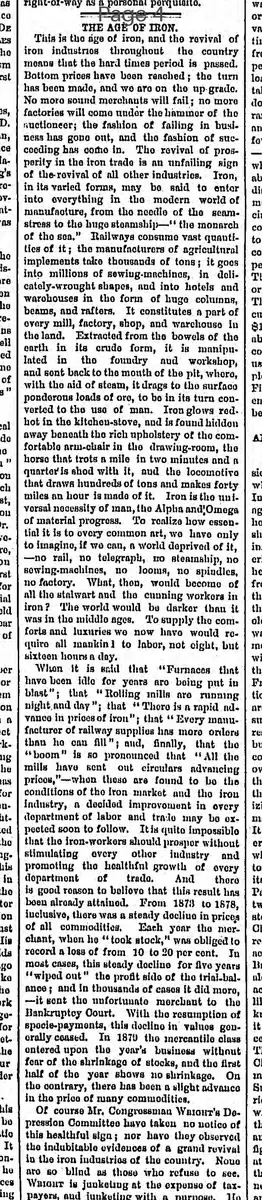
This is the age of iron, and the revival of iron industries throughout the country means that the hard times period is passed. Bottom prices have been reached; the turn has been made, and we are on the up grade. No more sound merchants will fail; no more factories will come under the hammer of the auctioneer; the fashion of failing in business has gone out, and the fashion of succeeding has come in. The revival of prosperity in the iron trade is an unfailing sign of the revival of all other industries. Iron, in its varied forms, may be said to enter into everything in the modern world of manufacture, from the needle of the seamstress to the huge steamship, the monarch of the sea. Railways consume vast quantities of it; the manufacturers of agricultural implements take thousands of tons; it goes into millions of sewing-machines, in delicately-wrought shapes, and into hotels and warehouses in the form of huge columns, beams, and rafters. It constitutes a part of every mill, factory, shop, and warehouse in the land. Extracted from the bowels of the earth in its crude form, it is manipulated in the foundry and workshop, and sent back to the mouth of the pit, where, with the aid of steam, it drags to the surface ponderous loads of ore, to be in its turn converted to the use of man. Iron glows red hot in the kitchen-stove, and in found hidden away beneath the rich upholstery of the comfortable arm-chair in the drawing-room, the horse that trots a mile in two minutes and a quarter is shod with it, and the locomotive that draws hundreds of tons and makes forty miles an hour is made of it. Iron is the universal necessity of man, the Alpha and Omega of material progress. To realize how essential it is to every common art, we have only to imagine, if we can, a world deprived of it,—no rail, no telegraph, no steamship, no sewing-machines, no looms, no spindles, no factory. What, then, would become of all the stalwart and the cunning workers in iron? The world would be darker than it was in the middle ages. To supply the comforts and luxuries we now have would require all mankind to labor, not eight, but sixteen hours a day.
When it is said that "Furnaces that have been idle for years are being put in blast"; that "Rolling mills are running night and day"; that "There is a rapid advance in prices of iron"; that "Every manufacturer of railway supplies has more orders than he can fill"; and, finally, that the "boom" is so pronounced that "All the mills have sent out circulars advancing prices," when those are found to be the conditions of the iron market and the iron industry, a decided improvement in every department of labor and trade may be expected soon to follow. It is quite impossible that the iron-workers should prosper without stimulating every other industry and promoting the healthful growth of every department of trade.
And there is good reason to believe that this result has been already attained. From 1873 to 1878, inclusive, there was a steady decline in prices of all commodities. Each year the merchant, when he "took stock," was obliged to record a loss of from 10 to 20 per cent. In most cases, this steady decline for five years "wiped out" the profit side of the trial-balance; and in thousands of cases it did more,—it sent the unfortunate merchant to the Bankruptcy Court. With the resumption of specie-payments, this decline in values generally ceased. In 1879 the mercantile class entered upon the year's business without fear of the shrinkage of stocks, and the first half of the year shows no shrinkage. On the contrary, there has been a slight advance in the price of many commodities.
Of course Mr. Congressman Wright's Depression Committee have taken no notice of this healthful sign; nor have they observed the indubitable evidences of a grand revival in the iron industries of the country. None are so blind as those who refuse to see. Wright is junketing at the expense of tax-payers, and junketing with a purpose. He is courting Socialists, Communists, and Flatists, and it is from those classes that he seeks and obtains testimony. The Democratic party is not ready for prosperous times. The Presidential campaign of 1880 impends, and Wright is in pursuit of evidence to prove that resumption, brought about by the Republican party, has not brought prosperity. But he is too late. The "boom" of the iron industries will overwhelm Democrats, Communists, Socialists, and Fiatists in one common ruin. The country is on the high road to prosperity, and, before the Presidential Convention of 1880 shall have been held, the present strong indications of a general revival of business will have crystallized into an active commercial and industrial campaign. The Socialists and the Communists—the rank and file—will have found constant employment; and they will have no time to listen to the wild and foolish harangues of their demagogical leaders. Make way for the iron horse!
This is the age of iron, and the revival of iron industries throughout the country means that the hard times period is passed. Bottom prices have been reached; the turn has been made, and we are on the up grade. No more sound merchants will fail; no more factories will come under the hammer of the auctioneer; the fashion of failing in business has gone out, and the fashion of succeeding has come in. The revival of prosperity in the iron trade is an unfailing sign of the revival of all other industries. Iron, in its varied forms, may be said to enter into everything in the modern world of manufacture, from the needle of the seamstress to the huge steamship, the monarch of the sea. Railways consume vast quantities of it; the manufacturers of agricultural implements take thousands of tons; it goes into millions of sewing-machines, in delicately-wrought shapes, and into hotels and warehouses in the form of huge columns, beams, and rafters. It constitutes a part of every mill, factory, shop, and warehouse in the land. Extracted from the bowels of the earth in its crude form, it is manipulated in the foundry and workshop, and sent back to the mouth of the pit, where, with the aid of steam, it drags to the surface ponderous loads of ore, to be in its turn converted to the use of man. Iron glows red hot in the kitchen-stove, and in found hidden away beneath the rich upholstery of the comfortable arm-chair in the drawing-room, the horse that trots a mile in two minutes and a quarter is shod with it, and the locomotive that draws hundreds of tons and makes forty miles an hour is made of it. Iron is the universal necessity of man, the Alpha and Omega of material progress. To realize how essential it is to every common art, we have only to imagine, if we can, a world deprived of it,—no rail, no telegraph, no steamship, no sewing-machines, no looms, no spindles, no factory. What, then, would become of all the stalwart and the cunning workers in iron? The world would be darker than it was in the middle ages. To supply the comforts and luxuries we now have would require all mankind to labor, not eight, but sixteen hours a day.
When it is said that "Furnaces that have been idle for years are being put in blast"; that "Rolling mills are running night and day"; that "There is a rapid advance in prices of iron"; that "Every manufacturer of railway supplies has more orders than he can fill"; and, finally, that the "boom" is so pronounced that "All the mills have sent out circulars advancing prices," when those are found to be the conditions of the iron market and the iron industry, a decided improvement in every department of labor and trade may be expected soon to follow. It is quite impossible that the iron-workers should prosper without stimulating every other industry and promoting the healthful growth of every department of trade.
And there is good reason to believe that this result has been already attained. From 1873 to 1878, inclusive, there was a steady decline in prices of all commodities. Each year the merchant, when he "took stock," was obliged to record a loss of from 10 to 20 per cent. In most cases, this steady decline for five years "wiped out" the profit side of the trial-balance; and in thousands of cases it did more,—it sent the unfortunate merchant to the Bankruptcy Court. With the resumption of specie-payments, this decline in values generally ceased. In 1879 the mercantile class entered upon the year's business without fear of the shrinkage of stocks, and the first half of the year shows no shrinkage. On the contrary, there has been a slight advance in the price of many commodities.
Of course Mr. Congressman Wright's Depression Committee have taken no notice of this healthful sign; nor have they observed the indubitable evidences of a grand revival in the iron industries of the country. None are so blind as those who refuse to see. Wright is junketing at the expense of tax-payers, and junketing with a purpose. He is courting Socialists, Communists, and Flatists, and it is from those classes that he seeks and obtains testimony. The Democratic party is not ready for prosperous times. The Presidential campaign of 1880 impends, and Wright is in pursuit of evidence to prove that resumption, brought about by the Republican party, has not brought prosperity. But he is too late. The "boom" of the iron industries will overwhelm Democrats, Communists, Socialists, and Fiatists in one common ruin. The country is on the high road to prosperity, and, before the Presidential Convention of 1880 shall have been held, the present strong indications of a general revival of business will have crystallized into an active commercial and industrial campaign. The Socialists and the Communists—the rank and file—will have found constant employment; and they will have no time to listen to the wild and foolish harangues of their demagogical leaders. Make way for the iron horse!
What sub-type of article is it?
Economic Policy
Partisan Politics
What keywords are associated?
Iron Industry
Economic Revival
Specie Resumption
Iron Trade Boom
Partisan Politics
1879 Prosperity
Depression Committee
What entities or persons were involved?
Mr. Congressman Wright
Democratic Party
Republican Party
Socialists
Communists
Fiatists
Editorial Details
Primary Topic
Revival Of Iron Industry Signaling Economic Prosperity
Stance / Tone
Optimistic Pro Republican Critique Of Democrats
Key Figures
Mr. Congressman Wright
Democratic Party
Republican Party
Socialists
Communists
Fiatists
Key Arguments
Revival Of Iron Industries Indicates End Of Hard Times And Beginning Of Prosperity
Iron Is Essential To All Modern Manufacturing And Progress
Iron Market Boom With Furnaces Restarting, Mills Running, Prices Advancing
Decline In Commodity Prices From 1873 1878 Ended With Resumption Of Specie Payments
Wright's Depression Committee Ignores Positive Economic Signs To Support Democratic Narrative Against Republican Resumption Policy
Iron Industry Boom Will Lead To General Business Revival Before 1880 Election