Thank you for visiting SNEWPapers!
Sign up free
The Rhode Island American, And General Advertiser
Providence, Providence County, Rhode Island
What is this article about?
A review from the Albany Daily Advertiser praises Lord Byron's 'Manfred,' a dramatic poem featuring a tormented magician haunted by lost love and seeking forgetfulness through supernatural means. It compares it to Childe Harold, excerpts key scenes of anguish and invocation, and notes its themes of despair and personal allusion, deeming it Byron's most magnificent work despite dramatic flaws.
Merged-components note: Continuation of the literary review of Byron's Manfred across pages; sequential reading order and text flow
Clippings
1 of 2
OCR Quality
Full Text
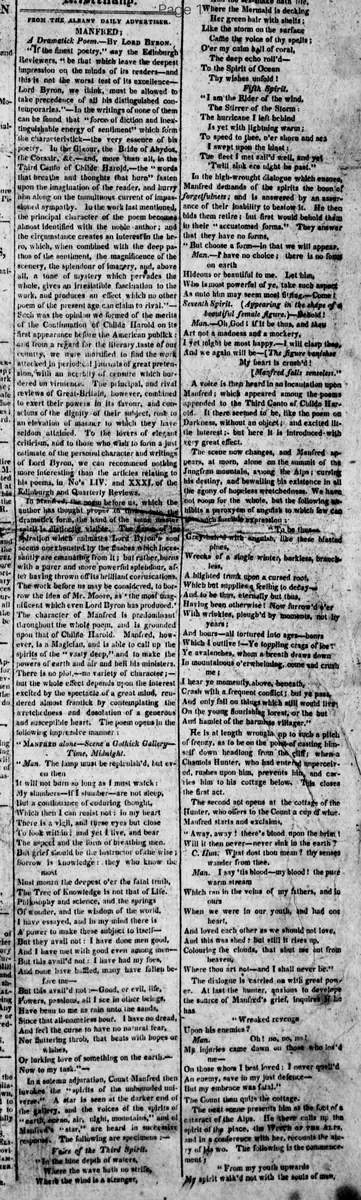
MANFRED;
A Dramatick Poem.—By Lord Byron.
"If the finest poetry," say the Edinburgh Reviewers, "be that which leaves the deepest impression on the minds of its readers—and this is not the worst test of its excellence—Lord Byron, we think, must be allowed to take precedence of all his distinguished contemporaries."—In the writings of none of them can be found that "force of diction and inextinguishable energy of sentiment" which form the characteristic—the very essence of his poetry. In the Giaour, the Bride of Abydos, the Corsair, &c. and, more than all, in the Third Canto of Childe Harold,—the "words that breathe and thoughts that burn" fasten upon the imagination of the reader, and hurry him along on the tumultuous current of impassioned sympathy. In the work last mentioned, the principal character of the poem becomes almost identified with the noble author; and the circumstance creates an interest in the hero, which, when combined with the deep pathos of the sentiment, the magnificence of the scenery, the splendour of imagery, and, above all, a tone of mystery which pervades the whole, gives an irresistible fascination to the work, and produces an effect which no other poem of the present age can claim to rival.—
Such was the opinion we formed of the merits of the Continuation of Childe Harold on its first appearance before the American publick; and from a regard for the literary taste of our country, we were mortified to find the work attacked in periodical journals of great pretension, with an acerbity of censure which bordered on virulence. The principal, and rival reviews of Great-Britain, however, combined to exert their powers in its favour, and conscious of the dignity of their subject, rose to an elevation of manner to which they have seldom attained. To the lovers of elegant criticism, and to those who wish to form a just estimate of the personal character and writings of Lord Byron, we can recommend nothing more interesting than the articles relating to his poems, in Nos. XIV. and XXXI. of the Edinburgh and Quarterly Reviews.
In Manfred; the poem before us, which the author has thought proper to give the dramatick form, the hand of the same master spirit—ludicrously visible. The dramatick demonstration which animates Lord Byron's soul seems unexhausted by the flashes which incessantly are emanating from it; but rather, burns with a purer and more powerful splendour, after having thrown off its brilliant corruscations. The work before us may be considered, to borrow the idea of Mr. Moore, as the most magnificent which even Lord Byron has produced. The character of Manfred is predominant throughout the whole poem, and is grounded upon that of Childe Harold. Manfred, however, is a Magician, and is able to call up the spirits of the "vasty deep," and to make the powers of earth and air and hell his ministers. There is no plot,—no variety of character;—but the whole effect depends upon the interest excited by the spectacle of a great mind, rendered almost frantic by contemplating the wretchedness and desolation of a generous and susceptible heart. The poem opens in the following impressive manner:
Manfred alone—Scene, a Gothick Gallery—Time, Midnight.
"Man. The lamp must be replenished, but even then
It will not burn so long as I must watch:
My slumbers—if I slumber—are not sleep,
But a continuance of enduring thought,
Which then I can resist not: in my heart
There is a vigil, and these eyes but close
To look within; and yet I live, and bear
The aspect and the form of breathing men.
But grief should be the instructor of the wise;
Sorrow is knowledge: they who know the most
Must mourn the deepest o'er the fatal truth,
The Tree of Knowledge is not that of Life.
Philosophy and science, and the springs
Of wonder, and the wisdom of the world,
I have essayed, and in my mind there is
A power to make these subject to itself—
But they avail not: I have done men good,
And I have met with good even among men—
But this availed not: I have had my foes,
And none have baffled, many have fallen before me—
But this availed not:—Good or evil, life,
Powers, passions, all I see in other beings,
Have been to me as rain unto the sands,
Since that all-nameless hour. I have no dread,
And feel the curse to have no natural fear,
Nor fluttering throb, that beats with hopes or wishes,
Or lurking love of something on the earth.—
Now to my task."—
In a solemn adjuration, Count Manfred then invokes the "spirits of the unbounded universe." A star is seen at the darker end of the gallery, and the voices of the spirits of "earth, ocean, air, night, mountains," and of Manfred's "star," are heard in successive response. The following are specimens:—
Voice of the Third Spirit.
"In the blue depth of waters,
Where the wave hath no strife,
Where the wind is a stranger,
And the sea-thing is free,
Fair forms, and their shadows, attend me at sea,
And in fresh beauty's smile, o'er the waters I see
The green hair with shells, Like the storm on the surface
Came the voice of thy spells
O'er my calm hall of coral, The deep echo rolled—
To the Spirit of Ocean, Thy wishes unfold!"
Fifth Spirit.
"I am the Rider of the wind,
The Stirrer-of the Storm:
The hurricane I raised behind
Is yet with lightning warm,
To speed to thee, o'er shore and sea
I swept upon the blast:
The fleet I met sailed well, and yet
'Twill sink ere night be past."
In the high-wrought dialogue which ensues, Manfred demands of the spirits the boon of forgetfulness; and is answered by an assurance of their inability to bestow it. He then bids them retire; but first would behold them in their "accustomed forms." They answer that they have no forms,
"But choose a form—in that we will appear"
Man.—"I have no choice; there is no form on earth
Hideous or beautiful to me. Let him,
Who is most powerful of ye, take such aspect
As unto him may seem most fitting.—Come,
Seventh Spirit. (Appearing in the shape of a beautiful female figure.) —Behold!
Man.—Oh God! if it be thus, and thou
Art not a madness and a mockery,
I yet might be most happy.—I will clasp thee
And we again will be—[The figure vanishes]
My heart is crushed!
[Manfred falls senseless.]
A voice is then heard in an incantation upon Manfred; which appeared among the poems appended to the Third Canto of Childe Harold. It there seemed to be, like the poem on Darkness, without an object; and excited little interest;—but here it is introduced with very great effect.
The scene now changes, and Manfred appears, at morn, alone on the summit of the Jungfrau mountain, among the Alps; cursing his destiny, and bewailing his existence in all the agony of hopeless wretchedness. We have not room for the whole, but the following exhibits a paroxysm of anguish to which few can find a parallel for forcible expression:
"To be thus,
Grey-haired with anguish, like these blasted pines,
Wrecks of a single winter, barkless, branchless,
A blighted trunk upon a cursed root,
Which but supplies a feeling to decay—
And to be thus, eternally but this,
Having been otherwise! Now furrowed o'er
With wrinkles, ploughed by moments, not by years;
And hours—all tortured into ages—hours
Which I outlive!—Ye toppling crags of ice!
Ye avalanches, whom a breath draws down
In mountainous overwhelming, come and crush me!
I hear ye momently above, beneath,
Crash with a frequent conflict; but ye pass,
And only fall on things which still would live;
On the young flourishing forest, or the hut
And hamlet of the harmless villager."—
He is at length wrought up to such a pitch of frenzy, as to be on the point of casting himself headlong from the cliff; when a Chamois Hunter, who had entered unperceived, rushes upon him, prevents him and carries him to his cottage below. This closes the first act.
The second act opens at the cottage of the hunter, who offers to the Count a cup of wine. Manfred starts and exclaims,
"Away, away! there's blood upon the brim!
Will it then never—never sink in the earth?
Cham. What dost thou mean? thy senses wander from thee.
Man. I say 'tis blood—my blood! the pure warm stream
Which ran in the veins of my fathers, and in ours
When we were in our youth, and had one heart,
And loved each other as we should not love,
And this was shed: but still it rises up,
Colouring the clouds, that shut me out from heaven,
Where thou art not—and I shall never be."—
The dialogue is carried on with great power. At last the hunter, anxious to develope the source of Manfred's grief, inquires if he has
"Wreaked revenge
Upon his enemies?
Man.
Oh! no, no, no!
My injuries came down on those who loved me—
On those whom I best loved: I never quelled
An enemy, save in my just defence—
But my embrace was fatal."—
The Count then quits the cottage:
The next scene presents him at the foot of a cataract of the Alps. He there calls up the spirit of the place, the Witch of the Alps, and in a conference with her, recounts the story of his woe. The following is the Count's commencement—
"From my youth upwards
My spirit walked not with the souls of men,
Nor look'd upon the earth with human eyes;
The thirst of their ambition was not mine,
The aim of their existence was not mine;
My joys, my griefs, my passions, and my powers,
Made me a stranger; though I wore the form,
I had no sympathy with breathing flesh,
Nor midst the creatures of the day that girded me
Was there but one who--but of, her anon."
He then goes on to speak of the feelings of his youth. The whole passage is eminently beautiful, but our limits do not permit us to insert it. After some time he again returns to the object which he has glanced upon before.
"She was like me in lineaments--her eyes,
Her hair, her features, all, to the very tone
Even of her voice, they said were like to mine;
But soften'd all, and temper'd into beauty;
She had the same lone thoughts and wanderings,
The quest of hidden knowledge, and a mind
To comprehend the universe: nor these
Alone, but with them gentler powers than mine,
Pity, and smiles, and tears--which I had not;
And tenderness--but that I had for her;
Humility--and that I never had.
Her faults were mine--her virtues were her own.
I loved her, and destroy'd her!"
Witch.
With thy hand?
Man. Not with my hand, but heart--which broke her heart--
It gazed on mine, and withered. I have shed
Blood, but not hers--and yet her blood was shed--
I saw--and could not stanch it.
This is indeed agonizing--but the witch retorts his anguish with scorn. He answers:
"Daughter of Air! I tell thee, since that hour--
But words are breath--look on me in my sleep.
Or watch my watchings--Come and sit by me,
My solitude is solitude no more,
But peopled with the Furies:--I have gnash'd
My teeth in darkness till returning morn,
Then curs'd myself till sunset;--I have pray'd
For madness as a blessing--'tis denied me.
I have affronted death--but in the war
Of elements the waters shrunk from me,
And fatal things pass'd harmless."
We know not where to search for a more powerful delineation of mental torture. Manfred at length bids the witch retire, and determines to seek assistance from powers of a still higher order. In the ensuing scene three Destinies are introduced as meeting on the summit of Mount Jungfrau, and recounting in songs and responses the deeds of woe and death in which they have delighted to engage. To them enters Nemesis, who seems inflated with her ancient dignity; and they all repair to the hall of Arimanes, the "Prince of Earth and Air." The scene then changes to that hall, where all the Spirits are assembled around the throne of their master. Manfred--a mortal--bursts in among them, determined to consult "powers deeper still beyond," and demands of Arimanes that the dead shall rise to answer the invocation of Nemesis, the phantom of Astarte to his inquiries. Arimanes consents, and at his bidding Astarte rises and stands in the midst: but the assembled powers of earth and air, in vain endeavour to compel her to break silence. It is then that Manfred breaks forth in the following strains of frenzied emotion.
"Hear me, hear me--
Astarte! my beloved: speak to me:
I have so much endured--so much endure--
Look on me! the grave hath not changed thee
Than I am changed for thee. Thou lovedst me
Too much, as I loved thee: we were not made
To torture thus each other, though it were
The deadliest sin to love as we have loved.
Say that thou loath'st me not--and that I do
Bear this punishment for both--that thou wilt be
One of the blessed--and that I shall die,
For hitherto all hateful things conspire
To bind me in existence--in a life
Which makes me shrink from immortality
A future like the past. I cannot rest.
I know not what I ask, nor what I seek:
I seek but that thou art--and what I am;
And I would bear yet once before I perish
The voice which was my music--Speak to me!
For I have call'd on thee in the still night,
Startled the slumbering birds from the hush'd boughs,
And woke the mountain wolves, and made the Caves
Acquainted with thy vainly echoed name,
Which answered me; many things answered me--
Spirits and men--but thou wert silent all.
Yet speak to me! I have outwatch'd the stars,
And gazed o'er heaven in vain in search of thee.
Speak to me! I have wandered o'er the earth
And never found thy likeness--Speak to me!
Look on the fiends around--they feel for me:
I fear them not, and feel for thee alone--
Speak to me! though it be in wrath;--but say--
I reck not what--but let me hear thee once--
This once--once more!"
Phantom of Astarte. Manfred!
Man.
Say on, say on
I hear a voice but it is not thy voice--
Than. Manfred! To-morrow ends thine earthly life.
Man. Yet one word more--am I forgiven?
Phan. Farewell!
Man.
Say, shall we meet again?
Phan. Farewell!
Man. One word for mercy! Say thou lovest me.
Phan. Manfred!
[The Spirit of Astarte disappears]
Nem. She's gone, and will not be recall'd;
Her words will be fulfill'd. Return to the earth.
A Spir. He is convulsed!
The scene now returns to mortal things, and the Abbot of St. Maurice is introduced as visiting Count Manfred at his castle, or
"Rumours strange
And of unholy nature, are abroad,
And busy with his name."
The good Abbot uses every endeavour to reclaim him, but the Count answers by the emphatic ejaculation--"It is too late!"
We are now approaching the conclusion.--After a scene in which Manfred addresses the setting sun, and bids the orb of day farewell forever;--and another in which two of the servants converse upon the subject of his grief;--Manfred appears alone at midnight in the interior of his tower.
"The stars are forth, the moon above the tops
Of the snow-shining mountains.--Beautiful!
I linger yet with nature, for the night
Hath been to me a more familiar face
Than that of man; and in her starry shade
Of dim and solitary loveliness,
I learn'd the language of another world."
While pursuing this train of meditation, the Abbot breaks in upon him, and is ordered to "retire, or peril is at hand."
Abbot.
What dost mean?
Man.
Look there!
Abbot.
What dost thou see?
Man.
Look there, I say,
And steadfastly;--now tell me what thou seest?
Abbot. That which shall shake me,--but I fear it not--
I see a dusk and awful figure rise
Like an infernal god from out the earth;
His face wrapt in a mantle and his form
Robed as with angry clouds; he stands between
Thyself and me--but I do fear him not.
This awful spectre is the genius of the Count, and comes to summon him to his dark and long abode. Manfred disputes the power of the spectre, and at length drives him and his legions baffled from his presence. But the hand of death is already upon him, and the Abbot exclaims--
"Alas! how pale thou art! thy lips are white--
And thy breast heaves--and in thy gasping throat
The accents rattle--Give thy prayers to heaven--
Pray--albeit but in thought--but die not thus."
Man. 'Tis over--my dull eyes cannot fix thee
But all things swim around me, and the earth
Heaves, as it were, beneath me. Fare thee well--
Give me thy hand.
[Manfred expires.]
Abbot.
Cold--cold--even to the heart--
But yet one prayer--alas! how fares it with thee?
He's gone--his soul hath ta'en its earthless flight--
Whither? I dread to think--but he is gone.
Such is the outline of this singular and extraordinary production, which, although its form be dramatick, was probably never intended for publick representation. Considered as a drama, its general character may perhaps bear a distant resemblance to that of the "Tempest." It is, however, destitute of all those softer scenes, and fanciful combinations which Shakspeare has interwoven in the latter, and which constitute its principal charm. We know not whether Lord Byron may have fixed his eye upon the example of the Bard of Avon, but in reference to the principal personage of all his writings, he has, assuredly, first
"Exhausted worlds, and then imagined new."
He had already advanced the character of Harold to the utmost limits of the capacity of our mortal nature; and now has taken a daring flight beyond, and soared unrestrained and unconfused through the trackless regions of an imaginary creation. The common herd of mortals are left at a distance. We gaze on Manfred as a being removed from humanity, and are ready to exclaim with the Abbot--
"It is an awful chaos--light and darkness--
And mind and dust."
For this reason, in part, we are not sure that the present work, with all its magnificence and energy, will obtain an equal share of popular favour with the pilgrimages of Harold, or the tales of the East. Harold, though eccentric and misanthropical, is yet a mortal. In his late wanderings over the continent, the frequent bursts of paternal affection,--the scenes of Waterloo and of "Geneva's Lake," with all their associated recollections, come home to every bosom and arouse an enthusiasm of feeling. But here are no apostrophes to the smiles and tears of infancy,--no fields on which the splendour of victory will fix the gaze of posterity,--no scenes over which the eloquence of Rousseau has cast the attractions of enchantment. All is wildness, desolation, and despair.
It has often been objected to Lord Byron that he has made his heroes villains. Our limits do not permit us to enter upon that vindication of his conduct in this respect, of which we think he is deserving. Himself the victim of a constitutional melancholy, his delight and his power consist in portraying the deeper and more gloomy emotions of the soul, and those inconsistencies and abrupt transitions of character and conduct which spring from an extravagance of passion. But how can these qualities exist in one who is obedient to all the dictates of virtue?
An idea is suggested by the perusal of this work, which if we should omit to notice, it would probably be ascribed to our want of penetration. The poem has undoubtedly an allusion to the domestick circumstances of the author?* The subject is delicate, and we wish not to dwell upon it. The extracts we have given will serve to shew whether this opinion be well founded, as well as mark the degree to which the allusion is extended.
If the work be considered as a drama--a mode of judging which we do not believe would meet the intention of the author--there is room for a variety of objections which, we have no doubt, will be zealously urged. Nor as a poem, can it by any means claim an exemption from defects. The three last scenes in particular, are tame and feeble in comparison with the rest. When his Lordship drops the points of resemblance between Manfred and the author, he seems to lose that vigour and power of condensation for which he is distinguished, and which he has rendered so conspicuous in the former parts of the work.
K.
What sub-type of article is it?
What themes does it cover?
What keywords are associated?
What entities or persons were involved?
Literary Details
Title
Manfred; A Dramatick Poem.—By Lord Byron.
Author
K.
Subject
Review Of Lord Byron's Dramatic Poem Manfred
Form / Style
Prose Literary Review With Excerpts From The Poem
Key Lines