Thank you for visiting SNEWPapers!
Sign up free
Story
April 16, 1851
North Carolina Standard
Raleigh, Wake County, North Carolina
What is this article about?
Dr. Hawes of Worcester, Mass., invents a self-feeding machine that automates envelope production, folding, pasting, pressing, counting into packages of 25, and producing 36,000 envelopes daily with three machines running, aiming for 120,000 per day.
Clipping
OCR Quality
98%
Excellent
Full Text
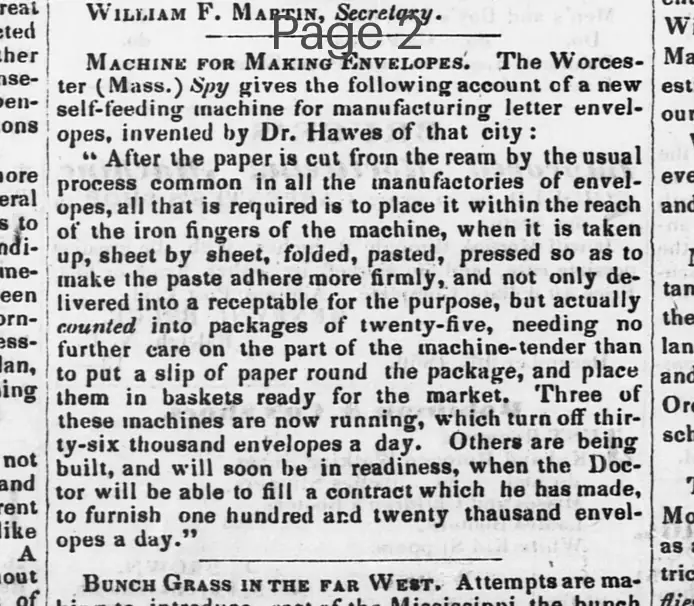
Machine For Making Envelopes. The Worcester (Mass.) Spy gives the following account of a new self-feeding machine for manufacturing letter envelopes, invented by Dr. Hawes of that city:
"After the paper is cut from the ream by the usual process common in all the manufactories of envelopes, all that is required is to place it within the reach of the iron fingers of the machine, when it is taken up, sheet by sheet, folded, pasted, pressed so as to make the paste adhere more firmly, and not only delivered into a receptacle for the purpose, but actually counted into packages of twenty-five, needing no further care on the part of the machine-tender than to put a slip of paper round the package, and place them in baskets ready for the market. Three of these machines are now running, which turn off thirty-six thousand envelopes a day. Others are being built, and will soon be in readiness, when the Doctor will be able to fill a contract which he has made, to furnish one hundred and twenty thousand envelopes a day."
"After the paper is cut from the ream by the usual process common in all the manufactories of envelopes, all that is required is to place it within the reach of the iron fingers of the machine, when it is taken up, sheet by sheet, folded, pasted, pressed so as to make the paste adhere more firmly, and not only delivered into a receptacle for the purpose, but actually counted into packages of twenty-five, needing no further care on the part of the machine-tender than to put a slip of paper round the package, and place them in baskets ready for the market. Three of these machines are now running, which turn off thirty-six thousand envelopes a day. Others are being built, and will soon be in readiness, when the Doctor will be able to fill a contract which he has made, to furnish one hundred and twenty thousand envelopes a day."
What sub-type of article is it?
Curiosity
Historical Event
What themes does it cover?
Triumph
What keywords are associated?
Envelope Machine
Invention
Dr. Hawes
Worcester
Manufacturing
What entities or persons were involved?
Dr. Hawes
Where did it happen?
Worcester (Mass.)
Story Details
Key Persons
Dr. Hawes
Location
Worcester (Mass.)
Story Details
A new self-feeding machine invented by Dr. Hawes automates envelope manufacturing from cut paper, handling folding, pasting, pressing, delivery, counting into packages of twenty-five, with three machines producing thirty-six thousand envelopes a day and plans to reach one hundred and twenty thousand.