Thank you for visiting SNEWPapers!
Sign up free
The Louisiana Democrat
Alexandria, Rapides County, Louisiana
What is this article about?
In September 1865, Judge James I. Weems and Bossier Parish Sheriff Alden were arrested by the Freedmen's Bureau for trying and convicting freedman John Gaines of horse-stealing in Bellevue, LA, violating Bureau jurisdiction amid claimed civil law interruption. Local bar protested; Bureau upheld the arrest.
Clipping
OCR Quality
Full Text
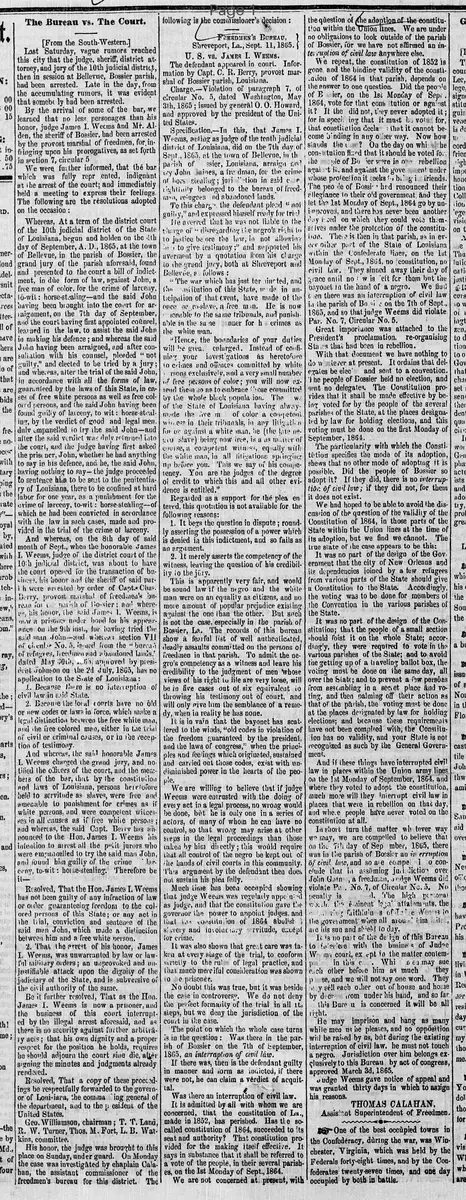
[From the South-Western.]
Last Saturday, vague rumors reached this city that the judge, sheriff, district attorney, and jury of the 10th judicial district, then in session at Bellevue, Bossier parish, had been arrested. Late in the day, from the accumulating rumors, it was evident that somebody had been arrested.
By the arrival of some of the bar, we learned that no less personages than his honor, judge James I. Weems and Mr. Alden, the sheriff of Bossier, had been arrested by the provost marshal of freedmen, for infringing upon his prerogatives, as set forth in section 7, circular 5.
We were further informed, that the bar which was fully represented, indignant at the arrest of the court; and immediately held a meeting to express their feelings.
The following are the resolutions adopted on the occasion:
Whereas. At a term of the district court of the 10th judicial district of the State of Louisiana, begun and holden on the 4th day of September, A. D., 1865, at the town of Bellevue, in the parish of Bossier, the grand jury of the parish aforesaid, found and presented to the court a bill of indictment, in due form of law, against John, a free man of color, for the crime of larceny. to-wit: horse-stealing—and the said John having been brought into the court for arraignment, on the 7th day of September, and the court having first appointed counsel. learned in the law, to assist the said John in making his defence ; and whereas the said John having been arraigned, and after consultation with his counsel, pleaded "not guilty," and elected to be tried by a jury; and whereas, after the trial of the said John, in accordance with all the forms of law, guaranteed by the laws of this State, in cases of free white persons as well as free colored persons, and the said John having been found guilty of larceny, to wit: horse-stealing, by the verdict of good and legal men. duly empanelled to try the said John—and after the said verdict was duly returned into the court, and the judge having first asked the prisoner, John, whether he had anything to say in his defence, and he, the said John, having nothing to say— the judge proceeded to sentence him to be sent to the penitentiary of Louisiana, there to be confined at hard labor for one year, as a punishment for the crime of larceny, to-wit: horse-stealing—of which he had been convicted in accordance with the law in such cases, made and provided in the trial of the crime of larceny.
And whereas, on the 8th day of said month of Sept., when the honorable James I. Weems, judge of the district court of the 10th judicial district, was about to have the court opened for the transaction of business. his honor and the sheriff of said parish were arrested by order of Capt. Chas. Berry, provost marshal of freedmen's bureau for parish of Bossier: and whereas, his honor, the said James I. Weems. is now a prisoner under bond for his appearance on the 9th inst., for having tried the said man John—and whereas section VII of circular No. 5. issued from the "bureau of refugees, freedmen and abandoned lands." dated May 30th, 1865, approved by president johnson on the 2d July, 1865, has no application to the State of Louisiana:
1. Because there is no interruption of civil law in said State.
2. Because the local courts have no old or new codes or laws in force. which make a legal distinction between the free white man and the free colored man, either in the trial of civil or criminal causes, or in the reception of testimony.
And whereas, the said honorable James I. Weems charged the grand jury, and notified the officers of the court, and the members of the bar, that by the constitution and laws of Louisiana, persons heretofore held to servitude as slaves, were free and amenable to punishment for crimes as if white persons, and were competent witnesses in all causes as if free white persons; and whereas, the said Capt. Berry has announced to the Hon. James I. Weems his intention to arrest all the petit jurors who were empanelled to try the said man John, and found him guilty of the crime larceny, to-wit: horse-stealing. Therefore be it
Resolved, That the Hon. James I. Weems has not been guilty of any infraction of law or order guaranteeing freedom to the colored persons of this State; or any act in the trial, conviction and sentence of the said man John, which made a distinction between him and a free white person.
2. That the arrest of his honor, James I. Weems, was unwarranted by law or lawful military orders; an unprovoked and unjustifiable attack upon the dignity of the judiciary of the State, and is subversive of the civil authority of the same.
Be it further resolved, That as the Hon. James I. Weems is now a prisoner, and the business of this court interrupted by the illegal arrest aforesaid, and as there is no security against further arbitrary acts; that his own dignity and a proper respect for the position he holds, requires he should adjourn the court sine die. after signing the minutes and judgments already rendered.
Resolved, That a copy of these proceedings be respectfully forwarded to the governor of Louisiana, the commanding general of the department, and to the president of the United States.
Geo. Williamson, chairman; T. T. Land R. W. Turner, Thos. M. Fort, L. B. Watkins, committee.
His honor, the judge was brought to this place on Sunday, under guard. On Monday the case was investigated by chaplain Callahan, the assistant commissioner of the freedmen's bureau for this district. The following is the commissioner's decision:
Freedmen's Bureau,
Shreveport, La., Sept. 11, 1865.
U. S. vs. JAMES I. WEEMS.
The defendant appeared in court. Information by Capt. C. R. Berry, provost marshal of Bossier parish, Louisiana.
Charge.—Violation of paragraph 7, of circular No. 5, dated Washington, May 30th, 1865 ; issued by general O. O. Howard. and approved by the president of the United States.
Specification.—In this, that James I. Weems, acting as judge of the tenth judicial district of Louisiana, did on the 7th day of Sept., 1865. at the town of Bellevue, in the parish of Bossier, Louisiana, arraign and try John Gaines, a freedman, for the crime of horse stealing; jurisdiction in said case rightfully belonged to the bureau of freedmen, refugees and abandoned lands.
To this charge the defendant plead "not guilty," and expressed himself ready for trial
He averred that he was not liable to the charge of "disregarding the negro's right to justice before the law, in not allowing him to give testimony;" and supported his averment by a quotation from his charge to the grand jury, both at Shreveport and Bellevue, as follows:
" The war which has just terminated, and the constitution of this State, made in anticipation of that event, have made of the once negro-slave, a free man. He is now amenable to the same tribunals, and punishable in the same manner for his crimes as the white man.
"Hence, the boundaries of your duties will be greatly enlarged. Instead of confining your investigations as heretofore to crimes and offences committed by white persons exclusively, and a very small number of free persons of color: you will now extend them so as to embrace those committed by the whole black population. The laws of the State of Louisiana having always made the free man of color a competent witness in their tribunals, in any litigation for or against a white man, he (the late negro slave) being now free, is, as a matter of course, a competent witness, equally with the white man, in all litigations springing up before you. This we say of his competency. You are the judges of the degree of credit to which this and all other evidence is entitled."
Regarded as a support for the plea entered, this quotation is not available for the following reasons:
1. It begs the question in dispute; roundly asserting the possession of a power which is denied in this indictment, and so fails as an argument.
2. It merely asserts the competency of the witness, leaving the question of his credibility to the jury.
This is apparently very fair, and would be sound law if the negro and the white man were on an equality as citizens, and no more amount of popular prejudice existing against the one than the other. But such is not the case, especially in the parish of Bossier, La. The records of this bureau show a fearful list of well authenticated. deadly assaults committed on the persons of freedmen in that parish. To admit the negro's competency as a witness and leave his credibility to the judgment of men whose views of his right to life are very loose, will be in five cases out of six equivalent to throwing his testimony out of court, and will only give him the semblance of a remedy, when in reality he has none.
It is in vain that the bayonet has scattered to the winds, "old codes in violation of the freedom guaranteed by the president. and the laws of congress," when the principles and feelings which originated, sustained and carried out those codes, exist with undiminished power in the hearts of the people.
We are willing to believe that if judge Weems were entrusted with the doing of every act in a legal process, no wrong would be done, but he is only one in a series of actors, of many of whom he can have no control, so that wrong may arise at other steps in the legal proceedings than those taken by him directly; this would require that all control of the negro be kept out of the hands of civil courts in this community.
This argument by the defendant then does not sustain his plea fully.
Much time has been occupied showing that judge Weems was regularly appointed as judge, and that the constitution gave the governor the power to appoint judges. and that it constitution of 1864 abolishes slavery and involuntary servitude, except for crime.
It was also shown that great care was taken at every stage of the trial, to conform strictly to the rules of legal practice, and that much more merciful consideration was shown to the prisoner.
No doubt this was true, but it was beside the case in controversy. We do not deny the perfect formality of the trial in all its steps, but we deny the jurisdiction of the court in the case.
The point on which the whole case turns is in the question: Was there in the parish of Bossier on the 7th of September, 1865, an interruption of civil law.
If there was, then is the defendant guilty in manner and form as indicted, if there were not, he can claim a verdict of acquittal.
Was there an interruption of civil law.
It is admitted by all with whom we are concerned, that the constitution of La. made in 1852, has perished. Has the so-called constitution of 1864, succeeded to its seat and authority? That constitution provided for the making itself effective. It says in substance that it shall be referred to a vote of the people, in their several parishes, on the 1st Monday of Sept., 1864.
We are not concerned at present with the question of the adoption of the constitution within the Union lines. We are under no obligations to look outside of the parish of Bossier, for we have not affirmed an interruption of civil law anywhere else.
We repeat, the constitution of 1852 is gone, and the binding validity of the constitution of 1864 in that parish, depends on the answer to one question. Did the people of Bossier, on the 1st Monday of Sept. 1864, vote for that constitution or against it? If they did not, they never adopted it; for in specifying that it must be voted for. that constitution declares; that it cannot become binding in any other way. Now how stands the fact? On the day on which the constitution fixed that it should be voted for; the people of Bossier were in open rebellion against the government under whose protection it seeks big friends.
The people of Bossier had renounced their allegiance to their old government, and they let that 1st Monday of Sept., 1864 go by unimproved, and there has never been another day fixed on which they could vote themselves under the protection of the constitution. There is then in that parish, as in every other part of the State of Louisiana within the Confederate lines, on the 1st Monday of Sept., 1864, no constitution, no civil law. They sinned away their day of grace until now is left for them but the bayonet in the hand of a negro. We find then there was an interruption of civil law in the parish of Bossier on the 7th of Sept. 1865, and so that judge Weems did violate Par. No. 7, Circular No. 5.
Great importance was attached to the President's proclamation, reorganizing States that had been in rebellion.
With that document we have nothing to do whatever at present. It ordains that delegates be elected and sent to a convention. The people of Bossier held no election, and sent no delegates. The Constitution provides that it shall be made effective by being voted for by the people of the several parishes of the State, at the places designated by law for holding elections, and this voting must be done on the first Monday of September, 1864.
The particularity with which the Constitution specifies the mode of its adoption. shews that no other mode of adopting it is possible. Did the people of Bossier so adopt it? If they did, there is no interruption of civil law; if they did not, for them it does not exist.
We had hoped to be able to avoid the discussion of the question of the validity of the Constitution of 1864, in those parts of the State within the Union lines at the time of its adoption, but we find we cannot. The true state of the case appears to be this:
It was no part of the design of the Government that the city of New Orleans and its dependencies joined by a few refugees from various parts of the State should give a Constitution to the State. Accordingly the voting was to be done for members of the Convention in the various parishes of the State.
It was no part, of the design of the Constitution; that the people of a small section should foist it on the whole State; accordingly, they were required to vote in the various parishes of the State; and to avoid the getting up of a traveling ballot box, the voting must be done on the same day, all over the State; and to prevent a few persons assembling in a secret place and voting, and then palming off their action as that of the parish, the voting must be done at the places designated by law for holding elections; and because these requirements have not been complied with, the Constitution has no validity, and your State is not recognized as such by the General Government.
And if these things have interrupted civil law in places within the Union army lines on the 1st Monday of September, 1864, and where they voted to adopt the constitution, much more will they interrupt civil law in places that were in rebellion on that day. and where people have never voted on the constitution at all.
In short turn the matter whatever way we may, we are compelled to believe that on the 7th day of September, 1865, there was in the parish of Bossier an interruption of civil law, and so we are compelled to conclude that in assuming jurisdiction over John Gaines, a freedman, Judge Weems did violate Par. No. 7. of Circular No. 5. No penalty is imposed. The high personal worth. the eminent legal attainments, the tried loyalty of Judge Weems to the government when all around him was in rebellion, are his sun and shield to day.
It is no part of the design of this Bureau to interfere with the business of Judge Weems court, except in the matter contemplated in this case. White men may sue each other before him as much as they please, and we will not say one word. They may sell each other out of house and home by decrees from under his hand, and so far as this Bureau is concerned it will be all right.
He may imprison and hang as many white men as he pleases, and no opposition will be raised by us, but during the existing interruption of civil law. he must not touch a negro. Jurisdiction over him belongs exclusively to this Bureau. by act of congress, approved March 3d, 1865.
Judge Weems gave notice of appeal and was granted thirty days in which to assign his reasons.
THOMAS CALAHAN.
Assistant Superintendent of Freedmen.
What sub-type of article is it?
What themes does it cover?
What keywords are associated?
What entities or persons were involved?
Where did it happen?
Story Details
Key Persons
Location
Bellevue, Bossier Parish, Louisiana; Shreveport, La
Event Date
September 4 11, 1865
Story Details
Local court in Bossier Parish tried and convicted freedman John Gaines of horse-stealing on September 7, 1865. Freedmen's Bureau arrested Judge Weems and Sheriff Alden on September 8 for violating jurisdiction under Circular No. 5, citing civil law interruption due to unadopted 1864 constitution. Bar passed protesting resolutions; Bureau's September 11 decision upheld arrest without penalty, affirming exclusive Bureau control over freedmen cases.