Thank you for visiting SNEWPapers!
Sign up free
Atlanta Daily World
Atlanta, Fulton County, Georgia
What is this article about?
Critique of Val J. Washington's claims on Eisenhower administration's civil rights achievements, crediting Korea armistice but questioning foreign aid reductions and attributing D.C. desegregation to courts rather than administration.
Clipping
OCR Quality
Full Text
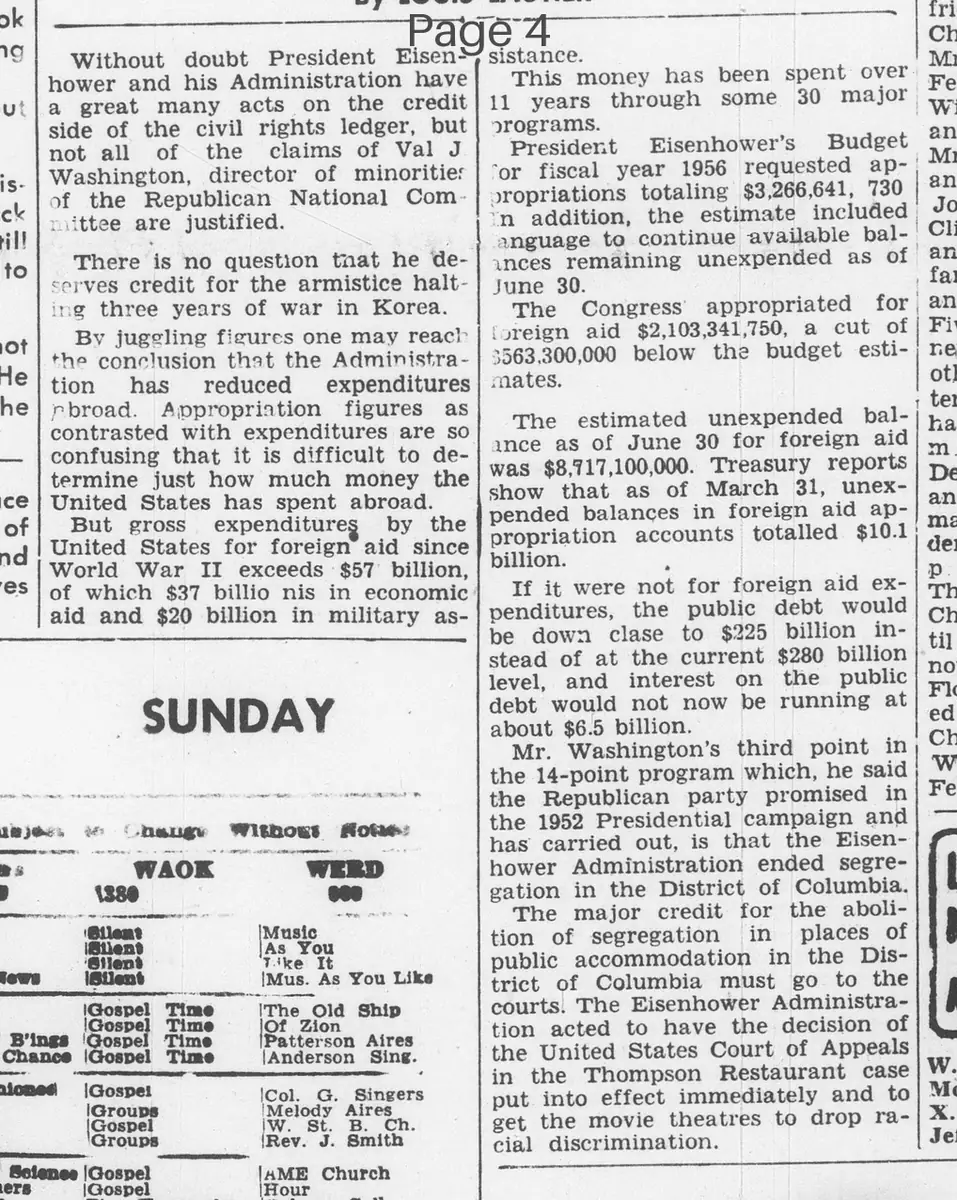
There is no question that he deserves credit for the armistice halting three years of war in Korea.
By juggling figures one may reach the conclusion that the Administration has reduced expenditures abroad. Appropriation figures as contrasted with expenditures are so confusing that it is difficult to determine just how much money the United States has spent abroad.
But gross expenditures by the United States for foreign aid since World War II exceeds $57 billion, of which $37 billion is in economic aid and $20 billion in military assistance.
This money has been spent over 11 years through some 30 major programs.
President Eisenhower's Budget for fiscal year 1956 requested appropriations totaling $3,266,641,730 in addition, the estimate included language to continue available balances remaining unexpended as of June 30.
The Congress appropriated for foreign aid $2,103,341,750, a cut of $1,163,300,000 below the budget estimates.
The estimated unexpended balance as of June 30 for foreign aid was $8,917,100,000. Treasury reports show that as of March 31, unexpended balances in foreign aid appropriation accounts totalled $10.1 billion.
If it were not for foreign aid expenditures, the public debt would be down close to $225 billion instead of at the current $280 billion level, and interest on the public debt would not now be running at about $6.5 billion.
Mr. Washington's third point in the 14-point program which, he said the Republican party promised in the 1952 Presidential campaign and has carried out. is that the Eisenhower Administration ended segregation in the District of Columbia.
The major credit for the abolition of segregation in places of public accommodation in the District of Columbia must go to the courts. The Eisenhower Administration acted to have the decision of the United States Court of Appeals in the Thompson Restaurant case put into effect immediately and to get the movie theatres to drop racial discrimination.
What sub-type of article is it?
What keywords are associated?
What entities or persons were involved?
Where did it happen?
Domestic News Details
Primary Location
United States
Key Persons
Outcome
congress cut foreign aid appropriations by $1,163,300,000 below budget estimates for fiscal year 1956; unexpended balances totaled $10.1 billion as of march 31.
Event Details
Critique of Republican claims on Eisenhower administration's civil rights record, crediting Korea armistice but questioning foreign aid expenditure reductions and attributing end of segregation in D.C. public accommodations primarily to court decisions, with administration aiding implementation.