Thank you for visiting SNEWPapers!
Sign up free
The New York Packet
New York, New York County, New York
What is this article about?
The Treaty of Navigation and Commerce between Britain and France, signed at Versailles on September 26, 1786, by William Eden and Joseph Matthias Gerard de Rayneval, outlines provisions for justice on prizes, merchant ship protections, handling of wrecks, piracy, and mutual privileges, with ratification within two months and revision possible after 12 years.
Clipping
OCR Quality
Full Text
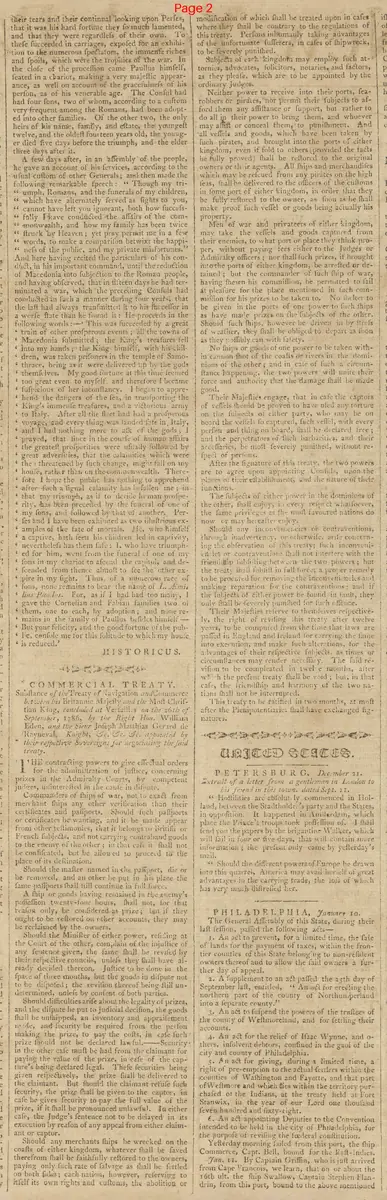
Substance of the Treaty of Navigation and Commerce between his Britannic Majesty and the Most Christian King, concluded at Versailles on the 26th of September, 1786, by the Right Hon. William Eden, and the Sieur Joseph Matthias Gerard de Rayneval, Knight, &c. &c. appointed by their respective Sovereigns for negotiating the said treaty.
The contracting powers to give effectual orders for the administration of justice, concerning prizes in the Admiralty Courts, by competent judges, uninterested in the cause in dispute.
Commanders of ships of war, not to exact from merchant ships any other verification than their certificates and passports. Should such passports or certificates be wanting, and it be made appear from other testimonies, that it belongs to British or French subjects, and not carrying contraband goods to the enemy of the other; in that case it shall not be confiscated, but be allowed to proceed to the place of its destination.
Should the master named in the passport, die or be removed, and another be put in his place the same passports shall still continue in full force.
A ship or goods having remained in the enemy's possession twenty-four hours, shall not, for that reason only, be considered as prize; but if they ought to be restored on other accounts, they may be reclaimed by the owners.
Should the Minister of either power, residing at the Court of the other, complain of the injustice of any sentence given, the same shall be revised by their respective councils, unless they shall have already decided thereon. Justice to be done in the space of three months, but the goods in dispute not to be disposed; the revision thereof being still undetermined, unless by consent of both parties.
Should difficulties arise about the legality of prizes, and the dispute be put to judicial decision, the goods shall be unshipped, an inventory and appraisement made, and security be required from the person making the prize, to pay the costs, in case such prize should not be declared lawful.—Security in the other case must be had from the claimant for paying the value of the prize, in case of the capture's being declared legal. These securities being given respectively, the prize shall be delivered to the claimant. But should the claimant refuse such security, the prize shall be given to the captor, in case he gives security to pay the full value of the prize, if it shall be pronounced unlawful. In either case, the Judge's sentence not to be delayed in its execution by reason of any appeal from either claimant or captor.
Should any merchant ships be wrecked on the coasts of either kingdom, whatever shall be saved therefrom shall be faithfully restored to the owners, paying only such rate of salvage as shall be settled on both sides; each nation, however, reserving to itself its own rights and customs, the abolition or modification of which shall be treated upon in cases where they shall be contrary to the regulations of this treaty. Persons inhumanly taking advantages of the unfortunate sufferers, in cases of shipwreck, to be severely punished.
Subjects of each kingdom may employ such attorneys, advocates, solicitors, notaries, and factors, as they please, which are to be appointed by the ordinary Judges.
Neither power to receive into their ports, sea-robbers or pirates, nor permit their subjects to afford them any assistance or support, but rather to do all in their power to bring them, and whoever may assist or conceal them, to punishment. And all vessels and goods, which have been taken by such pirates, and brought into the ports of either kingdom, even if sold to others (provided the facts be fully proved) shall be restored to the original owners or their agents. All ships and merchandies which may be rescued from any pirates on the high seas, shall be delivered to the officers of the customs in some port of either kingdom, in order that they be fully restored to the owner, as soon as he shall make proof such vessel or goods being actually his property.
Men of war and privateers of either kingdom, may take the vessels and goods captured from their enemies, to what port or place they think proper, without paying fees either to the Judges or Admiralty officers; nor shall such prizes, if brought into the ports of either kingdom, be arrested or detained; but the commander of such ship of war, having shewn his commission, be permitted to sail at pleasure for the place mentioned in such commission for his prizes to be taken to. No shelter to be given in the ports of one power to such ships as have made prizes on the subjects of the other. Should such Ships, however be driven in by stress of weather, they shall be obliged to depart as soon as they possibly can with safety.
No ships or goods of one power to be taken within cannon shot of the coasts or rivers in the dominions of the other; and in case of such a circumstance happening, the two powers will unite their force and authority that the damage shall be made good.
Their Majesties engage, that in case the captors of vessels should be proved to have used any torture on the subjects of either party, who may be on board the vessels so captured, such vessel, with every person and thing on board, shall be declared free; and the perpetrators of such barbarities, and their accessories, be most severely punished, without respect of persons.
After the signature of this treaty, the two powers are to agree upon appointing Consuls, upon the places of their establishment, and the nature of their functions.
The subjects of either power in the dominions of the other, shall enjoy, in every respect whatsoever, the same privileges as the most favoured nations do now or may hereafter enjoy.
Should any inconveniencies or contraventions, through inadvertency, or otherwise, arise concerning the observation of this treaty; such inconveniencies or contraventions shall not interfere with the friendship subsisting between the two powers; but the treaty shall subsist in full force; a proper remedy to be procured for removing the inconveniencies and making reparation for the contraventions; and if the subjects of either power be found in fault, they only shall be severely punished for such offence.
Their Majesties reserve to themselves respectively, the right of revising this treaty after twelve years, to be computed from the time that laws are passed in England and Ireland for carrying the same into execution, and make such alterations, for the advantages of their respective subjects, as times or circumstances may render necessary. The said revision to be completed in twelve months, after which the present treaty shall be void; but, in that case, the friendship and harmony of the two nations shall not be interrupted.
This treaty to be ratified in two months, at most after the Plenipotentiaries shall have exchanged signatures.
What sub-type of article is it?
What keywords are associated?
What entities or persons were involved?
Where did it happen?
Foreign News Details
Primary Location
Versailles
Event Date
26th Of September, 1786
Key Persons
Outcome
treaty concluded with provisions for prize justice, merchant protections, piracy suppression, wreck salvage, and mutual privileges; ratification within two months; revision possible after 12 years.
Event Details
The treaty establishes rules for administering justice on prizes in Admiralty Courts, verification of merchant ships, handling of missing passports, enemy possession limits, sentence revisions, prize disputes with securities, shipwreck restorations, legal representation, piracy punishments and restorations, prize handling by warships and privateers, coastal capture prohibitions, torture penalties, consul appointments, most-favored-nation privileges, and mechanisms for treaty observance and revision.