Thank you for visiting SNEWPapers!
Sign up free
Editorial
February 18, 1931
The Daily Alaska Empire
Juneau, Juneau County, Alaska
What is this article about?
The editorial contrasts the restrictive Canadian fishery licensing system in British Columbia, which limits cannery operations, with the more open U.S. administration in Alaska. It argues that such controls would provoke strong opposition from Alaska fishermen, who criticize the current system for favoritism.
Clipping
OCR Quality
98%
Excellent
Full Text
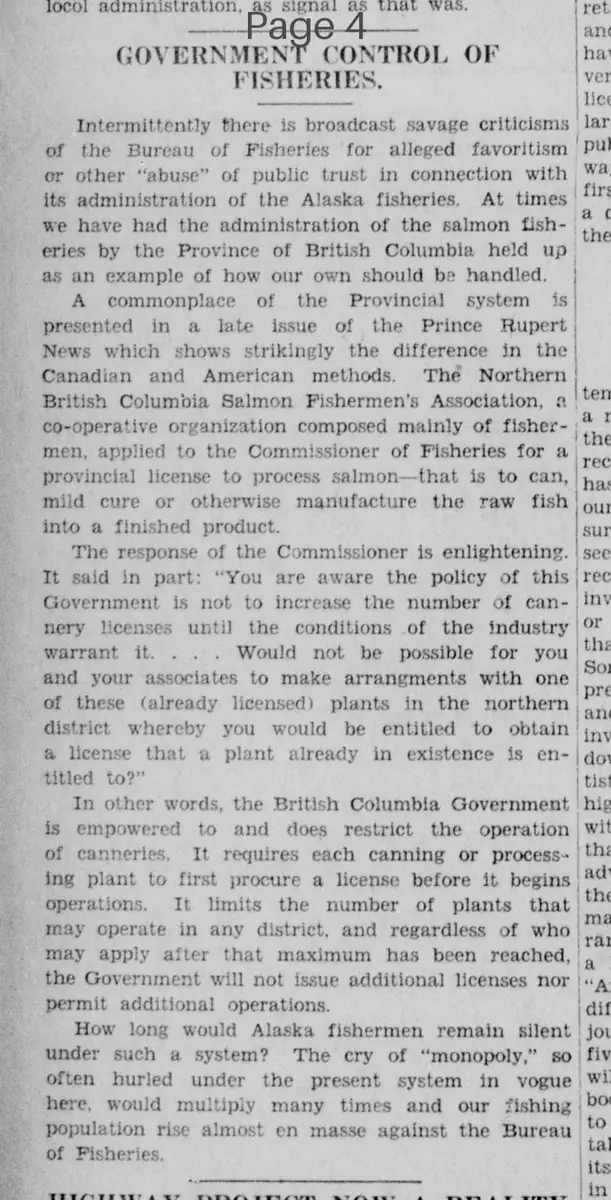
GOVERNMENT CONTROL OF FISHERIES.
Intermittently there is broadcast savage criticisms of the Bureau of Fisheries for alleged favoritism or other "abuse" of public trust in connection with its administration of the Alaska fisheries. At times we have had the administration of the salmon fisheries by the Province of British Columbia held up as an example of how our own should be handled.
A commonplace of the Provincial system is presented in a late issue of the Prince Rupert News which shows strikingly the difference in the Canadian and American methods. The Northern British Columbia Salmon Fishermen's Association, a co-operative organization composed mainly of fishermen, applied to the Commissioner of Fisheries for a provincial license to process salmon—that is to can, mild cure or otherwise manufacture the raw fish into a finished product.
The response of the Commissioner is enlightening. It said in part: "You are aware the policy of this Government is not to increase the number of cannery licenses until the conditions of the industry warrant it. . . . Would not be possible for you and your associates to make arrangements with one of these (already licensed) plants in the northern district whereby you would be entitled to obtain a license that a plant already in existence is entitled to?"
In other words, the British Columbia Government is empowered to and does restrict the operation of canneries. It requires each canning or processing plant to first procure a license before it begins operations. It limits the number of plants that may operate in any district, and regardless of who may apply after that maximum has been reached, the Government will not issue additional licenses nor permit additional operations.
How long would Alaska fishermen remain silent under such a system? The cry of "monopoly," so often hurled under the present system in vogue here, would multiply many times and our fishing population rise almost en masse against the Bureau of Fisheries.
Intermittently there is broadcast savage criticisms of the Bureau of Fisheries for alleged favoritism or other "abuse" of public trust in connection with its administration of the Alaska fisheries. At times we have had the administration of the salmon fisheries by the Province of British Columbia held up as an example of how our own should be handled.
A commonplace of the Provincial system is presented in a late issue of the Prince Rupert News which shows strikingly the difference in the Canadian and American methods. The Northern British Columbia Salmon Fishermen's Association, a co-operative organization composed mainly of fishermen, applied to the Commissioner of Fisheries for a provincial license to process salmon—that is to can, mild cure or otherwise manufacture the raw fish into a finished product.
The response of the Commissioner is enlightening. It said in part: "You are aware the policy of this Government is not to increase the number of cannery licenses until the conditions of the industry warrant it. . . . Would not be possible for you and your associates to make arrangements with one of these (already licensed) plants in the northern district whereby you would be entitled to obtain a license that a plant already in existence is entitled to?"
In other words, the British Columbia Government is empowered to and does restrict the operation of canneries. It requires each canning or processing plant to first procure a license before it begins operations. It limits the number of plants that may operate in any district, and regardless of who may apply after that maximum has been reached, the Government will not issue additional licenses nor permit additional operations.
How long would Alaska fishermen remain silent under such a system? The cry of "monopoly," so often hurled under the present system in vogue here, would multiply many times and our fishing population rise almost en masse against the Bureau of Fisheries.
What sub-type of article is it?
Economic Policy
Trade Or Commerce
What keywords are associated?
Fisheries Regulation
Alaska Fisheries
British Columbia Salmon
Cannery Licenses
Government Control
Monopoly Criticism
What entities or persons were involved?
Bureau Of Fisheries
Province Of British Columbia
Northern British Columbia Salmon Fishermen's Association
Commissioner Of Fisheries
Alaska Fishermen
Editorial Details
Primary Topic
Government Control Of Fisheries In Alaska Vs British Columbia
Stance / Tone
Opposition To Restrictive Licensing And Government Monopoly In Fisheries
Key Figures
Bureau Of Fisheries
Province Of British Columbia
Northern British Columbia Salmon Fishermen's Association
Commissioner Of Fisheries
Alaska Fishermen
Key Arguments
Bureau Of Fisheries Faces Criticisms For Favoritism In Alaska Fisheries Administration
British Columbia's System Restricts Cannery Licenses To Control Industry
Canadian Government Denies New Licenses Until Industry Conditions Warrant
Suggests Applicants Partner With Existing Licensed Plants
Such Restrictions Would Provoke Outcry Of Monopoly From Alaska Fishermen