Thank you for visiting SNEWPapers!
Sign up free
The New Hampshire Gazette
Portsmouth, Rockingham County, New Hampshire
What is this article about?
On December 30, Mr. Eppes delivered a speech in the U.S. Congress supporting resolutions to raise, arm, and equip 50,000 volunteers for two years to bolster national defense amid threats from Britain and France. He defended the embargo as a temporary measure, criticized opponents for misrepresenting it and favoring war with France, and called for unity to resist foreign decrees without submission.
Merged-components note: Continuation of Mr. Eppes' speech in Congress across pages 1 and 2; relabeled from foreign_news to domestic_news as it concerns U.S. domestic policy on foreign threats.
Clippings
1 of 2
OCR Quality
Full Text
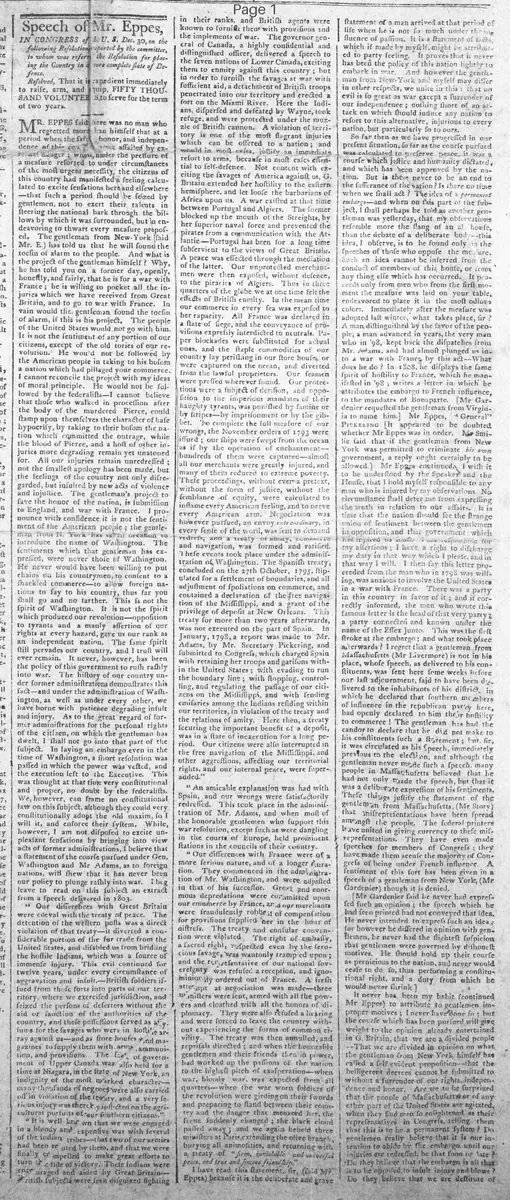
IN CONGRESS of the U.S. Dec. 30, on the following Resolutions reported by the committee, to whom was referred the Resolution for placing the Country in a more complete state of Defence.
Resolved, That it is expedient immediately to raise, arm, and equip, FIFTY THOUSAND VOLUNTEERS, to serve for the term of two years.
Mr. Eppes said there was no man who did not see that this was a period when the honor, and independence of this country assailed by external danger ; when, under the pressure of a measure resorted to under circumstances of the most urgent necessity, the citizens of this country had manifested a feeling calculated to excite sensations here and elsewhere —that such a period should be seized by gentlemen, not to exert their talents in steering the national bark through the billows by which it was surrounded, but in endeavoring to thwart every measure proposed. The gentleman from New-York (said Mr. E.) has told us that he will sound the tocsin of alarm to the people. And what is the project of the gentleman himself ? Why, he has told you on a former day, openly, honestly, and fairly, that he is for a war with France; he is willing to pocket all the injuries which we have received from Great Britain, and to go to war with France. In vain would the gentleman sound the tocsin of alarm, if this is his project, The people of the United States would not go with him. It is not the sentiment of any portion of our citizens, except of the old tories of our revolution. He would not be followed by the American people in taking to his bosom a nation which had pillaged your commerce. I cannot reconcile the project with my ideas of moral principle. He would not be followed by the federalists—I cannot believe that those who walked in procession after the body of the murdered Pierce, could stamp upon themselves the character of base hypocrisy, by taking to their bosom the nation which committed the outrage, while the blood of Pierce, and a host of other injuries more degrading remain yet unatoned for. All our injuries remain unredressed ; not the smallest apology has been made, but the feelings of the country not only disregarded, but insulted by new acts of violence and injustice. The gentleman's project to save the honor of the nation, is submission to England, and war with France. I pronounce with confidence it is not the sentiment of the American people ; the gentleman from N. York has taken occasion to introduce the name of Washington. The sentiments which that gentleman has expressed, were never those of Washington. He never would have been willing to put chains on his countrymen, to consent to a shackled commerce—to allow foreign nations to say to his country, thus far you shall go and no farther. This is not the spirit of Washington. It is not the spirit which produced our revolution—opposition to tyrants and a manly assertion of our rights at every hazard, gave us our rank as an independent nation. The same spirit still pervades our country, and I trust will ever remain. It never, however, has been the policy of this government to rush rashly into war. The history of our country under former administrations demonstrates this fact—and under the administration of Washington, as well as under every other, we have borne with patience degrading insult and injury. As to the great regard of former administrations for the personal rights of the citizen, on which the gentleman has dwelt, I shall not go into that part of the subject. In laying an embargo even in the time of Washington, a short resolution was passed in which the power was vested, and the execution left to the Executive. This was thought at that time very constitutional and proper, no doubt by the federalists. We, however, can frame no constitutional law on this subject, although they could very constitutionally adopt the old maxim, o I will it, and enforce their system. While, however, I am not disposed to excite unpleasant sensations by bringing into view acts of former administrations, I believe that a statement of the course pursued under Gen. Washington and Mr Adams, as to foreign nations, will show that it has never been our policy to plunge rashly into war. I beg leave to read on this subject an extract from a speech delivered in 1803.
" Our differences with Great Britain were coeval with the treaty of peace. The detention of the western posts was a direct violation of that treaty—it diverted a considerable portion of the fur trade from the United States, and disabled us from bridling the hostile Indians, which was a source of immense injury. This evil continued for twelve years, under every circumstance of aggravation and insult.—British soldiers issued from those forts into parts of our territory, where we exercised jurisdiction, and seized the persons of deserters without the aid or sanction of the authorities of the country, and these possessions served as asylums for the savages who were in hostile array against us—and as store houses and magazines to supply them with arms, ammunition, and provisions. The seat of government of Upper Canada was also held for a time at Niagara, in the state of New York, an indignity of the most marked character— many thousands of negroes were also carried off in violation of the treaty, and a very serious injury was thereby inflicted on the agricultural pursuits of our southern citizens."
" It is well known that we were engaged in a bloody and expensive war with several of the indian tribes—that two of our armies had been thrust by them, and that we were finally compelled to make great efforts to turn the tide of victory. These Indians were encouraged and aided by Great Britain— British subjects were seen disguised fighting in their ranks, and British agents were known to furnish them with provisions and the implements of war. The governor general of Canada, a highly confidential and distinguished officer, delivered a speech to the seven nations of Lower Canada, exciting them to enmity against this country; but in order to furnish the savages at war with us sufficient aid, a detachment of British troops penetrated into our territory and erected a fort on the Miami River. Here the Indians, dispersed and defeated by Wayne, took refuge, and were protected under the muzzle of British cannon. A violation of territory is one of the most flagrant injuries which can be offered to a nation; and would in most cases, justify an immediate resort to arms, because in most cases essential to self-defence. Not content with exciting the savages of America against us, G. Britain extended her hostility to the eastern hemisphere, and let loose the barbarians of Africa upon us. A war existed at that time between Portugal and Algiers. The former blocked up the mouth of the Streights, by her superior naval force and prevented the pirates from a communication with the Atlantic.—Portugal has been for a long time subservient to the views of Great Britain. A peace was effected through the mediation of the latter. Our unprotected merchantmen were then exposed, without defence, to the piracies of Algiers. Thus in three quarters of the globe we at one time felt the effects of British enmity. In the mean time our commerce in every sea was exposed to her rapacity. All France was declared in a state of siege, and the conveyance of provisions expressly interdicted to neutrals. Paper blockades were substituted for actual ones, and the staple commodities of our country lay perishing in our store houses or were captured on the ocean, and diverted from the lawful proprietors. Our seamen were pressed wherever found. Our protections were a subject of derision, and opposition to the imperious mandates of their haughty tyrants, was punished by famine or by stripes—by imprisonment or by the gibbet. To complete the full measure of our wrongs, the November orders of 1793 were issued ; our ships were swept from the ocean as if by the operation of enchantment— hundreds of them were captured—almost all our merchants were greatly injured, and many of them reduced to extreme poverty. These proceedings, without ever a pretext, without the form of justice, without the semblance of equity, were calculated to inflame every American feeling, and to nerve every American arm. Negotiation was however pursued, an envoy extraordinary, in every sense of the word, was sent to demand redress, and a treaty of amity, commerce and navigation, was formed and ratified.
These events took place under the administration of Washington. The Spanish treaty, concluded on the 27th October, 1795, stipulated for a settlement of boundaries, and all adjustment of spoliations on commerce, and contained a declaration of the free navigation of the Mississippi, and a grant of the privilege of deposit at New Orleans. This treaty for more than two years afterwards. was not executed on the part of Spain. In January, 1798, a report was made to Mr. Adams, by Mr. Secretary Pickering, and submitted to Congress, which charged Spain with retaining her troops and garrisons within the United States; with evading to run the boundary line; with stopping, controlling, and regulating the passage of our citizens on the Mississippi, and with sending emissaries among the Indians residing within our territories, in violation of the treaty and the relations of amity, Here then, a treaty securing the important benefit of a deposit, was in a state of nonexecution for a long period. Our citizens were also interrupted in the free navigation of the Mississippi, and other aggressions, affecting our territorial rights, and our internal peace, were superadded."
" An amicable explanation was had with Spain, and our wrongs were satisfactorily redressed. This took place in the administration of Mr. Adams, and when most of the honorable gentlemen who support this war resolution, except such as were dangling in the courts of Europe, held prominent stations in the councils of their country."
" Our differences with France were of a more serious nature, and of a longer duration. They commenced in the administration of Mr. Washington, and were adjusted in that of his successor. Great and enormous depredations were committed upon our commerce by France, and our merchants were fraudulently robbed of compensation for provisions supplied her in the hour of distress. The treaty and consular convention were violated The right of embassy, a sacred right, respected even by the ferocious savage, was wantonly trampled upon; and the representative of our national sovereignty was refused a reception, and ignominiously ordered out of France. A fresh attempt at negotiation was made—three ministers were sent, armed with all the powers and clothed with all the honors of diplomacy. They were also refused a hearing and were forced to leave the country without experiencing the forms of common civility. The treaty was then annulled, and reprisals directed; and when the honorable gentlemen and their friends then in power, had worked up the passions of the nation to the highest pitch of exasperation—when war, bloody war, was expected from all quarters—when the war worn old soldiers of the revolution were girding on their swords and preparing to stand between their country and the danger that menaced her, the scene suddenly changed ; the black cloud passed away; and we again beheld three ministers at Paris, extending the olive branch, burying all animosities, and returning with a treaty of "firm, inviolable and universal peace, and true and sincere friendship."
I have read this statement, sir, (Said Mr. Eppes) because it is the deliberate and grave statement of a man arrived at that period of life when he is not so much under the influence of passion. It is a statement of facts, which if made by myself, might be attributed to party feeling. It proves that it never has been the policy of this nation lightly to embark in war. And however the gentleman from New-York and myself may differ in other respects, we unite in this : that no evil is so great as war except a surrender of our independence ; nothing short of an attack on which should induce any nation to resort to this alternative, injurious to every nation, but particularly so to ours.
So far then as we have progressed in our present situation, so far as the course pursued was calculated to preserve peace, it was a course which justice and humanity dictated, and which has been approved by the nation. But is there never to be an end to the suffering of the nation? Is there no time when we shall act ? The idea of a permanent embargo—and when on this part of the subject, I shall perhaps be told as another gentleman was yesterday, that my observations resemble more the slang of an ale house, than the debate of a deliberate body—this idea, I observe, is to be found only in the speeches of those who oppose the measure. Such an idea cannot be inferred from the conduct of members of this house, or from any thing else which has occurred. It proceeds only from men who from the first moment the measure was laid on your table, endeavored to place it in the most odious colors. Immediately after the measure was adopted last winter, what takes place, sir ? A man distinguished by the favor of the people, a man advanced in years, the very man who in '98, kept back the dispatches from Mr. Adams, and had almost plunged us into a war with France by this act—What does he do ? In 1808, he displays the same spirit of hostility to France, which he manifested in '98 ; writes a letter in which he attributes the embargo to French influence, to the mandates of Bonaparte. [Mr Gardenier requested the gentleman from Virginia to name him.] Mr Eppes, "General Pickering" [It appeared to be doubted whether Mr Eppes was in order. Mr Smith said that if the gentleman from New York was permitted to criminate his own government, a reply ought certainly to be allowed.] Mr Eppes continued—I wish it to be understood by the Speaker and the House, that I hold myself responsible to any man who is injured by my observations. No circumstance shall deter me from expressing the truth in relation to our affairs. It is time that the nation should see the strange union of sentiment between the gentlemen in opposition, and that government which had injured us most. I am responsible for my assertions; I have a right to discharge my duty in that way which I please, and in that way I will. I then say this letter proceeded from the man who in 1798 was willing, was anxious to involve the United States in a war with France. There was a party in this country in favor of it ; and if correctly informed, the man who wrote this famous letter is the head of that very party? a party connected and known under the name of the Essex Junto. This was the first stroke at the embargo; and what took place afterwards ? I regret that a gentleman from Massachusetts (Mr Livermore) is not in his place, whose speech, as delivered to his constituents, was sent here some weeks before our last adjournment, and to have been delivered to the inhabitants of his district. in which he declared that southern members of influence in the republican party here, had openly declared to him their hostility to commerce ! The gentleman has had the candor to declare that he did not make to his constituents such a statement; but. sir. it was circulated as his speech, immediately previous to the election, and although the gentleman never made such a speech. many people in Massachusetts believed that he had not only made the speech, but that it was a deliberate expression of his sentiments. These things justify the statement of the gentleman from Massachusetts, (Mr Story) that misrepresentations have been spread amongst the people. The federal printers have united in giving currency to these misrepresentations. They have even made speeches for members of Congress : they have made them accuse the majority of Congress of being under French influence. A sentiment of this sort has been given in a speech of a gentleman from New York, (Mr Gardenier) though it is denied.
[Mr Gardenier said he never had expressed such an opinion ; the speech which he had seen printed had not conveyed that idea. He never intended to express such an idea. for however he differed in opinion with gentlemen, he never had the slightest suspicion that gentlemen were governed by dishonest motives. He should hold up their course as pernicious to the nation, and never would cease to do so, thus performing a constitutional right, and a duty from which he would never shrink ]
It never has been my habit (continued Mr Eppes) to attribute to gentlemen improper motives ; I never have done so ; but the course which has been pursued will give weight to the opinion already entertained in G. Britain, that we are a divided people —That we are divided in opinion on what the gentleman from New York himself has called a self evident proposition—that the belligerent decrees. cannot be submitted to without a surrender of our rights, independence and honor. Are we to be surprised that the people of Massachusetts or of any other part of the United States are agitated, when they find men so enlightened as their representatives in Congress, telling them that this is to be a permanent system ? Do gentlemen really believe that it is our intention to abide by the embargo until our injuries are redressed, be that soon or late Do they believe that the embargo is all that is to be opposed to insult injury and blows? Do they believe that we are destitute of
ense ? I for one unequivocally deny that I ever had such an idea, or any person with whom I ever conversed on the subject, except the gentlemen who opposed it, to whom it was convenient to represent it as a permanent measure. And whatever gentlemen may say on other subjects, they will do me the justice to say that at the last session I told them my opinion that the period would arrive when the embargo would be removed ; and that when it was, there was no other course than war, open and direct, or submission. I defy gentlemen, any where to find the embargo considered as a permanent measure, but in their own speeches and the prints of their party.
The circumstances which produced the embargo are well known ; but the misfortune is that gentlemen will not state the question fairly, but cover it under a heap of lumber, calculated to conceal from the people the real question--Let the question be fairly put, and there is not a man in America (always excepting old tories) who would not say that they will resist What is the real state of our affairs-and I will not stop here to discuss who began first. If we mean to assert and maintain our rights, it is totally immaterial to us who commenced, though on this subject I might refer gentlemen to the letter of Mr Hammond in 1793, in which he takes the ground now maintained, and asserts the right of G. Britain to blockade the whole of France. The statement of our Situation is simply this-G. Britain says if you go to France or her dependencies without a licence from her, your property shall be liable to seizure and condemnation. France says if you have visited Britain or been visited by a Briton, your vessel shall be liable to seizure and confiscation. Now take the dependencies and allies of France and England, and what remains? Your commerce is as completely blockaded by these decrees as the port of Boston was in the revolutionary war-and when gentlemen come forward and tell you that your ships are rotting in your ports, and the country suffering, and attribute this to the embargo, is it fair ? Is it manly? Is it not an assertion materially variant from our present situation ? I call upon any man, federalist, quid, or of what denomination he may be, to answer whether these decrees have not destroyed our commerce; and yet the destruction is imputed to the embargo.
At the time the embargo was laid, our exports amounted to one hundred and eight millions annually, Taking all the countries with whom we could trade, throwing Great Britain out of the question, with whom I contend that no man can be willing to trade under existing circumstances, and our whole commerce does not amount to seven millions and a half-a commerce not equal to one half of the exports from Massachusetts alone --and give Massachusetts her relative share of one fifth of-this even millions of commerce, and this is all she can have to support her seamen, to enrich her merchants whom the embargo is said to have destroyed. This is the real situation of the country. Do the people of the eastern portion of it know it ? No, sir, it is kept from them ; they cannot find it in the speeches of their representatives, No, sir : there it is all embargo, the favorite hobby horse of federalism.
Having thus attempted to shew that it was not my intention when the embargo was laid to consider it as a permanent measure, I will proceed to state some circumstances which have rendered this measure less operative than it would otherwise have been. The embargo had two objects, to gather in our capital, and to withhold supplies from our enemies. The first object has been completely answered, and there is not a period at which it would be more necessary to adhere to it than at the present moment. To withhold supplies from our enemies is now more important than ever. The nation must be put in a state to meet war.
It is in vain for gentlemen to attempt to delude the people. The decrees of England and France must be withdrawn, or we must fight : it cannot be avoided. We have declared we will not submit, and there is no species of effectual resistance but war. We have a right to carry our produce to every place on the globe whose municipal regulations do not forbid it. France has a right to interdict our trade with herself, but none to interdict it with her enemy. G Britain has a right to exclude us from her ports, but none to compel us to go there. What other course I ask can the U S take but war, or submission to these decrees ? Let gentlemen examine the various proposals brought forward. It is immaterial whether we pass a law that we will reduce our trade to the places left by the decrees, or suffer it to be reduced by the decrees themselves. In either case we submit--we allow foreign nations to fix the amount of our commerce-to destroy the fruits of our industry and legislate for us.
Now, sir, I do not believe that there is a native American in any part of the U. S. who is disposed to submit; and I rejoice that in this House there is no division of sentiment Gentlemen have publicly declared that they will not submit. In what form then will they resist ? We have tried paper long enough. It is time either to exert the energies of the nation, or give up our rights and again become the colonies of Great Britain. I am not for that; I have no other interest than that in land, by the produce of which I live. I would sooner let it go in the general wreck of my country. than surrender those rights which are so important to the nation, and which our fathers purchased with their best blood. I am not for disgracing our ancestors who fled from oppression abroad ; I am not for proving ourselves a base, degenerate offspring. We possess a country of 2000 miles extent, a population of six millions of souls, six hundred thousand men fit to bear arms. If with this we cannot preserve our independence, we deserve to be kicked out of the territory neck and heels by those powers whom we have suffered to trample on our maritime rights.
In the course of my remarks, I have noticed the strange union of sentiment between gentlemen in the opposition and the British ministry, on the subject of the embargo. On this subject I will read an extract of a ministerial pamphlet :
" Providence has ordained, that nations as well as individuals, should in a certain degree be dependent on each other ; and the inhabitants of no country can be debarred from their accustomed commercial communications, without being deprived of many advantages and enjoyments. Society being thus co-operated, the government that attacks the comfort and happiness of the people, by prohibiting this intercourse, alienates the affections, and consequently holds its authority by a very precarious tenure. When the late emperor Paul entered into the confederacy against Great Britain. his subjects were at once reduced to severe and general distress. Their hemp, their flax, their tallow, their ashes, their iron, their timber, all their great staple commodities, for the sale of which they depended on British purchasers, were left a dead weight upon their hands. If the produce of the land becomes of no value, the land!ord may apply to his tenant for rent in vain. If the vassal can procure no employment, he can pay nothing to his lord. Thus the nobles. whose revenue is derived from the rent of their estates, and the labor of their vassals, found themselves involved in the calamity of their inferiors, and were led by common interest, to attempt that revolution which cost the emperor his crown and his life."
"If any further elucidation of the principle to which this event is ascribed were wanting, it promises to be found in the United States of America, where the cultivators of the soil are deprived of the fruits of their labors, and the merchants, of their commercial gains, by the present embargo. This forced state of things cannot be of long continuance. Already have the Vermonters set the constituted authorities at defiance, and persist in carrying on their trade with the Canadians across lake Champlain, while the northern states manifest strong symptoms of discontent."
Perhaps I ought to apologise to the representatives from the state of Vermont, for reading a clause speaking particularly of that state, but I assure the gentlemen that it is not my wish to bring the attention of the house to circumstances which have passed there. I view them with that deep regret with which I shall ever view a similar state of things in any portion of the country. I regret that any portion of the people of this country, however they may feel, should not manifest their feeling in that form prescribed by the constitution and the laws. We are told by this pamphlet of true British origin that the United States cannot stand this measure; and what are we told on this floor ? " You cannot stand it, you are committing suicide on yourselves."All this goes to Great Britain; what I say never will reach it. All there seen of it will be a garbled statement in a federal paper. which could cover with my thumb, and that will be sent to Great Britain. Through this corrupted source their information is derived and they know nothing of the real situation of American feeling, or of the American character. And is the government to blame when I declare to God that I have seen speeches attributed to me which I have never made--the most shameful misrepresentation made by men brought here not for the purpose of reporting our proceedings to the nation but for supporting party purposes
Gentlemen tell us we cannot stand a permanent embargo. We never intended it Gentlemen well know that the rights of the nation cannot be abandoned without a struggle. The only question is when to commence it. Our resources will soon be at our command. Means of resistance are provided, and the period must soon arrive when nothing will be wanting but spirit on the part of the representatives to use them. The people are with you-you have their support Nothing can forfeit it but abandoning their rights. If by war only they can be maintained, the people will meet it with firmness, I never had any other feeling, but that these decrees must be withdrawn, or we must resort to war. I said so last year; I told it openly. My sentiments are known to the people I represent. They unite in that sentiment. It is the undivided sentiment of the state in which I live.
It has been said that the southern people wish to destroy commerce. I will ask gentlemen what but our commerce has produced our present difficulties ? If I had consulted my interest only, of what importance to me was the carrying trade? None sir ; but it was, it ever will be of infinite importance to me to support the principles of our constitution. What are these principles ? Equal and exact justice to every class of our citizens. United for common protection and for the general safety, the rights of no one class can be abandoned. The merchant has as good a right to protection in the use of his ship as the farmer in the use of his plough. I said so in 1805, and I say so still. Our situation however, is now changed ; it is no longer a commercial question; the late decrees and orders made a direct attack on the sovereignty of the nation ; it is no longer a question whether we will trade, but whether we will maintain or surrender our independence. The embargo at the time it was adopted, was believed, the best measure which could have been resorted to. Its operation was defeated partly by the misrepresentations of which I have spoken. While on this subject I will ask attention to another point, which I had nearly omitted. I have said something about tories. I wish it to be understood that I mean no gentleman in this house. I mean to state that the tory principle had manifested itself in a portion of this country, and that it was that principle, in union with.the agents and acts of the British government, which produced the evasions of our law. Your towns swarm with these British agents who send to their friends what is essential to their prosperity in violation of your laws. Nay, sir, toryism, in this country, has in one case assumed a sort of official form. I refer to the proceedings of the Essex Junto. I hold them in my hand, and I will read a resolution from them.
These patriots say
"As to the orders of council. It will be recollected that these orders bearing date 11th Nov. 1807, were occasioned by the decree of the French Emperor, dated Nov. 1806, declaring all the British dominions in a state of blockade. Great Britain may think these orders completely justified by the Lex Talionis (law of retaliation.) There is no reason to consider them as originating from a disposition hostile to this country, and they ought not to be-so considered : It is notorious that she could, according to known law and usage, plead the actual blockade, by her navy, of all the principal ports under the power of France."
Now, sir, this I say is a rank tory principle, and it is immaterial what may be the professions of men. The man who can say in the present situation of our country, that the conduct of Great Britain towards us is justified by the lex talionis, or by any other law. is a tory. It is in vain for people in any portion of the union to make professions of patriotism, when they come forward and by a public act say that we have no cause of complaint against Great Britain. I wish gentlemen correctly to understand me. If the British nation would come forward and make reparation for the insults offered in our ports and waters, he will stand with me on equal ground with France. But when I recollect that instead of tendering reparation for the most humiliating insults and injuries, she sent her a legalized spy to insult us with insolent demands, I cannot consider in point of injury done to this country, these two foreign nations as equal in the honorable career of injustice and violence towards us. Let Great Britain redress these injuries, and I would as soon tender the hand of reconciliation to her as to France. I believe the principles of both are infamous. That in a contest for the empire of the world they regard only their own aggrandizements. It is the duty of the United States to take a firm and manly attitude, and oppose both; to maintain the independence of the nation and spurn a foreign yoke. You must assert your rights ; they cannot be maintained without men. The independence of our country is an object before which all differences as to the internal administration of our affairs should sink. This is a period when all honest men have a common interest. It is a period when all party feelings should be sacrificed at the shrine of our countrys good. It is a period when federalists ought to forget that they have lost the helm of state, when the old tories, dispersed through our country, should forget that we have acquired our independence, and when all honest men should unite to maintain those rights, which are the birth right of an American.
What sub-type of article is it?
What keywords are associated?
What entities or persons were involved?
Where did it happen?
Domestic News Details
Primary Location
Congress Of The U.S.
Event Date
Dec. 30
Key Persons
Event Details
Mr. Eppes spoke in support of resolutions to raise 50,000 volunteers for national defense, defended the embargo as temporary, criticized opposition for favoring war with France and misrepresenting policies, referenced historical U.S. responses to foreign aggressions under Washington and Adams, and urged unity against British and French decrees.