Thank you for visiting SNEWPapers!

Sign up free
Page thumbnail for The New Hampshire Gazette
Domestic News November 24, 1829

The New Hampshire Gazette

Portsmouth, Rockingham County, New Hampshire

What is this article about?

The Astor Case, involving a land dispute in Putnam County, New York, was decided in favor of plaintiff John Jacob Astor. The ruling held that a 1758 marriage settlement protected the children's interest in the Philipse estate from the Revolutionary War attainder of Roger and Mary Morris, affecting only their life estate. The case may go to the U.S. Supreme Court.

Clipping
OCR Quality

98% Excellent

Full Text

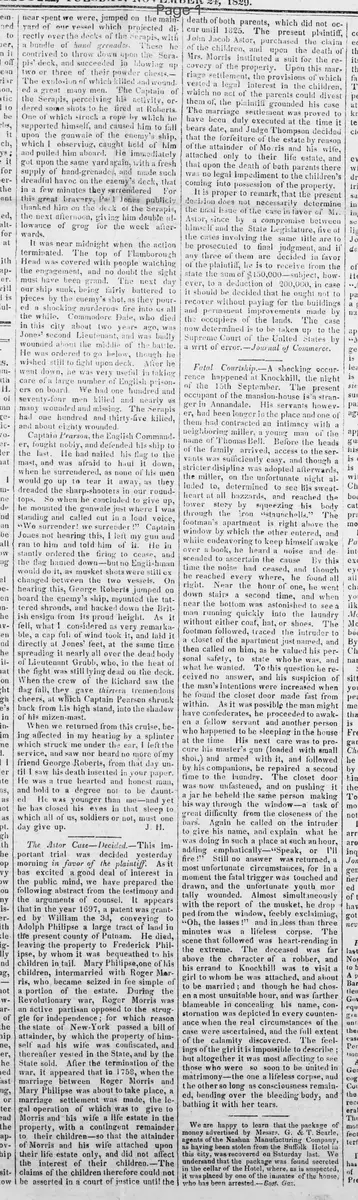
The Astor Case--Decided.--This important trial was decided yesterday morning in favor of the plaintiff. As it has excited a good deal of interest in the public mind, we have prepared the following abstract from the testimony and the arguments of counsel. It appears that in the year 1697, a patent was granted by William the 3d, conveying to Adolph Philipse a large tract of land in the present county of Putnam. He died, leaving the property to Frederick Philipse, by whom it was bequeathed to his children in tail. Mary Philipse, one of his children, intermarried with Roger Morris, who became seized in fee simple of a portion of the estate. During the Revolutionary war, Roger Morris was an active partisan opposed to the struggle for independence; for which reason the state of New-York passed a bill of attainder, by which the property of himself and his wife was confiscated, and thereafter vested in the State, and by the State sold. After the termination of the war, it appeared that in 1758, when the marriage between Roger Morris and Mary Philipse was about to take place, a marriage settlement was made, the legal operation of which was to give to Morris and his wife a life estate in the property, with a contingent remainder to their children--so that the attainder of Morris and his wife attached upon their life estate only, and did not affect the interest of their children.--The claims of the children therefore could not be asserted in a court of justice until the death of both parents, which did not occur until 1825. The present plaintiff, John Jacob Astor, purchased the claim of the children, and upon the death of Mrs. Morris instituted a suit for the recovery of the property. Upon this marriage settlement, the provisions of which vested a legal interest in the children, which no act of the parents could divest them of, the plaintiff grounded his case. The marriage settlement was proved to have been duly executed at the time it bears date, and Judge Thompson decided that the forfeiture of the estate by reason of the attainder of Morris and his wife, attached only to their life estate, and that upon the death of both parents there was no legal impediment to the children's coming into possession of the property.

It is proper to remark, that the present decision does not necessarily determine the final issue of the case in favor of Mr. Astor, since by a compromise between himself and the State Legislature, five of the cases involving the same title are to be prosecuted to final judgment, and if any three of them are decided in favor of the plaintiff, he is to receive from the state the sum of $150,000--subject, however, to a deduction of $200,000, in case it should be decided that he ought not to recover without paying for the buildings and permanent improvements made by the occupiers of the lands. The case now determined is to be taken up to the Supreme Court of the United States by a writ of error.--Journal of Commerce.

What sub-type of article is it?

Legal Or Court

What keywords are associated?

Astor Case Philip Se Estate Land Patent Marriage Settlement Attainder Revolutionary War Putnam County

What entities or persons were involved?

John Jacob Astor Adolph Philipse Frederick Philipse Mary Philipse Roger Morris Judge Thompson William The 3d

Where did it happen?

County Of Putnam, State Of New York

Domestic News Details

Primary Location

County Of Putnam, State Of New York

Event Date

Yesterday Morning

Key Persons

John Jacob Astor Adolph Philipse Frederick Philipse Mary Philipse Roger Morris Judge Thompson William The 3d

Outcome

decision in favor of the plaintiff; compromise with state legislature for $150,000 if three of five cases won, possible $200,000 deduction for improvements; case to be appealed to supreme court of the united states.

Event Details

Trial decided in favor of plaintiff John Jacob Astor regarding recovery of Philipse estate land in Putnam County. Patent granted in 1697 to Adolph Philipse; bequeathed to children including Mary Philipse who married Roger Morris in 1758 with settlement giving life estate to couple and remainder to children. Attainder during Revolutionary War confiscated only life estate; children's claims viable after parents' deaths in 1825. Astor purchased claims and sued after Mrs. Morris's death. Judge Thompson ruled settlement protected children's interest.

Are you sure?