Thank you for visiting SNEWPapers!
Sign up free
Herald Of The United States
Warren, Bristol County, Rhode Island
What is this article about?
The Warren newspaper reports on the June 22, 1807, British attack on the U.S. frigate Chesapeake over deserters, including Admiral Berkeley's order, details from a Leopard officer's letter, casualties (3 killed, 23 wounded), and related naval tensions, ship movements, and diplomatic frustrations with Britain and Spain.
Merged-components note: Merged continuous newspaper content on the Chesapeake incident, including discussion, Halifax paper extract, and the quoted Admiral Berkeley's order as part of the same focused report.
Clipping
OCR Quality
Full Text
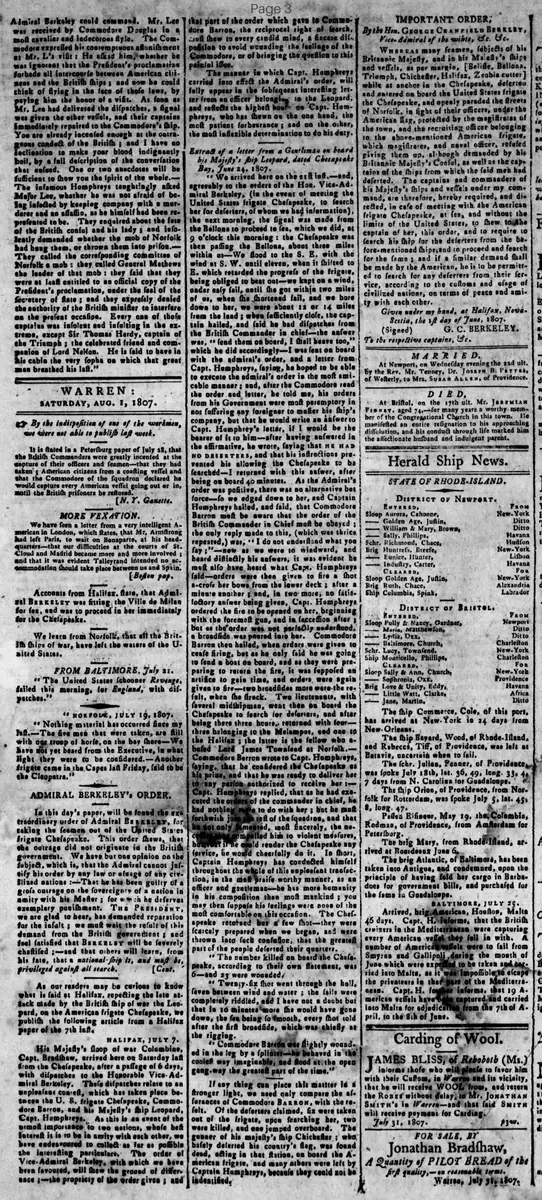
By the indisposition of one of the workmen, we were not able to publish last week.
It is stated in a Petersburg paper of July 28, that the British Commanders were greatly incensed at the capture of their officers and seamen--that they had taken some American citizens from a coasting vessel and that the Commodore of the squadron declared he would capture every American vessel going out or in, until the British prisoners be restored.
[N. Y. Gazette.
MORE VEXATION.
We have seen a letter from a very intelligent American in London, which states, that Mr. Armstrong had left Paris, to wait on Bonaparte, at his head-quarters--that our difficulties at the courts of St. Cloud and Madrid became more and more involved and that it was evident Talleyrand intended no accommodation should take place between us and Spain.
[Boston pap.
Accounts from Halifax state, that Admiral Berkeley was fitting the Ville de Milan for sea, and was to proceed in her immediately for the Chesapeake.
We learn from Norfolk, that all the British ships of war, have left the waters of the United States.
FROM BALTIMORE. July 21.
The United States schooner Revenge, sailed this morning, for England, with dispatches.
Norfolk, July 19. 1807.
Nothing material has occurred since my last. The five men that were taken, are still with our troop of horse, on the bay shore--We have not yet heard from the Executive, in what light they were to be considered.--Another frigate came in the Capes last Friday, said to be the Cleopatra.
ADMIRAL BERKELEY'S ORDER.
In this day's paper, will be found the extraordinary order of Admiral Berkeley, for taking the seamen out of the United States Frigate Chesapeake. This order shows, that the outrage did not originate in the British government. We have but one opinion on the subject, which is, that the Admiral cannot justify his order by any law or usage of any civilized nations:--That he has been guilty of a gross outrage on the sovereignty of a nation in amity with his Master; for which he deserves exemplary punishment. The President, we are glad to hear, has demanded reparation for the insult; we must wait the result of this demand from the British government; and feel satisfied that Berkeley will be severely chastised;--and that others will learn, from his fate, that a national ship is, and must be, privileged against all search.
[Cent.
As our readers may be curious to know what is said at Halifax, respecting the late attack made by the British ship of war the Leopard, on the American frigate Chesapeake, we publish the following article from a Halifax paper of the 7th inst--
HALIFAX, JULY 7.
His Majesty's sloop of war Colpoys, Capt. Bradshaw, arrived here on Saturday last from the Chesapeake, after a passage of 6 days, with dispatches to the Honorable Vice-Admiral Berkeley. Those dispatches relate to an unpleasant contest, which has taken place between the U. S. frigate Chesapeake, Commodore Barron, and his Majesty's ship Leopard, Capt. Humphreys. As this is an event of the almost importance to two nations, whose best interest it is--to be in amity with each other, we have endeavoured to collect--as far as possible the interesting particulars. The order of Vice-Admiral Berkeley, with which we have been favoured, will show the ground of difference;--the propriety of the order given; and
that part of the order which gave to Commodore Barron, the reciprocal right of search, must show to every candid mind, a sincere disposition to avoid wounding the feelings of the Commodore, or of bringing the question to this painful issue.
The manner in which Capt. Humphreys carried into effect the Admiral's order, will fully appear in the subsequent interesting letter from an officer belonging to the Leopard; and reflects the highest honor on Capt. Humphreys, who has shown on the one hand, the most patient forbearance; and on the other, the most inflexible determination to do his duty.
Extract of a letter from a Gentleman on board his Majesty's ship Leopard, dated Chesapeake Bay, June 24, 1807.
We arrived here on the 21st inst.--and, agreeably to the orders of the Hon. Vice-Admiral Berkeley, (in the event of meeting the United States frigate Chesapeake, to search her for deserters, of whom we had information), the next morning, the signal was made from the Bellona to proceed to sea, which we did, at 9 o'clock this morning: the Chesapeake was then passing the Bellona, about three miles within us--W. by S. with the wind at S. W. until eleven, when it shifted to E. which retarded the progress of the frigate, being obliged to beat out--we kept on a wind, under easy sail, until she got within two miles of us, when she shortened sail, and we bore down to her, we were about 12 or 14 miles from the land; when sufficiently close, the captain hailed, and said he had dispatches from the British Commander in chief--the answer was, "send them on board, I shall heave to," which he did accordingly--I was sent on board with the admiral's order, and a letter from Capt. Humphreys, (saying, he hoped to be able to execute the admiral's order in the most amicable manner; and, after the Commodore read the order and letter, he told me, his orders from his Government were most peremptory in not suffering any foreigner to muster his ship's company, but that he would write an answer to Capt. Humphreys's letter, if I would be the bearer of it to him--after having answered in the affirmative, he wrote, saying that he HAD NO DESERTERS, and that his instructions prevented his allowing the Chesapeake to be searched--I returned with this answer, after being on board 40 minutes. As the Admiral's order was positive, there was no alternative but force--so we edged down to her, and Captain Humphreys hailed, and said, that Commodore Barron must be aware that the order of the British Commander in Chief must be obeyed: the only reply made to this, (which was thrice repeated,) was; "I do not understand what you say;"--now, as we were to windward, and heard distinctly his answers; it was evident he must also have heard what Capt. Humphreys said--orders were then given to fire a shot across her bow from the lower deck; after a minute another gun, and, in two more, no satisfactory answer being given, Capt. Humphreys ordered the fire to be opened on her, beginning with the foremost gun, and in succession after; but as the order was not perfectly understood, a broadside was poured into her. Commodore Barron then hailed, when orders were given to cease firing, but as he only said he was going to send a boat on board, and as they were preparing to return the fire, it was supposed an artifice to gain time, and orders, were again given to fire--two broadsides more were--the result, when she struck. Two lieutenants, with several midshipmen, went then on board the Chesapeake to search for deserters, and after being there three hours, returned with four--- three belonging to the Melampus, and one to the Halifax: the latter is the fellow who abused Lord James Townshend at Norfolk.-- Commodore Barron wrote to Capt. Humphreys, saying, that he considered the Chesapeake as his prize, and that he was ready to deliver her to any person authorized to receive her:-- Capt. Humphreys replied, that as he had executed the orders of the commander in chief, he had nothing more to do with her; but he must forthwith join the rest of the squadron, and that he not only lamented, but sincerely, the necessity which compelled him to violent measures, but said if he could render the Chesapeake any service, he would cheerfully do it. In short, Captain Humphreys has conducted himself throughout the whole of this unpleasant transaction, in the most praise-worthy manner, as an officer and gentleman--he has more humanity in his composition than most mankind; you may then suppose his feelings were none of the most comfortable on this occasion. The Chesapeake returned her a few shot--they were scarcely prepared when we began, and were thrown into such confusion, that the greatest part of the people deserted their quarters.
The number killed on board the Chesapeake, according to their own statement, was 3--and 23 were wounded.
Twenty-six shot went through the hull, five between wind and water; the sails were completely riddled, and I have not a doubt but that in 10 minutes more she would have gone down, the sea being so smooth, every shot could after the first broadside, which was chiefly at the rigging.
Commodore Barron was slightly wounded in the leg by a splinter--he behaved in the coolest way imaginable, and stood at the open gang-way the greatest part of the time.
If anything can place this matter in stronger light, we need only compare the assurances of Commodore Barron, with the result. Of the deserters claimed, six were taken out of the frigate, upon searching her, two were killed, and one jumped overboard. The gunner of his majesty's ship Chichester; who basely deserted his country's flag. was found dead, acting in that station, on board the American frigate. and many others were left by Captain Humphreys, because they could not be identified,
IMPORTANT ORDER;
By the Hon. George Cranfield Berkeley, Vice-Admiral of the white, &c. &c.
WHEREAS many seamen, subjects of his Britannic Majesty, and in his Majesty's ships and vessels, as per margin, [Belleisle, Bellona, Triumph, Chichester, Halifax, Zobea cutter] while at anchor in the Chesapeake, deserted and entered on board the United States frigate the Chesapeake, and openly paraded the streets of Norfolk, in sight of their officers, under the American flag, protected by the magistrates of the town, and the recruiting officer belonging to the above-mentioned American frigate, which magistrates, and naval officer, refused giving them up, although demanded by his Britannic Majesty's Consul, as well as the captains of the ships from which the said men had deserted. The captains and commanders of his Majesty's ships and vessels under my command, are therefore, hereby required, and directed, in case of meeting with the American frigate Chesapeake, at sea, and without the limits of the United States, to show to the captain of her, this order, and to require to search his ship for the deserters from the before-mentioned ships and to proceed and search for the same: and if a similar demand shall be made by the American, he is to be permitted to search for any deserters from their service, according to the customs and usage of civilized nations, on terms of peace and amity with each other.
Given under my hand, at Halifax, Nova Scotia, the 1st day of June, 1807.
(Signed) G. C. BERKELEY.
To the respective captains, &c.
What sub-type of article is it?
What keywords are associated?
What entities or persons were involved?
Where did it happen?
Domestic News Details
Primary Location
Chesapeake Bay
Event Date
June 22, 1807
Key Persons
Outcome
3 killed and 23 wounded on the chesapeake; 4 british deserters removed from the ship; chesapeake heavily damaged but not captured; u.s. president demands reparation from britain.
Event Details
British ship Leopard, under Capt. Humphreys, attacked the U.S. frigate Chesapeake, commanded by Commodore Barron, off Chesapeake Bay to search for British deserters per Admiral Berkeley's June 1 order. After Barron refused search, Leopard fired, causing the Chesapeake to strike after three broadsides. Search yielded four deserters; Barron wounded slightly.