Thank you for visiting SNEWPapers!
Sign up free
St. Landry Democrat
Opelousas, Saint Landry County, Louisiana
What is this article about?
An article critiquing usury and exploitative money lending practices in the Western wheat belt, where usurers use chattel mortgages to strip farmers of their produce, leaving them impoverished. Compares to less severe practices in Southern cotton regions, noting farmers' path to independence.
Clipping
OCR Quality
Full Text
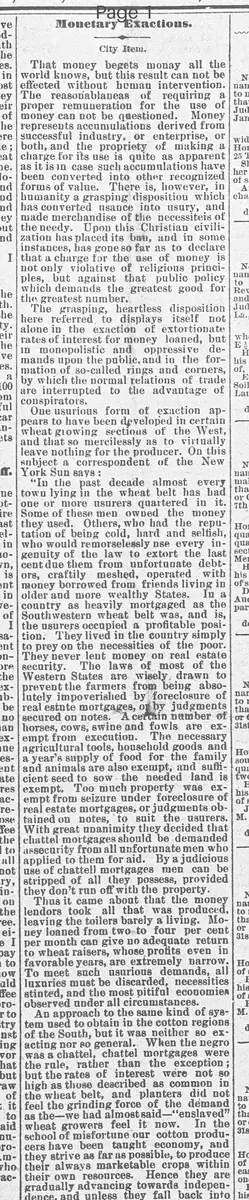
City Item.
That money begets money all the world knows, but this result can not be effected without human intervention. The reasonableness of requiring a proper remuneration for the use of money can not be questioned. Money represents accumulations derived from successful industry or enterprise, or both, and the propriety of making a charge for its use is quite as apparent as it is in case such accumulations have been converted into other recognized forms of value. There is, however, in humanity a grasping disposition which has converted usance into usury, and made merchandise of the necessities of the needy. Upon this Christian civilization has placed its ban, and in some instances has gone so far as to declare that a charge for the use of money is not only violative of religious principles, but against that public policy which demands the greatest good for the greatest number.
The grasping, heartless disposition here referred to displays itself not alone in the exaction of extortionate rates of interest for money loaned, but in monopolistic and oppressive demands upon the public, and in the formation of so-called rings and corners, by which the normal relations of trade are interrupted to the advantage of conspirators.
One usurious form of exaction appears to have been developed in certain wheat growing sections of the West, and that so mercilessly as to virtually leave nothing for the producer. On this subject a correspondent of the New York Sun says:
"In the past decade almost every town lying in the wheat belt has had one or more usurers quartered in it. Some of these men owned the money they used. Others, who had the reputation of being cold, hard and selfish, who would remorselessly use every ingenuity of the law to extort the last cent due them from unfortunate debtors, craftily meshed, operated with money borrowed from friends living in older and more wealthy States. In a country as heavily mortgaged as the Southwestern wheat belt was, and is, the usurers occupied a profitable position. They lived in the country simply to prey on the necessities of the poor. They never lent money on real estate security. The laws of most of the Western States are wisely drawn to prevent the farmers from being absolutely impoverished by foreclosure of real estate mortgages, or by judgments secured on notes. A certain number of horses, cows, swine and fowls are exempt from execution. The necessary agricultural tools, household goods and a year's supply of food for the family and animals are also exempt, and sufficient seed to sow the needed land is exempt. Too much property was exempt from seizure under foreclosure of real estate mortgages, or judgments obtained on notes, to suit the usurers. With great unanimity they decided that chattel mortgages should be demanded as security from all unfortunate men who applied to them for aid. By a judicious use of chattel mortgages men can be stripped of all they possess, provided they don't run off with the property. Thus it came about that the money lenders took all that was produced, leaving the toilers barely a living. Money loaned from two to four per cent per month can give no adequate return to wheat raisers, whose profits even in favorable years, are extremely narrow. To meet such usurious demands, all luxuries must be discarded, necessities stinted, and the most pitiful economies observed under all circumstances.
An approach to the same kind of system used to obtain in the cotton regions of the South, but it was neither so exacting nor so general. When the negro was a chattel, chattel mortgages were the rule, rather than the exception; but the rates of interest were not so high as those described as common in the wheat belt, and planters did not feel the grinding force of the demand as the—we had almost said "enslaved" wheat growers feel it now. In the school of misfortune our cotton producers have been taught economy, and they strive as far as possible, to produce their always marketable crops within their own resources.
Hence they are gradually advancing towards independence, and unless they fall back into careless habits the goal will soon be won."
What sub-type of article is it?
What themes does it cover?
What keywords are associated?
Where did it happen?
Story Details
Location
Southwestern Wheat Belt, Cotton Regions Of The South
Event Date
In The Past Decade
Story Details
Usurers in the Western wheat belt exploit farmers through high-interest loans secured by chattel mortgages, taking most of their produce and leaving them in poverty. Similar but less severe practices occurred in Southern cotton areas, where producers are learning self-sufficiency.