Thank you for visiting SNEWPapers!
Sign up free
The Ely Miner
Ely, Saint Louis County, Minnesota
What is this article about?
Excerpt from Mary Anderson's memoirs on the pros and cons of long-running theater productions for actors: benefits include perfected technique, while drawbacks involve mental fatigue causing forgotten lines, with examples from Joseph Jefferson in 'The Rivals,' Anderson in 'The Winter's Tale' in London, and Edwin Booth in 'Hamlet.'
Clipping
OCR Quality
Full Text
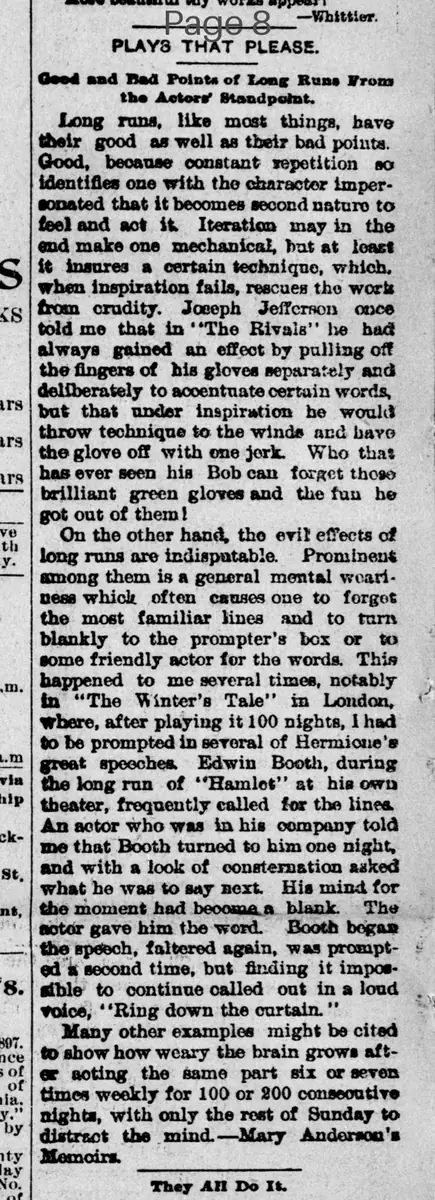
Good and Bad Points of Long Runs From the Actor's Standpoint.
Long runs, like most things, have their good as well as their bad points. Good, because constant repetition so identifies one with the character impersonated that it becomes second nature to feel and act it. Iteration may in the end make one mechanical, but at least it insures a certain technique, which, when inspiration fails, rescues the work from crudity. Joseph Jefferson once told me that in "The Rivals" he had always gained an effect by pulling off the fingers of his gloves separately and deliberately to accentuate certain words, but that under inspiration he would throw technique to the winds and bare the glove off with one jerk. Who that has ever seen his Bob can forget those brilliant green gloves and the fun he got out of them!
On the other hand, the evil effects of long runs are indisputable. Prominent among them is a general mental weariness which often causes one to forget the most familiar lines and to turn blankly to the prompter's box or to some friendly actor for the words. This happened to me several times, notably in "The Winter's Tale" in London, where, after playing it 100 nights, I had to be prompted in several of Hermione's great speeches. Edwin Booth, during the long run of "Hamlet" at his own theater, frequently called for the lines. An actor who was in his company told me that Booth turned to him one night, and with a look of consternation asked what he was to say next. His mind for the moment had become a blank. The actor gave him the word. Booth began the speech, faltered again, was prompted a second time, but finding it impossible to continue called out in a loud voice, "Ring down the curtain."
Many other examples might be cited to show how weary the brain grows after acting the same part six or seven times weekly for 100 or 200 consecutive nights, with only the rest of Sunday to distract the mind. -Mary Anderson's Memoirs.
What sub-type of article is it?
What themes does it cover?
What keywords are associated?
What entities or persons were involved?
Where did it happen?
Story Details
Key Persons
Location
London, Booth's Theater
Story Details
Long theater runs build technique through repetition but cause mental weariness and forgotten lines, as experienced by actors like Jefferson with glove tricks in 'The Rivals,' Anderson needing prompts in 'The Winter's Tale' after 100 nights, and Booth halting 'Hamlet' mid-speech.