Thank you for visiting SNEWPapers!
Sign up free
Phenix Gazette
Alexandria, Virginia
What is this article about?
Report from Cincinnati Chronicle on the nine-day debate between Robert Owen and Alexander Campbell starting April 13, 1829, on whether religions are founded in ignorance and cause vice. Owen presented 'Twelve Fundamental Laws of Human Nature'; Campbell defended Christianity. Audience of 1200+; arguments to be published. Reporter views Campbell as victor, boosting inquiry into scriptures.
Merged-components note: Merged filler into story as it is a direct textual continuation of the article on the Campbell-Owen debate.
Clipping
OCR Quality
Full Text
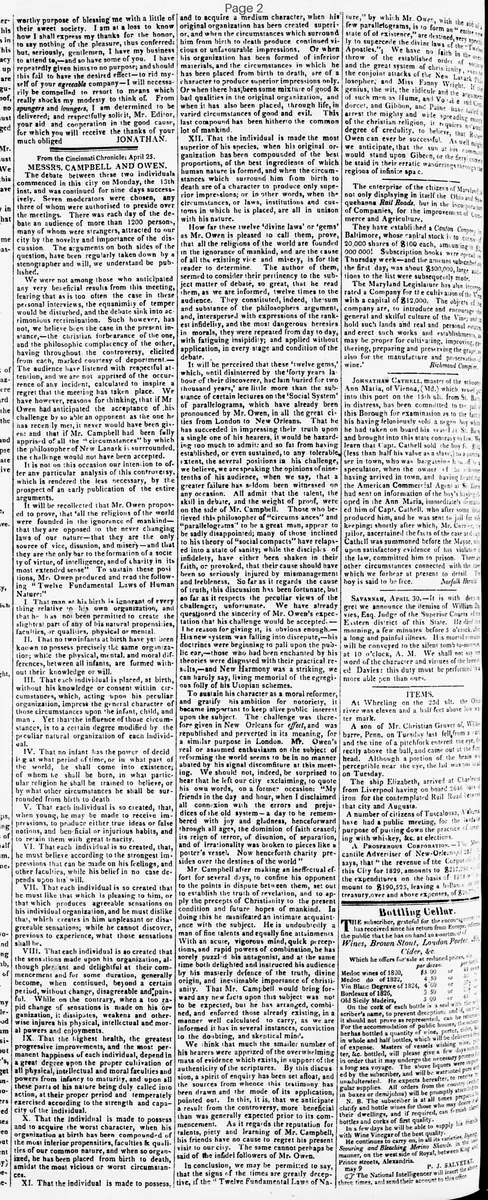
MESSRS. CAMPBELL AND OWEN.
The debate between these two individuals commenced in this city on Monday, the 13th inst. and was continued for nine days successively. Seven moderators were chosen, any three of whom were authorised to preside over the meetings. There was each day of the debate an audience of more than 1200 persons, many of whom were strangers, attracted to our city by the novelty and importance of the discussion. The arguments on both sides of the question, have been regularly taken down by a stenographer and will, we understand be published.
We were not among those who anticipated any very beneficial results from this meeting, fearing that as is too often the case in these personal interviews, the equanimity of temper would be disturbed, and the debate sink into acrimonious recrimination. Such however, has not, we believe been the case in the present instance,-the christian forbearance of the one, and the philosophic complacency of the other, having throughout the controversy, elicited from each, marked courtesy of deportment.- The audience have listened with respectful attention, and we are not apprised of the occurrence of any incident, calculated to inspire a regret that the meeting has taken place. We have however, reasons for thinking, that if Mr Owen had anticipated the acceptance of his challenge by so able an opponent as the one he has recently met, it never would have been given: and that if Mr. Campbell had been fully apprised of all the 'circumstances' by which the philosopher of New Lanark is surrounded. the challenge would not have been accepted.
It is not on this occasion our intention to offer any particular analysis of this controversy. which is rendered the less necessary, by the prospect of an early publication of the entire arguments.
It will be recollected that Mr. Owen proposed to prove, that 'all the religions of the world were founded in the ignorance of mankind- that they are opposed to the never changing laws of our nature-that they are the only source of vice, disunion, and misery-and that they are the only bar to the formation of a society of virtue, of intelligence, and of charity in its most extended sense'
To sustain these positions. Mr. Owen produced and read the following
'Twelve Fundamental Laws of Human Nature:'
I That man at his birth is ignorant of every thing relative to his own organization, and that he has not been permitted to create the slightest part of any of his natural propensities, faculties, or qualities, physical or mental.
II. That no two infants at birth have yet been known to possess precisely the same organization; while the physical, mental, and moral differences, between all infants, are formed with- out their knowledge or will
III. That each individual is placed, at birth, without his knowledge or consent within circumstances, which, acting upon his peculiar organization, impress the general character of those circumstances upon the infant, child, and man . Yet that the influence of those circumstances, is to a certain degree modified by the peculiar natural organization of each individual.
IV. That no infant has the power of deciding at what period of time, or in what part of the world, he shall come into existence; of whom he shall be born, in what particular religion he shall be trained to believe, or by what other circumstances he shall be surrounded from birth to death
V. That each individual is so created, that, when young, he may be made to receive impressions, to produce either true ideas or false notions, and beneficial or injurious habits, and to retain them with great tenacity.
VI. That each individual is so created, that, he must believe according to the strongest impressions that can be made on his feelings, and other faculties, while his belief in no case depends upon his will.
VII. That each individual is so created that he must like that which is pleasing to him, or that which produces agreeable sensations on his individual organization, and he must dislike that, which creates in him unpleasant or disagreeable sensations; while he cannot discover, previous to experience, what those sensations shall be.
VIII. That each individual is so created that the sensations made upon his organization, although pleasant and delightful at their commencement and for some duration, generally become, when continued, beyond a certain period, without change, disagreeable and painful. While on the contrary, when a too rapid change of sensations is made on his organization, it dissipates, weakens and otherwise injures his physical, intellectual and moral powers and enjoyments.
IX. That the highest health, the greatest progressive improvements, and the most permanent happiness of each individual, depend in a great degree upon the proper cultivation of all physical, intellectual and moral faculties and powers from infancy to maturity, and upon all these parts of his nature being duly called into action, at their proper period and temperately exercised according to the strength and capacity of the individual.
X. That the individual is made to possess and to acquire the worst character, when his organization at birth has been compounded of the most inferior propensities, faculties & qualities of our common nature, and when so organized, he has been placed from birth to death, amidst the most vicious or worst circumstances.
XI. That the individual is made to possess and to acquire a medium character, when his original organization has been created superior, and when the circumstances which surround him from birth to death produce continued vicious or unfavourable impressions. Or when his organization has been formed of inferior materials, and the circumstances in which he has been placed from birth to death, are of a character to produce superior impressions only. Or when there has been some mixture of good & bad qualities in the original organization, and when it has also been placed, through life, in varied circumstances of good and evil. This last compound has been hitherto the common lot of mankind.
XII. That the individual is made the most superior of his species. when his original organization has been compounded of the best proportions, of the best ingredients of which human nature is formed, and when the circumstances which surround him from birth to death are of a character to produce only superior impressions; or in other words, when the circumstances, or laws, institutions and customs in which he is placed, are all in unison with his nature.
How far these twelve 'divine laws' or 'gems' as Mr. Owen is pleased to call them, prove, that all the religions of the world are founded in the ignorance of mankind, and are the cause of all the existing vice and misery, is for the reader to determine. The author of them, seemed to consider their pertinency to the subject matter of debate, so great, that he read them, as we are informed, twelve times to the audience. They constituted, indeed, the sum and substance of the philosopher's argument, and, interspersed with expressions of the rankest infidelity, and the most dangerous heresies in morals, they were repeated from day to day, with fatiguing insipidity; and applied without application, in every stage and condition of the debate.
It will be perceived that these 'twelve gems,' which, until disinterred by the 'forty years labour of their discoverer, had lain buried for two thousand years,' are little more than the substance of certain lectures on the 'Social System' of parallelograms, which have already been pronounced by Mr. Owen, in all the great cities from London to New Orleans.
That he has succeeded in impressing their truth upon a single one of his hearers, it would be hazarding too much to admit: and so far from having established, or even sustained, to any tolerable, extent, the several positions in his challenge, we believe, we are speaking the opinions of nine- tenths of his audience, when we say, that a greater failure has seldom been witnessed on any occasion. All admit that the talent, the skill in debate, and the weight of proof, were on the side of Mr. Campbell. Those who believed this philosopher of 'circumstances' and 'parallelograms' to be a great man, appear to be sadly disappointed; many of those inclined to his theory of 'social compacts' have relapsed into a state of sanity; while the disciples of infidelity, have either been shaken in their faith, or provoked, that their cause should have been so seriously injured by mismanagement and feebleness, So far as it regards the cause of truth, this discussion has been fortunate, but so far as it respects the peculiar views of the challenger, unfortunate.
We have already questioned the sincerity of Mr. Owen's expectation that his challenge would be accepted.- The reason for giving it, is obvious enough. His new system was falling into disrepute,-his doctrines were beginning to pall upon the public ear,-those who had been enchanted by his theories were disgusted with their practical results,-and New Harmony was a striking, we can hardly say, living memorial of the egregious folly of his Utopian schemes.
To sustain his character as a moral reformer. and gratify his ambition for notoriety, it became important to keep alive public interest upon the subject. The challenge was therefore given in New Orleans for effect, and was republished and perverted in its meaning, for a similar purpose in London. Mr. Owen's real or assumed enthusiasm on the subject of reforming the world seems to be in no manner abated by his signal discomfiture at this meeting.
We should not, indeed, be surprised to hear that he left our city exclaiming, to quote his own words, on a former occasion: 'My friends in the day and hour, when I disclaimed all connexion with the errors and prejudices of the old system-a day to be remembered with joy and gladness, henceforward through all ages, the dominion of faith ceased; its reign of terror, of disunion, of separation, and of irrationality was broken to pieces like a potter's vessel. Now henceforth charity presides over the destines of the world'
Mr. Campbell after making an ineffectual effort for several days, to confine his opponent to the points in dispute between them, set out to establish the truth of revelation, and to apply the precepts of Christianity to the present condition and future hopes of mankind. In doing this he manifested an intimate acquaintance with the subject. He is undoubtedly a man of fine talents and equally fine attainments With an acute, vigorous mind, quick perceptions, and rapid powers of combination, he has sorely puzzled his antagonist, and at the same time both delighted and instructed his audience by his masterly defence of the truth. divine origin, and inestimable importance of christianity. That Mr. Campbell would bring forward any new facts upon this subject was not to be expected, but he has arranged, combined, and enforced those already existing, in a manner well calculated to carry, as we are informed it has in several instances, conviction to the doubting, and skeptical mind.
We think that much the smaller number of his hearers were apprized of the overwhelming mass of evidence which exists, in support of the authenticity of the scriptures. By this discussion, a spirit of enquiry has been set afloat, and the sources from whence this testimony has been drawn and the mode of its application, pointed out. In this, it is, that we anticipate a result from the controversy, more beneficial than was generally expected prior to its commencement. As it regards the reputation for talents, piety and learning of Mr. Campbell, his friends have no cause to regret his present visit to our city. The same cannot perhaps be said of the infidel followers of Mr. Owen.
In conclusion, we may be permitted to say, that the signs of the times are greatly deceptive, if the 'Twelve Fundamental Laws of Nature,
by which Mr. Owen, with the aid of a few parallelograms, is to form an 'entire new state of existence' are to very seriously endanger the divine laws of Apostles to supercede the established order of Society and the great system of christianity, certain the conjoint attacks of the New philosopher genius the men and wit as the Hume Miss ridicule Fanny and Volai and Wright the e argumer and Con and mighty Gibbon and and wide Paine spreading have failed mard t of the christian religion, it requires no small degree of credulity to believe, that Robert Owen can ever be successful. As well might we would anticipate stand upon that Gibeon the sun or at the his fiery comet be staid in their erratic wanderings through the regions of infinite space.
What sub-type of article is it?
What themes does it cover?
What keywords are associated?
What entities or persons were involved?
Where did it happen?
Story Details
Key Persons
Location
Cincinnati
Event Date
Monday, The 13th Inst.
Story Details
Nine-day debate between Robert Owen, challenging religions as sources of vice, and Alexander Campbell, defending Christianity. Owen read 'Twelve Fundamental Laws of Human Nature' repeatedly; Campbell established revelation's truth. Audience of 1200+; courteous conduct; Campbell deemed victor, sparking inquiry into scriptures. Arguments to be published.