Thank you for visiting SNEWPapers!
Sign up free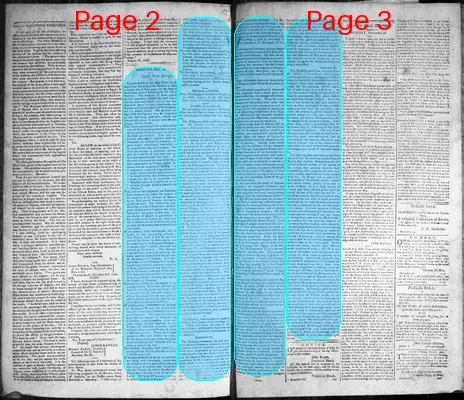
Alexandria Daily Advertiser
Alexandria, Virginia
What is this article about?
European news from Paris papers to Sept 30 reports escalating tensions: Austria seizes Bavarian territory, French and Austrian armies mobilize, Russian forces advance via Galicia. Diplomatic notes exchanged; war imminent but not declared. Napoleon leads French army across Rhine.
Merged-components note: The text content continues seamlessly across pages from the Norfolk European news article, forming a single coherent foreign news story on diplomatic relations and war preparations.
Clippings
1 of 2
OCR Quality
Full Text
Latest from Europe.
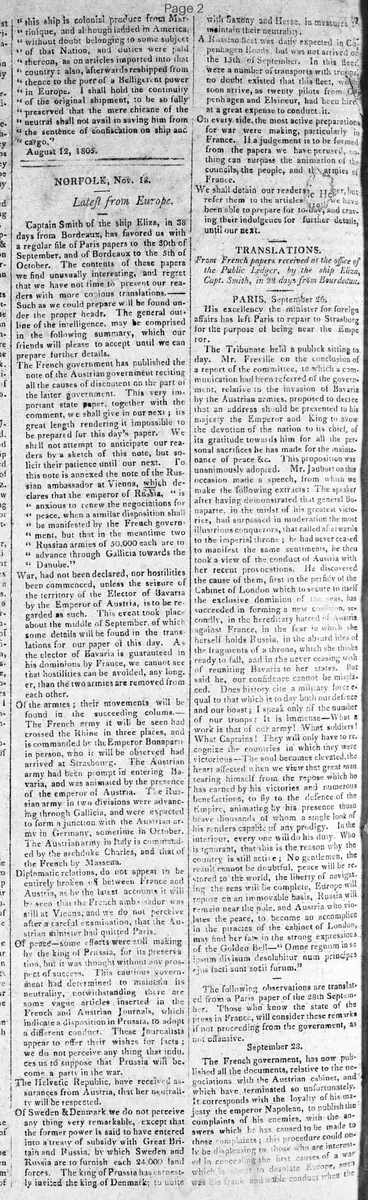
Captain Smith of the ship Eliza, in 38 days from Bordeaux, has favored us with a regular file of Paris papers to the 30th of September, and of Bordeaux to the 5th of October. The contents of these papers we find unusually interesting, and regret that we have not time to present our readers with more copious translations. Such as we could prepare will be found under the proper heads. The general outline of the intelligence, may be comprised in the following summary, which our friends will please to accept until we can prepare further details.
The French government has published the note of the Austrian government reciting all the causes of discontent on the part of the latter government. This very important state paper, together with the comment, we shall give in our next; its great length rendering it impossible to be prepared for this day's paper. We shall not attempt to anticipate our readers by a sketch of this note, but solicit their patience until our next. To this note is annexed the note of the Russian ambassador at Vienna, which declares that the emperor of Russia, "is anxious to renew the negociations for peace, when a similar disposition shall be manifested by the French government, but that in the meantime two Russian armies of 50,000 each are to advance through Gallicia towards the Danube."
War, had not been declared, nor hostilities been commenced, unless the seizure of the territory of the Elector of Bavaria by the Emperor of Austria, is to be regarded as such. This event took place about the middle of September. of which some details will be found in the translations for our paper of this day. As the elector of Bavaria is guaranteed in his dominions by France, we cannot see that hostilities can be avoided, any longer, than the two armies are removed from each other.
Of the armies: their movements will be found in the succeeding columns. The French army it will be seen had crossed the Rhine in three places, and is commanded by the Emperor Bonaparte in person, who it will be observed had arrived at Strasbourg. The Austrian army had been prompt in entering Bavaria, and was animated by the presence of the emperor of Austria. The Russian army in two divisions were advancing through Gallicia, and were expected to form a junction with the Austrian army in Germany, sometime in October. The Austrian army in Italy is commanded by the archduke Charles, and that of the French by Massena.
Diplomatic relations, do not appear to be entirely broken off between France and Austria, as by the latest accounts it will be seen that the French ambassador was still at Vienna, and we do not perceive after a careful examination, that the Austrian minister had quitted Paris.
Of peace-some efforts were still making by the king of Prussia, for its preservation. but it was thought without any prospect of success. This cautious government had determined to maintain its neutrality, notwithstanding there are some vague articles inserted in the French and Austrian Journals, which indicate a disposition in Prussia, to adopt a different conduct. These Journalists appear to offer their wishes for facts; we do not perceive any thing that induces us to suppose that Prussia will become a party in the war.
The Helvetic Republic, have received assurances from Austria, that her neutrality will be respected.
Of Sweden & Denmark we do not perceive any thing very remarkable, except that the former power is said to have entered into a treaty of subsidy with Great Britain and Russia, by which Sweden and Russia are to furnish each 24,000 land forces. The king of Prussia has earnestly invited the king of Denmark to unite with Saxony and Hesse, in measures to maintain their neutrality.
A Russian fleet was daily expected in Copenhagen Roads, but was not arrived on the 15th of September. In this fleet, were a number of transports with troops! no doubt existed that this fleet, which was soon to arrive, as twenty pilots from Copenhagen and Elsinore, had been hired at a great expense to conduct it.
On every side, the most active preparations for war were making, particularly in France. If a judgement is to be formed from the papers we have perused, nothing can surpass the animation of the councils, the people, and the armies of France.
We shall detain our readers no longer, but refer them to the articles to which we have been able to prepare for to-day, and craving their indulgence for further details, until our next.
TRANSLATIONS.
From French papers received at the office of the Public Ledger, by the ship Eliza, Capt. Smith, in 38 days from Bordeaux.
PARIS, September 26.
His excellency the minister for foreign affairs has left Paris to repair to Strasburg for the purpose of being near the Emperor.
The Tribunate held a public sitting to-day. Mr. Renville on the conclusion of a report of the committee, to which a communication had been referred of the government, relative to the invasion of Bavaria by the Austrian armies, proposed to decree that an address should be presented to his majesty the Emperor and King to avow the devotion of the nation to its chief, of its gratitude towards him for all the personal sacrifices he has made for the maintenance of peace &c. This proposition was unanimously adopted. Mr. Jaubert on this occasion made a speech, from which we make the following extracts: The speaker after having demonstrated that general Bonaparte, in the midst of his greatest victories, had surpassed in moderation the most illustrious conquerors, that called afterwards to the imperial throne : he had never ceased to manifest the same sentiments, he then took a view of the conduct of Austria with her recent provocations. He discovered the cause of them, first in the perfidy of the Cabinet of London which to secure to itself the exclusive dominion of the seas, has succeeded in forming a new coalition, secondly, in the hereditary hatred of Austria against France, in the fear in which she holds Russia, in the absurd idea of the fragments of a throne, which she thinks ready to fall, and in the never ceasing wish of reuniting Bavaria to her states. But said he, our confidence cannot be misplaced. Does history cite a military force equal to that which is to-day both our defence and our boast: I speak only of the number of our troops: It is immense--What a work is that of our army! What soldiers! What Captains! They will only have to recognize the countries in which they were victorious--The soul becomes elevated, the heart affected when we view that great man tearing himself from the repose which he has earned by his victories and numerous benefactions, to fly to the defence of the Empire, animating by his presence those brave thousands of whom a single look of his renders capable of any prodigy. In the interior, every one will do his duty. Who is ignorant, that this is the reason why the country is still active; No gentlemen, the result cannot be doubtful, peace will be restored to the world, the liberty of navigating the seas will be complete, Europe will repose on an immovable basis. Russia will remain near the pole, and Austria who violates the peace, to become an accomplice in the piracies of the cabinet of London, may find her fate in the strong expressions of the Golden Bull-"Omne regnum in se ipsum divisum desolabitur num principes ejus facti sunt socii furum."
The following observations are translated from a Paris paper of the 28th September. Those who know the state of the press in France, will consider these remarks if not proceeding from the government, as not offensive.
September 28.
The French government, has now published all the documents, relative to the negociations with the Austrian cabinet, which have terminated so unfortunately. It corresponds with the loyalty of his majesty the emperor Napoleon, to publish the complaints of his enemies, with the answers which he has caused to be made to those complaints : this procedure could only be displeasing to those who are interested in concealing the first causes of a war which is about to desolate Europe, such was his frank and noble conduct when the Treaty of Amiens was violated. The English government in burying in eternal oblivion, the motives which induced this violation of the faith of treaty. Whatever may be the result of this war, the authors of kindling it, will be inscribed in indelible characters in the pages of history. It is fortunate that doubts, now no longer exist, as to the first causes which have produced this new coalition. He who can advance arguments (which deserve no answer) in support of measures, feels no difficulty in exposing his motives; but the French people, will see in those arguments designs, calculated to sully their glory, and to destroy their national security and independence.
Those documents prove to demonstration, the great point which we are about to discuss.
The unfounded complaints of Austria & Russia, originate from a much more important source than the changes which have been produced in Italy. From the commencement of the present war, those two powers appear to have taken an interest in the war, not for the purpose of mediating but of associating themselves with England: Nothing but the excessive moderation of the emperor Napoleon, could have submitted to such open provocations.
A glance at the map of Europe will be sufficient to satisfy any one, that the situation of the European powers, relative to each other, has experienced considerable changes, since the peace of Luneville, more particularly since the violation of the treaty of Amiens. During a war which France was forced into, for the common good of Europe, Austria and Russia, have (avail themselves of the occasion) continued to augment and extend their influence while France in this respect has carried her spirit of moderation to excess.
The French people might have cause to complain of the confidence reposed in Austria & Russia, by the emperor Napoleon, if they were not justified in relying on his courage to avenge this scandalous abuse of his proud moderation.
At the time when the treaty of Amiens was broken, the emperor of Russia was very far from assuming the influence, which he now exercises with such insupportable arrogance, over the deliberations of the Divan. He did not insist upon the necessity of the Porte's admitting a Russian garrison into the Ottoman provinces, nor of dictating its diplomatic notes, and of giving it allies or enemies at pleasure. He did not then order his fleets and armies to pass under the ramparts of the seraglio. The protection granted to the Seven Islands, which was designed simply as an honorable guarantee of their independence, has been an instrument of acquiring absolute dominion. These isles have become a depot for arms, soldiers and ammunition. From this military position his Russian majesty can carry war, at the first signal, into the heart of the south of Europe, into Egypt, or the Morea. The Mediterranean has become subjected to his absolute rule. This assumption on the part of Russia, long since effected, is certainly of much more importance, in relation to the other powers of Europe, than can possibly be, a few formal changes in Italy, or the voluntary annexation of a small province, which in fact, adds nothing to the continental strength of France.
In respect to Austria, the emperor Napoleon, has no less cause to complain of the violation of many of the articles of the treaty of Luneville, and of successive usurpations on the rights of the German princes, and more particularly on those of the elector of Bavaria. These wrongs are sufficiently developed and substantiated in the official documents, and render any further illustration unnecessary.
The most striking of these circumstances which present themselves and subserve the cause and justification of France, is the evidence which they furnish of the hostility of Austria and Russia, by great and continued preparations for war, before one complaint was made to, or against France. These warlike preparations have been continued, notwithstanding that the emperor Napoleon in answer to the complaints of Russia and Austria, has stated that he is ready to separate the crowns of France and Italy, the moment the troops should be withdrawn from the frontiers, and assurances are given of pacific intentions. If there were anything wanting to substantiate the evidence of these facts, it could be observed that these coalesced powers owed the determinations openly hostile to France long before which they are the pretexts. Above all it must be remarked, that the activity of the emperor Napoleon, in prosecuting the naval war, the great expense which he has incurred in the formation of a new marine, the immense armament which he had destined for the glorious expedition against England, leaving his frontiers on the side of Italy and Germany, without soldiers, arms or magazines, prove his aversion to war, and that relying on the honor of Russia and Austria, he was intent only upon the prosecution of an enterprize, in the success of which the whole continent was deeply interested.
September 30.
The English papers just arrived in Paris are barren of information: they contain nothing positive upon opening of parliament that great council of the nation will assemble, however when new subsidies are to be voted for the coalition, which cannot fail of soon being in need of them. As this war is made only for the benefit of the English government, they must dispose themselves to defray it largely. In the first war of the revolution, they gave subsidies only as their contingent in the common cause; at this time the pecuniary succors are unlimited; all the expenses are at their charge. The two emperors of Germany and Russia are themselves only the vassals of the monarch of India. Thus everything induces us to believe that his Britannic majesty will soon call his faithful commons together. The pay of the Russian army must perhaps be supplied by before they reach their destination; and in this interval the emperor Napoleon may furnish a proper text to the orators of the opposition who wish to hold forth upon the advantages and utility of this new coalition on.
For this long time past nothing has been talked of but the immense preparations of Russia and Austria. Newspapers are daily filled with the details of the march of the troops, they carefully describe their composition, their progress, the place they stop at to-day, those they will arrive at next week. &c. In France less is said of the movements of the French armies: indeed they arrive before people have time to speak of them. It is a thing worthy of remark and which already gives a perception of the fate of the coalition, and the issue of the contest. that the two powers who meditated the war with so much precaution should be in some measure prevented, and taken unawares by the one who wished for peace. It is now upwards of fifteen months since the emperor Alexander put his troops upon the footing of war and began to transport an army into the Mediterranean. For this year past the emperor of Germany has been making secret dispositions. getting arms manufactured, and raising men: he has been storing up immense quantities of corn and other provisions at the risk of creating a scarcity among his subjects and of occasioning popular commotions even in his very capital. It was discovered some months since that he made numbers of soldiers file off in the dead of the night, under the guise of travelers, by cross roads to assemble upon the frontiers. And yet after so much care, precaution & preparation, it is probable the French army got together in haste, without either magazines or military stores upon the spot. will meet with no Austrian army on the borders of the Rhine, capable of withstanding it, and the Russian army will perhaps only arrive in time to witness the disasters of those whom blindness calls their allies, but whom good politicians will call their enemies, It is another glorious spectacle, to behold energy all of a sudden impressed upon the French people, to see the re-organization of the national guards, the rise of stocks at the very moment when the departure of court, the generals and so many distinguished personages must have carried away a considerable quantity of specie from the capital. This eminently proves that France has lost nothing of her national vigour: She will know how to parry the blows that her enemies were ready to strike at her, & she cooly waits the expeditions headed by such commanders as the dukes of York and Cambridge; whom Homer would so justly have stiled light-footed.
What sub-type of article is it?
What keywords are associated?
What entities or persons were involved?
Where did it happen?
Foreign News Details
Primary Location
Europe
Event Date
September 1805
Key Persons
Outcome
war not declared; austrian seizure of bavarian territory in mid-september; armies mobilizing but no hostilities commenced beyond seizure.
Event Details
French government publishes Austrian note of grievances; Russian ambassador notes desire for peace negotiations but advances two 50,000-man armies through Galicia. Austrian forces enter Bavaria; French army under Napoleon crosses Rhine at three points near Strasbourg. Russian armies to join Austrians in Germany by October. Austrian army in Italy led by Archduke Charles, French by Massena. Diplomatic ties not fully broken. Prussian neutrality efforts; Swedish subsidy treaty with Britain and Russia; Russian fleet expected in Copenhagen.