Thank you for visiting SNEWPapers!
Sign up free
Imperial Valley Press
El Centro, Imperial County, California
What is this article about?
Dr. Alexander Goetz at the California Institute of Technology reports using helium, liquified with frozen air and liquid hydrogen, to reach temperatures 366 degrees Fahrenheit below Siberia's record cold of -93°F, approaching absolute zero. A lead coil served as a thermometer, losing electrical resistance.
Clipping
OCR Quality
Full Text
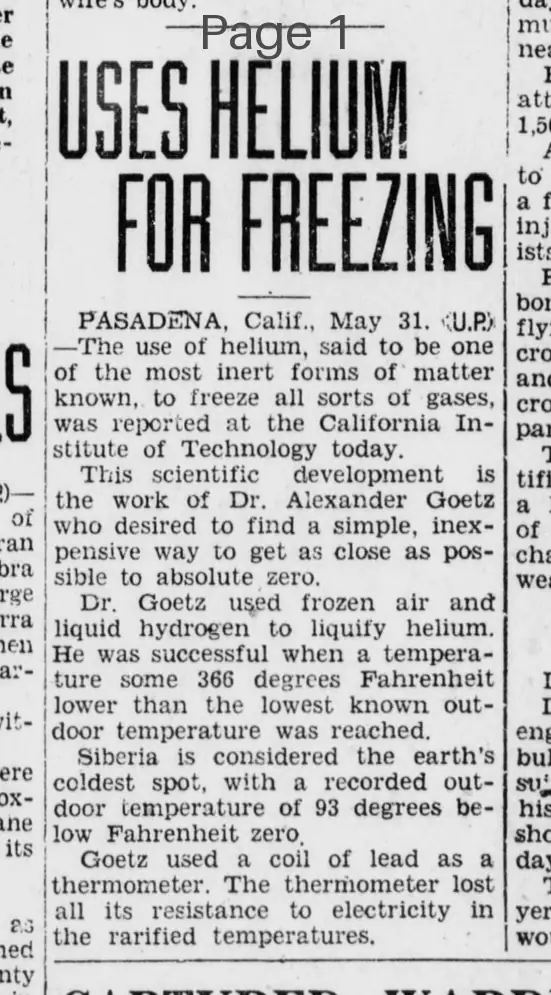
PASADENA, Calif., May 31. (U.P)
The use of helium, said to be one of the most inert forms of matter known, to freeze all sorts of gases, was reported at the California Institute of Technology today.
This scientific development is the work of Dr. Alexander Goetz who desired to find a simple, inexpensive way to get as close as possible to absolute zero.
Dr. Goetz used frozen air and liquid hydrogen to liquify helium. He was successful when a temperature some 366 degrees Fahrenheit lower than the lowest known outdoor temperature was reached.
Siberia is considered the earth's coldest spot, with a recorded outdoor temperature of 93 degrees below Fahrenheit zero.
Goetz used a coil of lead as a thermometer. The thermometer lost all its resistance to electricity in the rarified temperatures.
What sub-type of article is it?
What themes does it cover?
What keywords are associated?
What entities or persons were involved?
Where did it happen?
Story Details
Key Persons
Location
Pasadena, Calif., California Institute Of Technology
Event Date
May 31
Story Details
Dr. Goetz developed a method using helium, liquified with frozen air and liquid hydrogen, to freeze gases and reach temperatures 366 degrees Fahrenheit below the lowest known outdoor temperature in Siberia, approaching absolute zero, measured with a lead coil thermometer that lost electrical resistance.