Thank you for visiting SNEWPapers!
Sign up free
Concord Register
Concord, Merrimack County, New Hampshire
What is this article about?
The Superior Court of Judicature session closed on Saturday, 2d instant, with over 400 new entries and more criminal trials than usual. Several convictions for counterfeiting, theft, bigamy, and other crimes resulted in sentences including prison time and fines. Joseph Scoby was acquitted of altering a note amid bizarre witchcraft testimony. Ira St. Clair was admitted as an attorney.
Clipping
OCR Quality
Full Text
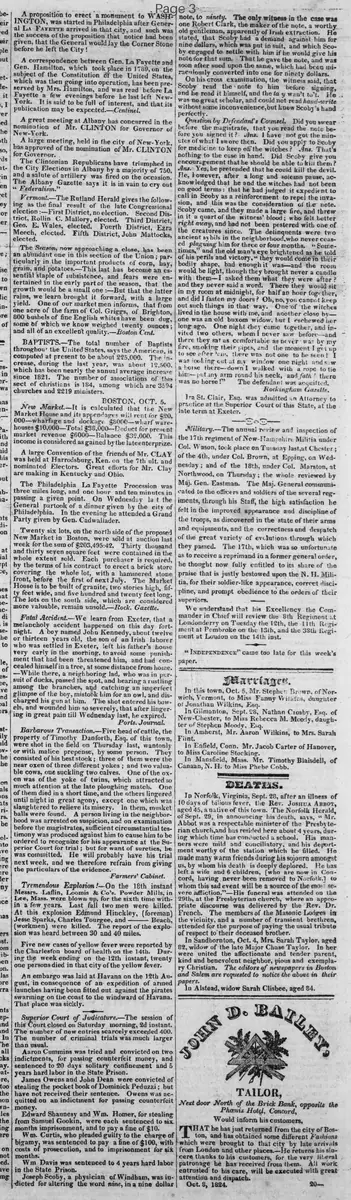
Aaron Cummins was tried and convicted on two indictments, for passing counterfeit money, and sentenced to 20 days solitary confinement and 5 years hard labor in the State Prison.
James Owens and John Dean were convicted of stealing the pocket book of Domnick Peduzzi: but have not received their sentence. Owens was acquitted on an indictment for passing counterfeit money.
Edward Shaunesy and Wm. Homer, for stealing from Samuel Gookin, were each sentenced to six months imprisonment, and to pay a fine of $10.
Wm. Curtis, who pleaded guilty to the charge of bigamy, was sentenced to pay a fine of $100, with costs of prosecution, and to imprisonment for six months.
Wm Davis was sentenced to 4 years hard labor in the State Prison.
Joseph Scoby, a physician of Windham, was indicted for altering the word nine, in a nine dollar note, to ninety. The only witness in the case was one Robert Clark, the maker of the note, a worthy old gentleman, apparently of Irish extraction. He stated, that Scoby had a demand against him for nine dollars, which was put in suit, and which Scoby engaged to settle with him if he would give his note for that sum. That he gave the note, and was soon after sued upon the same, which had been miraculously converted into one for ninety dollars.
On his cross examination, the witness said, that Scoby read the note to him before signing, and he read it himself, and the way wasn't to't. He was no great scholar, and could not read hand-writing without some inconvenience, but knew Scoby's hand perfectly.
Question by Defendant's Counsel. Did you swear before the magistrate, that you read the note before you signed it? Ans. I have not got the minutes of what I swore then. Did you apply to Scoby for medicine to keep off the witches? Ans. That's nothing to the case in hand. Did Scoby give you encouragement that he should be able to kill them? Ans. Yes, he pretended that he could kill the devil.
He, however, after a long and solemn pause, acknowledged that he and the witches had not been on good terms: that he had judged it expedient to call in Scoby as a reinforcement to repel the invasion, and this was the consideration of the note. Scoby came, and they made a large fire, and threw in it a quart of the witness' blood; who felt better right away, and had not been pestered with one of the creatures since. The delinquents were two ancient sybils in the neighborhood, who never ceased plaguing him for three or four months. "Sometimes," and the old man's eye brightened as he told of his perils and victory, "they would come in their bodily shape, bad enough it was—and the room would be light, though they brought never a candle with them—I asked them what they were after? and they never said a word. There they would sit in my room at midnight, for half an hour together, and did I fasten my doors? Oh, no, you cannot keep out such things in that way. One of the witches lived in the house with me, and another close by—one was an old buxom widow, but I eschewed her long ago. One night they came together, and invited two others, whom I never saw before—and there they sat as comfortable as never was by my fire, smoking their pipes, and the moment I got up to see after 'em, there was not one to be seen! I was looking out at my window one night and saw a horse there—down I walked with a rope to tie him—put my arm round his neck, and faith! there was no horse!"
The defendant was acquitted.
Rockingham Gazette.
Ira St. Clair, Esq. was admitted an Attorney to practice at the Superior Court of this State, at the late term at Exeter.
What sub-type of article is it?
What keywords are associated?
What entities or persons were involved?
Where did it happen?
Domestic News Details
Primary Location
Exeter
Event Date
2d Instant
Key Persons
Outcome
aaron cummins: 20 days solitary and 5 years hard labor for counterfeiting. james owens and john dean: convicted of theft, sentence pending; owens acquitted of counterfeiting. edward shaunesy and wm. homer: 6 months imprisonment and $10 fine each for theft. wm. curtis: $100 fine and 6 months for bigamy. wm davis: 4 years hard labor. joseph scoby: acquitted of altering note. ira st. clair: admitted as attorney.
Event Details
The Superior Court session closed with numerous criminal trials. Aaron Cummins convicted of passing counterfeit money. James Owens and John Dean convicted of stealing a pocket book. Edward Shaunesy and Wm. Homer convicted of stealing from Samuel Gookin. Wm. Curtis pleaded guilty to bigamy. Wm Davis sentenced. Joseph Scoby indicted for altering a nine-dollar note to ninety, involving a note given for medical services against witches; acquitted after witness testimony about witches. Ira St. Clair admitted as attorney.