Thank you for visiting SNEWPapers!
Sign up free
Virginia Argus
Richmond, Virginia
What is this article about?
George Logan writes to the Philadelphia County Society for the Promotion of Agriculture and Domestic Manufactures, reporting his winter experiment finding that Indian corn tops, cut and mixed with potatoes, shorts, or meal, provide better fodder for horses and cattle than rye straw, dated February 6, 1792, from Stenton.
Clipping
OCR Quality
Full Text
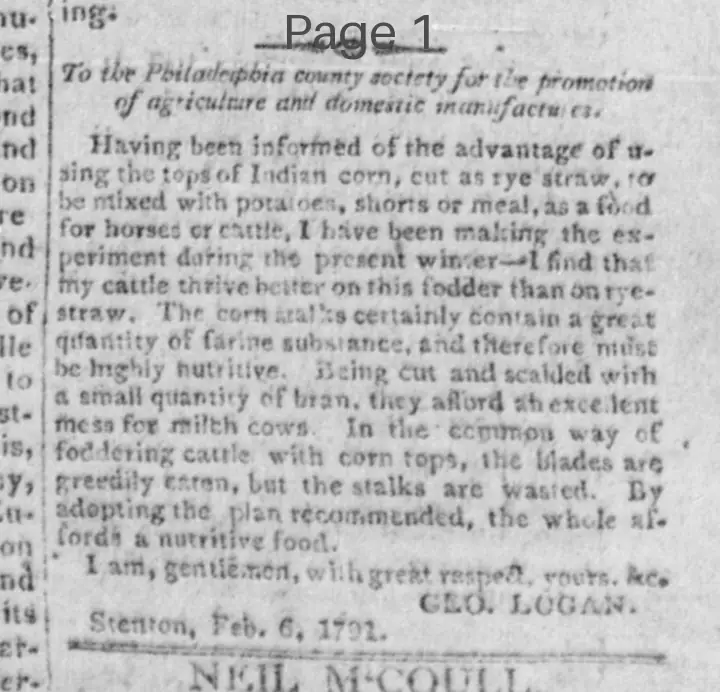
Having been informed of the advantage of using the tops of Indian corn, cut as rye straw, to be mixed with potatoes, shorts or meal, as a food for horses or cattle, I have been making the experiment during the present winter--and find that my cattle thrive better on this fodder than on rye-straw. The corn blades certainly contain a great quantity of farinaceous substance, and therefore must be highly nutritive. Being cut and scalded with a small quantity of bran, they afford an excellent mess for milch cows. In the common way of foddering cattle with corn tops, the blades are greedily eaten, but the stalks are wasted. By adopting the plan recommended, the whole affords a nutritive food.
I am, gentlemen, with great respect, yours, &c.
GEO. LOGAN.
Stenton, Feb. 6, 1792.
What sub-type of article is it?
What keywords are associated?
What entities or persons were involved?
Where did it happen?
Domestic News Details
Primary Location
Stenton
Event Date
Feb. 6, 1792
Key Persons
Outcome
cattle thrive better on indian corn tops fodder than on rye-straw.
Event Details
GEO. LOGAN reports experiment using tops of Indian corn, cut like rye straw and mixed with potatoes, shorts or meal, as food for horses or cattle during the present winter. Corn blades are highly nutritive; cut and scalded with bran, excellent for milch cows. This method utilizes whole plant, unlike common foddering where stalks are wasted.