Thank you for visiting SNEWPapers!
Sign up free
Editorial
January 8, 1810
Portland Gazette, And Maine Advertiser
Portland, Cumberland County, Maine
What is this article about?
The Monitor No. XVI editorial draws on St. Paul's teachings to advise young men on self-knowledge, humility in learning, pursuing useful knowledge, and forming proper mental habits to avoid vulgarity and elevate the soul above sensual pleasures.
Clipping
OCR Quality
95%
Excellent
Full Text
Communications.
The Monitor.....No. XVI.
"Covet earnestly the best gifts."
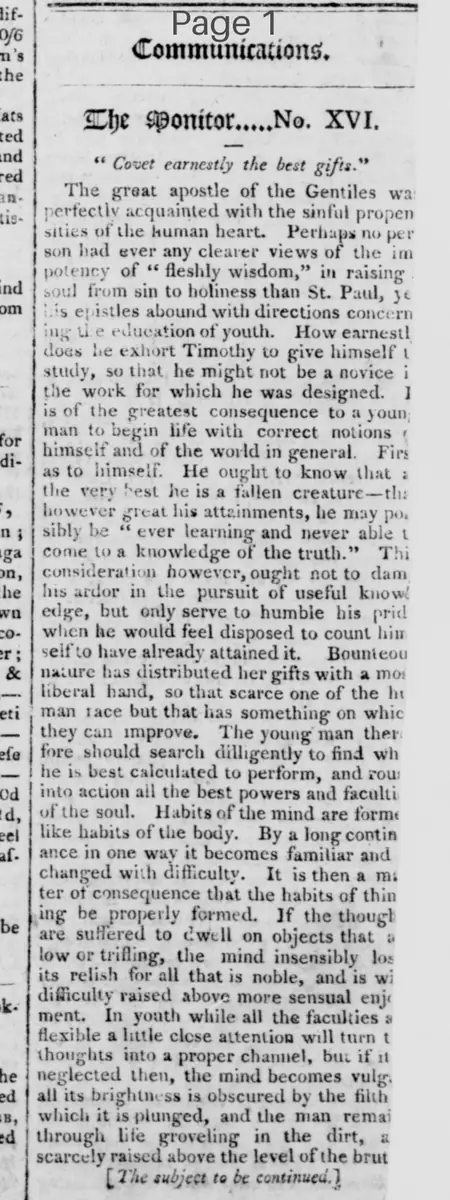
The great apostle of the Gentiles was perfectly acquainted with the sinful propensities of the human heart. Perhaps no person had ever any clearer views of the impotency of "fleshly wisdom," in raising the soul from sin to holiness than St. Paul, yet his epistles abound with directions concerning the education of youth. How earnestly does he exhort Timothy to give himself to study, so that he might not be a novice in the work for which he was designed. It is of the greatest consequence to a young man to begin life with correct notions of himself and of the world in general. First as to himself. He ought to know that: the very best he is a fallen creature--that however great his attainments, he may possibly be "ever learning and never able to come to a knowledge of the truth." This consideration however, ought not to damp his ardor in the pursuit of useful knowledge, but only serve to humble his pride when he would feel disposed to count himself to have already attained it. Bountiful nature has distributed her gifts with a most liberal hand, so that scarce one of the human race but that has something on which they can improve. The young man therefore should search diligently to find what he is best calculated to perform, and rouse into action all the best powers and faculties of the soul. Habits of the mind are formed like habits of the body. By a long continuance in one way it becomes familiar and changed with difficulty. It is then a matter of consequence that the habits of thinking be properly formed. If the thoughts are suffered to dwell on objects that are low or trifling, the mind insensibly loses its relish for all that is noble, and with difficulty raised above more sensual enjoyment. In youth while all the faculties are flexible a little close attention will turn the thoughts into a proper channel, but if it neglected then, the mind becomes vulgar and all its brightness is obscured by the filth which it is plunged, and the man remains through life groveling in the dirt, and scarcely raised above the level of the brutes.
The Monitor.....No. XVI.
"Covet earnestly the best gifts."
The great apostle of the Gentiles was perfectly acquainted with the sinful propensities of the human heart. Perhaps no person had ever any clearer views of the impotency of "fleshly wisdom," in raising the soul from sin to holiness than St. Paul, yet his epistles abound with directions concerning the education of youth. How earnestly does he exhort Timothy to give himself to study, so that he might not be a novice in the work for which he was designed. It is of the greatest consequence to a young man to begin life with correct notions of himself and of the world in general. First as to himself. He ought to know that: the very best he is a fallen creature--that however great his attainments, he may possibly be "ever learning and never able to come to a knowledge of the truth." This consideration however, ought not to damp his ardor in the pursuit of useful knowledge, but only serve to humble his pride when he would feel disposed to count himself to have already attained it. Bountiful nature has distributed her gifts with a most liberal hand, so that scarce one of the human race but that has something on which they can improve. The young man therefore should search diligently to find what he is best calculated to perform, and rouse into action all the best powers and faculties of the soul. Habits of the mind are formed like habits of the body. By a long continuance in one way it becomes familiar and changed with difficulty. It is then a matter of consequence that the habits of thinking be properly formed. If the thoughts are suffered to dwell on objects that are low or trifling, the mind insensibly loses its relish for all that is noble, and with difficulty raised above more sensual enjoyment. In youth while all the faculties are flexible a little close attention will turn the thoughts into a proper channel, but if it neglected then, the mind becomes vulgar and all its brightness is obscured by the filth which it is plunged, and the man remains through life groveling in the dirt, and scarcely raised above the level of the brutes.
What sub-type of article is it?
Education
Moral Or Religious
What keywords are associated?
Youth Education
Moral Habits
St Paul
Self Improvement
Humility In Learning
Mental Faculties
What entities or persons were involved?
St. Paul
Timothy
Editorial Details
Primary Topic
Moral Education And Self Improvement For Youth
Stance / Tone
Exhortatory Moral Instruction
Key Figures
St. Paul
Timothy
Key Arguments
St. Paul Urges Study And Education Despite Human Sinfulness
Youth Must Recognize Themselves As Fallen Creatures To Maintain Humility
Pursue Useful Knowledge Without Pride In Attainments
Discover And Develop Natural Talents Diligently
Form Proper Mental Habits Early To Avoid Vulgarity And Sensual Degradation