Thank you for visiting SNEWPapers!
Sign up free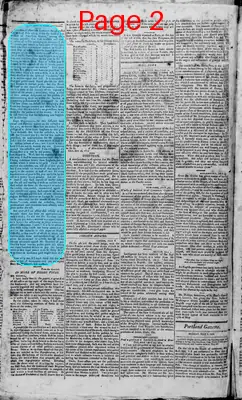
Jenks' Portland Gazette
Portland, Cumberland County, Maine
What is this article about?
Article from United States' Gazette discusses the 1803 act for protecting American seamen by requiring captains to transport destitute sailors at U.S. expense up to $10, but criticizes lack of payment provision. Details a case where Capt. W.-- is denied payment by the port collector despite penalties for refusal. Accuses administration of unfair economies and references unauthorized payment by Secretary Smith.
Clipping
OCR Quality
Full Text
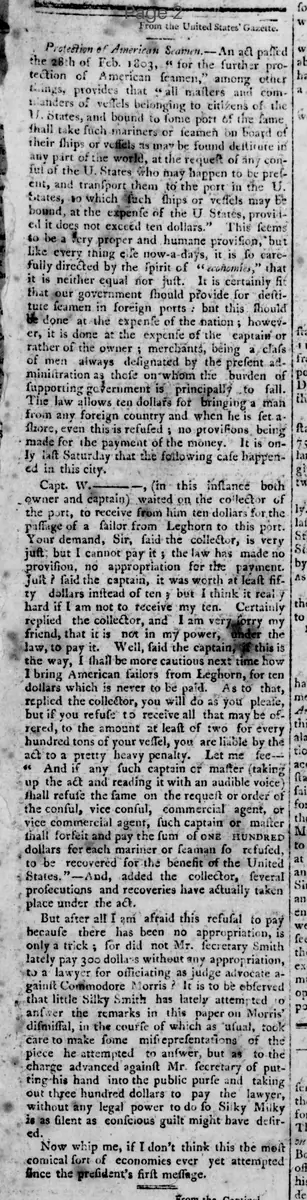
Protection of American Seamen.--An act passed the 28th of Feb. 1803, "for the further protection of American seamen." among other things, provides that "all masters and commanders of vessels belonging to citizens of the U. States, and bound to some port of the same shall take such mariners or seamen on board of their ships or vessels as may be found destitute in any part of the world, at the request of any consul of the U. States who may happen to be present, and transport them to the port in the U. States, to which such ships or vessels may be bound, at the expense of the U States, provided it does not exceed ten dollars." This seems to be a very proper and humane provision, but like every thing else now-a-days, it is so carefully directed by the spirit of "economies," that it is neither equal nor just. It is certainly fit that our government should provide for destitute seamen in foreign ports : but this should be done at the expense of the nation; however, it is done at the expense of the captains or rather of the owners ; merchants, being a class of men always designated by the present administration as those on whom the burden of supporting government is principally to fall. The law allows ten dollars for bringing a man from any foreign country and when he is set ashore, even this is refused ; no provision being made for the payment of the money. It is only last Saturday that the following case happened in this city.
Capt. W. --, (in this instance both owner and captain) waited on the collector of the port, to receive from him ten dollars for the passage of a sailor from Leghorn to this port. "Your demand, Sir," said the collector, is very just; but I cannot pay it ; the law has made no provision, no appropriation for the payment." "Just ?" said the captain, it was worth at least fifty dollars instead of ten ; but I think it really hard if I am not to receive my ten." "Certainly," replied the collector, and I am very sorry my friend, that it is not in my power,, under the law, to pay it." "Well," said the captain, this is the way, I shall be more cautious next time how I bring American sailors from Leghorn, for ten dollars which is never to be paid." "As to that," replied the collector, you will do as you please, but if you refuse to receive all that may be offered, to the amount at least of two for every hundred tons of your vessel, you are liable by the act to a pretty heavy penalty. Let me see--: "And if any such captain or master (taking up the act and reading it with an audible voice) shall refuse the same on the request or order of the consul, vice consul, commercial agent, or vice commercial agent, such captain or master shall forfeit and pay the sum of ONE HUNDRED dollars for each mariner or seaman so refused. to be recovered for the benefit of the United States." -And, added the collector, several prosecutions and recoveries have actually taken place under the act.
But after all I am afraid this refusal to pay because there has been no appropriation, is only a trick ; for did not Mr. Secretary Smith lately pay 300 dollars without any appropriation, to a lawyer for officiating as judge advocate against Commodore Morris ? It is to be observed that little Silky Smith has lately attempted to answer the remarks in this paper on Morris' dismissal, in the course of which as "usual, took care to make some misrepresentations of the piece he attempted to answer, but as to the charge advanced against Mr. Secretary of putting his hand into the public purse and taking out three hundred dollars to pay the lawyer, without any legal power to do so_Silky Milky is as silent as conscious guilt might have desired.
Now whip me, if I don't think this the most comical sort of economies ever yet attempted since the president's first message.
What sub-type of article is it?
What themes does it cover?
What keywords are associated?
What entities or persons were involved?
Where did it happen?
Story Details
Key Persons
Location
Leghorn, This City
Event Date
28th Of Feb. 1803, Last Saturday
Story Details
The 1803 act requires U.S. vessel captains to transport destitute American seamen from foreign ports at U.S. expense up to $10, with $100 penalties for refusal. Capt. W.--, after bringing a sailor from Leghorn, is denied payment by the port collector due to no appropriation, despite the law's provisions and actual prosecutions. Commentary criticizes the administration's economies and notes Secretary Smith's unauthorized $300 payment.