Thank you for visiting SNEWPapers!
Sign up free
Gazette Of The United States
New York, New York County, New York
What is this article about?
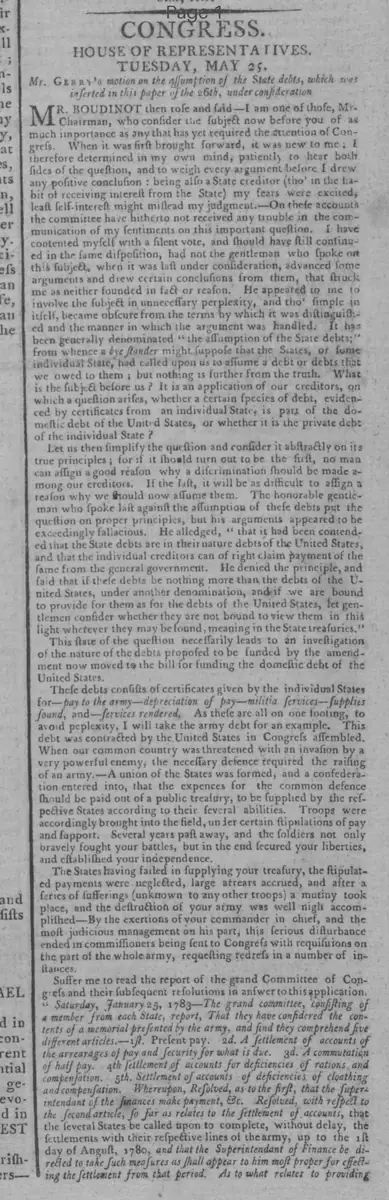
On May 25, in the House of Representatives, Mr. Boudinot delivered a speech supporting the assumption of state debts as federal obligations, citing historical army payments, congressional resolutions from 1783, and the U.S. Constitution's continuity of debts. He refuted arguments against it, quoting Mr. Madison.
Merged-components note: Continuation of congressional debate on assumption of state debts; the second component was mislabeled as editorial but is factual reporting on Congress.
Clippings
1 of 2
OCR Quality
Full Text
HOUSE OF REPRESENTATIVES.
TUESDAY, MAY 25.
Mr. Gerry's motion on the assumption of the State debts, which was inserted in this paper of the 26th, under consideration
Mr. BOUDINOT then rose and said—I am one of those, Mr. Chairman, who consider the subject now before you of as much importance as any that has yet required the attention of Congress.
When it was first brought forward, it was new to me; I therefore determined in my own mind, patiently to hear both sides of the question, and to weigh every argument before I drew any positive conclusion: being also a State creditor (tho' in the habit of receiving interest from the State) my fears were excited, least self-interest might mislead my judgment.—On these accounts the committee have hitherto not received any trouble in the communication of my sentiments on this important question. I have contented myself with a silent vote, and should have still continued in the same disposition, had not the gentleman who spoke on this subject, when it was last under consideration, advanced some arguments and drew certain conclusions from them, that struck me as neither founded in fact or reason. He appeared to me to involve the subject in unnecessary perplexity, and tho' simple in itself, became obscure from the terms by which it was distinguished and the manner in which the argument was handled. It has been generally denominated "the assumption of the State debts;" from whence a by-stander might suppose that the States, or some individual State, had called upon us to assume a debt or debts that we owed to them; but nothing is further from the truth. What is the subject before us? It is an application of our creditors, on which a question arises, whether a certain species of debt, evidenced by certificates from an individual State, is part of the domestic debt of the United States, or whether it is the private debt of the individual State?
Let us then simplify the question and consider it abstractly on its true principles; for if it should turn out to be the first, no man can assign a good reason why a discrimination should be made among our creditors. If the last, it will be as difficult to assign a reason why we should now assume them. The honorable gentleman who spoke last against the assumption of these debts put the question on proper principles, but his arguments appeared to be exceedingly fallacious. He alleged, "that it had been contended that the State debts are in their nature debts of the United States, and that the individual creditors can of right claim payment of the same from the general government. He denied the principle, and said that if these debts be nothing more than the debts of the United States, under another denomination, and if we are bound to provide for them as for the debts of the United States, let gentlemen consider whether they are not bound to view them in this light wherever they may be found, meaning in the State treasuries."
This state of the question necessarily leads to an investigation of the nature of the debts proposed to be funded by the amendment now moved to the bill for funding the domestic debt of the United States.
These debts consist of certificates given by the individual States for—pay to the army—depreciation of pay—militia services—supplies found, and—services rendered. As these are all on one footing, to avoid perplexity, I will take the army debt for an example. This debt was contracted by the United States in Congress assembled. When our common country was threatened with an invasion by a very powerful enemy, the necessary defence required the raising of an army.—A union of the States was formed, and a confederation entered into, that the expenses for the common defence should be paid out of a public treasury, to be supplied by the respective States according to their several abilities. Troops were accordingly brought into the field, under certain stipulations of pay and support. Several years passed away, and the soldiers not only bravely fought your battles, but in the end secured your liberties, and established your independence.
The States having failed in supplying your treasury, the stipulated payments were neglected, large arrears accrued, and after a series of sufferings (unknown to any other troops) a mutiny took place, and the destruction of your army was well nigh accomplished—By the exertions of your commander in chief, and the most judicious management on his part, this serious disturbance ended in commissioners being sent to Congress with requisitions on the part of the whole army, requesting redress in a number of instances.
Suffer me to read the report of the grand Committee of Congress and their subsequent resolutions in answer to this application. Saturday, January 25, 1783—The grand committee, consisting of a member from each State, report, That they have considered the contents of a memorial presented by the army, and find they comprehend five different articles.—1st. Present pay. 2d. A settlement of accounts of the arrearages of pay and security for what is due. 3d. A commutation of half pay. 4th settlement of accounts for deficiencies of rations and compensation. 5th. Settlement of accounts of deficiencies of cloathing and compensation. Whereupon, Resolved, as to the first, that the superintendent of the finances make payment, &c. Resolved, with respect to the second article, so far as relates to the settlement of accounts, that the several States be called upon to complete, without delay, the settlements with their respective lines of the army, up to the 1st day of August, 1780, and that the Superintendant of Finance be directed to take such measures as shall appear to him most proper for effecting the settlement from that period. As to what relates to providing security for what shall be found due on such settlement, Resolved, that the troops of the United States, in common with all the creditors of the same, have an undoubted right to expect such security; and that Congress will make every effort in their power to obtain from the respective States, substantial funds, adequate to the object of funding the whole debt of the United States, and will enter upon an immediate and full consideration of the nature of such funds, and the most likely mode of obtaining them. Nothing can more clearly appear, than that at the time of these resolutions, Congress considered the debt due to the army for pay and depreciation of pay, as well as that due to their other creditors, as the particular debts of the United States. Here was no pretence of denying the contract or turning them over to the States for payment. It is true, Congress in these resolutions call upon the individual States, to settle with their lines of the army to a given day, but the pay is to come from adequate funds to be provided by the efforts of Congress from the several States. In obedience to this requisition, the States proceeded to the settlement, not only of the pay to the lines of the army, but also of the claims of their citizens for supplies furnished to contractors, commissaries and quarter-masters with all their host of dependants, and certificates of the balances due to them, were given under the direction of the States individually, who thereby agreeably to the foregoing resolutions, became security to the creditors, on behalf of the confederated government, that their debts should be paid. Congress immediately proceeded to demand of the several States, an impost of 5 per cent. ad valorem on all goods, wares and merchandizes, imported into the United States, and, additional funds for 25 years, adequate to the payment of the interest of the whole debt agreeably to their assurances in answer to the memorial of the army. Some of the States complied with this requisition, and provided supplementary funds over and above the impost for 25 years—but others refusing, the whole project was rendered abortive and the creditors of the union left in the most distressing circumstances. The clamours of the citizens were too great to be withstood by many of the States who considered themselves as sureties for the United States, and indeed under a necessity of rendering some immediate, tho' partial supplies, to prevent every thing running into confusion. They thereupon undertook to pay their own citizens and interest due on their respective certificates, whether given by special officers of Congress (as the commissioners of loan) or under the direction of the standard before mentioned. The State of New-Jersey in this way paid five years interest, to the amount of several hundred thousand dollars. But although these partial payments put the evil day farther off, yet the time at last came, when the good sense of the people, finding the government unable to support itself and comply with their engagements, and seeing nothing but ruin and confusion before them, wisely brought about another revolution, and formed a new constitution founded on a more intimate union of the several States, with greater and more efficient powers for the purpose of establishing justice, insuring domestic tranquility, promoting the general welfare and securing the blessings of liberty.
Provision was also expressly made, that all debts and engagements binding on the former government, should be equally valid against the present. Under this new constitution, the government is vested in the fullest manner with all the resources and funds necessary for the payment of the general debt of the union, and what they had in vain asked of the several States under the former confederation. Of course the individual State was deprived of them, and no longer had it in her power to continue her partial aids towards satisfying the growing interest on the demands of their citizens. In this situation, and under these circumstances, our creditors came forward, with the evidences of their demands given by the individual State by order of the United States in Congress assembled, and demand payment of us, as their original debtor, for whom they performed the services and to whom they granted the supplies, alledging that by the transfer of the revenues and resources of government from the respective States to us, their security is invalidated and we are become able to pay them, agreeably to the spirit of our original contract. These questions then fairly arise,
Was the contract originally ours, or were the United States the original debtor?—if so, has the creditor been paid his just due, or has he released us from the obligation?
There can be no doubt in my opinion, from the foregoing view of the circumstances of the case; and I believe no gentleman will deny, but that we are the original debtors as representing the former government.
It is as clear that all the creditor has received for his demand, has been a certificate from the State, testifying a certain balance due to him for his services, or for supplies rendered. And here I should enter into the argument, to shew that this certificate from the State cannot on any principles of justice, honor or policy be considered as payment, was not the matter already done to my hand in language so much more forcible than any I can use on this occasion, and the omission of which would be imposing on the committee. This will be found in the 322d and 413th pages of the Congressional Register, where an honorable gentleman (Mr. Madison) in speaking on the subject of public certificates, though to another point, says, "Let us consider first by whom the debt was contracted, and then to whom it is due. The debt was contracted by the United States, who with respect to that particular transaction were in a national capacity. The government was nothing more than the agent or organ by which the whole body of the people acted. The change in the government which has taken place, has enlarged its national capacity, but it has not varied the national obligation with respect to the engagements entered into by that transaction—for in like manner the present government is nothing more than the organ or agent of the public. There is no change in our political duty nor in the moral or political obligation—The language I now use is the language of the constitution itself—it declares that all debts shall have the same validity against the United States, under the new as under the old form of government—The obligation remains the same, though I hope experience will prove that the ability has been favorably varied."
---Again a debt was fairly contracted; according to justice and good faith it ought to have been paid in gold or silver. A piece of paper was only substituted. Was this paper equal to gold or silver? No; it was worth in the market no more than one eighth or one seventh of that value. Was this depreciated paper freely accepted? No; the government offered that or nothing. The relation of the individual to the government and circumstances of the offer, rendered the acceptance a forced, not a free one. Again—"Here there was a debt acknowledged to have been once due, and which was never discharged, because the payment was forced and defective: the balance consequently is still due, and is of as sacred a nature as the claims of the holders can be. These conclusive arguments apply with double force to the question before the committee. Was the debt contracted by the United States? If so where have they any evidence of payment? If it is answered in the state certificates, I reply, a piece of paper was only substituted for the bare purpose of ascertaining the balance as preparatory to its being funded, and that by the particular order of Congress, under the idea of providing the creditor with security for his debts. Was this paper equal to gold and silver or any other substantial payment? The relation of the individual to the government and circumstances of the offer, rendered the acceptance a forced, not a free one. But, sir, a part of the objection is still unanswered. It is said that if these are debts of the United States in the hands of individual citizens, must they not be the debts of the United States in the Treasuries of the different states. I answer by no means. This argument is extremely fallacious. In common life, if any person who becomes my security, pays the debt for me and he owes me money, I can with propriety refuse to pay him till he settles his debt with me; but if such security refuses, or is unable
What sub-type of article is it?
What keywords are associated?
What entities or persons were involved?
Where did it happen?
Domestic News Details
Primary Location
House Of Representatives
Event Date
Tuesday, May 25.
Key Persons
Event Details
Mr. Boudinot spoke in support of Mr. Gerry's motion for the assumption of state debts as part of the federal domestic debt, arguing that these debts originated from contracts by the United States in Congress assembled, including army pay and supplies during the Revolution. He referenced 1783 congressional resolutions treating army debts as national obligations, state certificates as mere securities, failed funding attempts under the Confederation, and the Constitution's provision for assuming prior debts. He quoted Mr. Madison on the continuity of national obligations and refuted claims that state certificates constituted payment.