Thank you for visiting SNEWPapers!
Sign up free
Editorial
November 17, 1802
The Recorder
Richmond, Virginia
What is this article about?
A letter to the editor critiques the administration's defense of remitting James Callender's sedition fine, arguing the repayment breached the Constitution since the money was already in the U.S. Treasury via the Virginia marshal. It also notes the President's view of the Sedition Act as unconstitutional.
Clipping
OCR Quality
95%
Excellent
Full Text
FROM THE AMERICAN DAILY ADVERTISER.
MR. PAULSON,
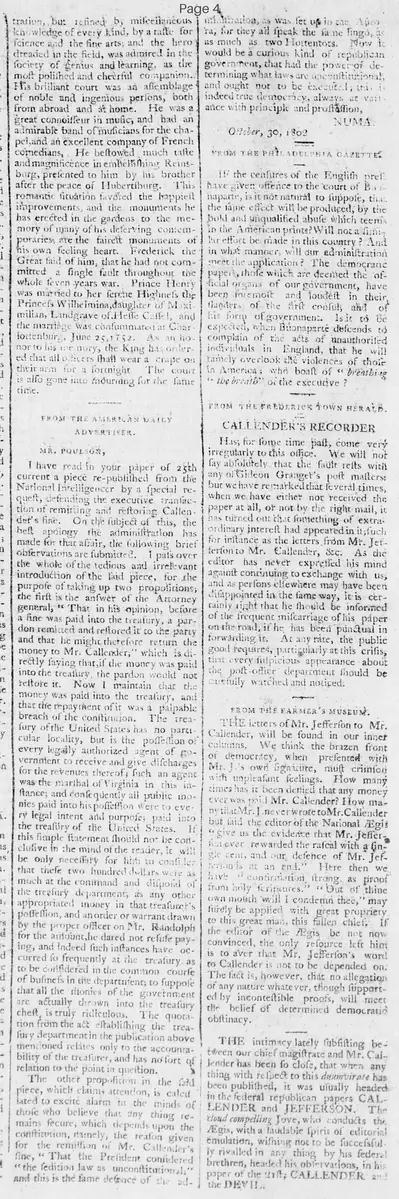
I have read in your paper of 29th current a piece re-published from the National Intelligencer by a special request, defending the executive transaction of remitting and restoring Callender's fine. On the subject of this, the best apology the administration has made for that affair, the following brief observations are submitted. I pass over the whole of the tedious and irrelevant introduction of the said piece, for the purpose of taking up two propositions; the first is the answer of the Attorney General, "That in his opinion, before a fine was paid into the treasury, a pardon remitted and restored it to the party and that he might therefore return the money to Mr. Callender;" which is directly saying that, if the money was paid into the treasury, the pardon would not restore it. Now I maintain that the money was paid into the treasury, and that the repayment of it was a palpable breach of the constitution. The treasury of the United States has no particular locality, but is the possession of every legally authorized agent of government to receive and give discharges for the revenues thereof; such an agent was the marshal of Virginia in this instance; and consequently all public monies paid into his possession were to every legal intent and purpose; paid into the treasury of the United States. If this simple statement should not be conclusive in the mind of the reader, it will be only necessary for him to consider that these two hundred dollars were as much at the command and disposal of the treasury department; as any other appropriated money in that treasurer's possession, and an order or warrant drawn by the proper officer on Mr. Randolph for the amount, he dared not refuse paying, and indeed such instances have occurred so frequently at the treasury, as to be considered in the common course of business in the department; to suppose that all the monies of the government are actually thrown into the treasury chest, is truly ridiculous. The quotation from the act establishing the treasury department in the publication above mentioned relates only to the accountability of the treasurer, and has no sort of relation to the point in question.
The other proposition in the said piece, which claims attention, is calculated to excite alarm in the minds of those who believe that any thing remains secure, which depends upon the constitution, namely, the reason given for the remission of Mr. Callender's fine, "That the President considered the sedition law as unconstitutional." and this is the same defence of the administration, as was set up in one term
MR. PAULSON,
I have read in your paper of 29th current a piece re-published from the National Intelligencer by a special request, defending the executive transaction of remitting and restoring Callender's fine. On the subject of this, the best apology the administration has made for that affair, the following brief observations are submitted. I pass over the whole of the tedious and irrelevant introduction of the said piece, for the purpose of taking up two propositions; the first is the answer of the Attorney General, "That in his opinion, before a fine was paid into the treasury, a pardon remitted and restored it to the party and that he might therefore return the money to Mr. Callender;" which is directly saying that, if the money was paid into the treasury, the pardon would not restore it. Now I maintain that the money was paid into the treasury, and that the repayment of it was a palpable breach of the constitution. The treasury of the United States has no particular locality, but is the possession of every legally authorized agent of government to receive and give discharges for the revenues thereof; such an agent was the marshal of Virginia in this instance; and consequently all public monies paid into his possession were to every legal intent and purpose; paid into the treasury of the United States. If this simple statement should not be conclusive in the mind of the reader, it will be only necessary for him to consider that these two hundred dollars were as much at the command and disposal of the treasury department; as any other appropriated money in that treasurer's possession, and an order or warrant drawn by the proper officer on Mr. Randolph for the amount, he dared not refuse paying, and indeed such instances have occurred so frequently at the treasury, as to be considered in the common course of business in the department; to suppose that all the monies of the government are actually thrown into the treasury chest, is truly ridiculous. The quotation from the act establishing the treasury department in the publication above mentioned relates only to the accountability of the treasurer, and has no sort of relation to the point in question.
The other proposition in the said piece, which claims attention, is calculated to excite alarm in the minds of those who believe that any thing remains secure, which depends upon the constitution, namely, the reason given for the remission of Mr. Callender's fine, "That the President considered the sedition law as unconstitutional." and this is the same defence of the administration, as was set up in one term
What sub-type of article is it?
Constitutional
Legal Reform
Partisan Politics
What keywords are associated?
Callender Fine
Sedition Law
Constitutional Breach
Presidential Pardon
Treasury Repayment
What entities or persons were involved?
Attorney General
President
Mr. Callender
Mr. Randolph
National Intelligencer
American Daily Advertiser
Editorial Details
Primary Topic
Critique Of Remitting Callender's Sedition Fine
Stance / Tone
Critical Of Administration's Constitutional Breach
Key Figures
Attorney General
President
Mr. Callender
Mr. Randolph
National Intelligencer
American Daily Advertiser
Key Arguments
Money Paid To Virginia Marshal Counts As Paid Into U.S. Treasury
Repayment Of Fine After Pardon Breaches Constitution
President Viewed Sedition Law As Unconstitutional
Treasury Has No Fixed Locality; Agents Like Marshals Handle Revenues