Thank you for visiting SNEWPapers!
Sign up free
Story
September 12, 1933
Imperial Valley Press
El Centro, Imperial County, California
What is this article about?
Article lauds the New York Sun's 100th anniversary edition on September 2, 1933, as a journalistic milestone, featuring a facsimile of the 1833 original, condensed history with writings by luminaries like Mark Twain and Eugene Field, and coverage of key U.S. events from gold rush to 1929 crash.
Clipping
OCR Quality
98%
Excellent
Full Text
NEW YORK SUN'S NUMBER PRIDE OF JOURNALISM
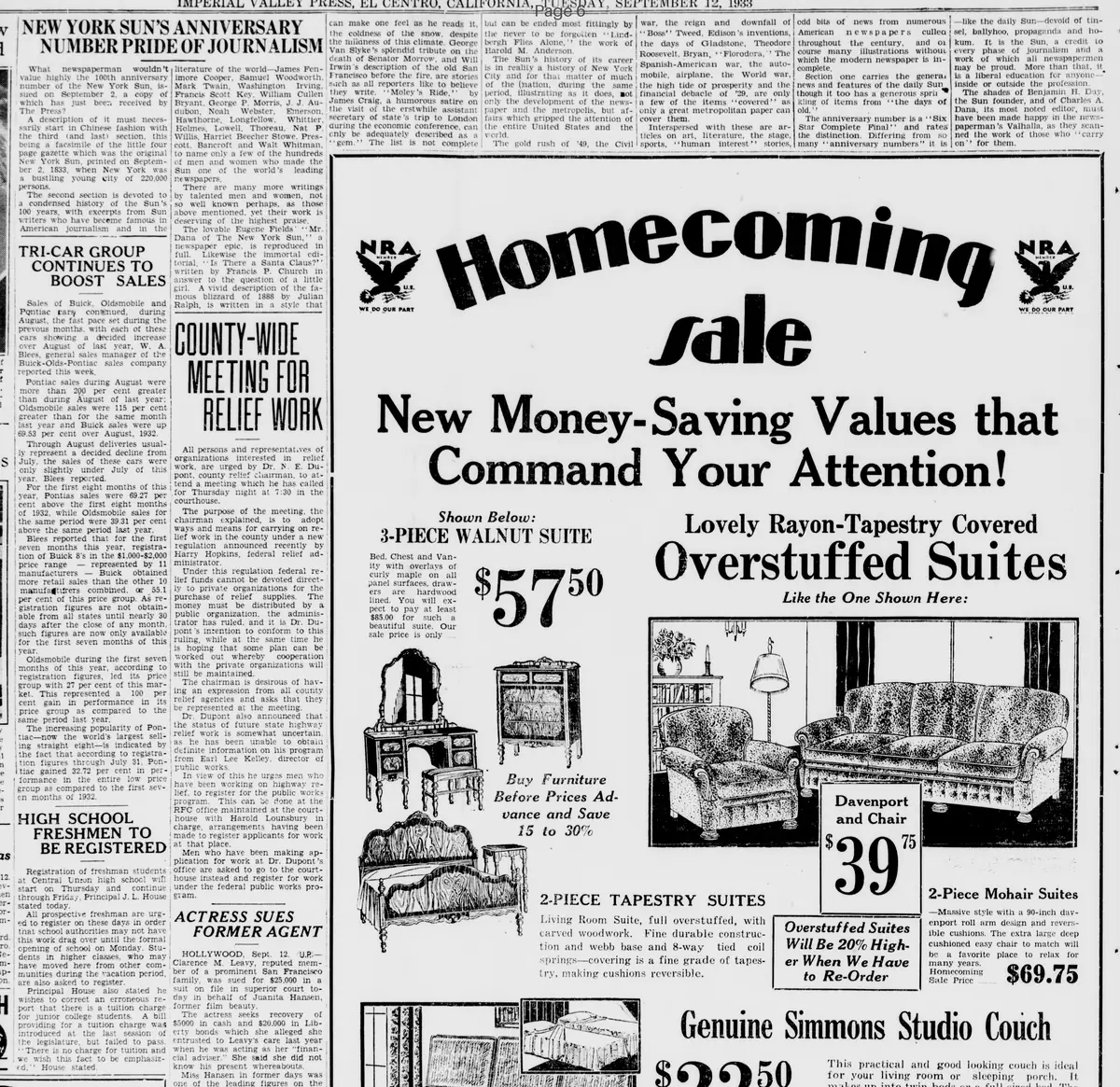
What newspaperman wouldn't value highly the 100th anniversary number of the New York Sun, issued on September 2, a copy of which has just been received by The Press?
A description of it must necessarily start in Chinese fashion with the third (and last) section, this being a facsimile of the little four page gazette which was the original New York Sun, printed on September 2, 1833, when New York was a bustling young city of 220,000 persons.
The second section is devoted to a condensed history of the Sun's 100 years, with excerpts from Sun writers who have become famous in American journalism and in the literature of the world—James Fenimore Cooper, Samuel Woodworth, Mark Twain, Washington Irving, Francis Scott Key, William Cullen Bryant, George P. Morris, J. J. Audubon, Noah Webster, Emerson, Hawthorne, Longfellow, Whittier, Holmes, Lowell, Thoreau, Nat P. Willis, Harriet Beecher Stowe, Prescott, Bancroft and Walt Whitman, to name only a few of the hundreds of men and women who made the Sun one of the world's leading newspapers.
There are many more writings by talented men and women, not so well known perhaps, as those above mentioned, yet their work is deserving of the highest praise. The lovable Eugene Field's 'Mr. Dana of The New York Sun,' a newspaper epic, is reproduced in full. Likewise the immortal editorial, 'Is There a Santa Claus?,' written by Francis P. Church in answer to the question of a little girl. A vivid description of the famous blizzard of 1888 by Julian Ralph, is written in a style that can make one feel as he reads it, the coldness of the snow, despite the mildness of this climate. George Van Slyke's splendid tribute on the death of Senator Morrow, and Will Irwin's description of the old San Francisco before the fire, are stories such as all reporters like to believe they write. 'Moley's Ride,' by James Craig, a humorous satire on the visit of the erstwhile assistant secretary of state's trip to London during the economic conference, can only be adequately described as a 'gem.' The list is not complete but can be ended most fittingly by the never to be forgotten 'Lindbergh Flies Alone,' the work of Harold M. Anderson.
The Sun's history of its career is in reality a history of New York City and for that matter of much of the nation, during the same period, illustrating as it does, not only the development of the newspaper and the metropolis, but affairs which gripped the attention of the entire United States and the world.
The gold rush of '49, the Civil war, the reign and downfall of 'Boss' Tweed, Edison's inventions, the days of Gladstone, Theodore Roosevelt, Bryan, 'Florodora,' The Spanish-American war, the automobile, airplane, the World war, the high tide of prosperity and the financial debacle of '29, are only a few of the items covered as only a great metropolitan paper can cover them.
Interspersed with these are articles on art, literature, the stage, sports, 'human interest' stories, odd bits of news from numerous American newspapers culled throughout the century, and of course many illustrations without which the modern newspaper is incomplete.
Section one carries the general news and features of the daily Sun though it too has a generous sprinkling of items from 'the days of old.'
The anniversary number is a 'Six Star Complete Final,' and rates the distinction. Differing from so many 'anniversary numbers' it is—like the daily Sun—devoid of tinsel, ballyhoo, propaganda and hokum. It is the Sun, a credit to every phase of journalism and a work of which all newspapermen may be proud. More than that, it is a liberal education for anyone—inside or outside the profession.
The shades of Benjamin H. Day, the Sun founder, and of Charles A. Dana, its most noted editor, must have been made happy in the newspaperman's Valhalla, as they scanned the work of those who carry on for them.
What newspaperman wouldn't value highly the 100th anniversary number of the New York Sun, issued on September 2, a copy of which has just been received by The Press?
A description of it must necessarily start in Chinese fashion with the third (and last) section, this being a facsimile of the little four page gazette which was the original New York Sun, printed on September 2, 1833, when New York was a bustling young city of 220,000 persons.
The second section is devoted to a condensed history of the Sun's 100 years, with excerpts from Sun writers who have become famous in American journalism and in the literature of the world—James Fenimore Cooper, Samuel Woodworth, Mark Twain, Washington Irving, Francis Scott Key, William Cullen Bryant, George P. Morris, J. J. Audubon, Noah Webster, Emerson, Hawthorne, Longfellow, Whittier, Holmes, Lowell, Thoreau, Nat P. Willis, Harriet Beecher Stowe, Prescott, Bancroft and Walt Whitman, to name only a few of the hundreds of men and women who made the Sun one of the world's leading newspapers.
There are many more writings by talented men and women, not so well known perhaps, as those above mentioned, yet their work is deserving of the highest praise. The lovable Eugene Field's 'Mr. Dana of The New York Sun,' a newspaper epic, is reproduced in full. Likewise the immortal editorial, 'Is There a Santa Claus?,' written by Francis P. Church in answer to the question of a little girl. A vivid description of the famous blizzard of 1888 by Julian Ralph, is written in a style that can make one feel as he reads it, the coldness of the snow, despite the mildness of this climate. George Van Slyke's splendid tribute on the death of Senator Morrow, and Will Irwin's description of the old San Francisco before the fire, are stories such as all reporters like to believe they write. 'Moley's Ride,' by James Craig, a humorous satire on the visit of the erstwhile assistant secretary of state's trip to London during the economic conference, can only be adequately described as a 'gem.' The list is not complete but can be ended most fittingly by the never to be forgotten 'Lindbergh Flies Alone,' the work of Harold M. Anderson.
The Sun's history of its career is in reality a history of New York City and for that matter of much of the nation, during the same period, illustrating as it does, not only the development of the newspaper and the metropolis, but affairs which gripped the attention of the entire United States and the world.
The gold rush of '49, the Civil war, the reign and downfall of 'Boss' Tweed, Edison's inventions, the days of Gladstone, Theodore Roosevelt, Bryan, 'Florodora,' The Spanish-American war, the automobile, airplane, the World war, the high tide of prosperity and the financial debacle of '29, are only a few of the items covered as only a great metropolitan paper can cover them.
Interspersed with these are articles on art, literature, the stage, sports, 'human interest' stories, odd bits of news from numerous American newspapers culled throughout the century, and of course many illustrations without which the modern newspaper is incomplete.
Section one carries the general news and features of the daily Sun though it too has a generous sprinkling of items from 'the days of old.'
The anniversary number is a 'Six Star Complete Final,' and rates the distinction. Differing from so many 'anniversary numbers' it is—like the daily Sun—devoid of tinsel, ballyhoo, propaganda and hokum. It is the Sun, a credit to every phase of journalism and a work of which all newspapermen may be proud. More than that, it is a liberal education for anyone—inside or outside the profession.
The shades of Benjamin H. Day, the Sun founder, and of Charles A. Dana, its most noted editor, must have been made happy in the newspaperman's Valhalla, as they scanned the work of those who carry on for them.
What sub-type of article is it?
Historical Event
Biography
What themes does it cover?
Triumph
What keywords are associated?
New York Sun
Anniversary Issue
Journalism History
Famous Writers
Newspaper Excerpts
Historical Coverage
What entities or persons were involved?
Benjamin H. Day
Charles A. Dana
James Fenimore Cooper
Mark Twain
Washington Irving
Francis Scott Key
William Cullen Bryant
Eugene Field
Francis P. Church
Where did it happen?
New York City
Story Details
Key Persons
Benjamin H. Day
Charles A. Dana
James Fenimore Cooper
Mark Twain
Washington Irving
Francis Scott Key
William Cullen Bryant
Eugene Field
Francis P. Church
Location
New York City
Event Date
September 2, 1933
Story Details
The article praises the New York Sun's 100th anniversary issue, reproducing the original 1833 edition, summarizing the paper's history with excerpts from famous writers, and covering major national events over a century, presented without exaggeration as a journalistic achievement.