Thank you for visiting SNEWPapers!
Sign up free
Story
December 24, 1814
The Enquirer
Richmond, Henrico County, Virginia
What is this article about?
Detailed report on the American military response to the British invasion of Washington, D.C. in August 1814, covering retreats, force estimates, losses at Bladensburg, command decisions by Gen. Winder, and analysis of defensive preparations and failures.
Clipping
OCR Quality
95%
Excellent
Full Text
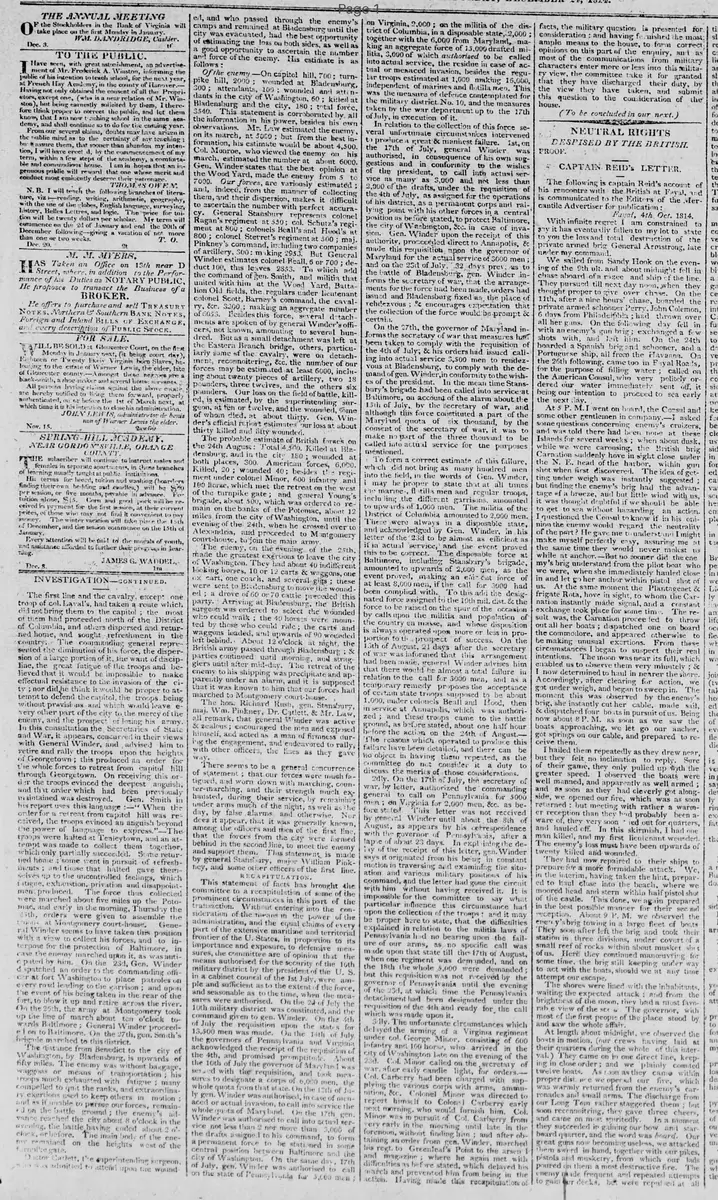
INVESTIGATION--CONTINUED.
The first line and the cavalry, except one troop of col. Laval's, had taken a route which did not bring them to the capitol; the most of them had proceeded north of the District of Columbia, and others dispersed and returned home, and sought refreshment in the country... The commanding general represented the diminution of his force, the dispersion of a large portion of it, the want of discipline, the great fatigue of the troops and believed that it would be impossible to make effectual resistance to the invasion of the city; nor did he think it would be proper to attempt to defend the capitol, the troops being without provisions and which would leave every other part of the city to the mercy of the enemy, and the prospect of losing his army.
In this consultation the Secretaries of State and War, it appears, concurred in their views with General Winder, and advised him to retire and rally the troops upon the heights of Georgetown; this produced an order for the whole forces to retreat from capitol hill through Georgetown. On receiving this order the troops evinced the deepest anguish, and that order which had been previously maintained was destroyed. Gen. Smith in his report uses this language :-- "When the order for a retreat from capitol hill was received, the troops evinced an anguish beyond the power of language to express." The troops were halted at Tenleytown, and an attempt was made to collect them together, which only partially succeeded. Some returned home; some went in pursuit of refreshments: and those that halted gave themselves up to the uncontrolled feelings, which fatigue, exhaustion, privation and disappointment men produced. The force thus collected were marched about five miles up the Potomac, and early in the morning, Thursday the 25th, orders were given to assemble the troops at Montgomery court-house. General Winder seems to have taken this position with a view to collect his forces, and "to interpose for the protection of Baltimore, in case the enemy marched upon it, as was anticipated by him. On the 23d, Gen. Winder dispatched an order to the commanding officer at fort Washington to place patroles on every road leading to the garrison; and upon the event of his being taken in the rear of the fort, to blow it up and retire across the river. On the 25th, the army at Montgomery took up the line of march about ten o'clock towards Baltimore; General Winder proceeded on to Baltimore. On the 27th, gen. Smith's brigade marched to this district.
The distance from Benedict to the city of Washington, by Bladensburg, is upwards of fifty miles. The enemy was without baggage, waggons or means of transportation; his troops much exhausted with fatigue; many compelled to quit the ranks, and extraordinary exertions used to keep others in motion; and as if unable to pursue our forces, remained on the battle ground; the enemy's advance reached the city about 8 o'clock in the evening, the battle having ended about 2 o'clock, or before. The main body of the enemy remained on the heights west of the Bladensburg gate.
Dr. Catlett, the superintending surgeon, who was admitted to attend upon the wounded, and who passed through the enemy's camps and remained at Bladensburg until the city was evacuated, had the best opportunity of estimating the loss on both sides, as well as a good opportunity to ascertain the number and force of the enemy. His estimate is as follows:
Of the enemy - On capitol hill, 700; turnpike hill, 2000; wounded at Bladensburg, 300; attendants, 100; wounded and attendants in the city of Washington, 60; killed at Bladensburg and the city, 180; total force, 3540. This statement is corroborated by all the information in his power, besides his own observations. Mr. Law estimated the enemy on its march, at 5000; but from the best information, his estimate would be about 4,500. Col. Monroe, who viewed the enemy on his march, estimated the number at about 6000. Gen. Winder states that the best opinion at the Wood Yard, made the enemy from 5 to 7000. Our forces, are variously estimated; and, indeed, from the manner of collecting them, and their dispersion, makes it difficult to ascertain the number with perfect accuracy. General Stansbury represents colonel Ragan's regiment at 550; col. Schutz's regiment at 800; colonels Beall's and Hood's Rt 800; colonel Sterret's regiment at 500; maj. Pinkney's command, including two companies of artillery, 800; making 2953. But General Winder estimates colonel Beall 600 or 700; deduct 100, this leaves 2853. To which add the command of gen. Smith, and militia that united with him at the Wood Yard, Battalion Old fields, the regulars under lieutenant colonel Scott, Barney's command, the cavalry, &c. 3280.; making an aggregate number of 6053. Besides this force, several detachments are spoken of by general Winder's officers, not known, amounting to several hundred. But as a small detachment was left at the Eastern Branch bridge, others, particularly some of the cavalry, were on detachment, reconnoitering, &c. the number of our forces may be estimated at least 6000, including about twenty pieces of artillery, two 18 pounders, three twelves, and the others six pounders. Our loss on the field of battle, killed, is estimated, by the superintending surgeon, at ten or twelve, and the wounded, some of whom died, at about thirty. Gen. Winder's official report estimates our loss at about thirty killed and fifty wounded.
The probable estimate of British forces on the 24th August: Total 4500. Killed at Bladensburg, and in the city 180: wounded at both places, 300. American forces, 6000. Killed, 20; wounded 40; besides the regiment under colonel Minor, 600 infantry and 100 horse, which met the retreat on the west of the turnpike gate; and general Young's brigade, about 500, which was ordered to remain on the banks of the Potomac, about 12 miles from the city of Washington, until the evening of the 24th, when he crossed over to Alexandria, and proceeded to Montgomery court-house, to join the main army.
The enemy, on the evening of the 25th, made the greatest exertions to leave the city of Washington. They had about 40 indifferent looking horses, 10 or 12 carts & waggons, one ox cart, one coach, and several gigs; these were sent to Bladensburg to move the wounded; a drove of 60 or 70 cattle preceded this party. Arriving at Bladensburg, the British surgeon was ordered to select the wounded who could walk; the 40 horses were mounted by those who could ride; the carts and waggons loaded, and upwards of 90 wounded left behind. About 12 o'clock at night, the British army passed through Bladensburg: & parties continued until morning, and stragglers until after mid-day. The retreat of the enemy to his shipping was precipitate and apparently under an alarm, and it is supposed that it was known to him that our forces had marched to Montgomery court-house.
The hon. Richard Rush, gen. Stansbury, maj. Wm. Pinkney, Dr. Catlett, & Mr. Law, all remark, that general Winder was active & zealous; encouraged the men and exposed himself, and acted as a man of firmness during the engagement, and endeavored to rally, with other officers, the lines as they gave way.
There seems to be a general concurrence of statement; that our forces were much fatigued, and worn down with marching, counter-marching, and their strength much exhausted, during their service, by remaining under arms much of the night, as well as the day, by false alarms and otherwise. Nor does it appear, that it was generally known, among the officers and men of the first line, that the forces from the city were formed behind in the second line, to meet the enemy and support them. This statement is made by general Stansbury, major William Pinkney, and some other officers of the first line.
RECAPITULATION.
This statement of facts has brought the committee to a recapitulation of some of the prominent circumstances in this part of the transaction. Without entering into the consideration of the means in the power of the administration, and the equal claims of every part of the extensive maritime and territorial frontier of the U. States, in proportion to its importance and exposure, to defensive measures, the committee are of opinion that the means authorised for the security of the 10th military district by the president of the U. S. in a cabinet council of the 1st July, were ample and sufficient as to the extent of the force, and seasonable as to the time, when the measures were authorised. On the 2d of July the 10th military district was constituted, and the command given to gen. Winder. On the 4th of July the requisition upon the states for 13,500 men was made. On the 14th of July the governors of Pennsylvania and Virginia acknowledged the receipt of the requisition of the 4th, and promised promptitude. About the 10th of July the governor of Maryland was served with the requisition, and took measures to designate a corps of 6000 men, the whole quota from that state. On the 12th of July gen. Winder was authorised, in case of menaced or actual invasion, to call into service the whole quota of Maryland. On the 17th gen. Winder was authorised to call into actual service not less than 2 nor more than 3000 of the drafts assigned to his command, to form a permanent force to be stationed in some central position between Baltimore and the city of Washington. On the same day, 17th of July, gen. Winder was authorised to call on the state of Pennsylvania for 5000 men; on Virginia, 2000; on the militia of the district of Columbia, in a disposable state, 2000: together with the 6000 from Maryland, making an aggregate force of 15,000 drafted militia, 3000 of which authorised to be called into actual service, the residue in case of actual or menaced invasion, besides the regular troops estimated at 1000 making 16,000, independent of marines and flotilla men. This was the measure of defence contemplated for the military district No. 10. and the measures taken by the war department up to the 17th of July, in execution of it.
In relation to the collection of this force several unfortunate circumstances intervened to produce a great & manifest failure. 1st, on the 17th of July, general Winder was authorised, in consequence of his own suggestions and in conformity to the wishes of the president, to call into actual service as many as 8000 and not less than 2000 of the drafts, under the requisition of the 4th of July, as assigned for the operations of his district, as a permanent corps and rallying point with his other forces in a central position as before stated, to protect Baltimore, the city of Washington, &c. in case of invasion. Gen. Winder upon the receipt of this authority, proceeded direct to Annapolis, & made this requisition upon the governor of Maryland for the actual service of 5000 men; and on the 22d of July, 32 days previous to the battle of Bladensburg, gen. Winder informs the secretary of war, that the arrangements for the force had been made, orders had issued and Bladensburg fixed as the place of rendezvous; & encourages expectation that the collection of the force would be prompt & certain.
On the 27th, the governor of Maryland informs the secretary of war that measures have been taken to comply with the requisition of the 4th of July; & his orders had issued calling into actual service 8500 men to rendezvous at Bladensburg, to comply with the demand of gen. Winder, in conformity to the wishes of the president. In the mean time Stansbury's brigade had been called into service at Baltimore, on account of the alarm about the 15th of July, by the secretary of war, and although this force constituted a part of the Maryland quota of six thousand, by the consent of the secretary of war, it was to make no part of the three thousand to be called into actual service for the purposes mentioned.
To form a correct estimate of this failure, which did not bring as many hundred men into the field, in the words of Gen. Winder, may be proper to state that at all times the marines, flotilla men and regular troops, including the different garrisons, amounted to upwards of 1000 men. The militia of the District of Columbia amounted to 2000 men. There were always in a disposable state, and acknowledged by Gen. Winder, in his letter of the 23d to be almost as efficient as if in actual service,' and the event proved this to be correct. The disposable force at Baltimore, including Stansbury's brigade, amounted to upwards of 2000 men, as the event proved, making an entire force of at least 8000 men, if the call for 3000 had been complied with. To this add the designated force assigned to the 10th mil. dist. & the force to be raised on the spur of the occasion by calls upon the militia and population of the country en masse, and whose disposition is always operated upon more or less in proportion to the prospect of success. On the 13th of August, 21 days after the secretary of war was informed that this arrangement had been made, general Winder advises him that there would be almost a total failure in relation to the call for 3000 men, and as a temporary remedy proposes the acceptance of certain state troops supposed to be about 1000, under colonels Beall and Hood, then in service at Annapolis, which was authorized; and these troops came to the battle ground, as before stated, about one half hour before the action on the 24th of August.--
The reasons which operated to produce this failure have been detailed, and there can be no object in having them repeated, as the committee do not consider it a duty to discuss the merits of those considerations.
2dly. On the 17th of July, the secretary of war, by letter, authorized the commanding general to call on Pennsylvania for 5000 men; on Virginia for 2000 men, &c. as before stated. This letter was not received by general Winder until about the 8th of August, as appears by his correspondence with the governor of Pennsylvania, after a lapse of about 23 days. In explaining the delay of the receipt of this letter, gen. Winder says it originated from his being in constant motion in traversing and examining the situation and various military positions of his command, and the letter had gone the circuit with him without having received it. It is impossible for the committee to say what particular influence this circumstance had upon the collection of the troops: and it may be proper here to state, that the difficulties explained in relation to the militia laws of Pennsylvania had no bearing upon the failure of our arms, as no specific call was made upon that state till the 17th of August, when one regiment was demanded, and on the 18th the whole 5000 were demanded; but this requisition was not received by the governor of Pennsylvania until the evening of the 23d, at which time the Pennsylvania detachment had been designated under the requisition of the 4th and ready for the call which was made upon it.
3dly. The unfortunate circumstances which delayed the arming of a Virginia regiment under col. George Minor, consisting of 600 infantry and 100 horse, who arrived in the city of Washington late on the evening of the 23d. Col. Minor called on the secretary of war, after early candle light, for orders.-- Col. Carberry had been charged with supplying the various corps with arms, ammunition, &c. Colonel Minor was directed to report himself to Colonel Carberry early next morning, who would furnish him. Col. Minor was in pursuit of Col. Carberry from very early in the morning until late in the forenoon, without finding him; and after obtaining an order from gen. Winder, marched his regt. to Greenleaf's Point to the arsenal and magazine; where he again met with difficulties as before stated, which delayed his march and prevented him from being in the action. Having made this recapitulation of facts, the military question is presented for consideration: and having furnished the most ample means to the house, to form correct opinions on this part of the enquiry, and as most of the communications from military characters enter more or less into this military view, the committee take it for granted that they have discharged their duty, by the view they have taken, and submit this question to the consideration of the house.
(To be concluded in our next.)
The first line and the cavalry, except one troop of col. Laval's, had taken a route which did not bring them to the capitol; the most of them had proceeded north of the District of Columbia, and others dispersed and returned home, and sought refreshment in the country... The commanding general represented the diminution of his force, the dispersion of a large portion of it, the want of discipline, the great fatigue of the troops and believed that it would be impossible to make effectual resistance to the invasion of the city; nor did he think it would be proper to attempt to defend the capitol, the troops being without provisions and which would leave every other part of the city to the mercy of the enemy, and the prospect of losing his army.
In this consultation the Secretaries of State and War, it appears, concurred in their views with General Winder, and advised him to retire and rally the troops upon the heights of Georgetown; this produced an order for the whole forces to retreat from capitol hill through Georgetown. On receiving this order the troops evinced the deepest anguish, and that order which had been previously maintained was destroyed. Gen. Smith in his report uses this language :-- "When the order for a retreat from capitol hill was received, the troops evinced an anguish beyond the power of language to express." The troops were halted at Tenleytown, and an attempt was made to collect them together, which only partially succeeded. Some returned home; some went in pursuit of refreshments: and those that halted gave themselves up to the uncontrolled feelings, which fatigue, exhaustion, privation and disappointment men produced. The force thus collected were marched about five miles up the Potomac, and early in the morning, Thursday the 25th, orders were given to assemble the troops at Montgomery court-house. General Winder seems to have taken this position with a view to collect his forces, and "to interpose for the protection of Baltimore, in case the enemy marched upon it, as was anticipated by him. On the 23d, Gen. Winder dispatched an order to the commanding officer at fort Washington to place patroles on every road leading to the garrison; and upon the event of his being taken in the rear of the fort, to blow it up and retire across the river. On the 25th, the army at Montgomery took up the line of march about ten o'clock towards Baltimore; General Winder proceeded on to Baltimore. On the 27th, gen. Smith's brigade marched to this district.
The distance from Benedict to the city of Washington, by Bladensburg, is upwards of fifty miles. The enemy was without baggage, waggons or means of transportation; his troops much exhausted with fatigue; many compelled to quit the ranks, and extraordinary exertions used to keep others in motion; and as if unable to pursue our forces, remained on the battle ground; the enemy's advance reached the city about 8 o'clock in the evening, the battle having ended about 2 o'clock, or before. The main body of the enemy remained on the heights west of the Bladensburg gate.
Dr. Catlett, the superintending surgeon, who was admitted to attend upon the wounded, and who passed through the enemy's camps and remained at Bladensburg until the city was evacuated, had the best opportunity of estimating the loss on both sides, as well as a good opportunity to ascertain the number and force of the enemy. His estimate is as follows:
Of the enemy - On capitol hill, 700; turnpike hill, 2000; wounded at Bladensburg, 300; attendants, 100; wounded and attendants in the city of Washington, 60; killed at Bladensburg and the city, 180; total force, 3540. This statement is corroborated by all the information in his power, besides his own observations. Mr. Law estimated the enemy on its march, at 5000; but from the best information, his estimate would be about 4,500. Col. Monroe, who viewed the enemy on his march, estimated the number at about 6000. Gen. Winder states that the best opinion at the Wood Yard, made the enemy from 5 to 7000. Our forces, are variously estimated; and, indeed, from the manner of collecting them, and their dispersion, makes it difficult to ascertain the number with perfect accuracy. General Stansbury represents colonel Ragan's regiment at 550; col. Schutz's regiment at 800; colonels Beall's and Hood's Rt 800; colonel Sterret's regiment at 500; maj. Pinkney's command, including two companies of artillery, 800; making 2953. But General Winder estimates colonel Beall 600 or 700; deduct 100, this leaves 2853. To which add the command of gen. Smith, and militia that united with him at the Wood Yard, Battalion Old fields, the regulars under lieutenant colonel Scott, Barney's command, the cavalry, &c. 3280.; making an aggregate number of 6053. Besides this force, several detachments are spoken of by general Winder's officers, not known, amounting to several hundred. But as a small detachment was left at the Eastern Branch bridge, others, particularly some of the cavalry, were on detachment, reconnoitering, &c. the number of our forces may be estimated at least 6000, including about twenty pieces of artillery, two 18 pounders, three twelves, and the others six pounders. Our loss on the field of battle, killed, is estimated, by the superintending surgeon, at ten or twelve, and the wounded, some of whom died, at about thirty. Gen. Winder's official report estimates our loss at about thirty killed and fifty wounded.
The probable estimate of British forces on the 24th August: Total 4500. Killed at Bladensburg, and in the city 180: wounded at both places, 300. American forces, 6000. Killed, 20; wounded 40; besides the regiment under colonel Minor, 600 infantry and 100 horse, which met the retreat on the west of the turnpike gate; and general Young's brigade, about 500, which was ordered to remain on the banks of the Potomac, about 12 miles from the city of Washington, until the evening of the 24th, when he crossed over to Alexandria, and proceeded to Montgomery court-house, to join the main army.
The enemy, on the evening of the 25th, made the greatest exertions to leave the city of Washington. They had about 40 indifferent looking horses, 10 or 12 carts & waggons, one ox cart, one coach, and several gigs; these were sent to Bladensburg to move the wounded; a drove of 60 or 70 cattle preceded this party. Arriving at Bladensburg, the British surgeon was ordered to select the wounded who could walk; the 40 horses were mounted by those who could ride; the carts and waggons loaded, and upwards of 90 wounded left behind. About 12 o'clock at night, the British army passed through Bladensburg: & parties continued until morning, and stragglers until after mid-day. The retreat of the enemy to his shipping was precipitate and apparently under an alarm, and it is supposed that it was known to him that our forces had marched to Montgomery court-house.
The hon. Richard Rush, gen. Stansbury, maj. Wm. Pinkney, Dr. Catlett, & Mr. Law, all remark, that general Winder was active & zealous; encouraged the men and exposed himself, and acted as a man of firmness during the engagement, and endeavored to rally, with other officers, the lines as they gave way.
There seems to be a general concurrence of statement; that our forces were much fatigued, and worn down with marching, counter-marching, and their strength much exhausted, during their service, by remaining under arms much of the night, as well as the day, by false alarms and otherwise. Nor does it appear, that it was generally known, among the officers and men of the first line, that the forces from the city were formed behind in the second line, to meet the enemy and support them. This statement is made by general Stansbury, major William Pinkney, and some other officers of the first line.
RECAPITULATION.
This statement of facts has brought the committee to a recapitulation of some of the prominent circumstances in this part of the transaction. Without entering into the consideration of the means in the power of the administration, and the equal claims of every part of the extensive maritime and territorial frontier of the U. States, in proportion to its importance and exposure, to defensive measures, the committee are of opinion that the means authorised for the security of the 10th military district by the president of the U. S. in a cabinet council of the 1st July, were ample and sufficient as to the extent of the force, and seasonable as to the time, when the measures were authorised. On the 2d of July the 10th military district was constituted, and the command given to gen. Winder. On the 4th of July the requisition upon the states for 13,500 men was made. On the 14th of July the governors of Pennsylvania and Virginia acknowledged the receipt of the requisition of the 4th, and promised promptitude. About the 10th of July the governor of Maryland was served with the requisition, and took measures to designate a corps of 6000 men, the whole quota from that state. On the 12th of July gen. Winder was authorised, in case of menaced or actual invasion, to call into service the whole quota of Maryland. On the 17th gen. Winder was authorised to call into actual service not less than 2 nor more than 3000 of the drafts assigned to his command, to form a permanent force to be stationed in some central position between Baltimore and the city of Washington. On the same day, 17th of July, gen. Winder was authorised to call on the state of Pennsylvania for 5000 men; on Virginia, 2000; on the militia of the district of Columbia, in a disposable state, 2000: together with the 6000 from Maryland, making an aggregate force of 15,000 drafted militia, 3000 of which authorised to be called into actual service, the residue in case of actual or menaced invasion, besides the regular troops estimated at 1000 making 16,000, independent of marines and flotilla men. This was the measure of defence contemplated for the military district No. 10. and the measures taken by the war department up to the 17th of July, in execution of it.
In relation to the collection of this force several unfortunate circumstances intervened to produce a great & manifest failure. 1st, on the 17th of July, general Winder was authorised, in consequence of his own suggestions and in conformity to the wishes of the president, to call into actual service as many as 8000 and not less than 2000 of the drafts, under the requisition of the 4th of July, as assigned for the operations of his district, as a permanent corps and rallying point with his other forces in a central position as before stated, to protect Baltimore, the city of Washington, &c. in case of invasion. Gen. Winder upon the receipt of this authority, proceeded direct to Annapolis, & made this requisition upon the governor of Maryland for the actual service of 5000 men; and on the 22d of July, 32 days previous to the battle of Bladensburg, gen. Winder informs the secretary of war, that the arrangements for the force had been made, orders had issued and Bladensburg fixed as the place of rendezvous; & encourages expectation that the collection of the force would be prompt & certain.
On the 27th, the governor of Maryland informs the secretary of war that measures have been taken to comply with the requisition of the 4th of July; & his orders had issued calling into actual service 8500 men to rendezvous at Bladensburg, to comply with the demand of gen. Winder, in conformity to the wishes of the president. In the mean time Stansbury's brigade had been called into service at Baltimore, on account of the alarm about the 15th of July, by the secretary of war, and although this force constituted a part of the Maryland quota of six thousand, by the consent of the secretary of war, it was to make no part of the three thousand to be called into actual service for the purposes mentioned.
To form a correct estimate of this failure, which did not bring as many hundred men into the field, in the words of Gen. Winder, may be proper to state that at all times the marines, flotilla men and regular troops, including the different garrisons, amounted to upwards of 1000 men. The militia of the District of Columbia amounted to 2000 men. There were always in a disposable state, and acknowledged by Gen. Winder, in his letter of the 23d to be almost as efficient as if in actual service,' and the event proved this to be correct. The disposable force at Baltimore, including Stansbury's brigade, amounted to upwards of 2000 men, as the event proved, making an entire force of at least 8000 men, if the call for 3000 had been complied with. To this add the designated force assigned to the 10th mil. dist. & the force to be raised on the spur of the occasion by calls upon the militia and population of the country en masse, and whose disposition is always operated upon more or less in proportion to the prospect of success. On the 13th of August, 21 days after the secretary of war was informed that this arrangement had been made, general Winder advises him that there would be almost a total failure in relation to the call for 3000 men, and as a temporary remedy proposes the acceptance of certain state troops supposed to be about 1000, under colonels Beall and Hood, then in service at Annapolis, which was authorized; and these troops came to the battle ground, as before stated, about one half hour before the action on the 24th of August.--
The reasons which operated to produce this failure have been detailed, and there can be no object in having them repeated, as the committee do not consider it a duty to discuss the merits of those considerations.
2dly. On the 17th of July, the secretary of war, by letter, authorized the commanding general to call on Pennsylvania for 5000 men; on Virginia for 2000 men, &c. as before stated. This letter was not received by general Winder until about the 8th of August, as appears by his correspondence with the governor of Pennsylvania, after a lapse of about 23 days. In explaining the delay of the receipt of this letter, gen. Winder says it originated from his being in constant motion in traversing and examining the situation and various military positions of his command, and the letter had gone the circuit with him without having received it. It is impossible for the committee to say what particular influence this circumstance had upon the collection of the troops: and it may be proper here to state, that the difficulties explained in relation to the militia laws of Pennsylvania had no bearing upon the failure of our arms, as no specific call was made upon that state till the 17th of August, when one regiment was demanded, and on the 18th the whole 5000 were demanded; but this requisition was not received by the governor of Pennsylvania until the evening of the 23d, at which time the Pennsylvania detachment had been designated under the requisition of the 4th and ready for the call which was made upon it.
3dly. The unfortunate circumstances which delayed the arming of a Virginia regiment under col. George Minor, consisting of 600 infantry and 100 horse, who arrived in the city of Washington late on the evening of the 23d. Col. Minor called on the secretary of war, after early candle light, for orders.-- Col. Carberry had been charged with supplying the various corps with arms, ammunition, &c. Colonel Minor was directed to report himself to Colonel Carberry early next morning, who would furnish him. Col. Minor was in pursuit of Col. Carberry from very early in the morning until late in the forenoon, without finding him; and after obtaining an order from gen. Winder, marched his regt. to Greenleaf's Point to the arsenal and magazine; where he again met with difficulties as before stated, which delayed his march and prevented him from being in the action. Having made this recapitulation of facts, the military question is presented for consideration: and having furnished the most ample means to the house, to form correct opinions on this part of the enquiry, and as most of the communications from military characters enter more or less into this military view, the committee take it for granted that they have discharged their duty, by the view they have taken, and submit this question to the consideration of the house.
(To be concluded in our next.)
What sub-type of article is it?
Historical Event
Military Action
Disaster
What themes does it cover?
Catastrophe
Misfortune
Bravery Heroism
What keywords are associated?
Battle Of Bladensburg
British Invasion
Washington Dc
Military Retreat
Force Estimates
War Of 1812
Gen Winder
Militia Failure
What entities or persons were involved?
General Winder
Gen. Smith
Dr. Catlett
Gen. Stansbury
Maj. Wm. Pinkney
Col. Monroe
Mr. Law
Col. Minor
Hon. Richard Rush
Where did it happen?
Washington, D.C., Bladensburg, Montgomery Court House
Story Details
Key Persons
General Winder
Gen. Smith
Dr. Catlett
Gen. Stansbury
Maj. Wm. Pinkney
Col. Monroe
Mr. Law
Col. Minor
Hon. Richard Rush
Location
Washington, D.C., Bladensburg, Montgomery Court House
Event Date
August 24, 1814
Story Details
Account of American retreat from Bladensburg after British victory, force estimates, command consultations leading to evacuation of Washington, British withdrawal, and analysis of preparatory failures in mobilizing militia.