Thank you for visiting SNEWPapers!
Sign up free
Clinch Valley News
Tazewell, Jeffersonville, Tazewell County, Virginia
What is this article about?
Virginia Agricultural Extension Service provides answers to common farming questions on beef cattle prices, hay substitution, chickweed control, pasture alternatives, and dairy ration supplements. County Agent warns against burning fields and gardens, advocating for better soil practices.
Clipping
OCR Quality
Full Text
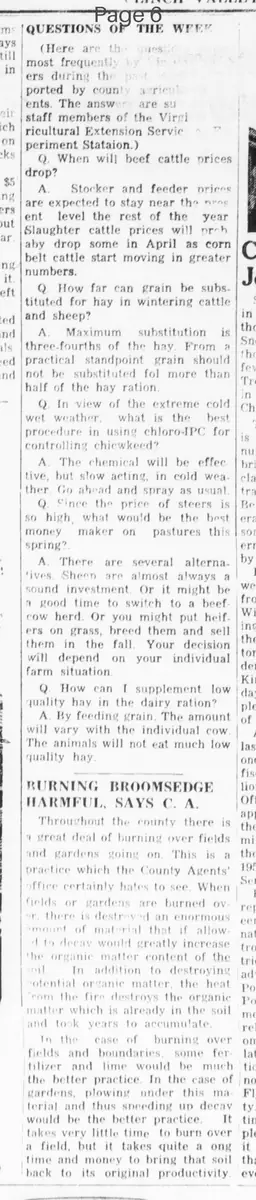
(Here are the most frequently asked questions during the period reported by county agents. The answers are supplied by staff members of the Virginia Agricultural Extension Service and Experiment Station.)
Q. When will beef cattle prices drop?
A. Stocker and feeder prices are expected to stay near the present level the rest of the year. Slaughter cattle prices will probably drop some in April as corn belt cattle start moving in greater numbers.
Q. How far can grain be substituted for hay in wintering cattle and sheep?
A. Maximum substitution is three-fourths of the hay. From a practical standpoint grain should not be substituted for more than half of the hay ration.
Q. In view of the extreme cold wet weather what is the best procedure in using chloro-IPC for controlling chickweed?
A. The chemical will be effective, but slow acting, in cold weather. Go ahead and spray as usual.
Q. Since the price of steers is so high, what would be the best money maker on pastures this spring?
A. There are several alternatives. Sheep are almost always a sound investment. Or it might be a good time to switch to a beef cow herd. Or you might put heifers on grass, breed them and sell them in the fall. Your decision will depend on your individual farm situation.
Q. How can I supplement low quality hay in the dairy ration?
A. By feeding grain. The amount will vary with the individual cow. The animals will not eat much low quality hay.
BURNING BROOMSEDGE HARMFUL, SAYS C. A.
Throughout the county there is a great deal of burning over fields and gardens going on. This is a practice which the County Agent's office certainly hates to see. When fields or gardens are burned over there is destroyed an enormous amount of material that if allowed to decay would greatly increase the organic matter content of the soil. In addition to destroying potential organic matter, the heat from the fire destroys the organic matter which is already in the soil and took years to accumulate.
In the case of burning over fields and boundaries, some fertilizer and lime would be much the better practice. In the case of gardens, plowing under this material and thus speeding up decay would be the better practice. It takes very little time to burn over a field, but it takes quite a long time and money to bring that soil back to its original productivity.
What sub-type of article is it?
What keywords are associated?
What entities or persons were involved?
Where did it happen?
Domestic News Details
Primary Location
Virginia
Key Persons
Event Details
Questions and answers on beef cattle prices expected to hold steady until April drop; grain substitution for hay up to half recommended; chloro-IPC effective but slow in cold weather; alternatives like sheep, beef cows, or heifers for pastures; supplement low quality hay with grain for dairy. County Agent advises against burning fields and gardens to preserve soil organic matter, suggesting fertilizer, lime, or plowing under instead.