Thank you for visiting SNEWPapers!
Sign up free
Editorial
November 5, 1805
The Enquirer
Richmond, Henrico County, Virginia
What is this article about?
A response letter to Thomas Turner in the Richmond Enquirer defends Thomas Jefferson against accusations of cowardice and treason during his governorship in 1781, refuting claims with evidence from records and certificates, and criticizing Turner's evasion and lack of substantiation. Dated November 4, 1805.
Clipping
OCR Quality
95%
Excellent
Full Text
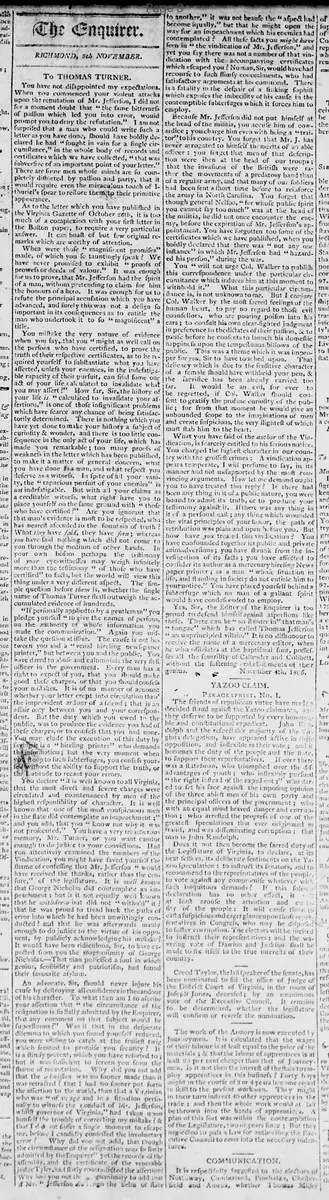
RICHMOND, 5th NOVEMBER.
To THOMAS TURNER.
You have not disappointed my expectations. When you commenced your violent attacks upon the reputation of Mr. Jefferson, I did not for a moment doubt that the same bitterness of passion which led you into error, would prompt you to deny the refutation. I am not surprised that a man who could write such a letter as you have done, should have boldly declared he had "sought in vain for a single circumstance," in the whole body of records and certificates which we have collected, "that was subversive of an important point of your letter." There are some men whose minds are so completely distorted by passion and party, that it would require even the miraculous touch of Ithuriel's spear to restore them to their primitive appearance.
As to the letter which you have published in the Virginia Gazette of October 26th, it is too much of a complexion with your first letter in the Boston paper, to require a very particular answer. It can boast of but few original remarks which are worthy of attention.
When were those "magnificent promises" made, of which you so tauntingly speak? We have never promised to exhibit "proofs of prowess or deeds of valour." It was enough for us to prove, that Mr. Jefferson had the spirit of a man, without pretending to claim for him the honours of a hero. It was enough for us to refute the principal accusation which you have advanced, and surely this was not a design so important in its consequences as to entitle the man who undertook it to so "magnificent" a title.
You mistake the very nature of evidence when you say, that you "might as well call on the persons who have certified, to prove the truth of their respective certificates, as to be required yourself to substantiate what you have asserted, unless your enemies, in the indefatigable rapacity of their pursuit, can find some one act of your life calculated to invalidate what you may assert?" How far, Sir, the history of your life is "calculated to invalidate your assertions," is one of those insignificant problems which have scarce any chance of being satisfactorily determined. There is nothing which you have yet done to make your history a subject of curiosity & wonder, and there is too little consequence in the only act of your life, which has made you remarkable; too many proofs of weakness in the letter which has been published, to make it a matter of general concern, what you have done as a man, and what respect you deserve as a witness. In spite of all your vanity, the "rapacious pursuit of your enemies" is not indefatigable. But with all your claims as a creditable witness, what right have you to place yourself on the same ground with "those who have certified?" Are you ignorant that that man's evidence is most to be respected, who has nearest ascended to the fountain of truth? What they have said, they have seen; whereas you have said nothing which did not come to you through the medium of other hands. In your own bosom perhaps the testimony of your eye-witnesses may weigh infinitely more than the testimony "of those who have certified" to facts, but the world will view this thing under a very different aspect. The simple question before them is, whether the single name of Thomas Turner shall outweigh the accumulated evidence of hundreds.
"If personally applied to by a gentleman" you pledge yourself "to give the names of persons, on the authority of whose information you made the communication." Again you mistake the question at issue. The cause is not between you and a "venal hireling news-paper printer," but between you and the public. You have dared to abuse and calumniate the very first officer in the government. Every man has a right to expect of you, that you should make good these charges, or that you should confess your mistakes. It is of no manner of account whether your letter crept into circulation through the improvident ardour of a friend; that is an affair only between you and your correspondent. But the duty which you owed to the public, was to produce the evidence you had of these charges, or to confess that you had none. You may elude the execution of this duty by saying it is a "hireling printer" who demands the information; but the very moment when you stoop to such subterfuges, you confess yourself without the ability to support the truth, or the fortitude to recant your errors.
You declare "it is well known to all Virginia, that the most direct and severe charges were circulated and countenanced by men of the highest responsibility of character. It is well known that one of the most conspicuous men in the state did contemplate an impeachment;" and you add, that you "know not why it was not prosecuted." You have a very treacherous memory, Mr. Turner, or you want candor enough to do justice to your convictions. Had you attentively examined the numbers of the Vindication, you might have saved yourself the shame of confessing that Mr. Jefferson "would have received the thanks, rather than the censure," of the legislature. It is well known that George Nicholas did contemplate an impeachment; but is it not equally well known that he withdrew but did not "withhold" it? that he was proud to tread back the paths of error into which he had been unwittingly conducted? and that he was afterwards manly enough to do justice to the virtue of his opponent, by publicly acknowledging his mistake?
It would have been ridiculous, Sir, to have expected from you the magnanimity of George Nicholas. That man possessed a soul in which genius, sensibility and patriotism, had found their favourite asylum.
An advocate, Sir, should never injure his cause by destroying all confidence in the candour of his character. To what then am I to ascribe your assertion that "the circumstance of the resignation is so flatly admitted by the Enquirer, that any comment on that subject would be superfluous?" Was it that in the desperate dilemma to which you found yourself reduced, you were willing to catch at the frailest twig which seemed to promise you security? It is a flimsy pretext, which you have resorted to; but it was sufficient to screen you from the shame of recantation. Why did you not add that the admission was no sooner made than it was retracted? that I had no sooner put forth the assertion to the world, than that a Virginian who was "of an age and in a situation personally to witness the conduct of Mr. Jefferson, when governor of Virginia," had taken upon himself the trouble of correcting my mistake? & that I did not suffer a single moment to escape me, before I candidly confessed the involuntary error? Why did you not add, that though the circumstance of the resignation was so flatly admitted by the Enquirer" yet the records of the assembly, and the certificate of the venerable judge Tyler, had flatly contradicted the assertion? Why had you not the magnanimity to add that if Mr. "Jefferson did resign the helm of state to another." it was not because the "apeak had become squally," but that he might open the way for an impeachment which his enemies had contemplated? All these facts you might have seen in "the vindication of Mr. Jefferson." and yet you say there was not a number of that vindication with the accompanying certificates which escaped you? No man, Sir, would have had recourse to such flimsy concealments, who had satisfactory arguments at his command. There is a fatality in the despair of a sinking sophist which exposes the imbecility of his cause in the contemptible subterfuges which it forces him to employ.
Because Mr. Jefferson did not put himself at the head of the militia, you accuse him of cowardice; you charge him even with being a "traitor" to his country. You forget that Mr. J. has never arrogated to himself the merits of an able officer: you forget that men of that description were then at the head of our troops; that the invasions of the British were rather the movements of a predatory band than of a regular army, and that many of our soldiers had been sent a short time before to reinforce the army in North Carolina. You forget that though general Nelson, "for whose public spirit you cannot say too much" was at the head of the militia, he did not once encounter the enemy, before the expiration of Mr. Jefferson's appointment. You have forgotten too some of the certificates which we have published, when you boldly declared that there was "not any one instance" in which Mr. Jefferson had "hazarded his person," during the war.
You "will not urge Col. Walker to publish this correspondence under the particular circumstance which induces him at this moment to withhold it." What this particular circumstance is, is not unknown to me. But I conjure Col. Walker by the most sacred feelings of the human heart, to pay no regard to those evil counsellors, who are pouring poison into his ears; to consult his own clear-sighted judgment in preference to the dictates of their passion, & to pause before he consents to launch his domestic happiness upon the tempestuous billows of the public. This was a theme which it was improper for you, Sir to have touched upon. That delicacy which is due to the sensitive character of a female should have withheld your pen, & the sacrifice has been already carried too far.
It would be an evil, for ever to be regretted, if Col. Walker should consent to gratify the profane curiosity of the public; for from that moment he would give an unbounded scope to the imaginations of men and create suspicions, the very slightest of which must stab him to the heart.
What you have said of the author of the Vindication, is scarcely entitled to his serious notice. You charged the highest character in our country with the grossest crimes: A vindication appears temperate, I will presume to say, in its manner and not unsupported by the most convincing arguments. How then ought you to have treated this reply? If there had been any thing in it of a public nature, you were bound to admit its truth, or to produce your testimony against it. If there was any thing in it of a personal cast; any thing which wounded the vital principles of your honour, the path of retribution was plain and open before you. But how have you treated this vindication? You have confounded together its public and private animadversions: you have shrunk from the investigation of its facts; you have affected to consider its author as a mercenary hireling News paper printer; as a man "whose situation in life, and standing in society do not entitle him to your notice." You have placed yourself behind a subterfuge which no man of a gallant spirit would have condescended to employ.
Yes, Sir, the Editor of the Enquirer is too proud to defend himself against aspersions like these. "There can be no slander in" that man's "tongue" which has called Thomas Jefferson "an unprincipled villain." It is no dishonour to receive the name of a mercenary editor, when he who officiates at the baptismal font, possesses all the scurrility of Callender and Cobbett, without the softening embellishments of their genius.
November 4th, 1805.
To THOMAS TURNER.
You have not disappointed my expectations. When you commenced your violent attacks upon the reputation of Mr. Jefferson, I did not for a moment doubt that the same bitterness of passion which led you into error, would prompt you to deny the refutation. I am not surprised that a man who could write such a letter as you have done, should have boldly declared he had "sought in vain for a single circumstance," in the whole body of records and certificates which we have collected, "that was subversive of an important point of your letter." There are some men whose minds are so completely distorted by passion and party, that it would require even the miraculous touch of Ithuriel's spear to restore them to their primitive appearance.
As to the letter which you have published in the Virginia Gazette of October 26th, it is too much of a complexion with your first letter in the Boston paper, to require a very particular answer. It can boast of but few original remarks which are worthy of attention.
When were those "magnificent promises" made, of which you so tauntingly speak? We have never promised to exhibit "proofs of prowess or deeds of valour." It was enough for us to prove, that Mr. Jefferson had the spirit of a man, without pretending to claim for him the honours of a hero. It was enough for us to refute the principal accusation which you have advanced, and surely this was not a design so important in its consequences as to entitle the man who undertook it to so "magnificent" a title.
You mistake the very nature of evidence when you say, that you "might as well call on the persons who have certified, to prove the truth of their respective certificates, as to be required yourself to substantiate what you have asserted, unless your enemies, in the indefatigable rapacity of their pursuit, can find some one act of your life calculated to invalidate what you may assert?" How far, Sir, the history of your life is "calculated to invalidate your assertions," is one of those insignificant problems which have scarce any chance of being satisfactorily determined. There is nothing which you have yet done to make your history a subject of curiosity & wonder, and there is too little consequence in the only act of your life, which has made you remarkable; too many proofs of weakness in the letter which has been published, to make it a matter of general concern, what you have done as a man, and what respect you deserve as a witness. In spite of all your vanity, the "rapacious pursuit of your enemies" is not indefatigable. But with all your claims as a creditable witness, what right have you to place yourself on the same ground with "those who have certified?" Are you ignorant that that man's evidence is most to be respected, who has nearest ascended to the fountain of truth? What they have said, they have seen; whereas you have said nothing which did not come to you through the medium of other hands. In your own bosom perhaps the testimony of your eye-witnesses may weigh infinitely more than the testimony "of those who have certified" to facts, but the world will view this thing under a very different aspect. The simple question before them is, whether the single name of Thomas Turner shall outweigh the accumulated evidence of hundreds.
"If personally applied to by a gentleman" you pledge yourself "to give the names of persons, on the authority of whose information you made the communication." Again you mistake the question at issue. The cause is not between you and a "venal hireling news-paper printer," but between you and the public. You have dared to abuse and calumniate the very first officer in the government. Every man has a right to expect of you, that you should make good these charges, or that you should confess your mistakes. It is of no manner of account whether your letter crept into circulation through the improvident ardour of a friend; that is an affair only between you and your correspondent. But the duty which you owed to the public, was to produce the evidence you had of these charges, or to confess that you had none. You may elude the execution of this duty by saying it is a "hireling printer" who demands the information; but the very moment when you stoop to such subterfuges, you confess yourself without the ability to support the truth, or the fortitude to recant your errors.
You declare "it is well known to all Virginia, that the most direct and severe charges were circulated and countenanced by men of the highest responsibility of character. It is well known that one of the most conspicuous men in the state did contemplate an impeachment;" and you add, that you "know not why it was not prosecuted." You have a very treacherous memory, Mr. Turner, or you want candor enough to do justice to your convictions. Had you attentively examined the numbers of the Vindication, you might have saved yourself the shame of confessing that Mr. Jefferson "would have received the thanks, rather than the censure," of the legislature. It is well known that George Nicholas did contemplate an impeachment; but is it not equally well known that he withdrew but did not "withhold" it? that he was proud to tread back the paths of error into which he had been unwittingly conducted? and that he was afterwards manly enough to do justice to the virtue of his opponent, by publicly acknowledging his mistake?
It would have been ridiculous, Sir, to have expected from you the magnanimity of George Nicholas. That man possessed a soul in which genius, sensibility and patriotism, had found their favourite asylum.
An advocate, Sir, should never injure his cause by destroying all confidence in the candour of his character. To what then am I to ascribe your assertion that "the circumstance of the resignation is so flatly admitted by the Enquirer, that any comment on that subject would be superfluous?" Was it that in the desperate dilemma to which you found yourself reduced, you were willing to catch at the frailest twig which seemed to promise you security? It is a flimsy pretext, which you have resorted to; but it was sufficient to screen you from the shame of recantation. Why did you not add that the admission was no sooner made than it was retracted? that I had no sooner put forth the assertion to the world, than that a Virginian who was "of an age and in a situation personally to witness the conduct of Mr. Jefferson, when governor of Virginia," had taken upon himself the trouble of correcting my mistake? & that I did not suffer a single moment to escape me, before I candidly confessed the involuntary error? Why did you not add, that though the circumstance of the resignation was so flatly admitted by the Enquirer" yet the records of the assembly, and the certificate of the venerable judge Tyler, had flatly contradicted the assertion? Why had you not the magnanimity to add that if Mr. "Jefferson did resign the helm of state to another." it was not because the "apeak had become squally," but that he might open the way for an impeachment which his enemies had contemplated? All these facts you might have seen in "the vindication of Mr. Jefferson." and yet you say there was not a number of that vindication with the accompanying certificates which escaped you? No man, Sir, would have had recourse to such flimsy concealments, who had satisfactory arguments at his command. There is a fatality in the despair of a sinking sophist which exposes the imbecility of his cause in the contemptible subterfuges which it forces him to employ.
Because Mr. Jefferson did not put himself at the head of the militia, you accuse him of cowardice; you charge him even with being a "traitor" to his country. You forget that Mr. J. has never arrogated to himself the merits of an able officer: you forget that men of that description were then at the head of our troops; that the invasions of the British were rather the movements of a predatory band than of a regular army, and that many of our soldiers had been sent a short time before to reinforce the army in North Carolina. You forget that though general Nelson, "for whose public spirit you cannot say too much" was at the head of the militia, he did not once encounter the enemy, before the expiration of Mr. Jefferson's appointment. You have forgotten too some of the certificates which we have published, when you boldly declared that there was "not any one instance" in which Mr. Jefferson had "hazarded his person," during the war.
You "will not urge Col. Walker to publish this correspondence under the particular circumstance which induces him at this moment to withhold it." What this particular circumstance is, is not unknown to me. But I conjure Col. Walker by the most sacred feelings of the human heart, to pay no regard to those evil counsellors, who are pouring poison into his ears; to consult his own clear-sighted judgment in preference to the dictates of their passion, & to pause before he consents to launch his domestic happiness upon the tempestuous billows of the public. This was a theme which it was improper for you, Sir to have touched upon. That delicacy which is due to the sensitive character of a female should have withheld your pen, & the sacrifice has been already carried too far.
It would be an evil, for ever to be regretted, if Col. Walker should consent to gratify the profane curiosity of the public; for from that moment he would give an unbounded scope to the imaginations of men and create suspicions, the very slightest of which must stab him to the heart.
What you have said of the author of the Vindication, is scarcely entitled to his serious notice. You charged the highest character in our country with the grossest crimes: A vindication appears temperate, I will presume to say, in its manner and not unsupported by the most convincing arguments. How then ought you to have treated this reply? If there had been any thing in it of a public nature, you were bound to admit its truth, or to produce your testimony against it. If there was any thing in it of a personal cast; any thing which wounded the vital principles of your honour, the path of retribution was plain and open before you. But how have you treated this vindication? You have confounded together its public and private animadversions: you have shrunk from the investigation of its facts; you have affected to consider its author as a mercenary hireling News paper printer; as a man "whose situation in life, and standing in society do not entitle him to your notice." You have placed yourself behind a subterfuge which no man of a gallant spirit would have condescended to employ.
Yes, Sir, the Editor of the Enquirer is too proud to defend himself against aspersions like these. "There can be no slander in" that man's "tongue" which has called Thomas Jefferson "an unprincipled villain." It is no dishonour to receive the name of a mercenary editor, when he who officiates at the baptismal font, possesses all the scurrility of Callender and Cobbett, without the softening embellishments of their genius.
November 4th, 1805.
What sub-type of article is it?
Partisan Politics
Military Affairs
What keywords are associated?
Jefferson Defense
Cowardice Accusation
Treason Charges
Virginia Governor
Revolutionary War
Partisan Attacks
Evidence Refutation
Impeachment Contemplation
What entities or persons were involved?
Thomas Turner
Mr. Jefferson
George Nicholas
Col. Walker
Judge Tyler
General Nelson
Editorial Details
Primary Topic
Defense Of Thomas Jefferson Against Accusations Of Cowardice And Treason
Stance / Tone
Strongly Defensive And Critical Of Accuser
Key Figures
Thomas Turner
Mr. Jefferson
George Nicholas
Col. Walker
Judge Tyler
General Nelson
Key Arguments
Turner's Attacks Stem From Passion And Party Bias
Jefferson's Spirit As A Man Is Proven Without Needing Heroic Deeds
Eyewitness Certificates Outweigh Turner's Hearsay Evidence
Turner Must Substantiate Charges Publicly Or Confess Errors
George Nicholas Contemplated But Withdrew Impeachment And Acknowledged Mistake
Jefferson's Resignation Was Not Due To Cowardice But To Allow Impeachment Proceedings
British Invasions Were Predatory, Not Requiring Jefferson's Personal Military Leadership
Jefferson Hazarded His Person As Per Published Certificates